
Darkest Hour should maybe be called Darkest Month. In 1940, Winston Churchill was asked by the King to take over as Prime Minister. It was a shitty time to get the job: Hitler was marching his Nazi army across Europe, and the threat of invasion was uncomfortably close. During this particular month, Churchill’s first on the job, he’s got an impossible task. He must decide whether to negotiate a treaty with Hitler, or whether to stand firm against the Nazis but in so doing risk his country. And he had to do this without his party’s support or the public’s understanding or any help from the King.
Winston Churchill is an iconic and influential figure in British history and he’s been portrayed with varying success by some truly venerable actors: Albert Finney, 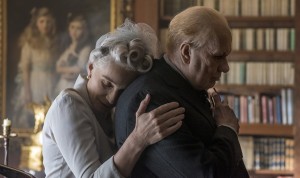 Brendan Gleeson, Timothy Spall, Robert Hardy, and most recently by John Lithgow in The Crown. He is not a saintly figure. He was a great orator but had some problematic positions that hindsight can’t afford to be kind about. Portrayals of him often emphasize his omnipresent cigar, and his particular style of speech (his custom dentures helped cover up a lisp). Gary Oldman is the gentleman tasked with bring old Winnie to life in Darkest Hour, and though he’s seen chomping on the necessary cigars, he turns the performance into something truly remarkable.
Oldman is transformed by makeup and prosthetics; his jowls are considerable. His tics and posture help render him unrecognizable. He dissolves into character. As Churchill he delivers some of history’s most famous and familiar speeches and he is electrifying. Kristin Scott Thomas as his tell-it-like-it-is wife, Lily James as his newbie secretary, and Ben Mendelsohn as the King help round out the cast but Darkest Hour feels like a one man show and Oldman is equal to the cast. Truthfully I don’t know many others who could carry 125 minutes of infamy, but Gary Oldman deserves his frontman status in all the Oscar pools. His portrayal is vigorous and complex and maybe even a little bit compassionate.
As for the movie itself, it’s not quite as formidable. The events are told simply, without a lot of cinematic flair, and it sometimes feels sluggish. There’s not a lot of imagination on display, and perhaps that’s an unfair criticism with the burden of historical accuracy weighing heavily, but director Joe Wright is more precise than entertaining. It’s Oldman who kept me in my seat, and I’m sure it’ll be Oldman bounding out of his on Oscar night to collect his well-deserved award.
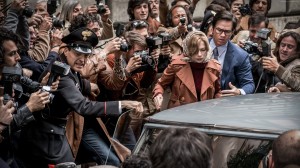 former father-in-law’s fortune. Getty (Christopher Plummer) is pretty set in his ways, and to avoid dealing with his mouthy daughter-in-law, he sends his “security guy” Chase (Mark Wahlberg) to do the dealing for him. But will this weird and uneasy alliance be enough to save Junior (Charlie Plummer, no relation)? If you were alive at the time you likely already know the answer.
 ars ago, and that I am sure has not improved over time. That The Cloverfield Paradox falls so far short of that (very) (very) (very) low bar is damning indeed.
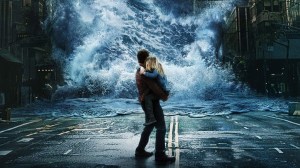 cause it brings Gerard Butler into the mix (because he designed the space station in question). Come to think of it, Butler as a space station designer is one of the most believable aspects of this film. That’s Geostorm in a nutshell.
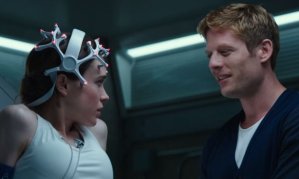 But you can hardly make something better if it isn’t remotely good to begin with. The thing is, the idea behind this movie is probably solid. But this movie takes an interesting premise and immediately flushes it down the nearest toilet. It takes philosophy and science and turns it into a party drug, giving lots of opportunity for shirtless dancing but not a whole lot else. It’s supposed to be a horror movie and it does lazily throw some things at the screen in order to startle you, but it doesn’t try hard enough at anything. I don’t even think the original was all that great, but trying to make a second cup of tea from the same old tea bag makes for a very weak cuppa.
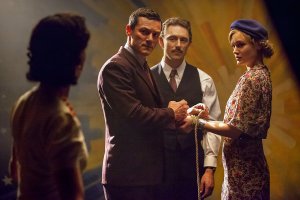 relationship, taboo and reviled in the 1930s and 40s, was that it inspired the creation of the Wonder Woman comic. Marston’s original stories (written under a pseudonym) incorporated the feminist ideals embodied by his wives. Wonder Woman was a strong woman who needed no man. His early comics also involved a fair amount of bondage and submission, which he pursued in his own bedroom and thought more young men should be turned onto. You can imagine the sort of censorship and uproar he faced.
 ASSHOLES WATCHING MOVIES