Monthly Archives: September 2019

In The Shadow of The Moon

A series of victims, each with the same puncture wounds on the back of their necks. They bleed from their noses, their ears, their eyes. They bleed and they die. The only thing that connects them is a mysterious woman in a blue hoodie, who seems to have visited each before they died. When Locke (Boyd Holbrook) and his partner Maddox (Bokeem Woodbine) investigate, along with their Lieutenant Holt (Michael C. Hall), what they uncover makes little sense.

Turns out, thanks to a glitch in the moon, every 9 years this hoodie woman (Cleopatra Coleman) gets to visit from the future and assassinate a few select people who would eventually contribute to Earth’s destruction. It’s like going back in time to kill Hitler’s grandparents. It’s for the good of humanity, but try telling that to the beat cop on the case. Locke gets a sense of this but no one else believes him, which means that every 9 years he gets crazier, more obsessed, more fixated on a narrative that can’t possibly be true.

The plot’s a little bumbly so it’s better to focus on how isolating it would be to hold a tiny piece of history secret in your heart, to chase a serial killer who reincarnates every 9 years, even after you think you’ve killed her. There’s no scenario in which that makes you a better person. Which the voice-over narration tells you pretty bluntly. And the thing about voice-over narration is that it’s usually used to mask glaring holes in a story that the film isn’t up to showing in a less obtrusive, sermonizing way. It’s rarely a good thing. And as you might guess, as we gain understanding of these slayings, the movie’s tone shifts from detective whodunnit to preachy science fiction – not exactly my favourite.

Jim Mickle’s In The Shadow Of The Moon starts off with promise and then declines steadily from there, perhaps falling to its own ambition, which does not incline me toward forgiveness.

TIFF19: Judy

In her late 40s, Judy Garland is down on her luck, near destitute in every way but loaded with debt, desperate to make just enough money to keep her kids with her but never quite sober enough to make it work. In America, her reputation for being unreliable practically a national headline. The real money is in London, but that’s a whole ocean away from her kids. But needs must.

The thing is, Judy’s demons are portable. They travel with her. Her engagements do not run smoothly. We flash back to her early days in the studio system, circa The Wizard of Oz. Studio head Louis B. Mayer is a total dick. He steals her childhood and replaces them with pills. Pills for everything: to pep her up, knock her out, thin her down, keep her going for 18 hour days. Judy’s addictions are traced with a very straight line back to these early days, before she’s even old enough to question them. Her parents practically sell her to the studio and she’s completely at the mercy of people who just want to exploit her.

But that voice, that talent, those unforgettable movies: it wasn’t Judy who got rich on them.

These shows, the London shows, are some of Judy’s last. She will be dead in 6 months, and the fact that she is waning is clear to all. A good day means a fantastic show: the legend is still in there somewhere. But there are bad days, and very bad shows.

Judy is not a biopic, it’s a very small sliver taken mostly from the end of her life. It is 0% glamour. This movie is a performance piece. It is a 100% ‘for your consideration’ love letter to the Academy for Renee Zellweger to be considered for her Oscar, please (in fact, she’s already got a Best Supporting, but rumour is, it’s a little lonely up there on her mantelpiece).

I never quite forgot that I was watching Renee, but I did often see Judy (and Sean, being less familiar with Judy, saw Liza), so she was doing something right. She was doing a LOT right: she channels Judy’s voice, singing more so than speaking. And she nails the spastic mannerisms of a pill-popper, jerking painfully across the screen. The total effect is an awful lot of sympathy for an icon who really just wanted to be a regular woman. But if you’re not a fan of Judy, there may not be much there for you. There isn’t a plot. There’s mostly just going to and from the venue, with gin and tonics in between. Is it a great, meaty role, well performed, with much to be admired? Absolutely, taking up so much space it leaves room for little else.

TIFF19: Abominable

Yi, a young woman with serious cankle problems, is grieving her father – not just his loss, but the music they shared and the adventures they’d planned but never went on. She spends less and less time at home, with her mother and grandma Nai Nai. Which is why her absence doesn’t raise any resounding alarm bells when she disappears suddenly.

Where has Yi (Chloe Bennet) gone?

Excellent question! The answer may surprise you! Unless of course you’ve seen the trailers, or the movie, in which case, the answer will be quite obvious.

A Yeti squats on the roof of her apartment building. He’s hiding out from the collector, Burnish (Eddie Izzard) who found him, and the scientist Dr. Zara (Sarah Paulson) who is determined to get him back. But poor Yeti (who Yi names Everest) just wants to go home – to, well, to Everest. So yeah, Yi sucks at naming pets, but the quest is clear: return Everest from whence he came, escaping bad guys in a series of escalating near-misses.

Along for the ride: next door neighbour and perennial cool guy Jin (Tenzing Norgay Trainor) and his rambunctious little cousin Peng (Albert Tsai).

[And just to satisfy your curiosity and save you a google search: yes, he is the grandson of  THE Tenzing Norgay, first man to reach the summit of Mount Everest alongside Sir Edmund Hillary. Nice reference, Abominable.]

Anyway: cue some effusively pretty animation of Chinese landscapes and countrysides, beautiful rivers and fluttering flowers. In fact, even the city scenes are pretty astonishing what with the attention to detail regarding lights and architecture and even advertising (I see you, McDonalds). And great use of music. It all works together to create something magical, and this movie wasn’t exactly short on magic, what with a yeti who speaks to nature with specific requests, and nature responds in creative yet helpful ways. But the script doesn’t sit back and let the animation do all the talking. There’s a sweet story in here about valuing what’s most important. “Sweet” is often a synonym for simple and perhaps minor, and that may be a fair assessment here. It’s most a movie for kids, with a King Kong reference or two thrown in for the grown-ups. And while it’s not really showing us or telling us anything we haven’t already seen, it is inherently endearing.

TIFF19: This Is Not A Movie

Director Yung Chang sets his sights on Robert Fisk, a ground-breaking and game-changing longtime foreign correspondent. Reporting primarily from the Middle East, the documentary visits his old stomping grounds – Syria, Palestine, Lebanon, and revisits many of his old stories, some of which (many of which) are ongoing. Problems in the Middle East are a revolving door, and a journalist has to have fortitude and determination to keep reporting with the same urgency and integrity when the story seems unending.

Robert Fisk clearly has a lot of deeply held beliefs about a journalist’s integrity, and it is clear that his has been questioned many times over the years. He writes what he sees, whether or not it’s what readers back home want to hear. His angle isn’t always the popular one. He’s been called racist, he’s been called an anti-Semite. But to him, truth is truth, even if it’s uncomfortable.

He also talks about what it’s been like to be amidst armed conflict so many times – and certainly, he seems inured, wanting to stop and poke around even as local guides nervously caution him of the danger. Wars are notoriously “dodgy things to predict” he tells us, as he barrels straight in. But there are consequences to this bombardment. One’s sensitivity becomes anesthetized; emotions are suppressed in the name of objectivity.

He’s a bit of a dinosaur, no longer truly of this world, which has moved on a bit in his absence. He still clings to newsprint even if his own words are purely digital. He’s realistic about the story’s ceaselessness, but keeps a fresh eye because “I still want to see what’s next.” Even in the face of great human tragedy “I can’t draw myself away.”

In the age of social media and fake news, Fisk is perhaps the kind of dinosaur we need. A reminder of how important it is to seek and expose truth. His rule of thumb: be on the side of those who suffer. Challenge authority. Don’t look away.

TIFF19: Honey Boy

Oh man. It’s already been more than a week and in many ways I’m still digesting this.

Honey Boy is an autobiographical movie that Shia LaBeouf wrote. Deep breaths.

Now we know a couple of things about Shia LaBeouf: he has suffered a pretty lengthy and public meltdown, and he has continued to put out some pretty worthy performances, albeit in smaller vehicles (American Honey and The Peanut Butter Falcon recently). In a review for Charlie Countryman, I attempted to parse the nature of his problems and his pain, but of course from the outside, you can only guess, and wish him well (or not). But Shia is at that point in his healing where he is letting us in. He is performing an exorcism here. The ghosts in his closet have been let loose – but will they haunt him less?

“Selfishly,” he told us, “I made this movie for 2 people: me, and my dad.” Let’s unpack that a bit.

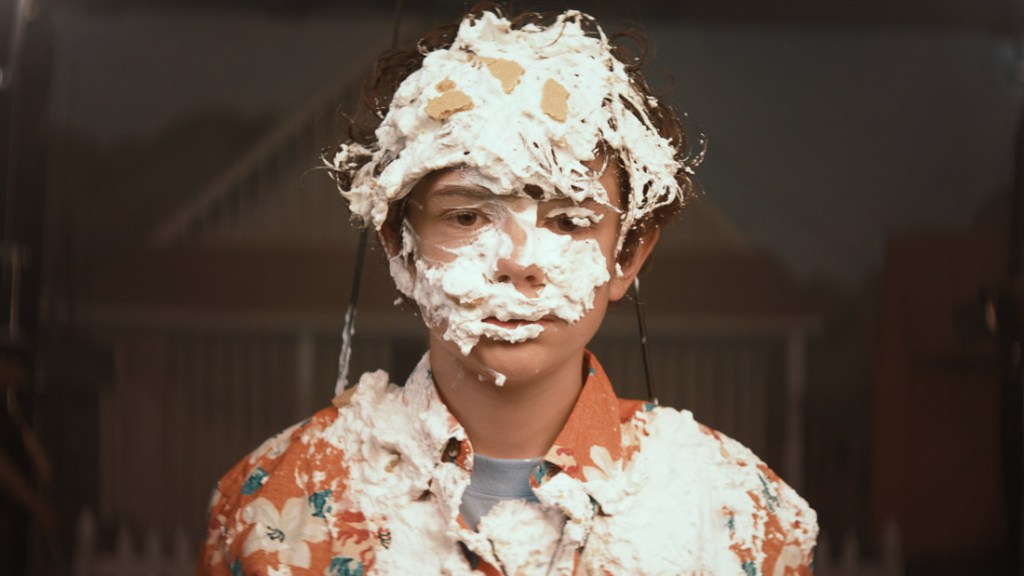
First, you need to know that in this movie he wrote, Shia plays his father. His own father. Noah Jupe and Lucas Hedges play young Shia and older Shia, though the character goes by Otis in the film. What does it mean that he’s written this painfully intimate autobiographical film, but called his character by another name?

Shia’s father James was (is) an addict, an ex-con, abusive to both Shia and his mother. And yet when we meet young Otis, who is hard at work on the set of a show not unlike Even Stevens, he is living in a dingy motel with his dad. His dad is not just acting as a parental guardian, but as a paid one. James doesn’t work. He takes money from his kid. Which doesn’t stop him from neglecting the son he’s being paid handsomely to watch, or from hitting the child who is technically his boss.

This makes for a complicated relationship and a complicated childhood. And though Otis’s mother is seldom heard from , you do have to wonder – if it’s dad who has custody, just how bad is mom?

So you start to realize that this little kid has no parents. Or, actually, that he’d be better off without the ones he does have. But what he does have is a full-time job and more money than most adults. But he’s also got family obligations and staff who are also relatives but virtually no one telling him how to navigate these complex situations. So by the time Noah Jupe magically transforms into Lucas Hedges, Otis has PTSD and his own struggles with addiction and no idea how to take time out from his busy career and the pressures of Hollywood to deal with them. Until a court gives him very explicit directions to do so (and thank goodness).

But maybe his best therapy has been writing this screenplay. Clearly troubled after the TIFF premiere of Honey Boy, Shia is quick to reassure us that he’s happy to be here with us, but he’s quiet, introspective, quick to deflect to his costars and the director he so admires, Alma Har’el. As his struggles have become increasingly public and undeniable, he is coping with the tools he has available: creatively. But will his creation be his catharsis? And is any of this interesting or entertaining to those of us who have to personal stake in his recovery?

Resoundingly: yes. The absolute best bits are between young Otis (Jupe) and his father (LaBeouf). Mostly stuck in a crappy motel room, the anger between them is never at less than an aggressive simmer, and it’s ALWAYS on the verge of boiling over. Even the quiet is not to be trusted. The tension is awful and soon we too are responding like an abused kid, ready to flinch at the least provocation. If you come from a conflict-filled background yourself, you won’t fail to identify the triggers. Be gentle with yourself.

Honey Boy is a moving, emotional movie-going experience. I also hope it brought a certain amount of closure to a young man still wrestling with his demons.

TIFF19: The Laundromat

“Based on actual secrets,” the screen tells us. Based on the trailer, I sort of expected The Laundromat to be the Erin Brockovich of money laundering. It was not. It was actually just a weak and poor copy of The Big Short.

The Big Short was about the Wall Street crash of 2008, more or less, precipitated by the housing bubble. And how all that lending, and then speculating against those bad mortgages, really fucked a lot of good people over. That film wove together a narrative interspersed with attempts to break down financial concepts to the audience. A celebrity – cameos by Margot Robbie or Selena Gomez, for example – would break the fourth wall to address the audience directly, and explain textbook concepts, like subprime mortgages, to us in a way we could easily grasp. It was celebrated for its unconventional techniques, which helped secure it the Oscar for adopted screenplay.

You can’t really blame The Laundromat for trying to capitalize on its success, but when your success is based on novelty and innovation, you pretty much inherently can’t replicate it. To even try seems…lazy.

Meryl Streep stars as an old lady who goes on a pleasure cruise with her husband, played by James Cromwell. An errant wave hits them and the boat capsizes, killing 21. In the wake of the accident, it is discovered that the cruise company is without insurance. Not that they didn’t have any – they thought they did – but that their policy was bought by another company, and another, and possibly another, until all there were were shell companies and no real policy, no real insurers, and definitely no money for the victims of the accident.

But Meryl Streep’s portion of the film is just one third of what we’re ultimately presented with. The other stories are only loosely connected by a law firm that exists just to hide money for its obscenely wealthy companies. The lawyers, played by Antonio Banderas and Gary Oldman, serve not just as characters, but also as narrators who get to skip through all the scenes, breaking the fourth wall and revealing the film’s sets to be just that: sets. It’s all very meta. And while these characters are a lot of fun, it stinks so badly of The Big Short you can never quite forgive it, even when it’s entertaining.

Based on the Panama Papers leak, the movie tries to reveal even just the tip of the iceberg when it comes to the rich getting richer: tax evasion, bribery, fraud, offshore accounts. But it’s sloppily assembled and is such a weak photocopy you can’t help but resent it outright. This is actually a very important issue that absolutely deserves our attention. But Steven Soderbergh just can’t pull this together, and in fact confuses the matter with his weird, episodic vignettes and title cards that just don’t add up. I’m just a lowly 99-percenter who pretends saving is optional and credit is use it or lose it. What do I know? Besides, you know, wanting my money back for this movie ticket.

TIFF19: The Aeronauts

James Glaisher (Eddie Redmayne) was a scientist and an aspiring meteorologist in a time when that field did not yet exist (1862, to be precise). So, he decided to invent it. To do that, he tapped balloon pilot Amelia Wren (Felicity Jones) (actually a balloon widow with a tragic backstory) to ascend toward the heavens, or at least beyond the clouds, in a historic balloon flight higher than any other.

Up they go, to dangerous heights. In the pursuit of science, Glaisher urges them higher still. With her husband’s death still fresh in her mind (and his blood perhaps still on her hands), Amelia prefers caution. Still, when they inevitably meet up with trouble, it is she who will save them both while he is basically just cargo, a useless man looking at his instruments.

It’s a dizzying and inspiring story, full of rah-rah, girls can do anything chutzpah that is of course completely fabricated. James Glaisher is in fact a real-life scientist, but the man who took him up in his balloon and ultimately saved his life was pioneer Henry Coxwell, who got written out of the story in order for these two The Theory of Everything costars to reunite. In truth, it is Amelia and not James who is the colour in the story. She is the one we naturally gravitate to. Would the story be as compelling without her?

Confusingly, IMDB lists the character as a Ms. Wren while the film itself seems to prefer Rennes. I suppose it doesn’t matter since she’s fictional, and perhaps it’s nearly fitting since Amelia is not just a fearless balloon pilot but a bit of a showgirl as well. Crowds have paid for the privilege of watching their launch, which funds their research, and she understands the value of putting on a bit of a show – which of course her stodgy scientist partner doesn’t get. He’s more into his pigeons, which he plans to throw from the balloon at different heights. The pigeons have no idea what’s in store for them.

The balloon ultimately reaches about 37 000 feet, which is roughly the cruising height of a jumbo jet. Up there, the air is cold, and there is less and less oxygen. Glaisher is the immediate victim, having brought along many thermometers but no warm clothes. For “authenticity,” director Tom Harper had Jones and Redmayne actually filming about 2000 feet in the air, which he captured via helicopter. In the olden days, an air balloon worked by 2 mechanisms. The basket was weighted with sandbags; to go higher, you let out some sand. To go lower, you let out some air. Today we have hot air balloons, which use fire to heat the air, and of course hot air rises. Allowing the air to cool means you drift down. I got to go up in a hot air balloon once. I am not overly fond of heights, or more specifically, of falling to my death from one, so I worried a lot about what the ascent would be like, and if I’d feel sick, or scared, and if the basket would bounce around, or if I’d have to hold on for dear life. In fact, the ascent was smooth, so utterly without event that I forgot to be scared at all and just completely enjoyed the ride. But then you have to get back down. That’s the part I’d failed to worry about, or even picture. And of course, that’s the bumpy part because the basket doesn’t just touch down gracefully, kissing the earth. It smacks it, hard, then jumps back up, then smacks down again, the basket getting drawn along jaggedly, thumping away while you assume the ‘crash’ position, huddled on its bottom, trying not to fall out.

There was something very satisfying about the movie, which is told within the framework of their historic 90 minute flight, with flashbacks telling the story of how they came to dance among the clouds together. Even from the sky, the film has a very strong sense of time and place. I was struck by the injustice of James presenting his findings to the Royal Society alone, because Amelia’s being female disqualified her from even being on the property. Of course since she never actually existed, the point is kind of moot, but their pairing does make for a very compelling story, and The Aeronauts are not exactly the first to embellish history in the service of better storytelling.

Playing Hooky At The Movies?

Excerpt from a 4-way Snapchat conversation I have going with my sisters at all times. Note that two of the sisters are sane and go to bed at reasonable hours, and two of us are not. In this particular conversation, it’s just myself (Jay here!) and my little sister, LittleJ.

LittleJ: Well guys, it’s 4:30am and The Giants game just finished. Does anyone want to skip work and go see a movie with me?

Jay: Yes. Although it’s only 3:46am here. You’re in the future

[There is in fact a solid 1 hour time difference between us but I was obviously 16 minutes late to the party.]

LittleJ: Haha, I usually am.

Jay: The only movies I haven’t seen are IT and Rambo.

LittleJ: Rambo it is!! I read IT when I was like 12 and it has low-key haunted me since. Not because it’s super scary, just a very questionable plot what with the child orgy in a sewer.

Jay: Ha. Well great. I haven’t seen any Rambo movie ever but I always say the best time to start a new franchise is 40 years in.

[I have since done the math and turns out we’re only 37 years in…but still.]

[I actually never say that, but I probably should: I also watched Star Wars for the first time about 40 years in.]

LittleJ: Haha nice. In that case, I feel like we should also watch an Alien and/or Predator. Though I usually prefer my Sylvester Stallone movies to have subtitles because I can barely understand the man.

Jay: Yeah, he’s not remotely understandable. I assume that’s why all his movies are 65-92% training montage.

LittleJ: Very good point.

At which point, my sister presumably fucked off and went to bed. But the thing is: I WISH middle of the night movies were possible. And early morning ones. And mid-afternoon.

When I first met Sean a decade ago, I worked the night shift, and we’d often find ourselves at a matinee with a few senior citizens (who ALWAYS buy the child size popcorn-drink combo!) but I find that those early shows are becoming increasingly rare.

Perhaps the rise of Netflix has made me greedy: movies on demand! When and where you want them. All the time! But it’s also that cinemas have become cineplexes have become multiplexes: it’s a rare theatre that doesn’t have 20 screens or more now. So when I show up at 8:36pm it makes me irrationally irate that I can’t simply waltz into the movie of my choice.

When I was a kid, you could see a movie at 7pm or 9pm. Those were the choices. You had to decide whether to grab dinner before or after. On Tuesdays there would be a special password hidden in the movie listings (we had 3 screens in town at the time) that you’d offer up to the box office in exchange for “cheap night” rates. Are Tuesdays still cheap at the movies? Do theatres even have box offices anymore? I’ve been buying tickets from an app for so long I haven’t noticed – and before that, it was from the ATM-style machines. I guess humans have been out of the equation for longer than I can recall.

But even though with multi-theatre cineplexes there are a lot more start times, they still tend to cluster around good old 7 and 9, which are basically useless to me. I may not work overnight anymore, but I still have the poor sleeping habits of a chronic insomniac. And movie theatres like to be able to close up shop by midnight, I’ve noticed. Which is garbage.

Theatres in this area are doing everything they can to compete with Netflix (in fact, recently at TIFF, the Cineplex chain refused to screen any Netflix or Amazon titles – we had to go elsewhere for those): theatres near us are converting entirely to recliner seating, spacious, comfortable, and clean, and tickets offer reserved seating, so you can show up last-minute and still get the best seat in the house. You can even get booze at the movies now! What will they think of next? Midnight movies, perhaps?

Actually, there used to be midnight movies too. I remember various nerdy boyfriends wanting to line up to see the latest comic book movie first. And so, as a movie typically was released on a Friday, the theatres would show the film at 12:01am and we’d line up late on a Thursday to make sure we got in to see Man of Steel or whatever monstrosity was on offer. But since studios got a whiff of our willingness to do that, they’ve capitalized by making those movies available on Thursdays now, usually as early as 7pm. Which is great, I suppose, to get a jump on your weekend viewing, but it’s really taken the special-ness out of it.

And it’s not like Netflix is totally exempt. Sure they have hundreds or perhaps thousands of titles ready to stream at the touch of a button, but when they’ve got a hot new release, they usually release at 12am San Francisco time (which is where their HQ is located). That’s 3am here, and 8am if you’re in London, and annoying pretty much everywhere. So I suppose the lesson is: I should have gone to bed when my sister did.

TIFF19: Knives Out

Every year there are a few TIFF titles that have everyone buzzing, and those tickets become nearly impossible to get our popcorn-greasy hands on. This year, those titles were Jojo Rabbit, Joker, and Knives Out. I saw all 3 because I am very, very fortunate, but I was the only Asshole to see Knives Out, which also means that I have a pretty big responsibility to get this right.

Harlan Thrombey (Christopher Plummer) is a highly successful mystery writer. His family gathers under the roof of his mansion to celebrate his 85th birthday, after which, they all retire to bed. The next morning, Harlan is found on his sofa with his throat slit. Initially ruled a suicide, both the local police and a private investigator are suspicious. As they start interviewing the family it becomes clear that each and every one of them has a motive, and that they’re all pretty enthusiastic about pointing the finger at someone else.

First, let’s get the cast of characters out of the way.

Marta (Ana de Armas) is Harlon’s nurse, and the last to see him alive. She put him to bed after administering his meds. As an outsider, she becomes P.I. Benoit Blanc’s (Daniel Craig) go-to source for all the family secrets.

Linda (Jamie Lee Curtis) is Harlon’s daughter, a successful businesswoman. She is married to Richard (Don Johnson) who is perhaps a bit of a leech. They have a son, Ransom (Chris Evans) who is way too old to never have worked a day in his life. He is supported by Grandpa Harlan because, though rebellious, Harlan sees a lot of himself in Ransom.

Joni (Toni Collette) was married to Harlan’s now-deceased son. She and daughter Meg (Katherine Langford) are still quite close to the family, and are supported by Harlan. Joni is a bit of a free-spirit and doesn’t quite fit in with the rest of the more conservative clan, though she may not realize it. She’s also at the other end of the political spectrum from brother-in-law Richard, and of course the two butt heads.

Walt (Michael Shannon) runs Harlan’s publishing empire, though with one hand tied behind his back as Harlan has no interest in selling movie rights or any other of Walt’s money-making suggestions. His wife Donna flies under the radar while his teenage son Jacob is a known weirdo and gossiped about as the family masturbator (does every family have one?).

That’s it. Those were all the people in the house the night Harlan died. It’s up to Blanc (a Poirot type, and not a little flamboyant) and police detective Elliott (Lakeith Stanfield) to sift through the pieces to try to assemble the puzzle. One helpful hint: nurse Marta is incapable of lying without barfing. It’s a tell that’s going to come in handy.

The movie is a lot of fun. First, there’s the fact that Harlan himself wrote murder mysteries. His house is full of mementos and artifacts – a display of knives behind the interview chair feels particularly ominous. But the ensemble cast makes it what it is. The script feeds them all some pretty snappy lines. I really loved Lakeith Stanfield’s referring to the Thrombey mansion as a “Clue board” – thanks for that, Rian. In fact, though the trailer bills Knives Out as a “whodunnit like no one has ever dunnit,” the truth is, plenty of murder mysteries came before it, and Johnson is not afraid to reference them. Johnson is a movie lover, a genuine movie lover, which makes his own movies so goddamn much fun to watch. He’s winking at us from the director’s chair. Going to a Rian Johnson movie is like taking my 5 year old nephew to a frozen yogurt place. He fills his little bowl with the first flavour, then a second, and probably a third. His eyes are bigger than his little belly. But he’s just getting started. Next come the toppings, which are his favourite part: cherries, chocolate chips, sprinkles, bigs of sugary cereal, broken up pretzels, strawberry flavoured boba, chunks of chocolate bar, pieces of cookie, bits of brownie. Next come syrups. Just one? Ha. That’s for amateurs. Then you cover it in whipped cream. Then a few more sprinkles, for the colour. More is more. Every spoonful digs up a new layer of goodness. He (both my nephew and Johnson) delights in every bite. There’s a sumptuous deliciousness to Rian Johnson’s films. And I don’t even worry about the belly ache: Rian Johnson is the one time you can eat every last bite and you never quite get enough.

Which is not to say this movie is unsatisfying. Johnson elevates the whodunnit by throwing in timely social elements that take a bite out of the wealth and class systems that literally allow people like this to get away with murder.

Ad Astra

Space is a lonely place. Cold, dark, and endless, it is described as the final frontier for good reason. Still, for as long as mankind has understood that the stars are bright balls of gas billions and billions of miles away, we have dreamed of exploring the darkness, and solving the many mysteries that must be there, waiting to be found.

MV5BYmFmMDA1ZTUtMmNlOS00ODc3LTkxYWEtMTA0OWM4MDQxMjEzXkEyXkFqcGdeQXVyNjg2NjQwMDQ@._V1_SY1000_CR0,0,1500,1000_AL_Roy McBride (Brad Pitt) has dedicated his life to space exploration. For better or worse, Roy has also spent his life living in his father’s shadow.  Roy’s dad, H. Clifford McBride (Tommy Lee Jones), was a legendary astronaut best known for disappearing somewhere near Neptune while searching for extraterrestrial life.  Roy never really knew his dad, so when he learns his father may not be as dead as was previously assumed, he’s not exactly jumping for joy.  Though to be fair, Roy has clearly never jumped for joy in his life. He’s detached, completely closed off from everyone around him, dedicated only to the missions he’s given, and his next mission is to try to make contact with his long-absent dad, who is now believed to pose a threat to all life on Earth.

The audience gets to accompany Roy on his journey, but of course we provide no company to him. Roy is alone, and while he mostly seems not to mind (indeed, he is really more comfortable in the solitude), Ad Astra weighed heavily on me. The mystery of space has fascinated me for as long as I can remember, and accordingly I have dragged Jay to more sci-fi films than can be counted. Of those countless films, Ad Astra is the first to ask me to examine my curiosity and ask what, exactly am I looking for? What is it about space that draws our dreams away from our home and into the endless void?

There are no easy answers in Ad Astra, and plenty of time to think about the many big questions raised by writers James Gray (who also directed) and Ethan Gross. Space is very quiet, and Roy’s journey is a satisfingly slow one. The journey feels even all the more important because of the slow pace. It becomes more an emotional, and even spiritual, journey than a spatial one, and an exploration of what really matters to us, both individually and as a species.  And it’s a wonderful trip.