
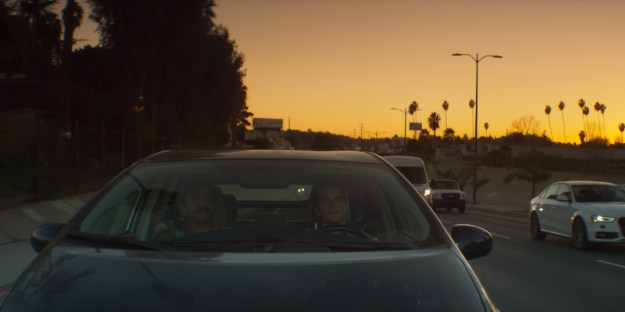
Jared is a good guy. He goes to church with is parents, where his father is the pastor. He plays on the high school basketball team. He’s kind to his girlfriend. But when he gets to collage, the world isn’t quite so good to him in return. He makes fast friends with a fellow runner, but that leads to a surprise sexual tryst one night that the other guy can’t live with. So, he tries to destroy Jared’s life, forcibly outing him to his deeply religious parents.
Jared (Lucas Hedges) respects his parents (Nicole Kidman, Russell Crowe) so he goes to gay conversion camp as instructed, in the hopes that they can turn him straight. Conversion therapy is nuts. I mean, it just is, on principle. What kind of whack jobs really believed this would work? And what kind of whack jobs wanted it to? It would almost  make a handy queer dating service, as it is probably the biggest concentration of homosexual folk any of these kids has seen before, if it wasn’t so nasty and abusive. That’s what it really boils down to. The head instructor, Victor Sykes (Joel Edgerton), blames your “problem” on some member of your family who made you gay. He wants you to pick someone to focus your anger on. He wants you to learn to “act” “straight” (did you know that the triangle is the straightest shape?). He focuses on behaviour – if you stop playing football, you are no longer a football player. Problem solved.
I mean, this whole thesis feels strangely out of date. Why is Hollywood still trying to convince people that gay is okay? I think societally we’ve moved past this point, except all these scripts that have been languishing for years are only now getting produced, and they’re already obsolete. You have to check out indie cinema to see some truly of-the-moment lgbt themes. But okay, gay conversion therapy is a horror. Of course it is. But the thing that’s great about Boy Erased is that Jared is such a strong character. Everyone and everything in his life is trying to make him feel wrong and ashamed and dirty, but he doesn’t. When he confirms to his parents that he thinks about men, he knows it goes against everything they believe, but it doesn’t seem like he’s internalized that self-hatred. It can’t be easy, in that house particularly, to know that his very being is not only repugnant but blasphemous to the people he loves most. And yet when he consents to the therapy, it’s for them, not for him. We never get the sense that he believes he needs to change. And that’s kind of astonishing to see.
Eventually Jared need to come to terms with disappointing the people he loves. And maybe he’ll need to cut out the people who are adding toxicity to his life. Those are hard choices, but they’re the right ones. This movie is really more about his parents needing to learn that they’re the idiots, and they’re the ones in need of education and re-conditioning. But while Nicole Kidman, in all her church lady big-hair, bejeweled glory, sort of comes around, there’s not a lot of remorse on the part of Russell Crowe’s character. And that’s where the movie falls short. Jared is surprisingly at ease with himself but the movie doesn’t give him nearly enough credit. Director Joel Edgerton, perhaps unsurprisingly, spends more time on his own character, than he does on the ones with real influence in this story.
Boy Erased is a good, competent little movie that will fail to make a big impression.
 them. Lots of crazy things are going to happen. LOTS OF CRAZY THINGS. I can only hope to prepare you fractionally for the craziness that’s about to be unleashed. I was not prepared at all. Some films at a festival are hardly finished. Lots don’t have trailers yet, or even production stills. Lots will go on to be re-edited so their final, released-in-theatres version will look wholly different that the version I saw at TIFF. Donnybrook felt finished but little was known about it. The only synopsis available simply states that “two men prepare to compete in a legendary bare-knuckle fight.” I thought I was sitting down to a boxing movie, not a HOLY SHIT WHAT THE FUCK JUST HAPPENED movie, and I shouted that more than once. More than twice!
 (Thomas Mann) has been to rehab and apparently still has a problem that isn’t quite addressed. But if his own son isn’t really his problem, why should someone else’s be?
 Cut back to present day: Bell is washed up, an alcoholic, estranged from her family. She looks like hell, smells like she’s pickled, practically lives in her car since that’s where she most often passes out. But when that murder scene turns out to be related to her old gang, she realizes its leader, Silas (Toby Kebbell) has resurfaced and she’ll have to dive back down the rabbit hole in order to make things right.
 one she found and returned. They all have ID and similar contents, and they’ve all been labelled with a name and number, presumably of the person who has returned it. Confused and appalled, Frances makes a hasty exit. But it’s too late. Greta has decided that Frances will be her friend. For life. Like it or not. Which is when things get stalkery. The police are no help, of course. They don’t intervene until some major shit has gone down. And believe me it’s about to go down.
 movie by Claire Foy), called him “emotionally disconnected.” In the film, he struggles to speak to fellow astronauts and even his own children, and goes out of his way not to. But it’s not that he doesn’t care. He clearly grieves the loss of his infant daughter, and thinks of her often. And he’s sensitive to the deaths of his colleagues. But these are internal struggles that rarely get expressed, or expressed correctly. He’s not unfriendly or unapproachable, exactly, but human connection is hard for him. Is undiagnosed autism what Gosling is hinting at with such a performance? And with that question in mind, the rest of the movie unlocks before me.
 McCarthy only has her own skin to live in, face naked save for an inept smear of lipstick on only the most special of occasions (ie, when asking for money), hair constantly overdue for its next dye job, frumpy clothes in various shades of poop. But it’s Israel’s personality that poses the real problem. She’s abrasive and reclusive and just doesn’t really know how to exist among people, so she’s basically stopped trying. It’s just her and her cat – a daunting thought when it’s just her and a blank page. A once-celebrated writer of biographies, her agent nowadays can’t get so much as a $10 advance for a book on Fanny Brice that nobody wants.
 What’s left is a story without a single breath of uniqueness. Drugs are bad, behaviour off the rails, shipped to rehab against his will, detox makes you sick, “I don’t need to be here,” resistance, rule-breaking, temptation, uncovering trauma, cautious optimism. Insert new names and this could literally describe at least a dozen movies about addictions, and those are just the ones I can name and I can’t name shit. Although Sam Taylor-Johnson makes things pretty (save her own husband, with cracked teeth and a broken nose), this feels like a very familiar, very formulaic iteration.
 reception follows in the courtyard of the family hotel. It is high-spirited, with lots of happy guests drinking, dancing, and making merry. Irene steals one too many unattended glasses of wine and retires to an early bedtime, with her little brother. But then the power goes out and Irene goes missing, which is when things get interesting.
 ASSHOLES WATCHING MOVIES