
High school funding for sports, and girls’ sports in particular, is on the decline, but fundraising isn’t the only issue for the members of the Salmon River High team. As the first all-Native girls lacrosse team in their section, they’ve got something to prove, and  not just to their rivals, but to their own community as well. Lacrosse was born on their land, the Akwesasne Mohawk Territory, but it’s a game traditionally reserved for men. Considered a gift from their Creator, lacrosse was meant as a way for men to settle disputes among tribes. The community is split as to whether women should be allowed to play this sacred game at all. Some believe that like all surviving culture, theirs too must grow and change to meet the needs of the people. Others cling to tradition. But all agree that this game is medicinal and can be used for healing. When the girls play, they take it seriously; they too want to honour their culture. Is it really such an abomination to take up their Nation’s sport?
Lacrosse is Canada’s national sport (or its summer sport, hockey being our winter one), and it so happens that I grew up on the Canadian side of the Akwesasne Mohawk Territory. The fact that none of this was unfamiliar to me didn’t make the documentary any less watchable – that’s a real credit to the movie. I have a deep respect for Aboriginal people, for their values, culture and beliefs, but there’s still a big part of me that struggles to see any woman being shut out of, well, anything in 2017. So I’m going to remind myself of some pretty important cultural context: the 2012 Olympic Games in London were the first games in which every participating country included female athletes, and in which women were able to compete in all sports. The very first Olympics were of course men only, and when women did start competing last century, it was only in golf and tennis. Women didn’t curl or play hockey in the Olympics until 1998. Weightlifting, pentathlon, taekwondo, and triathlon weren’t added until 2000. Also new to women in sports this century: bobsled, wrestling, and BMX. And finally in 2012, boxing and ski jumping were added to make women competitive in every sport. Isn’t that crazy? Of course, just because those sports are now included doesn’t mean you’ll get to see them played. NBC still spends more time covering men’s sports than women’s, particularly in winter (women fare a little better in the summer because American women win more medals than their male counterparts – BUT EVEN THEN IT’S STILL NOT EQUAL). TV time for women’s sports are still mostly dedicated to thinks like gymnastics and figure skating rather than say, judo or shotput. Women’s beach volleyball seems to get quite a bit of coverage, but I’m not sure that’s about pride in athleticism so much as the REGULATION uniform of bikinis. Yes, American women do quite well in beach volleyball. In 2008 both the men’s and women’s teams medaled but more coverage went to the women’s teams. The women’s indoor team also medaled that year but it wasn’t covered at all. So before we get on our high horses about a culturally-held belief, we need to remember that the sports most associated with women today – figure skating, swimming, gymnastics, beach volleyball – are all sports in which women are non-aggressive and scantily clad.
Back to the movie. Director Judd Ehrlich does an excellent job of sitting back and letting the girls speak for themselves. It’s clear from footage that there is no lack of skill or athleticism, but the girls are also thoughtful and expressive. Ehrlich frames the documentary as one season’s push to defeat a rival team, win a championship, and change hearts and minds along the way, but this documentary, part of the programming at the Canadian Sports Film Festival, is also an exploration of culture and identity. School sports do not exist in a vacuum. The girls attend a public school where the curriculum is very light on, and sometimes misleading about Native culture. They are taunted with racial slurs. They play competitors that have racist mascots. The film is much more than the game. And thanks to nimble editing and savvy camerawork, it’s a thrill to watch, too.
 injustice, and people’s pain, and she decided to do something about it. She was threatened and abused because she was exposing some very dirty secrets covered up by some very powerful people. The only help she ever got was from the adoptees themselves, all of them different shades of broken, harbouring the wounded children within. The real Margaret was awarded the Medal of the Order of Australia in 1993, and Commander of the British Empire in 2011 for her work, but as this film can attest, life was not made easy for her.
 body. Her aunt Antiope (Robin Wright) is the fiercest of them all, the greatest warrior the Amazons have ever known, and she’s in charge of training. Though Diana’s mother Queen Hippolyta (Connie Nielsen) wants to protect her daughter and extend her childhood, Antiope teaches Diana in secret. Themyscira is hidden from mankind, but you never know when the enemy might arrive. Themyscira is lush and beautiful. Filmed on location in Italy, the production is fantastic. The opening scenes where the diverse population of Amazonian women are all training with Antiope are gorgeous. The fight choreography is top notch, with particular sequences slowed down to showcase athletic feats. But we all know utopia can’t last forever, and as soon as Diana (Gal Gadot) is grown, one man does penetrate their paradise: a pilot named Steve Trevor (Chris Pine) is shot down in their waters. Diana saves him from the wreckage but they’re pursued by Germans. An epic battle between Amazons and Germans unfolds on the beautiful beaches of Themyscira. The Amazons fight unlike anything anyone has ever seen, but the Germans are armed with guns and the Amazons suffer loss. Steve Trevor tells the women that the world is at war (WWI to be exact) and that millions of lives have already been lost. Aghast, Diana swears to accompany him back to where he came from so she can help bring peace, as is her sacred duty.
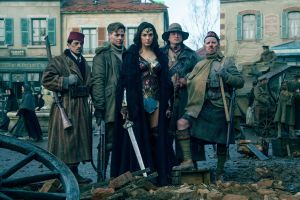 battle, there is no ego; they work together. The costumes are not sexualized as I feared, but instead they highlight muscular shoulders and toned legs. There can be no doubt that the Amazons are capable of truly anything. The fight sequences are among the best you’ve ever seen, the hand-to-hand combat precisely choreographed with as much grace as intensity. And it made me cry to see it. And I felt ashamed to cry, as a woman in 2017, ashamed that it’s taken this long to see a woman successfully take up the mantle of hero, and a woman behind the camera as well, capably directing a tentpole film. Patty Jenkins has so much unfair pressure placed on her shoulders but she’s made a movie that’s close to perfection, that far surpasses anything the DC Extended Universe has produced so far.
 superhero. The action sequences in this film are among the best, a delight to watch, full of energy, strength and ferocity, as good and frankly better than the stuff we we’ve seen from other comic book movies lately. And arguably, the reason she’s so strong is because she welcomes her softer side. Believing in fighting honourably, while looking your enemy in the eye, Diana never picks up a gun. She runs toward machine guns with only a shield and her cuffs to protect her. And she fights from a place of love. Not duty, not fury, not patriotism or revenge. She fights because she loves. Male superheroes seem to think that love is a weakness, but Wonder Woman knows better: love is the greatest motivator you could ever have.
 war, not men in uniform. Politicians run things but don’t bother to check in with the men on the ground, who are operating on the basis of “counter-insurgency”, a losing proposition each and every time. The soldiers can’t distinguish between the enemy and the people they’re trying to protect. The war is a clusterfuck but so is this lazy attempt at satire.
 his case worker is yanking him away to yet another group home. Tom has bounced around in the foster care system and Mary’s compassion is inflamed. Tom runs away one wintry night, and the fact that he seems to have run to her home briefly for refuge preys on her imagination. As the days go by and a powerful winter storm pummels them, townspeople give Tom up for dead but Mary becomes haunted by his ghost.
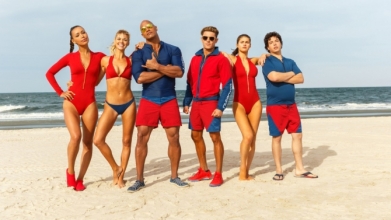 me certain they weren’t aware at all. The thing is, lifeguards save people who are struggling in the water. They have no business fighting crime. They shouldn’t touch dead bodies in a crime scene let alone attempt to solve the murders themselves. These lifeguards, however, take it upon themselves to impersonate doctors, take down drug lords, go undercover, break into morgues, confiscate evidence, and they do it all while on the clock, abandoning their actual jobs on the beach in order to do the jobs of police officers who don’t take the intrusion too kindly – although, in actuality, not unkindly enough. Because, you know, the lifeguards, instead of guarding lives, are actually putting them at risk, constantly, by doing this work.
 They’re all wrong on all counts. Chloe isn’t want she seems, and when Amy discovers her secrets she ends up not only fighting for her own life, but to keep intact the very same family that she’s up until now been eschewing. Seems like Chloe is the titular bad girl after all! Oh, teenage irony.
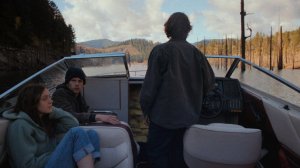 Night Moves isn’t so much about the environment as it is a character study between these three individuals trying to make a statement, and then living with the consequences. It’s slow, almost plodding. There’s no flashiness, just a creeping sense of guilt and paranoia.
