Author Archives: Matt

Son of Saul

A few days ago, I wrote about my experience with the movie Mustang, Turkey’s submission for the Oscar for Best Foreign Language Film. I was a little disconcerted by the hearty laughter from the audience at our local Bytowne cinema at the battle of wits  between a little girl and her mean (and probably violent) uncle. Even though the film’s director takes a hopeful and sometimes humorous approach to some tough material, I was way too nervous for this girl to laugh. I was reminded that night how differently two people can experience the same film.

Competing with Mustang for the Oscar is a film that even the Bytowne crowd can’t (and didn’t) find funny. Son of Saul is set in a Concentration Camp but is unlike any Holocaust movie I’ve ever seen.

There’s so much going on around Saul as he navigates his way through the camp in search of a rabbi who can help him give his son a proper Jewish burial. But we rarely see any of it. First-time feature director Laszlo Nemes used the Academy aspect ratio of 1.375:1, which I’d be lying if I claimed to understand exactly what it means but I gather that it produces an unusually narrow field of vision. The camera is usually either right in his face or right over his shoulder so we can see the camp only from his point of view. We have only the off-camera cries of anguish to remind us of the atrocities in the background. Through the eyes of Saul, there are no Oskar Schindlers, no Roberto Benignis to pretend for us that this is all a game.

This is some bleak material that is expertly shot by Nemes. With a technical prowess that occasionally reminded me of Alfonso Cuarón, I would have expected Son of Saul to move me more than it did. Mustang, for example, may not have the same flawless attention to detail but still managed to elicit an emotional response from me that I just couldn’t seem to manage with son of Saul. I was more impressed with the filmmaking than I was captivated by the story.

Mustang

I saw Mustang, as I see most foreign language films, surrounded by baby boomers. In Ottawa, the Bytowne is really the only place to go for foreign, documentary, and most independent films. The other thing about the Bytowne: Old people love it, partly because it’s reasonably priced but also because they can ask each other “Who’s she again?” without fear of getting shushed because their neighbours were most likely wondering the same thing. So I wondered at some points whether the hearty laughter coming from the audience during this tale of female oppression was the reaction that the director was hoping for.

To be fair, I’m not at all confident that I know exactly what reaction Deniz Gamze Ergüven was going for with her debut feature. Mustang can shift tones pretty quickly and, for once, I don’t mean that as a criticism. We first meet Lale (Güneş Şensoy, who’s just wonderful) and her four sisters on their way home on the last day of school in their small Turkish village. When they run into a group of boys, it’s off to the beach to sit on their shoulders and splash each other. In a Hollywood movie, this would just be a throw-away scene for a Best Summer Ever montage but, in this time and place, it’s enough to set in motion a chain of events that are just plain infuriating. Word spreads fast about the sisters’ scandalous behavior and their livid uncle immediately pulls them out of school and keeps them home to learn to cook, clean, and be good future wives. Worried that their reputation as corrupted girls would get worse, he rushes to marry them off as soon as possible.

They’re just good kids who like to have good silly fun. To see them oppressed in the name of sexist religious fundamentalism is an outrage. Ergüven’s trick is that she has made a film that effectively captures the cruelty of the situation but is always watchable -sometimes even entertaining- and almost never unpleasant. She is as committed to portraying the girls’ resilience in the face of oppression as to the oppression itself.

There are occasional scenes of very broad comedy in which I’m sure the Bytowne crowd’s laughter was exactly what Ergüven was hoping for. In the ever-escalating battle of wits between Lale and her mean uncle, I can’t be sure. I couldn’t laugh at Lale’s increasingly clever plots to sneak out of the house. The cost to her freedom and, eventually, her safety once she’s inevitably caught made me way too nervous.

It’s a credit to Ergüven that she’s made a film that could affect audience members so differently. Mustang calls attention to gender inequality and injustice that is as hopeful as it is frustrating. Through her faith in one young girl’s fighting spirit. her feature debut is a worthy nominee for the Best Foreign Language Film Oscar.


Melodrama… in 3D!: Part 2

Before Christmas, I questioned Gaspar Noe’s choice to film Love in 3D. While the gimmick of real sex in 3D managed to satisfy my moribid curiousity in a couple of scenes, the feeling that we could reach out and touch them couldn’t change the fact that the characters didn’t act or talk like real people.  Love was a dull, lifeless, depressing, and badly translated drama. But it had lots of sex.

Director Wim Wenders (whom I tend to like), also hit the 2015 festival circuit with an inexplicably 3D drama. Like Love, Every Thing Will Be Fine is dull, lifeless, depressing, and badly translated but doesn’t even have the decency to throw a little 3D ejaculate our way. What we DO get- and any Canadians out there might enjoy this- is Rachel McAdams doing a Quebec French accent. Despite the film being set in Montreal, why she would go out of her way to play Quebecoise, I have no idea. There are, after all, lots of English people living in the Canadian city. (I used to be one of them). Whatever her reasons, I’m willing to bet that the Screen Actors Guild did not see this movie or they would have never made the already questionable decision to nominate her for Best Supporting Actress in Spotlight.
Struggling writer Tomas’ (James Franco) relationship with Sara (McAdams) is already not going so great even before his life is changed forever by accidentally running over and killing a small boy with his car. The boy’s mother (Charlotte Gainsbourg) immediately makes it clear to Tomas that she doesn’t blame him but forgiving himself isn’t so easy for Tomas, even after he begins to profit from becoming a much more inspired and successful writer after the trauma.

My favourite Wim Wenders films (Wings of Desire and Paris, Texas) are understated and haunting but Every Thing Will Be Fine slows the pace down to a whole new level. Unsure of exactly, what the director’s looking for, Franco plays it safe by avoiding emoting at all costs. Probably aiming for restraint and subtlety (two qualities I admire most in an actor), he succeeds only at being wooden. He’s not burdened with an ill-advised accent but his performance is almost as embarrassing as McAdams’.

Gainsbourg and real-life Montrealer Marie-Josee Croze (The Barbarian Invasions, The Diving Bell and the Butterfly) don’t come out looking so bad but even they don’t have anything interesting to do. Wenders seems especially committed to losing our interest by constantly disrupting the narrative to jump ahead a year or two, or sometimes even more, whenever there’s even the smallest risk that someone in the theater may find themselves caring even a tiny bit. And the dialogue from Norwegian screenwriter Bjorn Olaf Johanessen feels badly translated into English and is already being compared to Tommy Wiseau’s The Room.

I was not able to catch a screening of Every Thing Will Be Fine in 3D so I have no idea exactly what Wenders was going for by shooting in 3D. I do know that I’ve seen 3D summer blockbusters that had more heart than Wenders’ painfully dull drama.

AUFDRUCK (LABEL)

LABEL

Last month, we got a Facebook message from a very brave filmmaker. Jaschar L Marktanner invited us to watch and review his short film, voluntarily facing the wrath of not one but three admitted Assholes. How fun it would be to pan AUFDRUCK (LABEL in English), from a writer-director so boldly putting themself in the hot seat.

Imagine my disappointment when I actually enjoyed it. LABEL is only four minutes long so a spoiler-free description is a unique challenge for me as a reviewer. I think (and hope) that Jaschar won’t mind me telling you that it’s shot in black and white, which is an excellent choice, partly because it adds to the French New Wave feel. In their first IMDB credits, Kira Mathis and Mary Krasnoperova play two women in a coffee shop describing a mutual acquaintance as a “son of a bitch”. Labelling and complaining with a friend over coffee may seem like a pretty universal experience but it soon becomes clear that these women use the label pretty liberally, as the conversation becomes more and more absurd.

LABEL is funny, gradually upping the ridiculousness as it follows the structure of a really good comedy sketch. Marktanner’s film has more to offer than just laughs though with what I read as an effective critique of modern fatalism. I am happy to report, however, that he has generously given this Asshole one thing to grumble about. Speaking no German, I was forced to watch LABEL with English subtitles which were colour-coded depending on who was speaking.  I found the dark red to be difficult to read against the black and white background. Once or twice, I had to pause it to avoid missing a single word. There, I said it.

Overall, LABEL is well worth your time and I am grateful to Jaschar for sharing it with us.

The Big Short

If you were one of the many Ron Burgundy fans who felt let down by Anchorman 2, the movie to blame is finally here. Adam McKay, Head Writer at Saturday Night Live during the late 90s and the director of all the most Will Ferrelly of Will Ferrell movies, was not the obvious choice to adapt such a serious book as The Big Short and reportedly only agreed to write a second Anchorman to sweeten the deal.

The Big Short, which I have not read, was written by Michael Lewis and documents the story of the small group of people who foresaw the collapse of the housing market in 2007 and took a giant gamble by betting against the banks. Now, I’ve seen Inside Job, 2010’s Oscar-winning documentary about the financial crisis and I’ve seen Wolf of Wall Street but still manage to get my dividends and my CDIs mixed up. With Inside Job going so far over my head, I couldn’t help but wonder how a writer best known for “Go fuck yourself, San Diego” would handle such potentially confusing material.

It turns out that McKay is the right guy to make a financial crisis movie for someone as financially illiterate as I am. He consistently finds creative ways to pause to explain the trickier concepts, often by breaking the fourth wall with outrageous celebrity cameos of which I wouldn’t dare spoil the surprise. There are enough jokes, often poking fun at the conventions of movies that are “based on a true story”, to hold our attention better than Inside Out or Wolf or Wall Street could hope to without ever abandoning the appropriate level of outrage at how so much greed could cause so much suffering.

How Hollywood could make a movie- a comedy no less- from Lewis’ book wasn’t the only reason to be curious about McKay’s film. It also boasts one of 2015’s most intriguing casts. Brad Pitt, one of The Big Short’s producers, has the smallest role of the four names above the title but stands out for his uncharacteristicallyy understated performance. I didn’t even recognize him in the preview. (I thought he was Peter Dinklage).  I couldn’t help noticing though that casting himself as the one guy who gets that “this is just not right” is becoming a bit of a self-serving habit of his. (See: 12 Years a Slave). Ryan Gosling, last seen in 2013’s Only God Forgives, makes his triumphant return to the big screen. As Jared Vennett, he channels all the handsome-and-he-knows-it smugness that we saw in Crazy Stupid Love and The Ides of March. Come to think of it, he’s versatile enough to have played pretty much any of the major characters so his talents may have been better served with a better part but he plays it well and has some really funny lines.

Christian Bale and Steve Carrell- believe it or not- are competing for the Best Actor in a Comedy or Musical Golden Globe. Bale plays Michael Burry, the brilliant hedge fund manager with Asperger’s who loves to air drum. He’s good but has been better. He plays the eccentric genius a little like he did the eccentric in American Hustle but he has some strong scenes, especially when he starts to let his humility show towards the end. It’s Carrell, though, who steals the show. With the other characters so impressed with their own coolnees or brilliance and so focused on how much money they’re going to make if their gamble pays off, Carrell brings the humanity. He plays money manager Mark Baum, based on Steve Eisman. He’s had it out for the banks ever since his brother lost all his money and jumped off the roof of a highrise. (I’m not sure if that happened to Eisman or not). His shock and anger is palpable in every scene. Because he’s played by Steve Carrell, he’s still funny. But McKay counts on him to remind us that, while laughing at the stupidity and recklessness of Wall Street can be a lot of fun, a lot of real people got hurt.

I’ll be cheering for him on Sunday.

The Hateful Eight!!!!!!!!

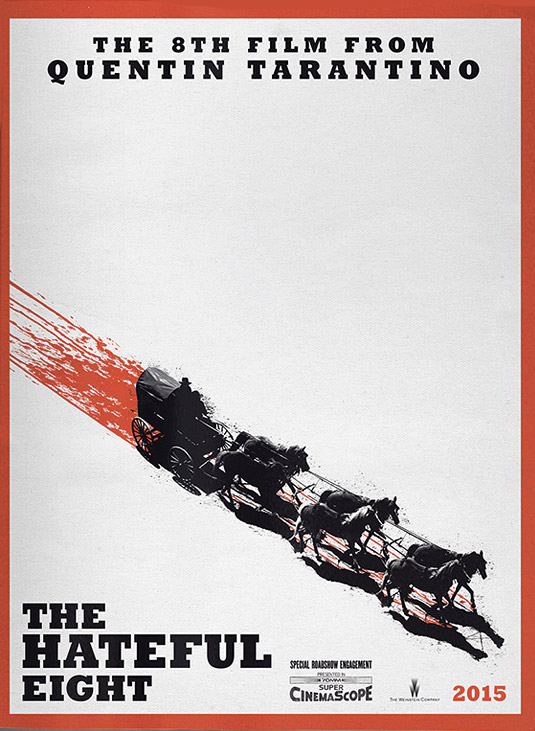
Daisy Domergue (Jennifer Jason Leigh) has a date with a hangman’s noose and bounty hunter hateful eight 3John Ruth, “The Hangman” (Kurt Russell), isn’t letting anyone stand in the way of his ten thousand dollar reward. Just to be safe, he’s got her chained to his wrist at all times and, to show her who’s boss, decks her any time she gives him any sass. Making their way through a blizzard, their stagecoach happens on a stranger stranded on the road: Major Marquis Warren (Samuel L. Jackson). “Got room for one more?” asks Marquis.

So begins The Hateful Eight, the eighth film from Quentin Tarantino. As the storm intensifies, Marquis and The Hangman are forced to wait it out in a tiny lodge with six other strangers. (It’s unclear to me which of these 9 Tarantino is excluding from being “Hateful”). I won’t attempt to describe the story that Tarantino weaves any further. No one in Hollywood tells a story quite like Quentin and for me to try to summarize the chain of events that follows in Minnie’s Haberdashery just wouldn’t be right. It’s best just to watch and let it unfold.

If you’ve been following the drama surrounding the 8th film from Quentin Tarantino, you may know that Daisy, Marquis, and The Hangman almost didn’t get to meet in snowy Wyoming. After a draft of the Hateful Eight script leaked online in early 2014, Tarantino felt so wounded that he vowed not to continue with the project. He got over it quick though. His enthusiasm was renewed three months later after a live read with the cast in Los Angeles.

His enthusiasm is contagious. I was almost giddy with excitement through the opening chapters of The Hateful Eight. It’s hard to tell quite where any Tarantino film is heading and the early scenes- with such wit, tension, and restraint- were full of promise. With each new character that he introduced, the more exciting and suspenseful the movie gets. Set in a confined space filled with people who can’t fully trust each other, The Hateful Eight is a welcome reminder of what it was like to see Resevoir Dogs for the first time. The first half is so deliberately paced that it’s tempting to think of it as the director’s most grown up film yet, tricking me into a false sense of security that left me completely unprepared for the second half.

Once the blood finally begins to spill, The Hateful Eight shows its true colours. By the end of its three-hour running time, Tarantino’s eighth film has revealed itself as his darkest, blood-thirstiest, meanest, nastiest and most pessimistic since Resevoir Dogs, a drastic shift from the tone of Inglorious Basterds and Django Unchained. I still count The Hateful Eight among the best of both Quentin’s filmography and of 2015. But the enthusiasm that I felt for the first half of the film was mostly gone by the time I left the theater. I left feeling a little disheartened and even a little guilty for the briliant bit of sadism that I participated in by watching it.

Have you seen The Hateful Eight yet? Does it rank among Tarantino’s harshest or am I just getting soft?

Melodrama… in 3D!: Part 1

The second row is a little too close for comfort to watch a prolonged bout of mutual masturbation in 3D but that’s exactly where I found myself a couple of weeks ago during the opening scene of loveGaspar Noe’s Love. With the camera zooming in so close to the action and me so close to the screen, it was hard to know where to look. Watch her give him a handjob to my left or him finger her to my right? I was so close to the action I couldn’t possibly do both. So I decided to compromise and sheepishly look down at my shoes.

Okay, obviously this is the movie where the sex is unsimulated and shot in 3D so clearly I showed up looking to see some sex. I regretted missing this at TIFF whose website peaked my interest with “3D ejaculation, anyone?”. What I could not have anticipated was how awkward it would be to watch at first. Or, once I’d gotten over the initial discomfort, how boring it would be. Love scenes are always tough to sell, it turns out, just because the penetration is real doesn’t mean the passion is.

love 2And just because the images are 3D doesn’t mean the characters are. Karl Glusman plays Murphy (so they can make a pointless reference to Murphy’s Law at some point), an American aspiring filmmaker living in Paris. He wakes up on New Years Day (or “January 1st”, as it’s called in this movie) to a frantic voice mail message from his ex’s mom. Elektra (Aomi Muyock) is missing and probably suicidal. Murphy is now living with Omi, with whom he has a young son, but his whiny interior monologue reveals that he is fed up with her and is still hung up on Elektra. Before you feel too sorry for him, you should know that he cheated on Elektra with Omi and called her a “selfish cunt” when she got upset that he had knocked up some other woman.

Murphy and Elektra are moody people and all this moodiness was starting to feel hypnotic. I could get into this story about Murphy trying to find his lost love. Unfortunately, Noe devotes love 3very little time to this mystery and overwhelms us with flashbacks of the Murphy-Elektra love affair, which seems to have been mostly a series of increasingly trashy fights followed by increasingly tedious make-up sex. It gets dull pretty quick and it doesn’t help that Noe made a big mistake writing this script in his second language. “Have you ever made love on opium?” Elektra asks. “No,” says Murphy. “You should. It’s great”.

So, did it need to be in 3D? Well, “unsimulated sex in 3D” is a cool gimmick and it clearly got my attention. And the 3D ejaculation was anything but anti-climatic and I dare you not to watch it without ducking or at least flinching. Other than that, the story is too dark and the filmmaking too pseudo-artsy to work as a guilty pleasure but it’s also too awful to work as art.

The Ridiculous 6

For some reason, I like Adam Sandler. Even though his movies are atrocious. For every funny scene, there are three times as many that just don’t work. Despite his efforts to appeal to the shortest of attention spans, his movies are usually ironic culprits of the worst crime any film can commit. They’re boring.

Still, I like him. Maybe I’m biased by my fond memories of 90s Saturday Night Live or the first time I saw Happy Gilmore. Or maybe he just seems like a nice guy. Everyone around him seems to be having so much fun. And as juvenile and offensive as his humour can sometimes be, that classic Sandler grin can’t help but make us feel like he means us no harm. Besides, he’s a funny guy who throws so much at you that some of it is bound to stick. I don’t think there’s a single Adam Sandler movie that hasn’t made me laugh out loud at least a few times.

Until now. This week I watched Sandler’s Netflix Original The Ridiculous 6, which has to be a new low for him both as an actor and as a writer. Sandler, Rob Schneider, Taylor Lautner, Jorge Garcia, Luke Wilson, and Terry Crews all play brothers from other mothers who Sandler meets one by one while on a mission to rescue their father from a gang of thieves. They’re a ridiculously diverse group of brothers; Sandler was adopted and raised by Native Americans so naturally knows how to do all kinds of mystical shit, Schneider is half-Mexican with a horse that sprays you with shit to let you know that it likes you, Lautner is a simple-minded redneck with a missing tooth, Garcia doesn’t speak English and is good at strangling people, Wilson was Abe Lincoln’s bodyguard, and Crews is a piano-playing black guy and of course has a huge penis.

So, obviously it all feels dated, desperately banking on the hope that the stereotypes from Adam’s SNL days are still funny 20 years later. The injustices suffered by First Nations people have been a hot and controversial topic in Canada lately, making Sandler’s performance and the film’s depiction of the culture in general just seem wrong. I believe that a gifted comedian can get away with joking about almost anything but firmly believe that, if you’re going to take on such a sensitive subject, you’d better make damn sure at the very least that you’re funny. There’s nothing funny going on here.

Thank God we’ve got Taylor Lautner. Sandler going Native was a bad idea but he can’t help being at least a little likeable and, thanks to Lautner, he does not come close to giving the worst performance of The Ridiculous 6. Lautner’s hillbilly feels less offensive since southern white guys have been fair game for so long now but rarely have they been portrayed by an actor with so little charisma and sense of comic timing. It’s hard to watch him without wondering how no one close to him was ever able to talk him out of this.

If you still want to watch it, the good news is that The Ridiculous 6 is not all bad. While it never made me laugh, I might have managed a chuckle or too had I not been so irritated by the rest of the movie. John Turturro’s cameo featuring an early version of baseball nearly got a “nice job with that” from me and the usual cast of Sandler cameos show up as real-life historical figures occasionally made me smile despite myself. I hate to name specific actors or characters here because I wouldn’t want to spoil what little fun this movie has to offer.

One Proud Canadian at the Whistler Film Festival

If you’ve glanced at our chaotic Comments section on Jay’s Golden Globes post, you may have noticed that I am a big supporter of Todd Haynes’ Carol, which had its Canadian premiere at the opening gala of this year’s Whistler Film Festival. It was the best by far of the films I saw at the festival but- my love for this Hollywood indie aside- I am as proud as I am surprised to announced that the Canadian films I saw outshone every other American entry. Here are my thoughts on the three most pleasant surprises from my side of the border.

I don’t know why why I was so surprised that How to Plan an Orgy in a Small Town was exactlyMV5BMTUzMjU2NzA4Ml5BMl5BanBnXkFtZTgwNzM0MTg5NjE@__V1_SX214_AL_ what it sounds like. Maybe knowing that it was Canadian, I was expecting it to be more polite and restrained. But, no, the second sex comedy from director Jeremy Lalonde does not skimp on the orgy. Having been labelled the town slut as a teenager, sex columnist and closet virgin Cassie returns to her conservative small town for her mother’s funeral. No one is particularly happy to see her until several townspeople- each one having reasons of their own- decide they need to have an orgy and beg her to facilitate it for them. Lalonde, on hand to introduce the film and to answer audience questions, packs Cassie’s living room with likable characters you’d never experience to show up to an orgy. The implausibility of the situation- especially that they’d keep coming back after every increasingly hilarious false start, is part of the fun. The jokes are mostly lowbrow (a montage of cum faces being one highlight) but rarely cross the line into juvenility.

In The Steps, Marla (Emmanuelle Chriqui) and Jeff (Jason Ritter) are brother and sister living inthe steps New York who are called to their estranged father’s (James Brolin) cottage in Ontario to meet his new Canadian wife Sherry (Christine Lahti) and her three kids. Truthfully, things haven’t been going great for Jeff lately. He’s lost his fancy New York job and his fancy New York girlfriend and he watches a little too much porn. But that doesn’t stop him from judging the shit out of his new step family; Sherry loves lame icebreaker games, David (Benjamin Arthur) owns the third largest paintball course in the province and loves hair metal and Nicolas Cage movies, Keith (Steve McCarthy) is a depressed former indie rock musician, and Sam (Vinay Virmany) keeps sneaking away to smoke pot. Obviously, this isn’t going to be one big happy family right away but (spoiler alert) they’ll be backing each other up in bar fights in no time. Obviously, it’s hard to watch this movie without knowing where it’s going and each character seems plucked from the Handbook for Movies About Dysfunctional Families. But the casting, both in how they inhabit their own characters as well as how they interact with the others, is bang on. It got big laughs from a small 9 am crowd at Whistler and was well worth getting up so early for.

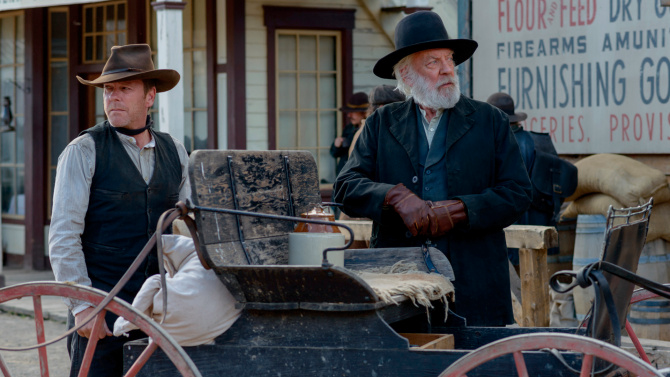
The Steps was a perfect example of how a familiar story, when told well, can feel new. This is just as true of Forsaken, which had its Western Canada premiere at the festival. Kiefer Sutherland (who stood like 20 feet from me when introducing the film) plays gunslinger John forsakenHenry Clayton who returns home to his Reverend father (Donald Sutherland, sharing the screen with his son for the first time). As a pacifist, Rev. Clayton is none too happy to see his boy and is skeptical that he is sincere in his vow to hang up his guns for good. John Henry’s abstinence from the way of the gun is tested when some bullies ride into town forcing people off their land and threaten his long-lost love (Demi Moore).
They don’t make westerns like this anymore. Forsaken is neither revisionist nor homage. Instead, it follows the tradition of the great westerns of the 50s that understood the excitement of watching a hero getting his revenge just as well as they did the importance of making us wait for it. John Henry takes a lot of abuse and witnesses a lot of injustice before finally unleashing hell. We’ve seen this character before and know how it’s all going to turn out but it’s fun to see it all play out, especially with first-time feature director Jon Cassar taking his time with telling the story. If there’s one thing Kiefer knows , it’s how to play a killer who just wants to retire but keeps getting pulled back in and plays John Henry with just the right mix of badass and bashful. Both Sutherlands play their parts well, although the accent Kiefer tries out in some scenes doesn’t suit him, and the two are at their best when onscreen together. Even more effortless, however, are the bad guys played by the great Brian Cox, Sean’s high school buddy Aaron Poole, and the amazing but underrated Michael Wincott. It’s a blast watching these three be despicable and even more fun knowing that, by the end, their uppance will come.

Her Composition

I’ve yet to comment on my Whistler experience because Jay has already written in detail about our first two days and was so spot on with her reviews of Carol, The Life and Death of an Unhappily Married Man, How to Plan an Orgy in a Small Town, and Love that I felt I had nothing to add. It was Friday (or, as I kept calling it, “Sunday”) that I dared to separate from the other Assholes and brave the Whistler Film Festival alone.

Whistler itself proved easy enough to navigate. I managed to explore almost the entire village on foot in about half an hour and is structured in such a way that even I would find it difficult (though not impossible) to get lost. Her Composition was a different story. After a chance encounter with director Stephan Littger earlier that day, I had the rare and awkward treat of sitting next to him at the Canadian premiere of his debut feature. Littger had already expressed some apprehension about the disappointing speakers at the Village 8 Theater and made a point of encouraging us all to move up to the front of the theater to get the full effect. Sitting so close to him made his anxiety contagious and we both shifted in our seats when the DVD began to skip only a minute into the screening. The problem soon corrected itself though and I was able to relax and enjoy this fascinating and challenging film.

Her Composition is, thankfully, not a comedy, sparing me the pressure of laughing on cue. Malorie (Joslyn Jensen), like Natalie Portman’s character in Black Swan, is an artist who wants to please her instructor so badly that she has trouble truly letting go. With her thesis composition due in a matter of weeks, she decides to start over. Finally getting out of her head, Malorie starts working as an escort and drawing inspiration from the sounds of the city and of her encounters with her clients. Her new unorthodox approach to songwriting feels empowering at first but the narrative begins to get darker and darker as her experiences as a sex worker get more and more dangerous and as her obsession with her masterpiece begins to border on madness.

Littger’s frustration with the house speakers is understandable. The sound mixing makes or breaks a film like this and Littger and his team have clearly put a lot of thought into how to communicate texture through sound. Malorie hears music in her head which, of course, is inspired by the sound and rhythm of the world around her. To communicate this to the audience- the relation between a man’s grunts during climax and the song in her head- is the hard part. It’s a work of exceptional editing and sound mixing.

Even if all the subtleties of the sound weren’t showcased as well as Littger would have liked, he’s still got Jensen- whose performance is nothing short of captivating. Her transition from teacher’s pet to tortured genius is believable every step of the way. I was disappointed that she was unable to attend the Canadian premiere last week because I would have been happy to meet her and congratulate her.

I hope a lot of people see this in theaters with speakers that would make Littger proud.