Category Archives: Kick-ass!

The highest honour we can bestow on a film. Anyrhing in this category is a must-see.

TIFF19: A Beautiful Day in the Neighborhood

A Beautiful Day in the Neighborhood is a beautiful excuse for a movie, but it is not a Mr. Rogers biopic.  It’s more like if this week’s episode of Mr. Rogers was tackling the theme of Lloyd Vogel (Matthew Rhys), who just happens to be a journalist who meant to write a Fred Rogers profile once.  And he didn’t really succeed – he wrote 10,000 words, mostly about himself.  But it was meeting Mr. Rogers that inspired and enabled him to start to process his childhood trauma and deal with his feelings.  The movie ends up being a 70-30 split, and not in Mr. Rogers’ favour.  Which isn’t a bad thing necessarily, it’s a reminder of the profound impact that Mr. Rogers’ love and Beautiful-Day-TIFF2019acceptance had on all of us.  Above all, he taught us it was okay to feel.

Lloyd Vogel is a cynic.  He normally writes about a broken world.  He’s not thrilled to be writing about a children’s television show, and he’s determined to see the star’s mask slip.  To see that Mr. Rogers isn’t a goody-two-shoes character but rather Fred Rogers’ honest expression of his best self is hard for Vogel to accept.  Meanwhile, Mr. Rogers sees through him – sees his anger, recognizes it for pain, and has a healing effect, despite Vogel’s resistance.  With a newborn baby at home and an estranged father who’s reappeared only to announce he’s dying, Vogel’s life is perhaps in need of some friendly ministration.

Director Marielle Heller finds exciting and innovative ways to frame the story, except she stole them all lovingly and conscientiously from Mr. Rogers himself.  It’s a way to honour what was truly special about his show – everything way thoughtful but low-tech, without fuss or flash.  The continuity was comforting.  Of course, the most incredible coup is the casting of Tom Hanks in the iconic cardigan.  He’s wonderful, channeling Fred Rogers’ sense of calm and peace.  His signature style of slow, deliberate speech is such a balm to those he’s talking to – it is rare to feel the scope of someone’s focus.  It’s also hilarious to watch his producers lose their shit as the time and attention he gives each guest means their show is constantly behind schedule.

It’s a Beautiful Day in the Neighborhood isn’t exactly the movie I expected, but it took me through all the feels (weep count: 3) and left me feeling like a very valued neighbour indeed.  Mr. Rogers has always said that he tried to look through the television into the eyes of one individual child.  Today I was that child, and I think you will be too.

TIFF19: The Lighthouse

Two men are dropped off on a rock in the middle of the ocean, left alone to tend the lighthouse.  The men, let’s call them Wick and Winslow, though they mostly go by “Sir” and “lad”, are strangers about to get extremely cozy during the four weeks of their isolation.

Winslow (Robert Pattinson) is a young guy, a bit of a drifter, here to make some serious money and go home.  Wick (Willem Dafoe) is gruff yet poetic, exacting yet frustrated by Winslow’s rule-abiding nature.  The two rub each other wrong right from the start, and the thing about having absolutely nothing but each other’s company is that you’ll either become best friends or the worst of enemies.lighthouse

The weeks pass slowly, marked by back-breaking work.  There’s wanking and drinking and farting, but eventually their time is up.  They’ve made it!  Except that’s really just where the story starts.

A storm blows in, which means no boat can come for them.  They’ve been stranded, but for how long?  Days?  Weeks?  Time becomes meaningless, reality blurred.  We’re witnessing a descent into madness, but the question is: whose?  Winslow’s? Wick’s? Our own?

Shot in stark black and white, with an aching cinematography and an arresting sound design, Robert Eggers (director of the Witch) returns with a dizzying, disorienting film about madness.

The candlelight serves perfectly to illuminate Dafoe’s lined face, his fevered eyes leaving us to wonder whether he’s a psychopath or just a drunk.  Dafoe and Pattinson spar thrillingly on screen, each pushed by the other to unravel even further.  It’s magnetic even if it’s not always easy to watch.

The Lighthouse is full of omens and mythic imagery awaiting decoding.  This film doesn’t have the same sense of unending, unbearable dread that the Witch did, but it will surprise and confound you in new and unique ways, daring you to look away.

TIFF19: The Personal History of David Copperfield

Dev Patel is David Copperfield – it’s an inspired bit of casting that’s instantly a perfect fit. In fact, the whole film is so overwhelmingly cast to perfection it’s almost embarrassing.

I worried about this film because though director Armando Iannucci’s previous film, The Death of Stalin, was extremely well-received by critics, it was not my the-personal-history-of-david-copperfieldcuppa, not by a long shot. As an introduction to this film’s premiere at TIFF, Iannucci informed/assured us the two films could not be more different. And while I’m not sure that’s true, I was relieved and elighted to find myself really enjoying it.

I hope it’s obvious that this movie is inspired by Charles Dickens’ David Copperfield, though TIFF Artistic Director & Co-Head Cameron Bailey rightly called it an “audacious” interpretation, and it is that. Iannucci was struck by how timeless the themes of love and friendship were, so though the film is undoubtedly a period piece, Iannucci reminds us that for the characters, it’s present day.

As for myself, I was most struck by how convincingly Copperfield is portrayed as a budding writer. Even as a child he’s wildly observant, with a knack for accents and a fondness for “collecting” lovely turns of phrase. The way this movie explores and plays with language is unlike anything I’ve seen onscreen. It was setting off fireworks in the verbal parts of my brain. And there are plenty of visual treats too – beautiful costumes, dingy apartments, bustling markets, whimsical seaside abodes, and blooming gardens teeming with donkeys.

Sean did not feel so positively about the film – though he liked it, he also found it boring and meandering. Well, he said slow. I thought meandering sounded better.

The Personal History of David Copperfield is a funny, perceptive, and inventive twist on an old favourite. I can’t help but think Dickens would approve.

TIFF19: Black Conflux

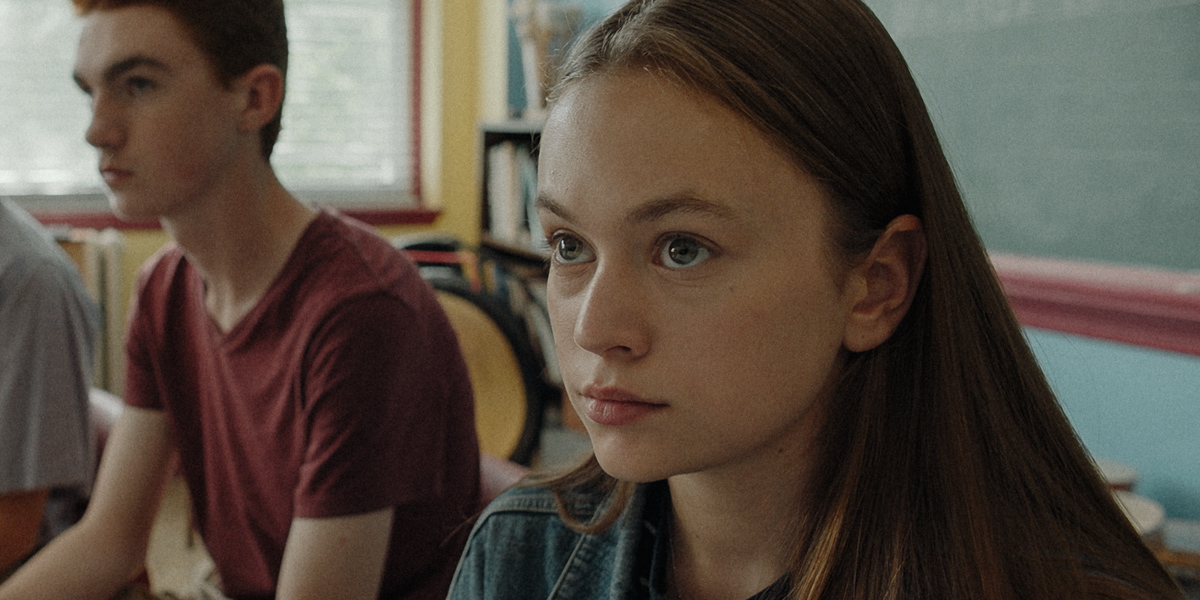
Set in 1980s Newfoundland, Black Conflux has an air of inevitability, and a foreboding sense of dread. There can be no doubt that this story will end badly. It seems certain that Jackie (Ella Ballentine) is going to cross paths with Dennis (Ryan McDonald). It also seems certain that if she does, it will not go well. You see, Dennis is an incel, or he would have been if that term had existed in 1987. He has a beer truck full of imaginary women who worship him, but he has nothing but contempt for the real women he meets. Jackie is a high schooler who has somehow caught Dennis’ attention, even though the two don’t seem to ever have met before. The more time we spend with Dennis, the more we come to think that the women in the beer truck might not be imaginary. They might be ghosts of other women that caught Dennis’ attention, and it seems like Jackie could be next.blackconflux_0HERO

Writer-director Nicole Dorsey’s talent and confidence are on full display in her first feature-length film. She has written two great characters in Jackie and Dennis. We quickly feel like we know them and can predict them, and Dorsey uses that to generate a great deal of tension in anticipation of the convergence (/conflux) of their stories. Adding to the tension are the slow pacing and the atmospheric shots of Newfoundland’s wild beauty, which reminded me there are plenty of places on the rock to hide a body or two or ten.

Dorsey is aided by two great performances from Ballentine and McDonald, who make their characters feel real. We care what happens to Jackie because we like her and we can relate to the teenage world she is trying to navigate, having been there ourselves. And while we don’t really like Dennis, we feel a bit sorry for his struggles to navigate the world he inhabits, even though he’s clearly making things more difficult than they need to be. Jackie is the more sympathetic one (mainly because she is not acting like a serial killer) but despite Dennis’ issues (or maybe because of them) I found myself fascinated by both characters.

It’s not that Black Conflux keeps the audience guessing, because a confrontation between Jackie and Dennis seems inevitable (after all, it’s in the title!). What makes Black Conflux so enjoyable is that it keeps the audience engaged, invested and interested in the journey to the climax. It’s a great debut feature for Dorsey and a great start to my 2019 Toronto International Film Festival viewing.

Chicken Run

Mr. & Mrs. Tweedy are modernizing the farm, which is a euphemistic way to say they’re installing a chicken pot pie factory on premises, which might make for savoury dinners, but it spells utter disaster for the farm’s chickens, who are, after all, our beloved protagonists.

Yes the chickens didn’t know how good they had it. Sure there was the stress of not laying enough eggs and having your head cut off as a result, but that felt like only a remote possibility, whereas the chicken pot pie machine has an actual conveyor belt built to render chickens into cutlets in mere seconds. If you thought the chickens had hustle before (and there’s a couple of excellent montages that suggest they do) boy are you about to see the ante upped now that there’s REAL motivation on the line.

Ginger (Julia Sawalha) is a natural leader of chickens and perhaps a little too bright for her lot in life. But good news: she and all the other chickens believe they are saved when a suave flying rooster named Rocky (Mel Gibson) lands in their yard. He’s grounded with a broken wing, but he promises to earn his keep during this tumultuous time by teaching the chickens to fly. Thus the great chicken rebellion of 2000 is staged, and one of the most ridiculous escape attempts every committed to celluloid is born.

Which is not a complaint. Rather, Chicken Run is quite good fun. And though this film is nearly 20 years old, it’s aged quite well (I suppose there are limited advancements in clay). You all know by now how partial I am to stop-motion animation. It’s the details that get to me. Babs is a clucking little hen who likes to sit and knit; the knitting is real, done with toothpicks. Someone did that! The chicken’s bodies were molded with wire and covered with silicone, but their faces, which changed constantly to reflect their speech, had to be done in plasticine, which is much less durable; halfway through the shoot they’d already gone through 3,370 pounds of it!

With joy sprinkled liberally throughout, this movie has something for everyone, and makes for easy family viewing.

Dora and The Lost City of Gold

I’m not what you might call a Dora stan. I have nothing against her, and I even have a measure of respect for intrepid young women who are curious and resourceful. But I’m a billion and a half light years too old to be watching her show – though I believe I did about 700 million years ago as a babysitter. Had Dora been on TV that long, or is she just living an extended life on Netflix?

No matter.

The movie doesn’t ask you to know much about the Dora universe; you could easily jump right in and be the 5th wheel on her trek through the jungle. If you do know the show, you’ll be delighted by several in-jokes; the movie is not afraid to poke fun of its origins, and those little touches separate Dora and The Lost City of Gold from others in its genre.

In the cartoon, Dora is a 6 year old, but the movie, unwilling to imperil a small child, instead chooses to imperil a slightly larger one, aging her up a decade, but keeping her innocence and hair band intact, though neither of those things makes her very popular in high school.

Little Dora was raised in the jungle by her professor/explorer parents, Elena (Eva Longoria) and Cole (Michael Pena). But when they’re preparing an epic and intensive search for Parapata (a lost Incan civilization, the film’s titular city of gold), they send Dora (Isabella Moner) away, to a proper big city with actual schools, and worse, peers. High school turns out to be an even more dangerous place. And while she’s happy to reconnect with cousin Diego (Jeff Wahlberg, nephew to Mark and Donnie), it doesn’t last long because she and a small group of students are kidnapped by mercenaries trying to find her parents, and not incidentally, all that lost gold.

Thus ensues an epic adventure, the kind only Dora could have, which is to say: filled with monkeys who may or may not wear boots, foxes who may or may not swipe, and songs that may or may not be about pooping. So even though Dora has boobs, she’s still a youthful, fun-loving gal who embraces the absurd (adorably, her grown-up back pack is designed in such a way that it appears to have a smiling face). There’s some very common denominator humour in here that had the kids in our screening spitting out their popcorn in delight. Truly, there was a variety of hoots the likes of which I have possibly never experienced before in a theatre. Moner is winning and lovable in the role, and what more could you ask for? It ticks all the boxes, occasionally manages to surprise and delight, and if I’m being honest, it exceeded my modest expectations, so I’m chalking this up as a win.

Must Love Dogs

Sarah (Diane Lane) comes from a big family, and they’ve all gathered in her kitchen to humiliate her. And by humiliate her, I mean that they’re throwing an intervention. That makes it sound like a party, I suppose, and it is most decidedly not. Nor is it quite as serious as it sounds. They’re not trying to send her to rehab. They’re trying to relaunch her back into the dating world after a devastating divorce. It doesn’t work – at least, not until she accidentally answers her own father’s personal ad. That’s a new low, as you can imagine. So maybe now she’s open to it. Ish. Her sister makes her a dating profile with quasi-consent (a good time to remind you that this movie was released in 2005).

Meanwhile, across town, a boat builder named Jake (John Cusack) is also newly on the market with a bruised heart that’s still trickling blood. He’s also got a friend/divorce attorney pushing him into the internet dating thing, and that’s how they wind up meeting – at a dog park, each with a borrowed canine friend. The date is shaky; Jake is so nervous he can’t stop insulting Sarah. Their next date has crazy beautiful moments of connection and chemistry, and then terrible lows that radiate awkwardness. So there’s wiggle room for a guy like Bobby (Dermot Mulroney) to enter the picture and sweep Sarah off her feet with his smooth technique. Dramaaaaa!

Anyway, it’s nice to see a rom-com for the middle aged. For the sad-sacks post divorce. For the cynics and the chronically depressed. And yet it still manages to charm. Of course, you might hope for a little more from two grown-ups who have loved and lost. You’d hope they’d have grown, that they’d have some insights. That they’d be better at this. And they’re really not.

Must Love Dogs should have Loved Rewrites. There’s nothing in here that you haven’t seen before. It’s not just that you see things coming from miles away – it’s that they’ve literally just traced a rom-com road map and hit up each and every landmark and rest stop along the way. And yet Lane and Cusack are just so good together. Never underestimate the likability of your leads.

I never got to write myself a dating profile, but even if I had, it probably wouldn’t have occurred to me to write Must Love Dogs, even though that’s obviously true. And thank goodness I wasn’t able to cock-block myself, because Sean never would have answered such an ad. He grew up with cats. But my little puppy Herbie won him over. No surprise there: Herbie is a stud, he wins over everyone he meets. Sean is a harder sell, and yet he was surprisingly able to win over Herbie, which was the more important part of the equation. I’d only had Herbie about 4 months when I met Sean, but Herbie had already been subjected to quite a few gentlemen callers and let me tell you – he wasn’t impressed. He’d scowl and growl and generally do his best to look ornery and intimidating (he was a four pound fluff ball but in his mind he was a full-fledged hell hound). He kept his eye on Sean for a bit, but he made it clear they were friends. That said, Herbie will never let Sean forget that it’s me and Herbie who are the original members of this household, and Sean’s just lucky we let him in the club. Now we have 3 more dogs because we can’t get enough. And this movie definitely put me in the mood for more. I mean, a gentle wind can put me in the mood for more. I Do Love Dogs! But I live in a city where the bylaws actually state that acquiring a fifth animal would force me to declare myself a farm. And as much as I Super Duper Love Dogs, it seems like a lot of hassle. Or…is it maybe a little bit of hassle and an excellent tax write off? Or a medium amount of hassle and a whole lot more love in my life? Or quite a bit of hassle but a good excuse to buy cute cowboy boots? Or a heck of a lot of hassle that I can offload on Sean, and simply reap the rewards of puppy love while outsourcing the work?

Did I just talk myself into puppy #5?

Notting Hill

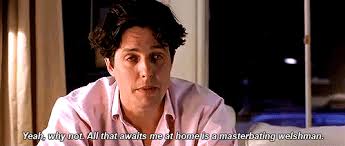
Don’t even try to tell me you’re not charmed by Notting Hill. Don’t. Even.

Directed by Roger Michell from Richard Curtis’s script, it’s really just about a girl, standing in front of a boy, asking him to play it cool, goddammit.

Mega superstar and talented actress Anna Scott (Julia Roberts) walks into a cute neighbourhood (travel) book store and meets bumbling store owner Will (Hugh Grant) and though their worlds are both geographically and metaphorically miles apart, they somehow allow a mutual attraction to play out.

Endearingly, their first real date is a group thing, a dinner party thrown in honour of Will’s little sister’s birthday. The friends assembled are a notable bunch of kooks. The birthday girl, Honey (Emma Chambers), has no chill at all; having always fantasized a famous bestie, she immediately gloms on to Anna. Host and cook Max (Tim McInnerny) will be mortified he’s just served meat to a vegetarian. His wife Bella (Gina McKee) is just so happy that Will’s brought a girl that she can’t help but embarrass him over and over. And hopeless Bernie (Hugh Bonneville) is sweetly clueless, not even recognizing the fame monster in their midst, and benignly quizzing her as to whether she’s able to get by on a working actor’s wages (she is). They’re a bunch of nuts, but they’re quite delightful as a group, and Anna is made to feel welcome and not too conspicuous. Will is a door to a quieter, humbler way of life. Not always enamoured with the trappings of fame – though clearly tied to them financially – it’s a wonderful respite for Anna. But is that enough?

No one recites a Richard Cutis line quite as well as Hugh, and no one twinkles half as hard as Julia. They were perhaps not the best of mates on set but it’s a testament to their talent that they are nothing but fireworks on screen.

The cool thing about this movie is that it was actually filmed on the streets of Notting Hill. There really was a house with a blue door (Curtis lived there for a time himself). And there really was a travel book shop, though it was too narrow to film in, so they confiscated an antiques store around the corner and outfitted it with books. Notting Hill has since been overrun with tourists, and not just the kind who come to snap a few pictures and leave. Many have been enticed to buy property there; prices in the area went up by 66% in the 5 years since the movie was released, double the growth rate elsewhere in London. 

Anyway, this film isn’t deep, and perhaps not altogether realistic, either. But it’s so filled with good cheer you don’t mind. And of course you know exactly where it’s going practically before it even starts, but the fun is in the getting there because you get to ride along with such an oddball cast of characters, plus a couple of romantic leads at their peak, floppy haired cuteness.

Brittany Runs A Marathon

This year I discovered that I really like listening to podcasts on long drives, and we drive a lot. One that I’ve particularly enjoyed is Fortune Feimster’s Sincerely Fortune, which she does with her fiancee Jax, and sometimes her mother, Ginger. Although I love Fortune’s standup, the podcast is consciously a more sincere and authentic discussion. Occasionally she has friends on, and one day, she had her good friend and former improv classmate Jillian Bell on the show. You may not know her name, but you would almost certainly recognize her. I had a heck of a time proving to Sean that he knew her, what with roles like “clingy friend” in Rough Night and “pregnant wife” in The Night Before being not super memorable or easy to point to. But this film is Bell’s first chance at a starring role and boy did she ride it for all it’s worth. Fortune was expansive with praise, clearly proud of her friend, and not only did I find it a moving testament to female friendship, it made me incredibly interested in the movie.

I’m happy to say I was not disappointed.

Ostensibly, Brittany Runs A Marathon is about a woman, perhaps an unlikely runner, who trains for the NYC Marathon. Her life is kind of a mess and her health could use improvement, so she takes up training as a means to exert a little more control on a life she sees as perhaps moving on without her, perhaps unsalvageable.

While we are experiencing Brittany’s transformation in miles traversed and pounds lost, this movie isn’t really about the running, and certainly not about the weight loss. It’s really about learning to grow, to being open to it. It’s about reawakening old dreams and letting go of old, toxic relationships. Brittany doesn’t become a better person when she becomes a thinner person. In fact, she might be at her most nasty. What saves her is showing herself what she can do – that her stagnant life can be nourished, that the dead ends are in fact just cul-de-sacs.

Jillian Bell in the lead role lives up to every aspect of her character. She undertook the same transformation as her character, Brittany, and you can tell how closely she relates to the material in the film. The supporting cast, including Micah Stock, Lil Rel Howery, Michaela Watkins, and Utkarsh Ambudkar, is extremely strong. There’s a lot of great chemistry and everyone has the benefit of a good, solid script from writer-director Paul Downs Colaizzo.

Because Jillian Bell is slightly wider than a No. 2 pencil, she’s often relegated to playing the out-of-control pal who’s very physical and quite obnoxious. In Brittany Runs A Marathon, she gets to go beyond just her fearless talent for physical comedy and flex the rest of her acting muscles as well. It’s terrific to see her in a role that’s worthy of her and I hope this means there are many more to come. It turns out that Brittany really didn’t need to transform her body. It was her head that needed the makeover – new confidence, more agency, bigger ambitions. Her salvation wasn’t found on a bathroom scale, it was in accomplishing her goals and widening her circle of support. Her trajectory isn’t straight. Her ups and downs sometimes push us away, make her hard to root for. But she’s an exceptionally real character who feels authentic and relatable and she’s exactly the kind of woman we need to celebrate.

American Factory

As the trade war between the US and China escalates, American Factory arrives on Netflix and shows why this war is one that China is likely to win.  The US is at a severe disadvantage in this war that it started, because the American Dream now belongs more to China than to the endangered American middle class, and because idyllic post-war America was built in large part on cheap imports from China and now the pendulum is swinging the other way.

American Factory is the first Netflix film from the Obamas’ production studio, and its release is perfectly timed.  China and the US continue to threaten each other higher and higher tariffs, announcing another round of increases to take effect american-factory-1this fall. Of course, these threats are not really to the countries themselves; they are threats to consumers, who will inevitably bear all these increases in the form of higher priced goods.

While American Factory isn’t really about tariffs, the tariffs are still an important part of the story. That’s because the tariffs were instigated by the US in order to bring manufacturing back to the American heartland, which has been decimated by the loss of factory jobs as more and more of those jobs elsewhere to take advantage of cheaper labour and lower safety standards.

One of those shuttered factories is a former GM plant in Dayton, Ohio. Its closure in 2008 put thousands out of work, but in 2015 Fuyao Glass America, a Chinese-backed company, reopened the plant and brought hope back to Dayton. However, we quickly see that the reality is not quite as rosy as the fantasy, because the workers have taken a 30% pay cut, safety standards are not enforced, and management uses every dirty trick in the book to prevent the workers from unionizing.

Chinese workers are brought in to show the Americans how to operate the plant, and managers from the US are trained in China to help them better motivate the workers. American Factory captures the remarkable contrast between the workers’ attitudes in the two nations, and the attitudes of the nations as a whole. The Chinese are willing to work harder for less, sacrificing their bodies and family lives for the benefit of the company. The Americans, on the other hand, feel entitled to earn more money than their Chinese counterparts without making any of the same sacrifices.

Something has to give there.  In both the Fuyao factory and in the larger trade war, the Americans can’t possibly get everything they want but are oblivious to that reality.  Working-class Americans seem not to have realized that their consumer-centric society only exists because of other countries’ cheap labour, and that unskilled labourers will never again be “middle class”. If these American factory workers want to achieve their desired standard of living, they need to acquire marketable skills. Labour is no longer marketable on its own, and China and the rest of the world are eager to live the American Dream. China and the rest of the world also clearly want to realize that dream so much more than the Americans do, so in any head-to-head battle the Americans are going to lose out. The only question is whether the Americans will realize that before it’s too late.