Category Archives: Kick-ass!

The highest honour we can bestow on a film. Anyrhing in this category is a must-see.

Toy Story 3

Time and again, we have been told that a toy’s only intrinsic value is to be useful. And when that toy ceases to be useful – either it gets broken, or a kid stops playing with it – well, that toy has met the end of its life. Yikes. Woody and friends have occasionally had the chance to grab at immortality but have always convinced themselves that to be Andy’s toy is the highest possible achievement. There is no better thing, therefore it is okay to accept the eventual certainty of death. One day, Andy WILL grow up, will leave for college, will leave them behind.

That day has come.

Andy is indeed off to college. Toy Story 3 was released in 2010, 15 years after the first one, so by any accurate count, Woody and the gang have had some bonus years. But their luck has run out. Andy is packing up his room – putting aside a few things to store in his mother’s attic, a few essentials to bring along with him, and the rest will be marked for garbage. Andy’s sentimental side has him setting aside Woody for college, and bagging the rest of his old pals for storage, but a misunderstanding leads both his mother and the toys themselves to think that they’re meant for the trash. The toys manage to save themselves from the metallic maw of the garbage truck, and they throw themselves into a donation pile destined for Sunnyside Daycare.

The toys are sad to leave Andy, but thrilled that they might once again be played with. Until now, the toys have spent their lives caring solely for Andy, wanting nothing but his happiness. Their own needs have occasionally gone unmet in this quest, especially in these last few years, with Andy the teenager no longer having time for them. The toys, and Woody in particular, have often seemed parental in their concern for him, and in fact, with Andy’s dad curiously absent and unremarked upon, Woody seems to have stepped into that of father figure. But parents too must say goodbye to their children eventually, and when they grow to become useless, they too will be placed in an institution. The toys are optimistic about the daycare centre, but it’s easy to read it as relegation to retirement living, being put out to pasture (Buzz even gets lobotomized, like a dementia patient). There’s always been this double read to Toy Story, one that often leaves us choked up. Thanks a lot, internet. I thought the well had finally run dry, and now I’m flooding my keyboard with tears.

But that’s not even the sad part! Toy Story 3’s genius has the toys not just facing oblivion and meaninglessness without a kid to serve, but it has them facing actual death. When the daycare turns out to be a pretty awful, tyrannical living situation, they find themselves embracing death. This is possibly this decade’s most traumatic and touching scene: with death mere moments away, the toys stop their futile efforts to save themselves, and hold hands to face it bravely together. Luckily, Pixar thinks better of killing off their revered heroes, and they do get a last minute reprieve and a second chance at life with Bonnie, a little girl just down the street from Andy. Even Woody, who was meant to accompany Andy to college, gets reassigned, and frankly, it’s with a sigh of relief that we find he will remain with his friends. Because for me at least, it wasn’t actually death that seemed the worst of it, it was thinking of Woody and Buzz, best buds and life partners, being separated in their twilight years. Is anyone not thinking of their grandparents, and who will die first, leaving the other to face those bleak years alone?

Toy Story 3 improves upon its predecessors in my ways. In 11 years, the animation has of course improved by big heaping gobs. In the first film, we briefly see a teddy bear that’s been relegated to the shelf; they chose not to make him part of the gang because fur was just too hard to get right. In this film, Lotso the bear is made a proper villain, and he looks glorious. Not only are the colours and textures perfect, but the animators find ways to show proper wear and tear on the toys as well. The animation is vivid and astonishing. The expressions on the toys’ faces are often so realistic that you have to pinch yourself to remember it’s just a cartoon (Woody has 229 animation points of movement in his face alone). In Toy Story 3, the Pixar animators are fearless. Whereas before they struggled to get clothes right, in this film they embrace them, with Ken making over 20 costume changes alone (and all of them fabulous). Hair swings. Fibers are differentiated. But they’re not just improving, they’re innovating. Believe it or not, in this film, the real challenge was the trash bag. They have properties that apparently you and I take for granted, but the animators truly struggled with.

But we don’t keep coming back to this franchise for the richly drawn cartoons, we come back because these characters are our friends, and the excellent story-writing has made us care. And boy did we line up in droves to see this film, even if it had been more than a decade since the last installment: it was the first animated film to make a billion dollars worldwide, which it did in just over 2 months at the box office. It was also one of only 3 animated films to score an Oscar nomination for Best Picture (Beauty and the Beast and Up were the other 2), and it did it without any of its predecessors being nominated. Toy Story has continued to surprise fans because it actually feels that each sequel is better than the last, while Hollywood of course has led us to expect exactly the opposite. Although, it should be noted: while the first and second films both had 100% ratings on Spoiled Red Fruit, this one had a mere 99.

If the nostalgia attached to vintage toys and TV shows and lunchboxes isn’t enough for you, I find it kind of neat that Toy Story has managed to keep the same guy, John Morris, as Andy’s voice for its entire run (there was an 11 year gap between this film and the one before it – the producers had no idea if adult Morris would at all be suitable, but they called him up and his voicemail convinced them on the spot). And Laurie Metcalf as his mom; Roseanne was still on network TV when the first film premiered, and now I suppose it’s kind of on again. Of course, we’ve lost some voice actors along the way: Jim Varney (Slinky) was replaced by his friend Blake Clark. And Don Rickles (Mr. Potato Head) will appear in the latest film via archival audio. But we’ve also seen some great additions. Toy Story 3 introduces Ned Beatty (Lotso), Michael Keaton (Ken), Jodi Benson (Barbie – but most famous as the voice of Ariel, of course), Timothy Dalton (Mr. Pricklepants), Kristen Schaal (Trixie), Bonnie Hunt (Dolly), and the list goes on. Toy Story 3 has over 300 characters, which is a lot for any movie, never mind one in which each needs to be rendered from scratch!

Toy Story 3 earned a place in our hearts with scenes that register both pleasure and pain – bittersweet, like life. It taps into our primal fears (uselessness, loneliness, death) but ends with a hopeful note. Toy Story 3 was the perfect way to end a beloved franchise: Andy says goodbye to his toys, and so do we. We know they’re safe and happy in their after(Andy)life, with the final scene panning up into white fluffy cloud, reminiscent of Andy’s wallpaper, but also a sure symbol of heaven. But this franchise has again proved irresistible and Disney-Pixar just couldn’t stay away: a fourth installment hits theatres this weekend, so if you’re curious what life has been like for the toys in their new home, you’re in luck. Just pray that this one holds up to the rest.

Toy Story 2

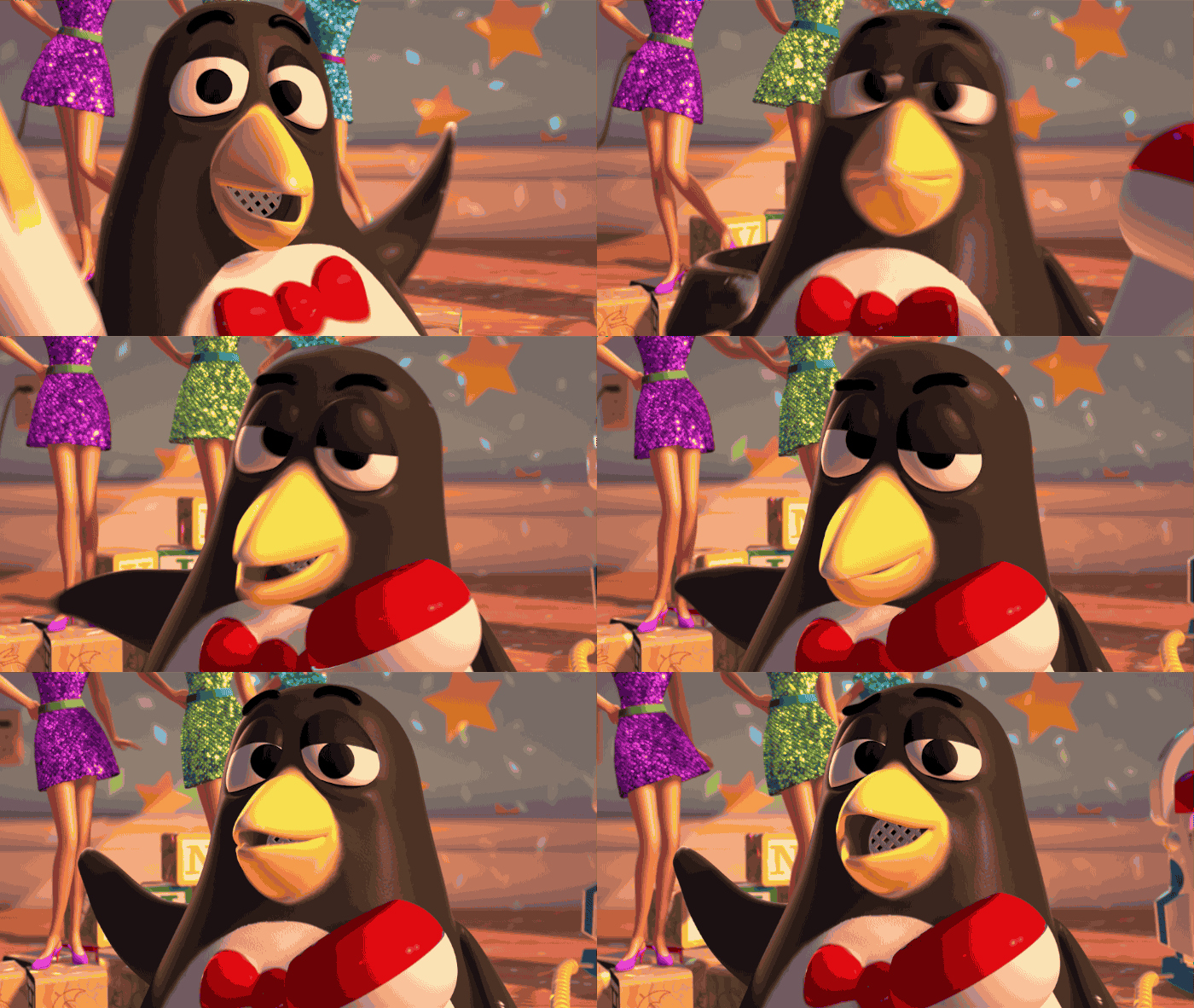
Minutes from departing for cowboy camp, Woody (Tom Hanks) suffers a rip to his arm seam that shelves him. Up there, in the dusty recesses of Andy’s room, Woody has an existential crisis. If he is a broken toy, what value does he have? Is he to be forgotten forever? Has his time as Andy’s toy come to an end? It doesn’t help when he meets an old friend up there, Wheezy the penguin, who was shelved months ago due to a broken squeaker. Even worse, an impending yard sale is a serious threat to all and any toys who may not have been recently played with – especially when a declutter-happy mom (Laurie Metcalf) is allowed to make cuts while Andy’s still at camp.

Woody gets a little too close to the yard sale and an eagle-eyed toy collector, Al, from Al’s Toy Barn (Wayne Knight), refuses to take no for an answer. He steals Woody, to the toys’ horror. Turns out, Woody is the valuable central piece in a collector’s set of retro toys. Woody meets the other toys in the set: yodeling cowgirl Jessie (Joan Cusack), Woody’s sidekick and noble steed, Bullseye, and the prospector, Stinky Pete (Kelsey Grammer). True to his nature, Woody is at first concerned with returning to Andy, but as he contemplates his fate as the broken toy of a growing boy versus the intoxication of a full restoration by Al in order to be sold to a toy collector in Japan, he can’t help but weigh his options. And his new friends have a vested interest in Woody’s sticking with them: without him to complete their set, they’ll go back into storage. Without him, they’re worthless.

I moaned on and on about how cleverly the characters were built in the last movie, and once again, I can’t help but admire what they’ve done with the new toys. Jessie wants very much to convince Woody to stay, but as a former toy herself, she remembers the heady feeling of being someone’s beloved. Pete, on the other hand, is mint in the box. He’s never been played with. Together they sow the seeds of doubt.

But if the first Toy Story was a buddy comedy of sorts, all of the films in the franchise are a testament to friendship. Woody’s friends at home once again launch a rescue mission, and it’s adorable the lengths they’ll go to in order to reunite their friend with his owner. But will Woody go?

At its heart, this film is once again more contemplative and nihilistic than your typical children’s movie. Heck, than most movies, period. Being loved by a child is the thing that gives a toy’s life meaning. But accepting that means that one day you will be rendered useless, which is worse than death. It means a brief period of being adored followed by an eternity of nothingness. But this toy museum in Japan offers Woody another option: immortality. He may not be loved by anyone, but he’ll be appreciated, not forgotten. And Jessie really drives that home with her heart breaking flashback wherein she remembers being loved, and then being abandoned. Because all children grow up, and all toys are eventually discarded.

So yeah, there are some dark ass themes in this movie, but they’re told with boldly coloured characters that make the whole thing just so gosh darned palatable. Woody is still the rootinest, tootinest cowpoke we know, but there’s an edge to him, a darkness. Woody’s been through some shit. Is there a single soul who watched this movie who didn’t, at least for a split second, experience dread over the treatment and neglect of their own childhood friends? I wager there is not.

The first Toy Story was ground-breaking in its animation, but this sequel, which came out just 4 years later in 1999, is already lightyears beyond it. They’re better at animating hair; Andy’s mom has her hair down in this film whereas she had to keep it in a ponytail during the first because of animation limitations. Everything’s gone up a notch. Bo Peep, who Andy uses as a toy, is actually a detachable porcelain figurine who belongs on his little sister’s lamp. In this movie, we can actually SEE that she’s porcelain; she has a particular sheen to her that the plastic toys do not. Pixar was motivated to keep its reputation as an innovator, so they didn’t just recycle stuff from the first film, they went in and upgraded character models, created new locations, and utilized more complicated camera shots that weren’t possible in the first. But they were careful not to let the look evolve too much from the first, wanting to keep the films looking cohesive. Perhaps their greatest technical achievement was up on that dusty shelf where a broken Woody reunites with Wheezy the Penguin. Turns out, dust motes are frustratingly complex to animate. Pixar animated 2 million of them – a major feat since this sequel was originally planned as a direct-to-video release which got bumped up at the last minute, leaving animators scrambling, and fully a third of them with some sort of repetitive strain injury (like carpel tunnel) by the time animation was complete. In a perfect world, making movies wouldn’t result in injuries, but this isn’t a perfect world. It is, however, a perfect sequel. A perfect movie, in fact. I wouldn’t dare tell anyone their injuries were “worth it” but Toy Story 2 achieves even more than its predecessor. It capitalizes on what made the first film great but it doesn’t recycle its success. The story works harder, the characters dig deeper. Though the toys are often out of their element, we are firmly in their universe, a universe that is clever and expansive and shockingly complete.

Pixar establishes itself as a studio that animates adventures that kids will love but writes stories that speak directly to the adults in the audience. It even has an erection joke that’s cloaked in Pixar’s special camouflage – obvious to adults, unnoticed by kids. That’s a rare and unique talent from a studio that keeps the boundaries on what we’ve come to expect from an animated film.

Beats

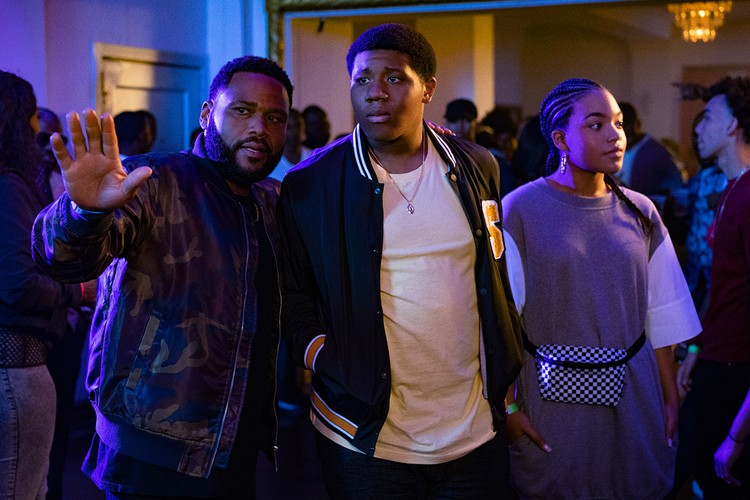
August (Khalil Everage) hasn’t left the house in 18 months, not since his sister was gunned down in front of him. Now he’s suffering from crippling PTSD, living the hermit life, which his mother (Uzo Aduba) isn’t too mad about. They clearly love and care for each other, but they’re both so broken they can’t heal each other. August retreats into his music, creating beats, safe under his world-cancelling headphones.

But then one day his school’s security guard Romello (Anthony Anderson) comes looking for him. Coincidentally (or not), he’s a washed up manager with one big ex-client and a whole lot of baggage, including an estranged wife for a current boss, who expects him to bring back truant students so her school’s funding doesn’t get cut. But instead of bringing August back to school, Romello wants to bring him into a studio. He hears gold records, and a chance to get back on top. But that’s going to be extra challenging when your 17 year old prodigy producer is a recluse with mental health problems.

In Chicago, hip hop and gun violence intermingle, but in Chris Robinson’s movie about both, it’s fear that reigns the day. It feels trite to talk about the ‘healing power of music’ but it’s clear that for August, his music is a retreat, and a balm. But as good as his beats are (and they do hold up thanks to some authentic Chicago talent), it’s going to take more than that to get August back on his feet, and to make this movie better than average.

So is it? Better than average? I’m going to say yes. It’s not super profound but for all its simplicity, it does really speak to a particular brand of tragedy. It’s a painful testimony to all the victims in Chicago’s south side and beyond. August’s story isn’t particularly noteworthy in his community. Everyone has suffered loss. Everyone risks their lives just walking home at night. We really understand how something so horrific can come to feel normal to people who live it every day. It’s only through August’s mother’s eyes that we remember how crazy this is. She is willing to sacrifice everything, to keep her son locked up at home, if that’s what it takes for him to live to his 18th birthday. Uzo Aduba is of course wonderful, her presence strong. And Khalil Everage also makes a strong impression on his first time out.

Netflix dropped Beats today, perhaps in honour of Juneteenth. Also known as Juneteenth Independence Day or Freedom Day, it’s a national day of observance that commemorates the June 19, 1865 announcement of the abolition of slavery in Texas, and in fact the emancipation of enslaved African Americans throughout the confederate states. The Emancipation Proclamation was of course enacted as of January 1, 1863, but Texas was quite remote, and the proclamation was not enforced until after the confederacy collapsed.

While it’s certainly worth celebrating, this movie is perhaps a good way to think about the modern manifestations of slavery, and the ways we may be withholding true liberation, inadvertently or not.

Beats has a strong sound and a good message. It’s not solving the gun violence in America, but it shows us how to have courage even when things look hopeless.

Toy Story (1995) (1995?) (1995!)

You can blame John Wick for this review. As the lights were dimming in our theatre I suddenly thought – should I have rewatched the previous films? The answer was yes, but I hadn’t. I am a learner of lessons. More or less. Occasionally. When the lesson means watching movies instead of doing work. I did rewatch the incredibly complex The Secret Life of Pets in order to fully appreciate the nuances of its sequel. Now I shall do the same for a much better franchise of movies, one that has more than earned a spot on this site anyway – Toy Story.

As you can likely tell from the title, I was taken aback by the year of its release. Intellectually I probably could have told you the year, but emotionally I just wasn’t prepared to face the consequences. This movie is dang near 25 years old. I was a kid when it came out and don’t remember if I saw it at the cinema. In fact, I don’t remember seeing it for the first time at all, which is strange for such a defining moment in animation (and I’m sure I called it such when I reviewed it on the playground).

Toy Story introduces us to a little boy named Andy and his most beloved toy, a cowboy with a pull-string and a snake in his boot but no gun in his holster named Woody. Woody is the natural leader of Andy’s toys, of which there are many: an etch-a-sketch, a Mr. Potato Head, a dinosaur named Rex, a slinky dog, Little Bo Peep, a pig-shaped piggy bank named Hamm, green army guys galore. But Woody is Andy’s absolute favouritest toy, and we see them at play in Andy’s cloud-wallpapered room, and tucked into bed together at night, under a Sheriff Woody duvet. But Andy’s birthday brings a plethora of new toys as birthdays often do, but only one toy competes for Andy’s prime affection: a space ranger named Buzz Lightyear. The interesting thing about Buzz, other than his quest to save the universe from Emperor Zurg, is that Buzz doesn’t know he’s a toy. He believes he’s the actual hero, and that the galaxy depends on him.

Woody, who up until now has assured all the other toys that just being Andy’s toy is an honour, is of course insanely jealous. And when he is kinda sorta responsible for Buzz “falling” out a window into the sadistic neighbour’s yard, the other toys are naturally upset with their old pal Woody and mount a rescue mission for new friend Buzz. In actuality, Buzz has all but saved himself, but our two heroes end up outside, essentially “lost toys” in the world, and they’ll have to rely on each other to get home safely. Andy’s family is moving in just 2 days so there’s no time to waste!

Toy Story was the first animated film to earn an Oscar nomination for its screenplay, and it’s well-deserved [It lost to The Usual Suspects. It also lost best original musical or comedy score to Pocahontas. There was no best animated film category in 1995, that didn’t happen until 2002, but John Lasseter was given a special achievement Oscar to commemorate the film’s ground-breaking success. Those are pretty rare; the only other one handed out in the past 25 years was in 2017 to Alejandro Gonzalez Inarritu for his contribution to VR film Flesh and Sand.]

The characters are wonderful because the toys all manage to feel timeless. Buzz and Woody are created especially for the film and each is meant to be a character on a hit TV show (though Woody seems to be a relic, perhaps a toy handed down from Andy’s mom or dad). Buzz is newer, all plastic and flashing lights and fancy buttons compared to Woody’s stuffing and low-fi technology. But Andy’s other toys may be more recognizable. In fact, slinky dogs and potato heads and telephones saw a resurgence in popularity after each of the Toy Story films were released. The wonderful voice actors of course go a long way to help bring these toys to life. Tom Hanks (Woody) was drawn to the project because he too had as a child wondered what his toys were up to when he wasn’t looking. Tim Allen (Buzz) was drawn because his comedy idol, Chevy Chase, had been offered the role and turned it down (so had Billy Crystal, who was wise enough to regret it – when Lasseter came calling again, for 2001’s Monsters Inc, Crystal said yes before Lasseter got a single word out). Hanks recorded his lines in the early 90s, while filming Sleepless in Seattle and A League of Their Own – he wanted the voicework wrapped up before he started in on Philadelphia or Forrest Gump as he felt he’d be in the wrong frame of mind. Little Bo Peep is voiced by Annie Potts, but Bo almost didn’t make the film. Initially, Pixar had planned for her to be a Barbie, but Mattel was sure this movie would be a disaster and declined the role, rather fooolishly in hindsight. Similarly, Pixar was not able to use G.I. Joe’s name either; they rewrote the character as ‘Combat Carl.’ Rex the dinosaur, voiced to perfection by Wallace Shawn, is a particular favourite of mine because the idea of a neurotic dinosaur who suffers from self-esteem issues and extreme anxiety turns out to be a whole lotta fun. He’s got an inferiority complex and doesn’t do well with conflict, at odds with him being the biggest of the toys, and depicting a classically scary character. Hamm the piggy bank is voiced by Pixar fixture John Ratzenberger. He’s a board game enthusiast and seems to know the most about the outside world. His frequent board game opponent and best friend is Mr. Potato Head (Don Rickles), who covers his loneliness with sarcastic wise-cracking but he prays every birthday for a Mrs. Potato Head. Like all good dogs, Slink (Jim Varney) is very loyal to his pal Woody; he often manages to have a hang-dog look about him that’s incredibly sympathetic.

Toy Story was the world’s first computer-animated feature film, and it changed animation forever. To be honest, this film still looks good today because they were careful to avoid things they weren’t quite up to animating convincingly yet, like long hair and water droplets. Pixar has continuously astonished us with increasingly intricately-animated films, and by that standard, Toy Story is its worst. What a marvelous, beautiful worst.

All these toys work together to evoke childhood and warm feelings. Toy Story tickled our imaginations, reinvigorated the field of animation, and established Pixar as a giant in the genre.

Late Night

Mindy Kaling is an actress, a director, a producer, an Emmy-nominated writer. She’s written best-sellers and acted alongside Oprah and created television series. You may not know that her foot in the door was portraying Ben Affleck in an off-Broadway play she co-wrote with her best friend called Matt & Ben, about how the pair came to write Good Will Hunting. I wish to god I had seen it.

She was hired to write for The Office when she was just 24 years old – the only woman in a room full of men. She was technically a diversity hire, part of NBC’s diversity writing programme, but don’t mistake that for a lack of qualification. “For a long time I was really embarrassed about that. No one [on The Office] said anything to me about it, but they all knew and I was acutely aware of that. It took me a while to realize that I was just getting the access other people had because of who they knew.” Mindy’s parents, an architect and an OB-GYN, immigrated to the U.S. from India (via Nigeria) only months before she was born, and gave her the most American of names, ripped from their favourite sitcom, Mork & Mindy.

In Late Night, Kaling plays Molly Patel, also a diversity hire, straight from a chemical plant (don’t call it a factory!). She’s hired to be the first and badly needed female writer on Katherine Newbury’s show as its steady ratings decline threatens its existence. Kaling wrote the role of Newbury specifically for Emma Thompson and it is indeed a perfect fit. Newbury is exacting and imperious, but has grown out of touch with her core audience. Molly is exactly the injection of colour and culture that this writer’s room needs even though it longs to stay beige. Of course, Kaling had to invent a fictional world in which a woman is actually allowed to host a late night show, but once she does (and we get over that depressing fact), she invents a very good one, one in which her very successful host is over 50 and undeniably at the top of her game, but hasn’t had to sacrifice her life to gain such a position. Newbury has both a love life (John Lithgow) and a sex life, and she still gets to be the boss. Kaling is so devoted to this character, she took a page from her parents’ baby naming book and called her own daughter Katherine.

Late Night is a lot of laughs, and it benefits from the excellent chemistry between Kaling and Thompson. I suppose it takes a woman to write two such meaty yet tender roles for women. Roles that don’t apologize for emotions and characters who don’t get disempowered for expressing them. And a female director to give these ladies their space to create complexity. Late Night tackles a lot of themes as you might imagine, but it never loses its sharp and incisive comedy. Thompson proves more than able, with impeccable timing and buckets of condescension. She’s formidable. Meanwhile, Kaling orbits around her, not just absorbing her light but casting her own glow as well. They don’t diminish each other, they brighten the whole damn screen. It’s a party where ambitious women, perhaps for the first time this century, are truly celebrated. Yes there were applause-worthy moments, though the theatre I was in was unfortunately a packed but non-clapping one (well, okay, save for me, who couldn’t resist). And there’s a lesson plan for how to apologize correctly and take responsibility like a big kid. But mostly there’s just a lot of zing, and a surprising amount of relatability [My work recently turned one of two women’s washrooms in the building into a “gender neutral” washroom which is nice in theory but in practice has become the washroom where men go to poop. Because men, who still had 2 bathrooms to themselves, think it’s more important to stink up a third than to create safe spaces. They’re literally shitting their privilege all over the place.]

Kaling wrote this movie while she was pregnant, and on the set of A Wrinkle In Time. She shot it while literally breastfeeding her daughter. Motherhood is not slowing her down, it’s just another bullshit hurdle she’s going to plough straight through while we lay down our dollars like a red carpet made out of green because she is the Queen and we her loyal subjects.

The Secret Life of Pets 2

Let me ask you a question: are you a sack of shit? Yeah, I didn’t think so. In that case, it’s pretty safe to say you’ll find this movie enjoyable. Like the first one, it’s not going to rock your world. It’s not going to usher in a new era of animation. It’s not a story that will be passed down generation to generation. It’s a just-funny-enough, tug-on-the-old-heartstrings, relate to humans through their better counterparts kind of thing.

The best kinds of people are dogs. That is a FACT.

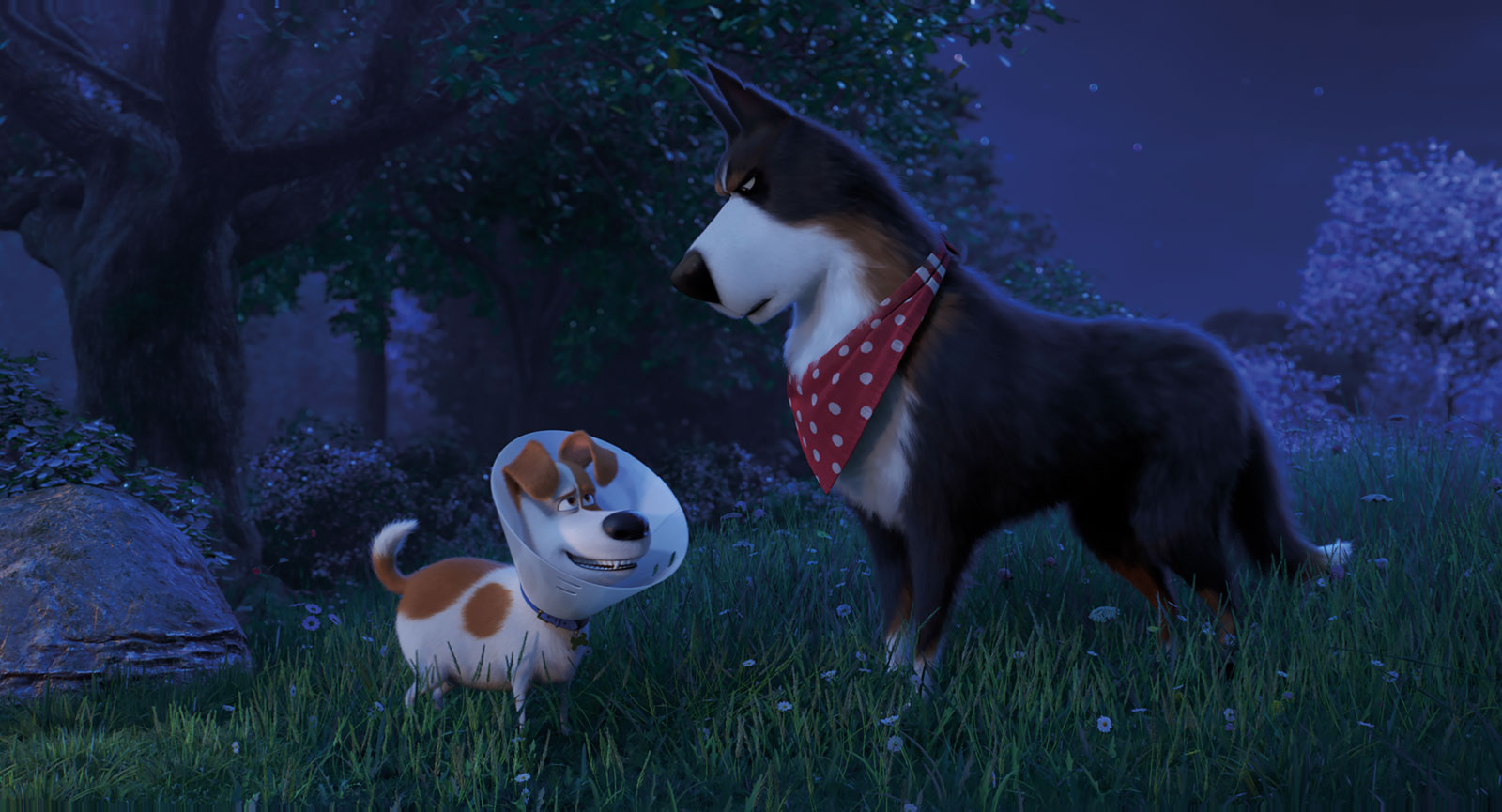
Max (this time voiced by Patton Oswalt rather than the sex offender Louis C,K.), the very good boy from the first film, is back again. He and his very good boy brudder Duke (Eric Stonestreet) are welcoming yet another new addition to their family: a human baby named Liam. Yes, owner Katie (Ellie Kemper) has met and married a human man and produced an heir. We still don’t know what it is that Katie does to afford her very nice Manhattan apartment, but her life is very full. And Max, initially quite ambivalent about human children, grows to love Liam very very much. The feeling is mutual. But just loving Liam is not enough; Max feels he must protect him from the world. Max, normally a happy-go-lucky dog, is now a bit of a nervous nelly. The behaviourist outfits him with a cone of shame, and then his owners pack him off to the farm. Oh gosh, not the proverbial farm, an actual farm, where he meets rough and tough farm dog Rooster (Harrison Ford), who is determined to cure him with tough love and hard work.

Meanwhile, back in the city, old friends are up to new tricks. Fuzzy bunny Snowball (Kevin Hart) is helping new pal Daisy (Tiffany Haddish) to, believe it or not, rescue a tiger from a circus. And sweet little fluffball Gidget (Jenny Slate) has her own little rescue mission going, and enlists Chloe the cat (Lake Bell) for her particular brand of expertise.

This movie caught me right in the feels on at least to parts: a) My sister had a lovely good boy, also named Max, who got a little “overprotective” during her pregnancy, and through the birth of her first child, and he had to go to the proverbial farm. We all miss him to this day. b) My own little Fudgie is himself a bit of a nervous nelly and is newly on anti-anxiety meds actually called Clomicalm. He is not yet calm, but he is definitely not unhappy. He mostly worries about stupid stuff like: am I posing with my toy in exactly the right way to impress Sean when he comes in? How about now? How bout now? Now? NOWWW????

And of course, as pet owners generally and dog lovers specifically, and people who are just plain old not monsters, you can’t help but melt a little when you recognize a bit of your own four legged friend up on the screen. When Daisy made her mad face, I saw my Herbie. And when Max learned how to howl, I heard my Bronx (though Bronx does more of an “Awuuuuu.”)

So no, it’s not a terrific film. But it’s a sweet film, a cute film, it’s the film I wanted to see tonight and I’m glad I did. Awuuuuuu.

I Am Mother

All that remains of humanity is a maternal droid and 63 000 human embryos. Following her directive, the Mother robot grows a baby and raises it, alone in some sort of bunker. Mother (Rose Byrne) seems programmed to repopulate the earth but is in no hurry to do it, so far working just one at a time, and in fact, stopping at just the one. Their bond is unique but not without warmth and nurturing (though it did make me think of those experiments of rhesus monkeys raised by wire “mothers” who would cling to and love them as long as they had literally any kind of padding).

I watch countless sci-fi movies and read many books more in the genre, but I never understand how or why humans think they deserve to save themselves – or rather, why, when failing to save themselves personally, they still feel so strongly about saving ‘humanity’ in general. It’s conceit, obviously, to think we can and should thwart the natural order of things. To defy our own extinction when the time comes. To watch countless plant and animal species become endangered and then disappear but continue to place ourselves above them. We’ve had a good long run at the top of the food chain and of course we’d like to extend that indefinitely, but everything must end, and we seem to be doing our best to hasten ours. But when actually faced with the consequences of our footprint on the earth, our best fictional accounts continue to depict our self-importance.

When daughter (Clara Rugaard) reaches early adulthood, she’s been reading a lot about our kind, and even though Mother warns her of the toxicity outside the bunker’s doors, she can’t help but be curious as to what’s out there. It must be hard to imagine living among other people when you’ve never laid eyes on another. But it also seems part of our genetic makeup to want to be part of a pack, and a robot Mother will only cut it for as long as there’s no choice.

And then one day, choice comes knocking. A woman (Hilary Swank) bangs on an outer door. She’s wounded, shot, and is begging for access. Daughter lets her in, but there’s immediate tension between the Woman and the robot Mother. They’re telling VERY different stories about what’s going on in the outside world, and the droids’ role in everything. What motivation could Mother have for lying? But then again, we could say the same of Woman.

I Am Mother develops a striking sense of the creepy. There is lots of room for doubt, which fills the holes in our imagination. Which is good, because the setting is sparse. We’ve got one cold bunker, a constant interior shot that’s not going to vary. And Daughter’s interactions are against an imposing hunk of metal named Mother. It’s hard to act against a robot, and it’s hard for a robot to act. So it’s got a couple of strikes against it cinematically but much more going for it thematically, combining heaping helpings of Passengers and Ex Machina, with liberal sprinklings of Isaac Asimov for kick.

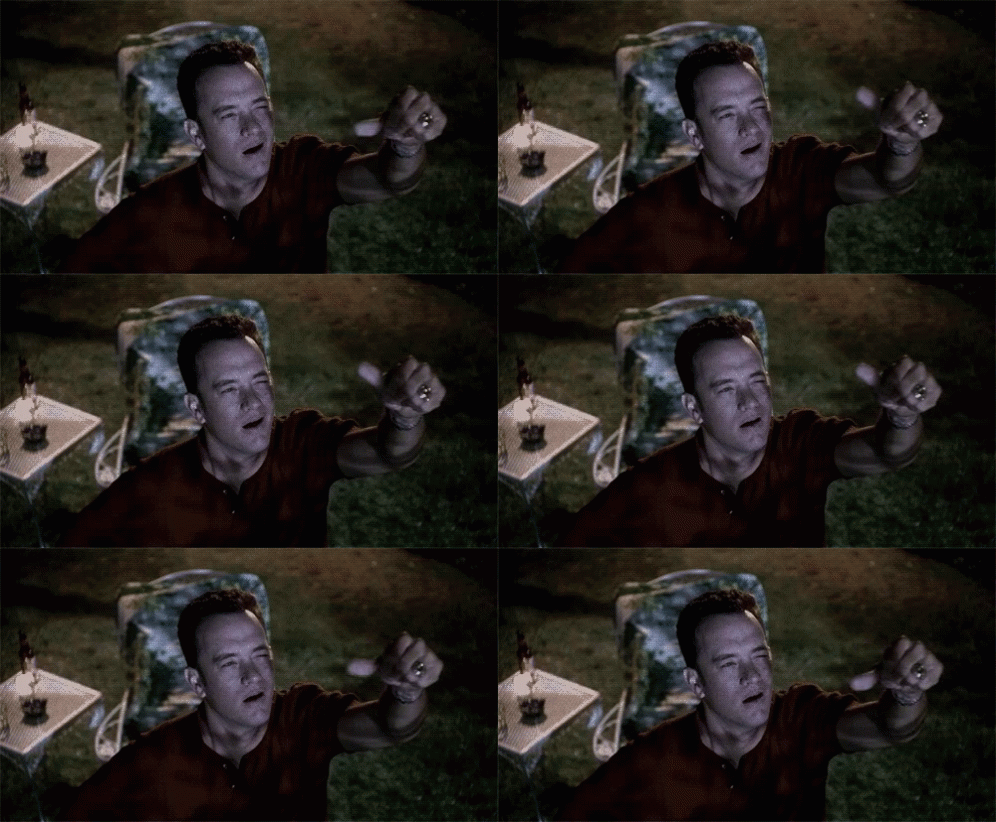
Apollo 13

The real Apollo 13 mission was largely ignored in 1970. People had already seen men walk on the moon twice before, so this just seemed like more of the same. Interest was so low that lots of news programs weren’t even broadcasting it. Until, that is, things went wrong.

An oxygen tank exploded, which crippled essential systems. The 3 astronauts aboard just had to hang out in an increasingly inhospitable ship as the NASA crew on the ground scrambled to get them home safely. The planned moon walk was of course aborted; they never landed on the moon, just orbited around it. Over the next few days, the spacecraft had limited power, a worrying loss of cabin heat, a shortage or drinkable water, and an urgent need to fix the carbon dioxide removal system or die trying.

America might have been bored with moon walks, but for astronaut Jim Lovell, it would be the culmination of his life’s ambition. It was not to be.

Ron Howard brought this story of NASA’s most successful failure to the big screen in 1995, and still thinks of it as his best film. In fact, he thinks the launch sequence is the highest point of his career, and he’s not wrong. Watching First Man more than 20 years later, it’s clear that Apollo 13 had a huge impact on movies that would follow it.

Jim Lovell thought that perhaps Kevin Costner had a passing likeness, but once Ron Howard signed on as director, he immediately sent the script to Tom Hanks, who is a known space buff. Bill Paxton portrayed Fred Haise, while Kevin Bacon got the role of Jack Swigert, who was never supposed to be there. He was only on the mission as a backup, but blood screening suggested that Ken Mattingly (Gary Sinise) might have the measles, and he was replaced last minute. Though this was an undoubtedly heartbreaking switch, it was Mattingly’s expertise on the ground that ultimately helped save his crewmates. He sat in the simulator for days, doing simulation after simulation until he could work out a way to rescue his friends.

The actors, or actornauts as Howard called them on set, floated around in $30K space suits. And yes, they really did float. Steven Spielberg suggested that Howard approached NASA for special permission to use its KC-135 airplane, and permission was granted. Dubbed the vomit comet, the plane climbs to 38 000 feet and then does a big 15 000 foot drop, creating a zero-gravity effect, but it only creates about 23 seconds of weightlessness. For the film’s production, they had the plane perform 612 dives, for a total of 54 minutes of footage. Even still, sometimes when you see the actors just bobbing around in their capsule, they’re actually just sitting on seesaws. Pretending to be in space is hard! [Note: the 3 actors were very proud to report that none of them vomited on the comet…but several cameramen could not say the same.]

It took them 6 days to get them safely home, and while America did not care about a third module landing on the moon, it became obsessed with the imperiled mission that may or may not return. Millions of people tuned in every night, and so did the friends and families of the astronauts on board. NASA didn’t have time to give them proper updates, so they, like everyone else, relied on Walter Cronkite to feed them information. Ron Howard brought Cronkite in to record a few extra reports.

Tom Hanks and Gary Sinise had of course appeared together the year before in Forrest Gump, where Sinise’s Lieutenant Dan says to Forrest: ” If you’re ever a shrimp boat captain, that’s the day I’m an astronaut.” Lo and behold. The movie is full of little Ron Howard nods: Kathleen Quinlan who plays Jim’s wife Marilyn, actually had her first ever screen credit in American Graffiti, in which she played Peggy, a girl complaining in a bathroom about her boyfriend Steve – who was of course played by Howard himself. He also found a role for Roger Corman, the producer who gave Ron his first big break in Grand Theft Auto. Ron’s mother, his father, his wife, and of course his brother all appear in the film. The real Marilyn Lovell is briefly seen in the grandstands at the launch, and the real Jim shakes hands with the fake Jim aboard the Iwo Jima.

Apollo 13 was well-received, and it holds up well almost 25 years later. There are lots of movies about astronaut heroes, but Apollo 13 sets itself apart by portraying the time when someone’s dream doesn’t come true. It takes a story whose outcome is known (and in fact infamous: “Houston, we have a problem”) and still makes it feel tense and compelling.

Chasing Happiness

I missed the Jonas Brothers Happening. I mean, I wasn’t exactly living under a rock, but I was disconnected from pop music. I was going through a rough divorce from a partner whose mental health was on the rocks. I was rebuilding my life from scratch, working hard to finance my fresh start. I was exhausted and exhilarated and my playlist was full of power anthems, a kick-ass score for my happy new life. I remember being in a movie theatre and the trivia before the movie had me guessing between a Jonas and a Bieber, and I was clueless. Although I knew of them, I hadn’t knowingly consumed either – though I knew I’d likely heard their songs in malls or cabs if not clubs – and couldn’t name a song, or a brother. And then just as I was sticking my head up above the sand, the brothers were no more. Well, bands dissolve more readily than blood, but Jonas Brothers was over, and soon enough each Jonas was hitting the radio individually, which made it marginally easier to keep track of them.

Chasing Happiness is streaming now on Amazon Prime; it’s about Jonas Brothers reforming as a band now that they’re adults. A lot of shit went down, which they are surprisingly candid about. I’m obviously not a fan, but their transparency and realness are readily apparent and it’s hard not to get sucked into their particular brand of rags to riches.

They were close growing up, and they were competitive too. Like any brothers anywhere. Or indeed sisters. My sisters and I get super competitive if we’re playing a board game or competing for Mom’s attention, but I guess we’re not talented enough to have Jonas-level game. We’re not even good at the same things. But those brothers are disgustingly talented; any one of them can sing 9 out of 10 top 40 artists right off the billboard any day of the week. And they’re for real: they play real instruments, they write their own songs. Even as kids they were writing their own songs. Fifteen year olds are pretty shitty song writers, but they were so earnest and industrious it’s hard not to admire them anyway.

Few people have experienced such meteoric fame, let alone so quickly, and at such a young age. It’s three literal dreams come true, but enormous pressure too. Their father was a pastor, and he lost his job when his sons chose rock and roll (trying hard not to snigger when I write that), and the family home too. So now these teenage boys are the bread winners for their family. Meanwhile the machine just keeps getting bigger and bigger until it feels unmanageable.

Anyway, even having no idea who these guys really are, I still really enjoy sitting in on their family therapy sessions. Their Christianity and sexuality were on constant display despite them being minors. The media scrutiny sometimes made them into a joke, and their seminal years were tainted sometimes by fear and paranoia. There are cracks in Jonas Brothers, and one of the brothers plugs the crack with a stick of dynamite and lights it up.

Kaboom. Other bands can implode and go their own ways. But these boys are actual family. It’s sad and fascinating and honest. Man. I felt their pain. There’s resentment and betrayal and heartbreak there. Still is. It’s intense. But I really admire their willingness to lay themselves bare. I’m fairly confident that no one reading this has walked in shoes like theirs. But anyone with siblings will relate to this. We’ve all felt that knife. I’ve felt that knife. And anyone whose life changed after kids will relate to this. Anyone who’s grown apart from a best friend will relate to this. Maybe just anyone with a pulse will relate to this. I’ve gone and surprised myself by giving a damn about the Jonas Bros. I think I’m actually recommending this guys. Colour me surprised.

Knives And Skin

Carolyn Harper makes out with a football player but when she pushes away his roaming hands, he leaves her alone in the woods and she’s never seen alive again. Her disappearance disrupts her high school and the entire community, as the disappearances of beautiful young white women often do.

In the aftermath of her disappearance, we watch things unravel for her friends, her fellow bandmates and classmates, her mother, and the well-intentioned but inexperienced local sheriff. More than that, though, we experience the way that grief accelerates the coming of age for a group of teenagers, which makes it rather obvious that their parents’ haven’t exactly completed the growing up process either.

Writer-director Jennifer Reeder creates a very atmospheric teen noir that pulls from a lot of sources but manages to be its very own thing. The closest thing I can compare it to is Twin Peaks for its eerie tone but believe me when I say Knives And Skin is its own gothic soup – a horror broth steeped with many surprising flavours. Reeder brings in familiar tropes and mixes them with haunting song and feminist references and the result is hard to categorize but fascinating to watch, even if it is uneven, a little long, and prone to meandering. If it occasionally feels a little piecey, it also feels dreamy, surreal. The story is less concerned about finding Carolyn than it is about exploring the various ways people feel trapped, and subtle reminders that escape is possible. Although it starts off with a dead girl in the woods, it subverts the expectations of that genre over and over with its confident female leads and the weaponization of sex. It’s like a parody, but self-aware and dead serious.

Reeder may value style over narrative, but Knives And Skin interesting, beautiful, and unforgettable.