Category Archives: Jay

Berlinale 2021: Tides

In the not too distant future, humanity will have completely decimated the Earth and fled 500 light years away, to a distant, alternate planet in the Keplar star system. But this planet isn’t the utopia they’d hoped; within just a couple of generations, they’ve lost the ability to reproduce. The first envoy they send back to Earth to check things out disappears completely. The second fares only a little bit better.

Astronaut Blake (Nora Arnezeder) barely survives the splashdown landing and immediately has some real problems; there are survivors, and they’re none too trusting.  Earth is a barren wasteland ruled by extreme tides and split into two warring, violent factions. But they are able to reproduce – Blake sees plenty of children and babies before she’s taken prisoner. Her jailers turn out to be surprisingly friendly – leader Gibson (Iain Glen) knew her as a child, was a friend of her father, who disappeared with the first envoy. He’s been working very hard to make things tenable for the Keplar community to return to Earth but lacks the means to communicate. Only Blake has that, but the longer she’s there, the more sinister everything seems, and she’s no longer convinced it’s the best course. But Gibson and his gang aren’t about to let go of their plans without a fight.

Tides doesn’t have a great script. Its details are frustratingly vague, and if you care about strict logic, I’m pretty sure the math here doesn’t remotely add up. But if you’re simply in the mood for an unabashed sci-fi genre film, you’ve got yourself a sure bet. So sure, in fact, you might find it looking familiar. It actually feels like, rather than telling its own story, director Tim Fehlbaum is setting up some sort of dystopian hub where more successful films in the genre might convene. It wouldn’t feel strange to see Tom Hardy drive by with someone strapped to the front of his doon buggy, or Kevin Costner sail by on a really big boat. But aside from building a world that feels and looks familiar, Tides fails to establish its own story. Despite a committed performance by Arnezeder and some interesting nuggets of premise, Tides is ultimately too weak to stand on its own legs.

Berlinale 2021: Language Lessons

Hello from the Berlin International Film Festival, streaming live from my bedroom for the first time ever. I’ve got a full slate of great movies ahead of me this week, or they better be after the very first one set the bar extremely high.

Adam’s husband Will gifts him with Spanish lessons. Two years worth of Spanish lessons! Hope you like them, Adam, because this is quite a commitment. Adam (Mark Duplass) is still getting used to the lavish lifestyle Will’s success affords them, and the time and freedom to pursue such projects at leisure. Cariño (Natalie Morales) is the Spanish teacher, beaming in from Costa Rica. Over the next two years, they’ll come to know each other very well through the miracle of conversation. Adam’s Spanish grammar may leave something to be desired but when you spend dedicated time in simple conversation with another human being, over time a relationship is cultivated almost as if by magic. Bonding over their own personal tragedies, the two are perhaps a little surprised by the friendship that seems to grow organically between them. They’ve never been in the same country let alone the same room, but their bond feels genuine and strong. Is it real, can it be trusted?

Natalie Morales directs the story she and Duplass wrote for themselves. It’s an interesting exploration of human attachment and what it means to connect authentically. We experience their relationship solely through the split screen of their online connection. I worried this conceit may wear thin over the course of a feature-length film, but these two share such compelling chemistry, and go to such lengths to entertain and stimulate each other, I found myself not minding it at all.

Perhaps most amazingly, this spontaneous friendship is allowed to remain platonic throughout the film. Adam and Cariño have shared pain and grief in their backgrounds, and the fact that they can find a way to reach out despite it is a tenuous little miracle it feels a privilege to witness. Trust is of course one of the most universal human hardships, and it feels elemental to watch it be birthed and nurtured on screen. Adam and Cariño are an endearing but flawed pair; their simple humanity is what’s touching. Language Lessons is disarming in the most delightful way.

Jump, Darling

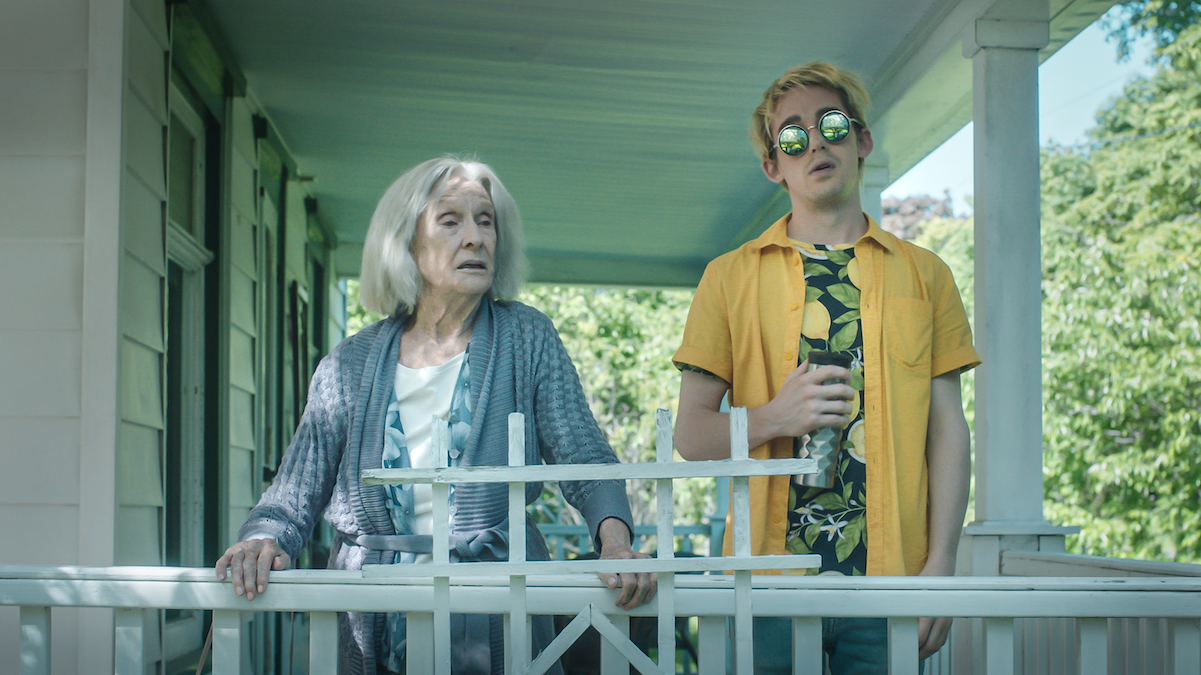
What do you do when you you’re reeling from a break-up with no place to stay and no money to make things happen? To grandmother’s house you go, of course. It’s what Russell does. Russell (Thomas Duplessie) has decided to pack up his wigs and fishnets and lick his wounds in the country, at his Grandma Margaret’s place. Grandma (Cloris Leachman) is delighted to have him, not least of all because it’ll help her avoid the local nursing home, which she adamantly and steadfastly refuses to go to despite it being well established that she’s really no longer able to care for herself at home.

Russell has, until recently, pursued acting, but has dropped that passion for another – drag – which may have contributed to his breakup. His mother Ene (Linda Kash) drops in from time to time and hardly seems to know who to be most exasperated with – her stubborn, sickly mother, or her waffling, still-dependent son. Equally inefficient with both, she seems just to pop in to be a bummer and then leave again. Meanwhile, neither housemate is doing well. Russell is stagnant, torn between leaving, which means restarting, which is terrifying not to mention the whole abandoning Grandma thing, or staying, and quietly extinguishing an important part of himself. Grandma, meanwhile, is rapidly declining, but no less unwavering in her resolve to live at home. But this together time means they’re both learning about each other’s lives, their secrets, their dashed hopes, things many grandma-grandson duos may never normally exchange. Their relationship is unconventional but sweet.

Director Phil Connell keeps things simple, allowing the relationship to be the film’s primary focus. Newcomer Duplessie pours his whole self into the role. On the other end of the spectrum, this is Cloris Leachman’s final role. She died in January of this year, a talented lady to the very last, and though she seems as feisty and vibrant as ever, physically the years were taking a toll and it’s hard not to think of her demise while watching her declining mental state in the film. Still, such a meaty, involved role for a woman this late in her life is a rarity (she was 94 when she died), and Leachman was such a gem. This film isn’t her best, but it’s a great way to say goodbye to a legend.

A caveat: although I enjoyed this movie, and I enjoy drag as a whole, I do have one problem with both, and that’s the use of the word ‘fish.’ In drag, ‘fish’ is a compliment. It means the queen is looking particularly feminine, perhaps even passing as female. But fish is a dirty word, a derogatory word. I don’t mind anyone dressing up as a woman or performing as a woman but I do mind the offensive language, and I’m pretty sure you can guess where the term fish comes from. It’s a word that’s been used to shame women about the scent of their sex, as if a natural odor is somehow wrong. As a term it’s been co-opted by the drag community, the very people who apparently admire femininity so much they want to emulate it, but at the same time insult the people they’re imitating. It seems strange to put on heels and wigs and corsets and makeup and then sling sexist terms like this, but the patriarchy is pretty strong and even the marginalized will oppress those beneath them. The word is unnecessary, easily scrubbed. Let’s make that happen.

Billie Eilish: The World’s A Little Blurry

Whether or not you’re a fan of Billie Eilish, you should probably watch her documentary. The music industry has a habit of chewing up and then spitting out female artists and Eilish’s meteoric rise to fame at such a young and tender age would normally be an immediate red flag. Couple that with her seemingly dark personality and you might be tempted to put her on your worry list, but Eilish surrounds herself with a tight-knit family who don’t just care for her – they care for each other.

RJ Cutler’s Billie Eilish documentary has a tremendous amount of access. We get to see her from the young woman first tasting success on SoundCloud to, almost instantly, a global superstar weighted down with Grammy awards. The film follows her while she writes her first album, whether she’s on the road, or at home, or even up on stage, performing to hundreds, then thousands, then tens of thousands of people. And yet Billie, still a kid, doesn’t seem to love the attention, or being looked at, or being treated like an idol. She struggles to write songs, she struggles with quality vs. quantity when touring non-stop takes a toll on her body and she’s unable to deliver the top-notch performance that only she expects of herself. For such a young kid, her work ethic is remarkable, but even more so is her ability to stay grounded. Clearly mom Maggie, dad Patrick, and big brother Finneas have a lot to do with this. Mom will be helping Billie do the blocking for her next music video in the backyard while dad obliviously picks up dog poop. Finneas delivers sitcom-quality pep talks, psyching up his sister as only he can, and only he understands she needs. The two are clearly close, he her writer and producer, as much responsible for her success as she is. They are a team, often together, never seen squabbling, delighting in each other’s success.

Maybe because this documentary is being shot so early in her career, Eilish in her family seem totally authentic and filter-free, not that they have anything to hide. They’re a surprisingly wholesome family, Billie’s biggest complaint that Maggie drives a minivan, an unappealing thought for a teenager about to get her first driver’s license, and her parents’ main concern seems to have been a tweenage obsession with Justin Bieber that’ll really come full circle by the documentary’s end.

Eilish is a massively talented woman with a solid lime green head on her shoulders and her Nikes firmly on the ground. She is a different kind of pop star, not divorced from her image, but not co-opting it either. She’s protective of herself without being jaded. You will hope, while watching this, that she can continue down this path, continue to make healthy choices, and to blaze a path for a new kind of entertainer – the kind that doesn’t have to sell her soul to get what she wants and deserves.

Tom and Jerry

Did you ever wonder how Tom met Jerry, and why it was hate at first sight? Well too bad, this movie’s going to tell you anyway.

Jerry is a mouse, newly arrived in Manhattan, and while apartment hunting he comes across a blind, keyboard-playing cat busking in Central Park. Only the cat isn’t really blind, and of course Jerry finds time in his busy schedule to provoke him just before disappearing into his new digs, the fabulous Royal Gate Hotel. Between its floorboards he sets up a little rodent bachelor pad, and he sets out to sample all of the hotel’s fine amenities. The hotel’s manager is none too pleased to have vermin in his prestigious hotel, particularly before the year’s grandest event – the wedding of Preeta and Ben, set to take place in his hotel ballroom in just a few days. Event planner Terence (Michael Pena) needs help, and Kayla (Chloe Grace Moretz) needs a job, so she fudges her qualifications and through the magic of live action-animated children’s movies, Kayla has herself a job.

Kayla’s first task is of course ridding the hotel of its mouse infestation, and what better way to get rid of a mouse than to hire a cat to do the job. Enter Tom, who we know already has a beef with Jerry due to their earlier altercation in the park. True to their heritage, Tom and Jerry will get up to their same old antics, the same old back and forth, cat and mouse, push and pull of destruction that they’ve been getting up to since the dawn of time (well, since 1940, which is pretty much the same thing). Director Tim Story doesn’t have much of a modern twist to add to the proceedings, nor does he have much respect for his young audience.

Inserting Tom and Jerry into an uninspired live action scenario is not the best use of these vintage television characters. It won’t please older fans, nostalgic for the cat and mouse of their childhood, nor is it likely to impress young audiences meeting Tom and Jerry for the first time. Terence and Kayla are helping to plan the wedding of the century. Preeta (Pallavi Sharda) and Ben (Colin Jost) are getting married in the most over the top, larger than life way you can imagine; obviously this leaves lots of room for hijinks and lots of opportunity for trouble. The problem is, the hijinks are kind of played out, like, last century. I can’t really guess who this movie is made for, but I do know it wasn’t me and it definitely wasn’t Sean. Will it be you? Probably not. But if you’re willing to find out, wait until the movie doesn’t cost $25 to rent anymore. Even if you don’t hate it, there’s definitely not 25 bucks worth of movie in here and you’ll end up hating yourself, and possibly an age-old rivalry between a cat and a mouse.

The Last Vermeer

WW2 was ending, but for some, the work was just beginning. Captain Joseph Piller (Claes Bang) will spend the war’s aftermath investigating art – art stolen from the Jews as they fled or were removed from their homes. The few lucky enough to return found their homes stripped of valuables, and many of those pieces are still being searched for today. Piller is tasked with investigating renowned Dutch artist Han van Meegeren (Guy Pearce), who is accused of selling Vermeer’s Christ and the Adulteress to the Nazis.

People were still rebuilding and recovering from the war so there was little mercy for suspected Nazi collaborators/conspirators/sympathizers. But something strange happens to Piller as he looks into van Meegeren’s background: he begins to suspect that he’s innocent. With the help of Minna (Vickey Krieps) and Dekker (Roland Moller), Piller will have to dig awfully deep to prove van Meegeren’s assertion that he is not a Nazi-loving traitor but a patriot who swindled the Nazis by selling them fake Vermeers painted by none other than himself.

Is van Meegeren’s story simply too good to be true? Does he have any credibility? Is he playing Piller, with his life on the line? Is there any post-war courtroom that would find him anything other than worthy of hanging? Is van Meegeren a master forger or a master of deception?

The best thing about this movie is Pearce’s performance; van Meegeren is funny, flagrant, and flamboyant, eminently entertaining even while on trial for his life. The rest of the cast is perfectly fine, but rarely rise above the perfunctory material. The Last Vermeer is a fascinating true story not particularly done justice by this paint-by-numbers film. Director Dan Friedkin lacks the inspiration to make this something special. It is a good but not great historical drama that gets the job done but fails to capture the imagination.

Bigfoot Family

New on Netflix this weekend, Bigfoot Family is the sequel to 2017’s Son of Bigfoot (but don’t worry, if you missed the first one, I’m confident you’ll still be able to navigate the plot of the second).

In the first film, teenage Adam went on a quest to find his long-lost father and found him hiding out in the woods. After a science experiment gone wrong mutated his DNA and turned him into Bigfoot, a pharmaceutical company got wind of things and Adam’s dad felt the only way to protect himself and his family was to go into hiding.

In the sequel, Adam’s father is technically back home but rarely there because his Bigfoot status has accorded him some fame. Adam has learned that he, too, is a Bigfoot – aside from the really big feet, he can heal himself and talk to animals, which is a good thing because several of his father’s four-legged forest friends have since moved in with them, including Wilbur the bear and Trapper the raccoon. Adam’s dad has decided to use his fame in a positive way, lending his celebrity to a village in Alaska concerned that a power company claiming to be 100% clean is actually damaging their ecosystem in secret. But when Adam’s dad goes out there to help out, he quickly disappears. Adam, his mom, plus Wilbur and Trapper, pile into a camper and drive up to Alaska to save their dad, and hopefully also stop the Big Bad Oil Company from doing their thing.

While there’s nothing really wrong about this movie, there’s also nothing very right, or very memorable. There are no big names lending their voices, there are no energetic pop songs, and the plot’s details are going to be a little frustrating to anyone above the age of 5. If you have kids under the age of 5, this might be an okay watch for them, as long as you don’t have to be in the same room. Otherwise this is an unfortunate skip, even knowing how much we need family-friendly fare right now.

The Mauritanian

This is the true story of Mohamedou Salahi, a man from Mauritania who was kidnapped from his home and detained and (it goes without saying) tortured in Guantanamo Bay by the U.S. government in the wake of 9/11 for years without being charged with a single crime.

Salahi (Tahar Rahim) has been languishing in a cell in Cuba for years by the time we meet him; he’s just added a sympathetic lawyer to his cause. Nancy Hollander (Jodie Foster) takes a lot of flak for defending a terrorist but everyone’s supposed to have the same rights, bad guy or good guy, innocent or guilty. Right? Yeah, right. The US government believes it can switch its own laws, conditions, and human rights on and off at will, and hide their worst transgressions offshore (ahem, Cuba). Nancy adds Teri Duncan (Shailene Woodley) to her team, and off they trot to good old Guantanamo where they learn they’re in for an extremely uphill battle. Meanwhile, the other side is covered by Stuart Couch (Benedict Cumberbatch) who isn’t having the easiest time either. Meanwhile, fair to say Mohamedou is having the absolute worst time of all because as you may have heard, Guantanamo is more or less synonymous with horrible abuse.

Tahar Rahim’s performance is magnetic, finding the sweet spot between hero and villain that is every shade of human, and his nomination is well deserved. In fact, Foster, Cumberbatch, and to a lesser extent Woodley, are in top form as well (but look out for Benedict’s Southern accent and report back on your opinion immediately!). The story is fascinating even if you’ve read extensively about it before. Kevin Macdonald’s direction, however, is simplistic and straight-forward. The Mauritanian isn’t so much a good movie as a compelling story. It’s solidly well-made in a no-frills way but won’t impress anyone beyond basic competence. Should you watch it? I think it’s interesting and informative and covers a pretty important topic that most Americans seem to have largely ignored. The answer is yes: check out The Mauritanian. It is necessary and infuriating.

Minari

This perfect little movie made my heart sing today. It’s humble and understated but flawlessly distills everything that is right about life and love and family and hope into a simple yet effective cinematic microcosm.

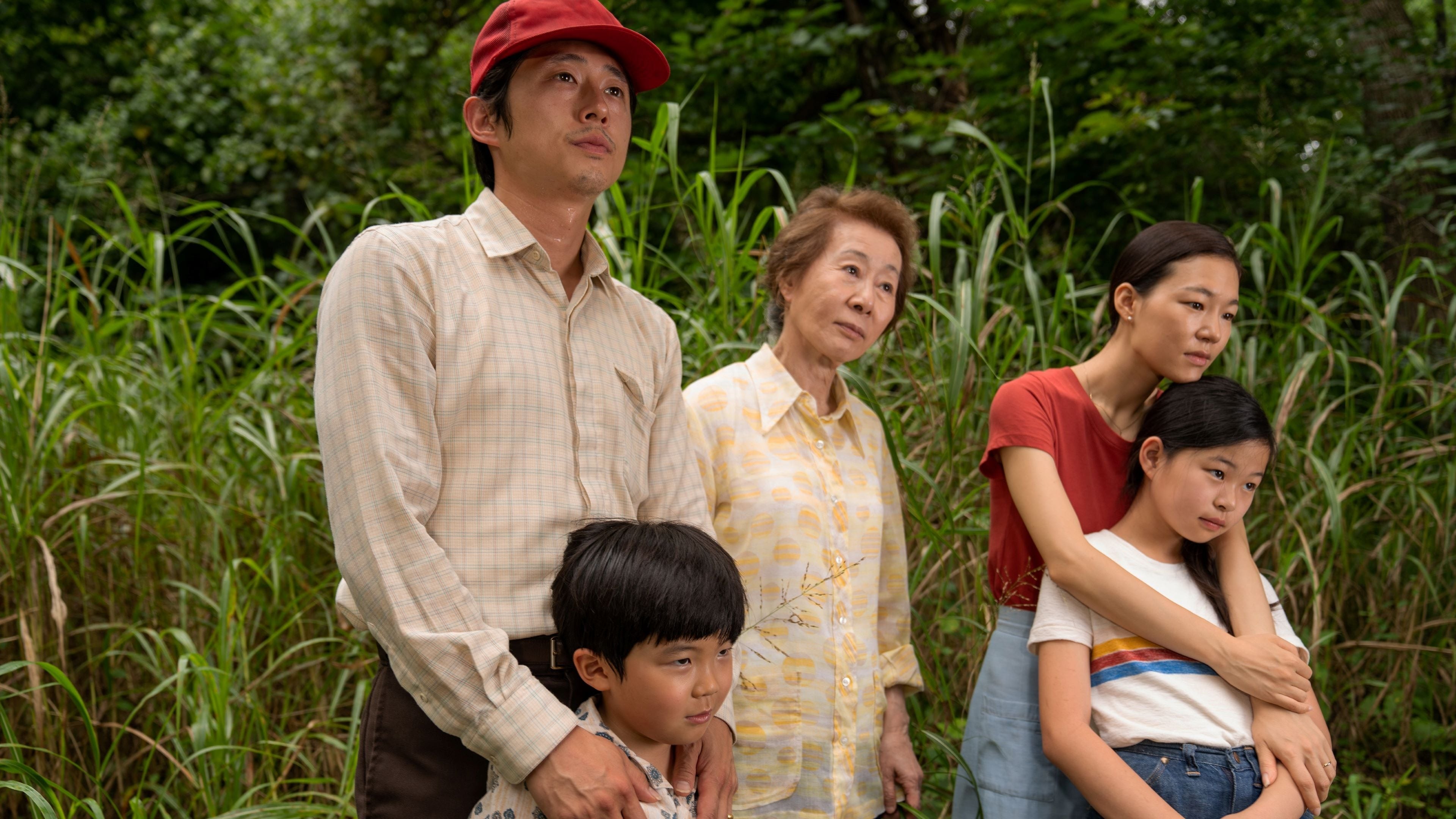
Jacob (Steven Yeun) moves his family from their small apartment in California to a farm in Arkansas. Well, a potential farm, at least. It has promise. At the moment it’s a small plot of land, a trailer, and a dream. Jacob’s wife Monica (Yeri Han) isn’t as enthusiastic about this dream, or about the trailer, or about leaving California, but she’s going along with it because finally her mother Soonja (Yuh-jung Youn) will be able to join them. Little David (Alan Kim) isn’t so keen on Grandma Soonja – she smells like Korea and swears like a sailor and prefers to gamble at cards than bake cookies like other grandmothers do. This Grandma’s a dud and she sleeps in his room!

Jacob and Monica work at a local hatchery sexing chickens. David and sister Anne (Noel Cho) go to church to save on babysitting. Jacob and a religious zealot named Paul (Will Patton) plant seeds and irrigate the land. Soonja gets addicted to Mountain Dew. Minari is the story of an immigrant family in search of the American Dream in 1980s Arkansas. It may not be the typical experience, but it does manage to feel universal. At its heart, Minari is about family – about where we plant roots, how we cultivate intimacy, why a home is not the building that houses us but the people who live inside.

Writer-director Lee Isaac Chung allows the story to unfold naturally, never pushing us into emotions but quietly earning them nonetheless. The film is semi-autobiographical and benefits from Chung’s store of intimate details that really make his story come alive. They help establish a sense of time and place, an important backdrop to this family’s origin story. The Yi family is at a critical juncture; these hardships will either pull them apart or cement them together. Their instability puts a lot of stress on them, and what starts as a fight between mom and dad trickles down to insecurity in the children. Only Grandma, who has certainly seen much worse, is a constant source of strength and love. Little David doesn’t always love her back, in fact sometimes he’s downright cruel, but Grandma has nothing but love for him – just not the kind he’s become accustomed to from American sitcoms. It takes him a while to warm up to her, but their relationship is the best part of the movie.

Minari is named after a Korean plant, a resilient little bigger that has the strength and tenacity to grow even in rough soil. The movie, likewise, is deceptively simple, but once you crack the nut, its insides are warm and nourishing. The film is disarming, the cast is uniformly excellent, and Chung finds a perfect balance between the bitter and the sweet.
 

Minari is releasing on all digital and on-demand platforms across Canada on February 26th.

Test Pattern

Renesha’s just had a good first day at a new job and is looking forward to having a good second day, so she’s a little hesitant to go out and join her friend at their favourite place for a drink, but she vows to her boyfriend that it’ll just be a quick one, and she’ll be back home at a decent hour. Renesha (Brittany S. Hall) invites Evan (Will Brill) along of course, but drinks with the girls isn’t his thing, so he stays home and she goes out, and doesn’t return home that night at all. When she turns up the next morning, she’s been raped. Plied with free alcohol the night before, a man takes her back to his place, not just against her will, but when she’s so inebriated she no longer has any will at all.

The next day, Renesha and Evan will negotiate the difficult intersection of race and gender at the heart of the justice system and health care. But we’re not just talking institutional injustice and inequality; her private life is also unraveling. Director Shatara Michelle Ford examines this topic from every angle and none of them are flattering. The film doesn’t fall into the easy trap of victimhood, it’s much more complicated, intimate, and heartbreaking than that. Ranesha’s trauma is relived at every turn, and Hall’s performance is so nuanced we can see her being crushed in slow-motion.

You might mistake this for a small film but it packs a hell of a punch. Ford’s observations are as meticulous as they are tragic. Renesha suffers through so much: guilt, shame, embarrassment, resentment, self-recrimination, anger, even doubt, and that’s before uncaring institutions start revictimizing her. Sexual assault is obviously a sensitive topic but also a necessary one. Ford treats it with respect and specificity, but the film’s greatest achievement is also its most devastating: naked realism.

Test Pattern is available through virtual cinemas, including Toronto’s Revue Cinema and Vancouver’s The Cinematheque.