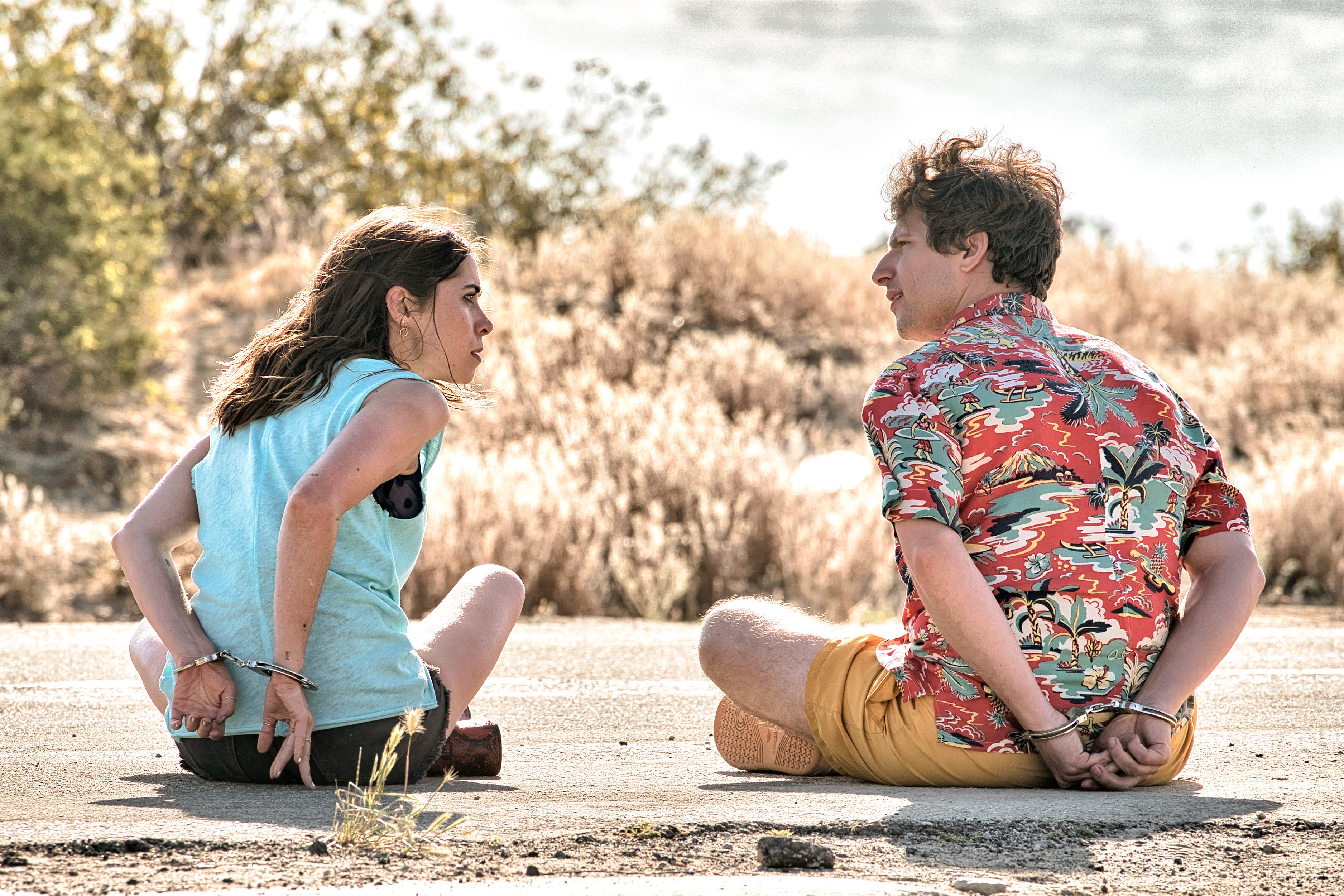
Nyles (Andy Samberg) is in Palm Springs (I assume – the title might have you believe this is of even the slightest importance, but it’s really not, could be anywhere) for a wedding. His girlfriend is a bridesmaid and he’s her plus one, which doesn’t quite account for just how uninvested he is in the proceedings. Even if you’re not close to the couple, you generally want to be respectful of their big day. Nyles shows up in a bad Hawaiian shirt, pops beers all ceremony long, and then hijacks the maid of honour’s speech to the bride. You can’t quite pinpoint how or why Nyles seems just a little bit off, but he is, considerably, and yet when he directs his charm toward the bride’s sister and maid of honour, Sarah (Cristin Milioti), even she seems unable to resist, and she doesn’t appear to be having a great day herself.
What gives? Turns out, it’s one of those infinite time loop situations you might have heard about. You know, like Groundhog Day? And a dozen other copycats, none of worth mentioning? Yeah, like that. Nyles has been reliving the same day over and over for goodness knows how long (you know who does know? The screenwriter. Excellent source. His answer: about 40 years. Forty fucking years!). Anyway, after a particularly nice day spent with Sarah, she follows him into the time loop cave of doom despite him cautioning her not to. The rest isn’t so much history as an infinite present. Nyles has 40 years of this under his belt, so he’s given himself over completely to nihilism (hence the Hawaiian shirt), but Sarah is new enough to the game to be fed by her anger, resentment, and frustration. She wants out, and she’s so determined to solve or win the time loop, she’ll try anything, including but not limited to: exploding an innocent goat, getting hit by a truck, making the ultimate sacrifice, and learning quantum physics.
Time loop movies are a dime a dozen and I haven’t liked a single one since Bill Murray, but now, suddenly, there are two. Like Groundhog Day, Palm Springs is a rom-com of sorts, or perhaps an anti-rom-com – there is no worse romance killer, not even death, than too much time together. But one man’s existential crisis is another man’s pure entertainment. Samberg and Milioti not only have a viable chemistry, she brings a darkness that balances Samberg’s goofball energy perfectly so that, despite the extreme challenge to mental health in this film, we don’t fly off the deep end of either side of the continuum, but we do enjoy a sliding scale of extremes and a lot of laughs because of it. Writer Andy Siara keeps us intrigued with a script that is unpredictable and unexpected, but most of all coated in well-earned giggles that are executed perfectly by the cast, including JK Simmons as Roy, someone else caught in the infinite loop thanks to Nyles, and not super gracious about it either. Siara and director Max Barbakow work well together to subvert our expectations and challenge what we think we know about rom-coms.
Palm Springs was bought by Hulu at Sundance for a record-setting sum: 17.5 million dollars and 69 cents. The 69 cents set the record; Birth of a Nation held it before this, and that turned out to be a bit of a debacle, didn’t it? But Palm Springs was a great investment for Hulu, becoming the most-streamed in its first weekend Hulu had ever seen. Since Canada doesn’t have Hulu, it is now available to stream on Amazon Prime, and that’s a good thing, because Palm Springs is one of the brightest spots in an otherwise dull year.
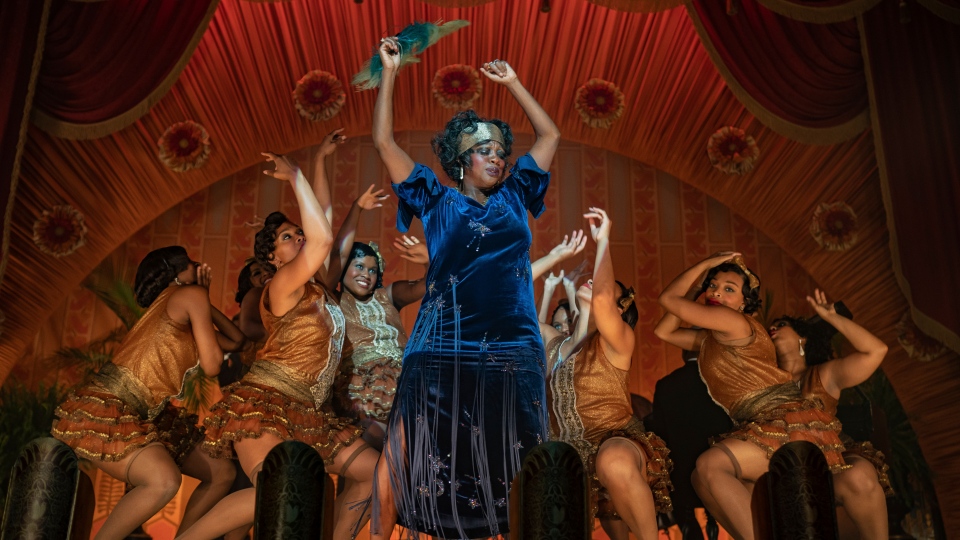
Chicago, 1927. Welcome to a single recording session of Ma Rainey’s Black Bottom. Ma (Viola Davis) is running late, of course, cause she’s the star. The band is rehearsing in the “studio,” a dank basement room that’s not big enough for the egos it’s asked to contain. Levee the horn player (Chadwick Boseman) in particular is testing everyone’s nerves with his outsized ambitions and his new $11 shoes.
When Ma arrives, tensions mount. Levee is trying to rearrange her music, and she’s got to show him his place. But she’s also battling the (white) management, who are subtly trying to push her in different directions, disrespecting her status as the mother of the blues, trying to control a product they don’t fully understand. The other band members – Cutler (Colman Domingo), Toledo (Glynn Turman), and Slow Drag (Michael Potts) – try to run interference, but they know their place and are loathe to stray from it.
Ruben Santiago-Hudson adapts from August Wilson’s excellent play. You may know that Denzel Washington intends to bring all 10 of Wilson’s “century cycle” plays to screen, starting with Fences, for which David received an Oscar, and following this one with The Piano Lesson, for which he’ll cast his son, John David Washington. Of course, he wasn’t far off in casting Boseman for this one; Boseman was his longtime protégé; Washington had sponsored him at Howard University, paying his tuition so he could take Phylicia Rashad’s coveted acting class. Ma Rainey’s Black Bottom is Boseman’s last role. He was secretly receiving treatment for the colon cancer that killed him earlier this year while filming.
As far as legacy goes, Ma Rainey’s Black Bottom is about as good a final role as you can hope for. He’s magnetic, vital, crackling with suppressed rage, electrifying and dangerous. Opposite him, Viola Davis’s Ma can afford to be a little more confident, a little more sedate. Perhaps because of her career she has more experience dealing with the white man’s power struggle, but she holds her own, knows her worth and insists on it.
August Wilson’s play is urgent and alive (I personally prefer this one to Fences). Director George C. Wolfe does an excellent job of making us feel every inch of that tiny recording studio’s claustrophobic walls. It’s hot, it’s crowded, there is little room for maneuvering (physically and symbolically) and plenty of potential for mistakes. Egos and tempers are bouncing off each other in desperate and menacing ways. Meanwhile, the white managers and producers sit comfortably upstairs, dictating how the session will go, depriving even their star of a 5 cent bottle of Coke.
This recording session is a microcosm of the Black experience in America in the early 20th century. Generational trauma, informed by racism, religion and violence, is evident in every note sung in the blues, and white men stand by to monetize and profit from it. It is no wonder that this session may turn explosive at any moment, and very telling that when that escalating pressure so carefully cultivated finally does release, the lateral violence is just another heartbreaking blow to an already wounded community.
According to critics, I really shouldn’t like this movie. They make some pretty valid arguments, yet I’m going to stray from the path and mow one of my own, over the green, green hills of Ireland, which provide such lusty landscape porn over the opening credits alone that I need very little further convincing.
Neighbouring farms belonging to the Muldoons and the Reillys have supplied friction as well as friendship over the years, and if this was anywhere else this might have made them enemies, but these two generational farming families are wise enough to know not to completely estrange the very people who will be counted upon in a pinch should the need arise, and the need is always arising. Rosemary Muldoon (Emily Blunt) and Anthony Reilly (Jamie Dornan) have known each other their entire lives, and since there’s not exactly an excess of options, it’s been assumed by locals that they would someday marry. Now their elderly parents are dying off, but the relationship hasn’t deepened much beyond “Good morning to ya'” because Anthony is terminally awkward and believes too strongly in a family curse. And he’s always at odds with his father (Christopher Walken), who decides to pass over bachelor Anthony in favour of keeping the family name and the farm’s inheritance alive and well. Enter Anthony’s American cousin Adam (Jon Hamm), a Yank in every sense of the word. Arrogant, showy, with no real concept of farming, Adam’s worst crime is of course this his eye is immediately caught by the girl next door, Rosemary, who is understandably growing antsy waiting for “shy,” “slow” Anthony to come around.
Writer-director John Patrick Shanley adapts his own play for the screen and gives us a unique love story specific to a corner of Ireland just outside Mullingar. Rosemary and Anthony remain separated by a gate and a silly family feud, but they’re emotionally separated as well, never really able to connect. Since we spend privileged time with both, we’re privy to them each burning up from wanting the other, which makes their failure to connect all the more frustrating.
You’ll need three things to even have a hope of enjoying Wild Mountain Thyme: 1. patience; she’s a slow burn, folks 2. a willingness to overlook some pretty dodgy accents, and 3. a willingness to let go of convention and embrace its offbeat charm. Wild Mountain Thyme isn’t just set in Ireland, but set in its own time and place, a place that looks Irish and a time that seems like the 21st century, and yet is so rural and insular not only have modern conveniences barely touched them, our grown-ass protagonists also seem almost child-like in their (lack of) lived experience. They’re naïve. The film has its own rules and internal logic but doesn’t feel compelled to share them with us, things just are how they are and you can either love it or leave it, and honestly I won’t blame you either way. Like all truly quirky movies, this one is not meant for everyone. For those of us whose souls thirst for the truly eccentric, it is a puzzle not to be solved but to be admired for its opacity. When things come out of left field, we should merely note what a lovely field it is, and remember to admire the right one as well, while we’re at it. I know first hand what it is to spend a movie yelling “WHAT THE HELL IS HAPPENING” at the screen and checking wild-eyed with our co-watchers to see if they, too, are experiencing the brain melt. But this one simmered just above that level for me, an enjoyable stew of lyricism, unconventionality, and idiosyncratic story-telling that exists well outside the normal realm of romance I couldn’t help but admire its bold posture.
The last time John Patrick Shanley adapted his own work for us, we got Doubt, a small film with big impact. This is not Doubt. It is very much its own thing, without comparison or peers. Emily Blunt, of course, could make me watch almost anything; every performance seems to find some new undiscovered corner of her essence as she stretches to reach corners of the human spirit she hasn’t shown us before. She’s the best thing in this, and reason to watch all on her own, as long as you’re up for some uncommon trappings.
Wild Mountain Thyme is in select theatres now, and will be available on digital and on-demand Dec 22.
[Note: not so much a review as a full-on recap and discussion…I’d say *spoilers ahead* except you already know she’s going to sing…right? So let’s get into what she wore and to whom she was bitchy.]
Some might say that a “premise” isn’t really necessary for a Mariah Carey Christmas Special. She’s practically Christmas royalty – hand her a microphone and we’re set. But nobody ever accused Mariah of not being extra, and so we have this:
Tiffany Haddish opens up a book and begins reading a Christmas tale about the year 2020 and how it was very difficult for people, resulting in a general lack of Christmas cheer. We check in with Billy the Elf (Billy Eisner) at the North Pole, who confirms the numbers are dangerously low. He greets Millie Bobby Brown, Bette Midler, and Heidi Klum, who concur (a random consortium, but I’ll take it). Billy surmises that there’s really only one thing to be done:
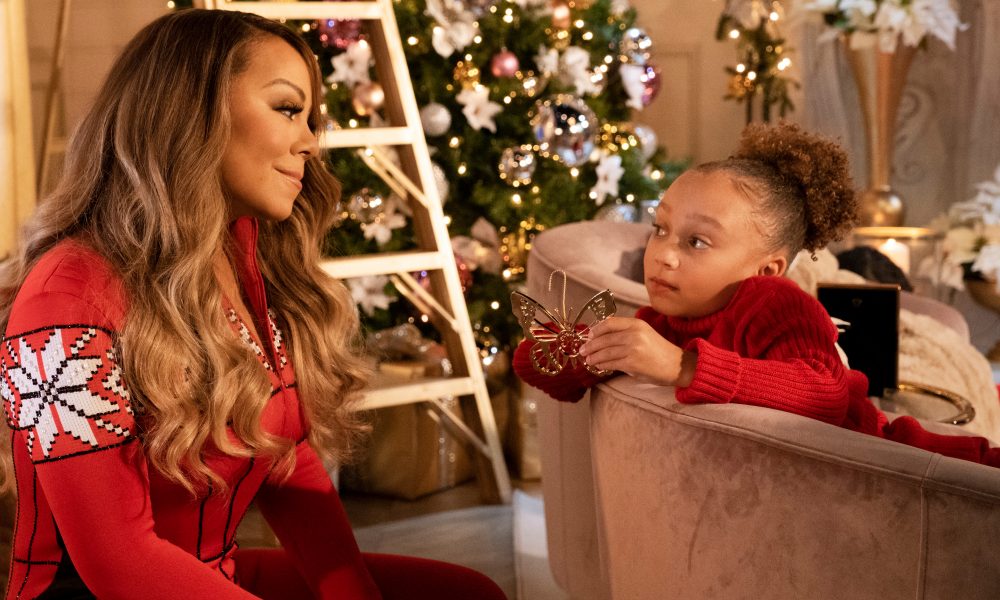
Cut to: Mariah Carey in a body-con holiday onesie the envy of ski bunnies everywhere, trimming the tree with her beautiful twins, Monroe and Moroccan, and a third child who’s basically just there to do the acting on their behalf. Unfortunately, no such stand-in is available for Mariah, who gives the most wooden Mariah Carey performance of her life (in fairness, she is probably physically incapable of moving her face). Mariah’s secret Santa phone is ringing, and she is summoned to the North Pole to save Christmas the way only Mariah Carey can. To the Batcave! Or the secret Christmas cave behind the fireplace anyway, where a self-propelled sleigh is awaiting to to whisk her away to the North Pole.
Anyway, she arrives to the North Pole like she is its Queen, and she kind of basically is. As “Santa’s Great Friend,” her arrival merits a parade thrown in her honour, rolled out so quickly they must keep it on standby and rehearse it periodically, like funerals for all the members of the royal family.
Or, I suppose I should say the “North Pole” – we’ve really taken increasing artistic license with the North Pole over the years. The geographic North Pole is found in the Arctic Ocean, on constantly shifting pieces of sea ice. It’s mostly just the sea ice, icebergs, and glaciers up there (no, those aren’t synonyms), with plant life mostly limited to grasses, mosses and lichens, not the oodles of evergreens Christmas Special set decorators are prone to overuse.
Mariah consents, from the bottom of her generous bosom heart to give a concert that will bring cheer to all who hear it. In her first costume change (out of 6.5), she appears in a glittering gold gown and stands beside a red lacquered piano to belt out the first of many Christmas carols.
In a third outfit, a short red and black dress with an impressively unnecessary train, she greets Snoop Dogg and Jermaine Dupri for a song, Snoop Dogg looking like he’s blissed out on some sort of special elf blend in a big red Santa suit he’s not remotely self-conscious about. And then Ariana Grande and Jennifer Hudson join her on stage, and by join her I mean quite visibly play back up singer to Mariah Carey’s lead singer. Wearing green dresses (Ariana in a cute velvet number and Jennifer looking like an absolute vision in sequins) and standing slightly behind and to the sides of Ms. Diva Carey, flanking her like they’re definitely not the stars of this special. When Mariah hits those high whistle notes of hers with a finger in her ear (an affectation when you’re lip-syncing, sure, but Mariah Carey is like 117% affectation), you might almost believe she’s doing it to block out Ms. Grande who’s joining her up in that upper register, but no, Mariah Carey has marked her territory and no one could mistake this as anything but her show. Not even Misty Copeland, ballerina extraordinaire, who’s up next.
Then there’s the silver dress which Mariah wears standing out in the “forest.” Let’s take a moment to shout out the formidable wardrobe department who help Mariah’s considerable assets defy gravity with a minimum of straps or structural support. This, above all, is the magic in Mariah Carey’s Magical Christmas Special. Her wig department is no less overworked but a little less technically proficient. The silver dress segment has her sporting a windblown look that stays windblown even without her dedicated wind machines, of which there are many.
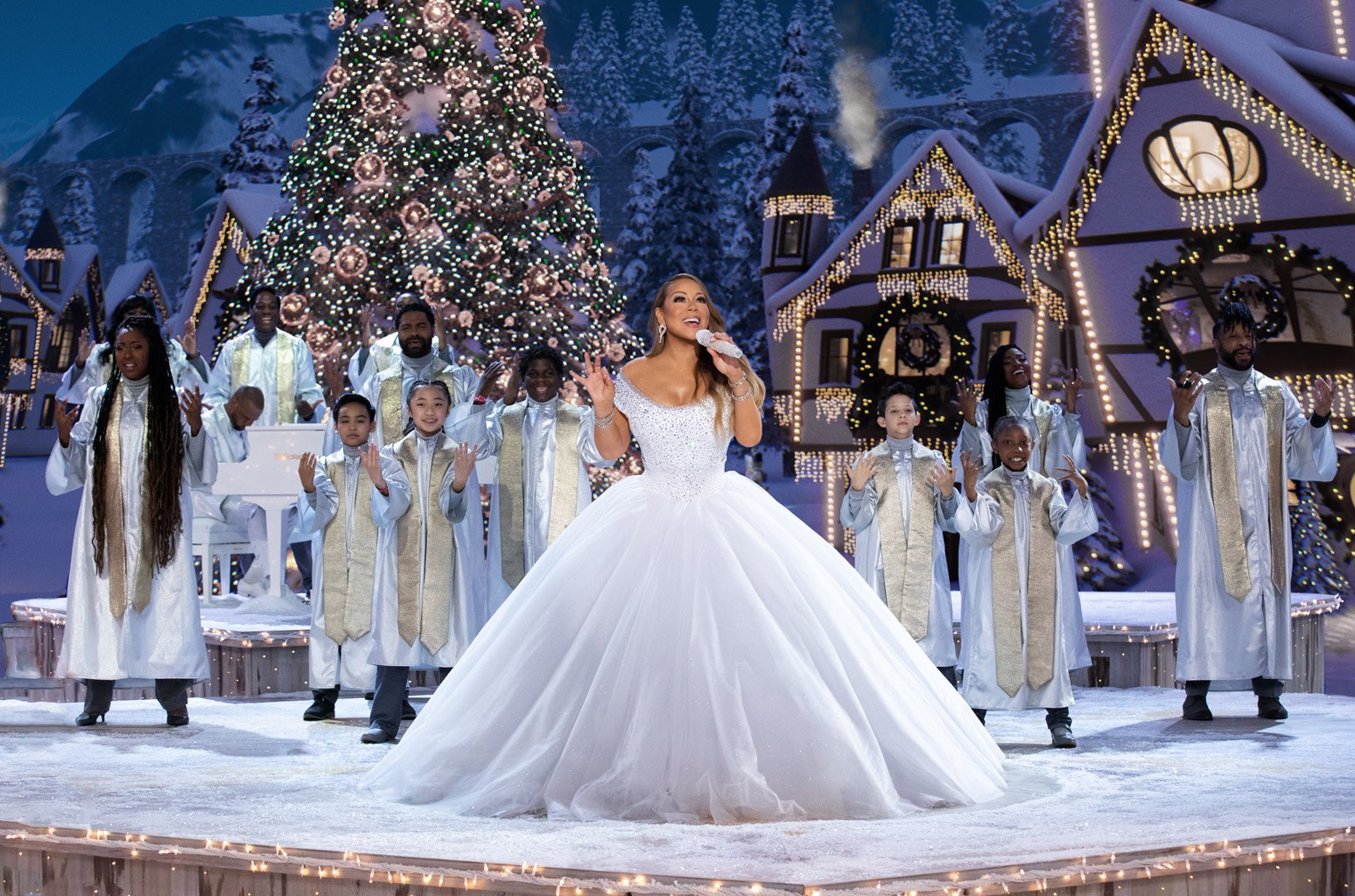
Next we have the great big white dress that takes up nearly the entire stage. If you saw a woman wearing it down the aisle you’d wonder who the hell she think she is (Celine Dion?). She could be hiding several Billy Eichners under there. But then, for the next song, it seems the voluminous skirt is removed to reveal a fitted mermaid dress underneath, with sheer cutouts, no sleeves, and plenty of cleave. This is the portion of our evening in which Mariah will now heal the world, and she does it with two things: candle light, and extensive humming. If you’re thinking about watching this special, BYOC (bring your own candle). Millie, Heidi, and Bette all seem to have been cured. Billy Eichner confirms up: cheer is alive and well! Mariah has indeed saved the day, as we all knew she would.
Tiffany Haddish closes the book on Mariah’s Christmas miracle, but have no fear, we’re all heading back to the North Pole for one last number, and Mariah will be joined onstage by her children, who are pretty enthusiastic little dancers. Her encore deserves one last costume change, into a military/nutcracker inspired red sequined number that is worthy of the song that inspired the special, All I Want For Christmas Is You. Mariah Carey could be cryogenically frozen the other 11 months of the year and just rolled out for Christmas, and to add another billion to her bank account for a song she co-wrote and co-produced with Walter Afanasieff. That song gains in popularity every damn year, it’s a modern Christmas classic and it keeps her busy all December long, belting it out at every tree lighting ceremony across the country. It even broke the record for the longest trip to the number one position, reaching the spot 25 years after the song’s original release. It’s her bread and butter and has the coveted last spot in her Christmas Special (though it’s teased earlier). It’s exactly the kind of special you need around the holidays, and it couldn’t contain any more Mariah per square inch without exploding.
Maybelline Metcalf (Jacki Weaver) is pretty much what you imagine when you hear the name – conservative, christian, Texan. She’s the church choir director, a good friend, dutiful wife, and what the hell, a little catty. She’s also shocked and heart broken to learn that her only child is dead – a gay son who’s been estranged and battling addictions since he left for San Francisco years ago.
Though husband Jeb is determined to continue on as if they never had a son at all, Maybelline’s grief and regret lead her to San Francisco where she finds Rickey’s funeral is not quite to her taste. Her son’s drag family is performing their tribute to him and it’s all a little much for this mother who has never before claimed her son in public. Her clear disdain makes a bad first impression with her son’s grieving and offended boyfriend, Nathan (Adrian Grenier), who is suspicious of her sudden appearance. He suspects she’s come sniffing around for an inheritance, and indeed there is one since Nathan and Rickey were never married – the drag bar where everyone performs. The bar isn’t doing well with Rickey gone, so instead of going home, Maybelline inexplicably stays and not only whips the bar into shape, but nurtures the acts of Rickey’s drag family.
There is a heart ache to this film as Maybelline is clearly transferring the love and acceptance she was never able to show her son unto the surrogates she finds at the bar. And what a tragic comment on society that so many at the bar are indeed in need of mothering, even if it’s from someone else’s mother.
Director Thom Fitzgerald chooses not to have Maybelline wallow in self-recrimination; instead, she rolls up her sleeves and gets to work. Perhaps being useful and creating ties to her son’s chosen family is the only way she can cope. But overall, the film doesn’t carry a dark or heavy tone, it capitalizes on drag’s new mainstream status and concentrates on making things pretty and tuneful. The other drag performers are not much more than caricatures, but this is not about the resilient queer community of San Francisco, it’s about a traditional wife rejecting her husband’s bigotry and learning to judge based on the values in her own heart instead. Stage Mother is a bit old-fashioned, perhaps a bit dated in tone, but the movie’s upbeat feel combined with a terrific performance from Weaver makes Stage Mother a worthy watch.
Safety plays it pretty safe as far as inspirational sports movies go. Following in the footsteps of Remember The Titans or The Blindside, Safety tells the true story of a freshman college football player who’s got a lot more on his plate than just practice.
Ray (Jay Reeves) is just like any other athlete at Clemson University, until things back home start to fall apart. His mother is an addict, and little brother Fahmarr (Thaddeus J. Mixson) has been alone since her most recent arrest. And things are about to get worse: the good news is, Ray’s mom is going on to a rehab facility to get help. Bad news? That leaves Fahmarr alone, and he’s just a kid. There’s no one else to take him, so it’s either a group home, or…. Or Ray decides to sneak him unto campus where he secretly cares for him for the next month or so, just barely managing between class, football, and childcare, plus the burden of a pretty big secret.
Remember that Ray McElrathbey was a real kid who took on the raising of his younger brother while attending school on a full sports scholarship. He couldn’t really afford to risk his full ride by becoming distracted, nor could he afford to risk his brother’s life. For a while he manages both, but eventually his school and those darn NCAA folks who are sticklers for rules.
Safety skirts around its darker corners, focusing instead on the importance of family and community; if you were feeling cynical you might call it sanitized, but if you were feeling generous of heart you might just find it admirable for its sense of duty, sacrifice, support, and good old fashioned taking care of each other. It’s formulaic and completely unsurprising but it’s also the kind of heart warming stuff that’s hard to resist, especially around the holidays. Director Reginald Hudlin knows he’s got a good story, and tells it in a low-frills, straight forward kind of way, and if it’s a little saccharine, well, we could all use a little extra sweetness this year, couldn’t we?
Director Graham Kolbeins’s Queer Japan has a big, open heart. The documentary examines the multi-faceted queer community in Japan with a generous cross-section of its members. Tomato Hatakeno is a transgender activist and video game guide book author; Gengoroh Tagame is a gay erotic artist known internationally for his hardcore BDSM-themed manga; Vivienne Sato is a famed artist and drag queen. But despite the film’s depth of trailblazing artists and activists, it punches most heavily when it’s sitting with everyday people, people who are making compromises and taking risks just to live some part of their truth. One young person, a misfit, a gender outlaw, commented at a pride parade “I don’t give a shit about love, I need toilets” – a brutally honest reminder of a hierarchy of needs and rights that are not addressed equally within the community (or, I suppose, without).
Curating from over a hundred interviews conducted over 3 years in various locations across Japan, Kolbein has more than enough colour to paint a rainbow. We get a back stage pass to the glossy parties and the seedy underground, meeting people living boldly in all walks of life. It’s truly a prismatic view of Japan’s deliciously diverse queer culture, and a glossary of terms is helpfully provided so we enjoy as immersive an experience as possible.
Queer Japan is a celebration of non-conformity, of alternative thinking, of living life without apology. But this party is also well-informed by that same community’s hardships, struggles, and minority status. While much of it is still lived in the margins, the documentary’s hopeful, irrepressible tone makes it clear that change is coming, and this vibrant, resilient community is not just ready for it. They’re making it happen.
Queer Japan is available in virtual cinemas and on demand December 11.
The Prom is a new movie on Netflix based on a Broadway musical of the same name about a handful of Broadway stars looking to clean up their image by taking on a random cause. The cause in question is a prom in Indiana that the PTA would rather cancel than allow a gay student to attend with her girlfriend. It’s a pretty gay musical that Ryan Murphy manages to make bigger, better, and gayer than ever, with boatloads of sequins and buckets of wigs, and the shiniest, sparkliest cast he could assemble.
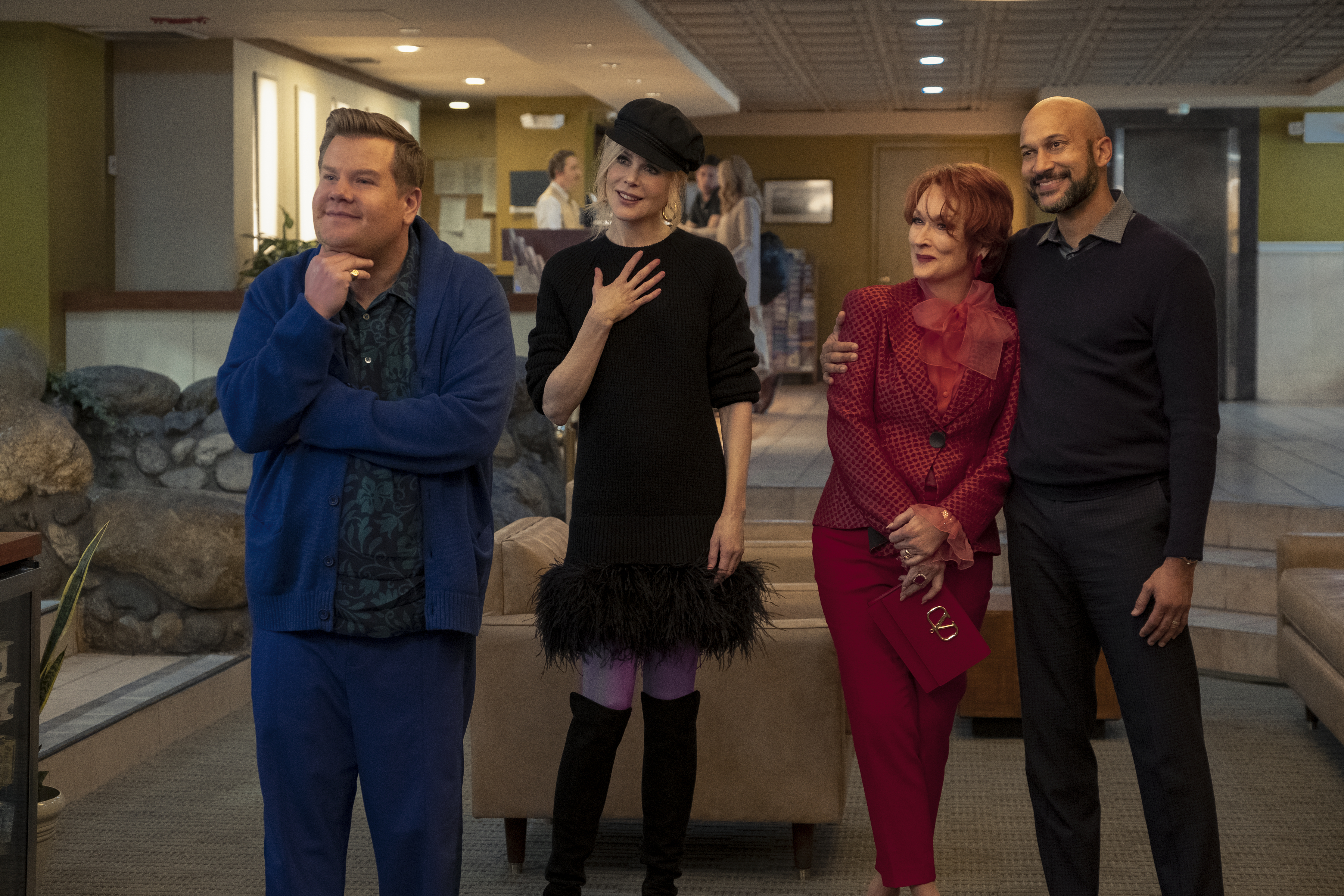
Dee Dee (Meryl Streep) is a veteran stage actress, a Broadway phenom with a Tony in her purse and an outsized sense of entitlement. When we meet her, she’s starring in the opening night of Eleanor, a musical about Eleanor Roosevelt. Co-starring as FDR is Barry (James Corden), a Broadway mainstay who’s still chasing that first Tony, and hoping this might be it. Unfortunately, a bad review pretty much shuts them down on that first night, and someone has the temerity to point out that it’s not so much that the show is bad as that the two of them are so disliked. They’re narcissists, they’re told, though they’re not convinced that’s such a bad thing. But in the best interest of their careers, they decide to rehab their reputations by support a cause (a cause celebre, they specify) along with Broadway actor “between gigs” Trent (Andrew Rannells) and inveterate chorus girl Angie (Nicole Kidman), who ride the next bus out of town toward homophobic Indiana.
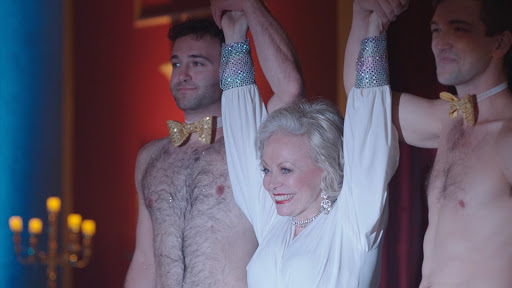
Emma (Jo Ellen Pellman) is the sweet teenage girl who just wants to take her girlfriend to prom. Alyssa (Ariana DeBose) is her closeted girlfriend and the daughter of Mrs. Greene (Kerry Washington), the “homosexual prom’s” #1 opponent. Principal Tom (Keegan-Michael Key) does what he can to mitigate the damage but he’s pretty powerless with so much opposition. Plus, now he’s start struck on top of everything else – he’s Dee Dee’s biggest fan.
As our Broadway do-gooders get to know Emma and her situation, what started out as a charitable act of self-interest turns into something a little more genuine, although the unironic, attention-hogging performance of It’s Not About Me had its charms. Both the songs and the film are uneven, but they’re also so much fun, who cares? I didn’t particularly buy Nicole Kidman as a mere chorus girl either, but do you hear me complaining? No. Because singing and dancing have put so much joy in my heart I should feel ashamed to ask for anything more.
The Prom is not a great movie, but it is boisterous, glittery good fun, full of beautiful costumes, beautiful voices, and a totally stacked cast. Ryan Murphy doesn’t do subtle, but he does have an eye for a fantastic musical number and this movie has north of a dozen. Though the feeling may be flitting, you can’t help but feel good while watching it, and what a perfect way to spend an evening near the holidays. The Prom is pure indulgence – tacky, campy, cheesy, and unforgivably feel-good. So feel it.
I was in the right kind of mood to fall in love with a movie, and Mank was it for me.
Sean and I were at the cottage last weekend celebrating his birthday, and it was the first 48 hours I’d spent movie-free all year. Which is weird, considering 2020 will be known, among so many other things, as the year without movies. And yet, if you’re devoted to movie views and reviews, there were actually plenty of films to watch (this is my 428th review this year, not including some of Halloween and Christmas content that I backdate). Still, a lot (most) of the big releases have been delayed and there were perhaps fewer films to really get excited about – most markedly at this time of year, as Christmas is usually the big awards kick-off. So I was ripe to be swept away, ripe to appreciate something big and intentional, thoughtful and well-crafted. Mank was a cinematic gift under my tree this year, and the tag reads ‘With Love from David Fincher.’
Herman J. Mankiewicz (“call me Mank”), having just survived a car crash, is laid up in bed with a broken leg. Recovering in seclusion, and bedridden due to injury, he is perhaps in a wonderful position to do some serious writing, or that’s what Orson Welles is hoping. Orson Welles is a hot shot young director who’s just been given the Hollywood golden ticket, a rare opportunity to have complete creative control over his films. Welles has selected notorious drunk Mankiewicz as his screenwriter, leaving him with a stack of pristine white pages, a nurse, and a typist to get the work done in just a few weeks. What Mank eventually turns in will be a whirlwind, and long-winded, but beautifully written script for what will turn out to be the greatest film ever made: Citizen Kane. David Fincher’s movie takes a closer look at the duress under which that screenplay came to be written, and the Hollywood experiences that inspired it.
1930s Hollywood had a lot of stuff going on: a great depression, a looming war, rising anti-Semitism, the demonization of socialism…it was the Golden Age of Hollywood, but if you rubbed at the gold plating just a little, you could easily expose an awful lot of ugliness. Mank was a skeptic and a scathing social critic. Before he wrote for movies, he wrote for newspapers; he was the Berlin correspondent for the Chicago Tribune but really sharpened his wit as the drama critic for The New York Times and as the first regular drama critic at The New Yorker. When he made the move to Hollywood, Mank was often asked to fix the screenplays of other writers, with much of this work going uncredited. Ultimately he worked on The Wizard of Oz, Man of the World, Dinner at Eight, Pride of the Yankees, and The Pride of St. Louis, and dozens more. He became one of the highest-paid writers in the world, audiences gobbling up his new style of “fast” and “immoral” characters and plot. He wasn’t the most important man in Hollywood but he knew the ones that were – studio head Louis B. Mayer, for example, of whom Mank was not a fan.
David Fincher’s film sees Mank (Gary Oldman) laid up in bed, reflecting on his time in Hollywood, and digesting it into a movie that Welles (Tom Burke) would immortalize, critics would applaud, history would remember, and Hollywood insiders revile, for they knew the man Mank was referencing behind a veil so thin it left very little doubt. The man was of course frenemy and newspaper tycoon William Randolph Hearst (Charles Dance).
As typist Rita (Lily Collins) races to keep pace, turning his volumes of scrawls into something legible, Mank writes feverishly and drinks furiously. He has clearly been holding on to a lot of resentment as we flashback to specific events that are easily related to characters and scenes that we know and love from Citizen Kane. Hearst’s mistress, for example, Marion Davies (Amandy Seyfried), an actress for whom Hearst co-founded a movie studio, and to whose career he devoted many headlines throughout his vast media empire. And Mayer (Arliss Howard) at the studio, shamelessly churning out propaganda that would be mistaken for news (fake news, we’d call it in 2020) in order to sway elections. Mank has contempt for them all, and yet he’s able to turn into a script about spiritual corruption into, well, an enjoyable movie about spiritual corruption. It’s beautiful, in its way, in its insight and compassion.
Fincher’s film attracts my attention, my whimsy, and my admiration from the very first frame – from the opening credits, even. It looks and feels like a movie made during the period in which it’s set, and yet it also looks and feels as though it has every benefit that modern 21st century film making has to offer. With the help of cinematographer Erik Messerschmidt, Fincher straddles a line of his own making, and manages to lay down on film the very best of both worlds. Mank is textured and technically brilliant. It is a love letter to cinema, to the greatest movie ever made, and to film making itself, by brilliant film maker himself, an auteur, a highly skilled visual storyteller who eschewed film school and cut his teeth instead on Rick Springfield music videos (true story). After making his way through the very best (Madonna, Aerosmith, Iggy Pop, George Michael, Michael Jackson, the Stones), he made the leap to the big screen with 1992’s Alien³ (which also starred Charles Dance, fyi), which wasn’t a critical darling but did take some admirable risks with the franchise’s mythology. Ice broken, Fincher never looked back, and if you’re any kind of cinephile, chances are pretty good at least one of his films is in your top 10 (Se7en, Fight Club, Zodiac, The Social Network, Gone Girl), yet he’s never won an Oscar for direction, nor have any of his films landed the coveted Best Picture award, though The Curious Case of Benjamin Button seemed a shoo-in with 13 nominations that year (it lost to Slumdog Millionaire). Will this be Fincher’s year?
Mank‘s cast is not to be forgotten, the film’s success in large part thanks to an extremely talented ensemble who really work the material. The razor-sharp dialogue can be a lot of fun, and some of the drunken soliloquies are absolutely the stuff Oscar clips are made of. Gary Oldman of course deserves top credit for portraying a cynic with a secret soft heart, but he’s surrounded by people able to rally, particularly Charles Dance who is most hypnotic as a titan outraged by criticism. The quasi-betrayal between these two men is a magnetic source of conflict and intrigue.
The script too, is something to behold, and it’s perhaps the component that fascinates me most, credited to a Jack Fincher. Any relation, you might ask? Indeed, Jack Fincher is David’s father. David’s dead father, in fact, dead since 2003 in fact. Mank is his only screen credit. Clearly this script has been languishing in a drawer somewhere for quite some time, perhaps its only companion a screenplay about Howard Hughes that never got made once Scorsese chose John Logan’s version for The Aviator. Still, Mank must have been the favourite, since David recalls that as a budding child cinephile shepherded mostly by his father, there was no question which was “the greatest movie ever made.” Of course, that was very much nearly fact for a very long time, the film beloved and admired from the 1950s on (especially once it started being screened on television). It has been the watermark against which all other film is measured, and has informed an entire generation of film makers. Jack Fincher’s script is a clever way to let us celebrate the film once again, and perhaps appreciate some of its most personal influences. The senior Fincher gets lone credit for the script, though the way it proficiently draws such incisive parallels to present day makes it clear that Junior has had a hand in it is well. I wouldn’t be bothered one bit to see Jack Fincher receive an Oscsar nomination for his work, and I do wonder who holds the record for (forgive me) most posthumously awarded recipient.
Mank manages a send up to an entire era of film making while also saluting the man who gave so many favoured films of the time their unique flavour and identity. It’s a peek behind the scenes that isn’t necessarily pretty, but incredibly fascinating, an homage to an undisputed classic that just may turn into a classic itself.
Two years after we first met her, little Angela, an Irish lass living in the very early 20th century, is still known in her little town for having stolen the baby Jesus from the church’s nativity scene. It was pretty innocent, as far as thefts go; she only thought he looked cold lying there in his manger, and took him home to make him warm and cozy.
Nowadays the baby Jesus has a very nice knit sweater to keep him warm, but Angela still visits him in the church to pray and ask for help. With Christmas fast approaching, Angela has her eye on a fancy dolly in the storefront window, but her family is still largely impoverished despite her father having left for work in Australia over two years ago. Setting aside their own interests, Angela and brother Pat decide to use their Christmas wish to bring their father home – or rather, to go and get him. When digging to Australia doesn’t work, they start busking for a train ticket. Their plan is not the most efficient, but their hearts are in the right place.
Is there any chance that Angela’s family will find happiness this holiday? You’ll have to watch to find out. The characters are based on the writing of Frank McCourt. The animation is as sweet as it sounds. And at just 47 minutes, it’s a great little watch for a special pre-bedtime treat with the kids.













 ASSHOLES WATCHING MOVIES