Category Archives: Movie Reviews

Our reviews and thoughts on the latest releases, classics, and nostalgic favourites. Things we loved, things we hated, and worst of all, things we were ambivalent about.

Dirty 30

Kate is reflecting on her life, as one tends to do on or around milestone birthdays. A string of no-good, very bad, choose-celibacy dates has left her a little dismayed.  Good thing she’s got two reliable best friends, Evie and Charlie, to walk her back from the ledge – particularly when her high school teacher mails her a letter she once wrote to her future 30 year old self. The letter brims with a conviction that rankles; 15 year old Kate never doubted that she’d have love and babies and professional success. She’s going to need both friends and about a gallon of wine to come back from those bounteous predictions. But it’s a chance encounter with an old high school rival that pushes Kate from sad to mad. And mad can be solved with tequila shots and a blowout party.

The party goes off the rails, as you knew it would. It’s peopled with old flames, new flames, current high school students, current high school teachers, and of course, eventually, the cops. It includes antics such as yoga-enabled keg stands, bubble baths, TPing, unhygienic body shots, dentistry, and juicy secrets. It’s got grossly misspelled tshirts and banners, and a cake that’s about 8 sizes too small. Mostly, though, this is a movie about Kate (Mamrie Hart) and her two besties, Evie (Grace Helbig) and Charlie (Hannah Hart). Their chemistry is good enough to make you miss your own best friends.And while you’ll understandably want to skip the rager, and the white russians (does anyone seriously drink those?), a couple of bottles of wine are always appropriate.

For my 30th, I was in New York City. I saw Wicked on Broadway, drank a couple of bottles of wine at a terrific Italian place, and had a carriage ride around Central Park. What did you do – or can you even remember?



The New Romantic

Blake’s lackluster love life just got her fired. She used to be the sex columnist for her college newspaper, but since she can’t remember the last time she even gave a hand job, her readers have lost interest in her sex life, and maybe she has too.

Conveniently for both the script, and her sudden interest in gonzo journalism (prize money is at stake), the VERY next night she tapped to be the third party in a sexual tryst where two of the positions were be paid, hers included.

Prostitute? Gold digger? An older, wealthy man “helps” a young woman out, in exchange for sex and the good, easy parts of a relationship – dates but not feelings, essentially. MV5BNWVkNDc2NDAtMzg5Ny00NDNlLWI5MmItZDRlOTY5YjFiMTY5XkEyXkFqcGdeQXVyNTA5NDQ1NjU@._V1_SX1777_CR0,0,1777,957_AL_Rather than cash, she gets paid in designer hand bags and trips to Paris. Wait. Is this sounding a little too much like sex with Sean? Not that Sean has ever bought me a sex moped. A “ho”ped if you will. But bags and trips for sure. So there’s a gifty element to almost any relationship. And Blake wonders why we’re so squeamish about gold diggers anyway. History is filled with patrons.

The New Romantic is an entertaining if enjoyably predictable introduction to the sugar baby lifestyle choice – a world I knew little about, and to be honest, I hadn’t often thought of this side of the equation. Sugar Daddies are a known quantity. In this case, Ian claims not to know what women want, and he has enough money to not spend the energy figuring it out. It hurt my feelings a bit that the rich old man is played by Undeclared’s Timm Sharp, who is younger than Sean, but I guess this is our new reality. Ian doesn’t play games; he makes faithful transactions. He even seems to like Blake (Jessica Barden), which is confusing for her. Blake is young enough to confuse money and its trappings for romance. After dating broke college boys, fancy french restaurants and conflict-free diamond tennis bracelets seem awfully chivalrous. Of course, where some men may expect sex after such “chivalry”, Ian feels entitled – he’s owed, because technically, he’s paid for it. So that one time you try to beg off and realize that your No doesn’t hold salt, it’s a bit of a wake up call.

This movie is a sweet surprise and Jessica Barden is a big part of its success. Director Carly Stone has a light touch. For the most part it’s fun and flirty – which makes the few weightier scenes all the more noticeable. The New Romantic features an actually likeable Millennial and a forthrightness about her particular dating woes, told in a way that makes us all feel a lot less judgmental. And it also might make you wonder if you’re underpaid for all that milk you’ve been giving away.

Certain Women

Laura (Laura Dern) is a lawyer in smalltown America. She has a client who got a raw deal from his work after an injury. But since he took their initial offer of compensation, there’s not much she can do. Of course, for months he’s refused to believe her, and only hearing the same words from a man seems to do the trick. That is, until she gets a call  in the middle of the night that he’s taken someone hostage and thanks to an ineffectual crime response in Montana, it falls to her to defuse the situation.

Gina (Michelle Williams) and her husband are trying to build their dream home. AMV5BMjE4MDE3NzA3Nl5BMl5BanBnXkFtZTgwNzA5OTA1NzE@._V1_SY1000_CR0,0,1499,1000_AL_ conversation with an elderly gentleman who may or may not have some soapstone to sell exposes some cracks in the foundation of her marriage. Are they even on the same page?

Fresh out of law school,  Elizabeth couldn’t bed certain she’d land a good job so she started taking anything she could get. That’s why, despite landing a position with a law firm, she’s also driving 4 hours each way twice a week to teach an adult education class where the students don’t seem to quite appreciate what they’re doing there. Her only real connection is with an unenrolled student, a ranch hand (Lily Gladstone) who’s just wandered in off the street, curious. Curious about people, not the subject. The rancher and the teacher will converse over greasy spoon fries after class.

These three stories only intersect in the vaguest, merest of ways. Certain Women is more about the female experience in this tiny town, and what it’s like to be breaking new ground, literally and figuratively. Director Kelly Reichardt gives us these stories like she’d give a gift. She has uncommon skill at finding compassion and nuance in the smallest of everyday stories. We feel like we know her characters. There aren’t a lot of big, bold happenings, but the attempts at connection, and in fact, the missed opportunities left me bereft. Certain Women tugs so subtly at your heart. It’s full of tiny moments that you can hoard and love in whatever capacity you feel best.

Tomorrow is Another Day

Mrs. Wong (Teresa Mo) is too exhausted to care that her husband is having an affair. She tolerates it in order to keep her family together, especially important since her 20 year old son Kwong (Man-Lung Ling) has autism, and developmental disabilities, that require stability and a lot of care. But one day the young mistress (they’re always young) stops by the house and agitates Kwong. After a terrible fight, Mr. Wong (Ray Lui) leaves. He leaves them. Now the burden of caring for her disabled son falls to Mrs. Wong entirely, and with his father gone, he’s acting out more than ever. If she was tired before, she’s beyond tired now. There’s almost nothing in Mrs. Wong’s life that’s just for her – her only indulgence during these dark days is to plot revenge scenarios against the dreaded mistress.

Teresa Mo, Ray Lui, and Man-Lung Ling make for a very attractive family; you’d hardly MV5BY2U2OTQ2ODQtNjQzMC00YTdiLWJiZTYtOWQ3MGI1OTE3NTJjXkEyXkFqcGdeQXVyNzI1NzMxNzM@._V1_believe from the outside all the difficulties they face. But Mo and Lui are good at communicating a marriage strained by years of putting someone else’s needs above their own, of never having the time to honour their coupledom. We know that this is not Mr. Wong’s first dalliance, and we see the toll it’s taken on their marriage.
Ling’s portrayal of special needs is perhaps not the best we’ve seen on screen, but it’s Kwong’s relationship with his mother that is the most essential of the film. He’s normally cheerful and energetic; he skips along, vocalizing sounds more than words. But his meltdowns are ferocious. A full-grown man, when he starts self-harming, Mrs. Wong really can’t cope on her own. By showing us the enormity of her caregiver’s role, director Chan Tai-lee (the guy who wrote Ip Man) highlights a dearth of resources, of respite. Mrs. Wong shoulders it all, without complaint, facing down discrimination like that’s to be expected. All of her anger and resentment are saved for the mistress (a one-note, selfie-taking villain); murder fantasies are her only escape.

Her social life’s only balm is a group of housewives with whom she sews and sings karaoke. But these are the same women who will uncover her plot. And then what? You’ll have to watch to the end to find out.

Ramen Shop

Masato is a young man working in his father’s successful ramen shop in Japan. Though it’s just been the two of them since Masato’s mother died, their relationship is strained. Masato thinks the only way to get his father’s attention is to be a steaming bowl of noodles. After work, Masato’s father disappears to drink alone; at home, they’re like two ships passing in the night. But then one day his father dies, as all fathers must, and Masato is alone in the world.

Curious about his mother, Masato (Takumi Saitoh) reads the old diaries she’d left behind and for the first time discovers the inter-racial courtship between his father, who was Japanese, and his mother, who was Chinese, and understands the source of the rift between his mother and his grandmother that prevented them from reuniting even as his mother lay dying.

Masato decides to travel to Singapore where he’s introduced not just to long-lost family members but secret family recipes as well, and through food, culture.

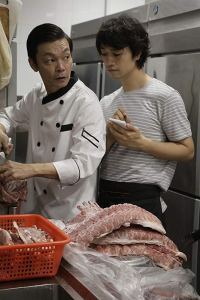
Ramen Shop is slow to start. I didn’t feel emotionally invested until about half-way through, but once the delicious, 10 hour pork rib soup starts to simmer, so did my heart. MV5BYmM0NjkxZWItOTI4MC00ZWZkLTk3ZTItZTBjNGYyZWYxMjA5XkEyXkFqcGdeQXVyNTc5OTMwOTQ@._V1_SY1000_CR0,0,666,1000_AL_The cast is endearing, and I love how director Eric Khoo blends together race as if it’s fusion cooking. The Japanese and Chinese people have had an uneasy past and you can see that Masato has a hard time reconciling the two parts of himself. However, grief is a powerful motivator, and when he understands how his father honoured his mother’s memory by incorporating her culture into his cooking, Masato is inspired to do the same.

Since Masato and his uncle and cousins speak different languages, they communicate primarily in their shared third language, English. His grandmother, however, does not speak English. Masato speaks to her on a more elemental level: food. He cooks for her and hopes his dish will prove not just love, but the link that’s been missing between them all these years. This detail felt so familiar to me. It may not always be ramen, but almost all families across many cultures have some dish they call their own, a dish that tastes like home.

For me, it’s my grandma’s molasses cookies. She’s been gone 15 years but one of my most treasured items is a recipe for them in her own hand. I make them for my niece and nephews who never met her but still enjoy the same treat I did growing up, and I know her love is in each bite. My other grandma, who I call Nanny, stood by my side in her kitchen and taught me how to make her apple pie when I was a girl. Today pie crust comes out of my hands instinctually. I don’t need to make Nanny’s apple pie because we’re lucky to still have her with us (though we did lose the apple trees in her backyard). She assures us that her chest freezer is well enough stocked that we’ll have apple pies well after she’s gone. I’m pretty sure she means that to be comforting. What’s the recipe in your family?

Blue My Mind

Mia has just transferred to a new high school where she’s desperate to fall in with the popular mean girls. Gianna and company are serious mean girls though; their first group activity is breath play, where the teenage (tweenage?) girls grab each other by the throat until they pass out. You know, kid stuff. Unconscious, Mia has a dream or a hallucination that she’s underwater, the bubbles overtaking her.

At home, Mia (Luna Wedler) and her parents are struggling to get along. She thinks they might be keeping her adoption a secret from her. They’re not sure whether her recent moodiness is regular teenage stuff or not. I’m not exactly sure how old Mia is. She looks easily 15 to me, but she gets her first period and has her first sexual experience back to back, and not necessarily in that order. I do know that whatever’s going on with her MV5BOTAzODhiZGItOWI0Ny00ZjE2LTlkNDItNzk2ODY1YWY2YjIyXkEyXkFqcGdeQXVyNjE3NzgzMDM@._V1_SX1777_CR0,0,1777,743_AL_emotionally, her physical transformation is NOT normal teenage stuff. She’s suddenly compelled to eat the family’s pet goldfish. She grows webbing between her toes. In her mind, these are linked to the onset of her period but her doctor disagrees. Moodier than ever, Mia is also learning to be more secretive.

Some of you will remember how hard it is to be a teenage girl. Well, it’s a whole lot harder when you’re a teenage girl in the process of becoming a fish. And though her transformation seems random to her, to us it feels linked to her increasing desire to fit in with a crowd travelling way faster than her normal speed. The more she conforms, the more her body changes – and all she wants to do is fit in! It’s a cool idea that feels a little familiar, because all the rest of the bratty teenage tropes are right there.

The movie gets uncomfortably into body horror territory when Mia tries to alter or “fix” the changes in her body. This is a bold movie and probably not for everyone. Wedler and Zoe Pastelle Holthuizen manage some pretty compelling performances, and director Lisa Bruhlmann creates some stunning visuals. The metaphor’s a little too on the nose, but if you’re intrigued by the fishiness or you’ve always had a thing for mermaids, this might be worth a watch for you.

Letter From Masanjia

A woman is rooting through her garage, looking for Halloween decor she can repurpose for her daughter’s 5th birthday, which falls around the holiday. She retrieves a styrofoam grave marker that says RIP, purchased at Kmart 2 years prior but not yet used. Out of the box falls a note, a plea really, begging the recipient to turn it in to a human rights organization. The note details the abuses suffered by the man who made the decorative headstone; it is signed by a prisoner from China’s most notorious forced labour camp – Masanjia.

The woman is understandable freaked out but she complies with the note’s directive – she contacts Human Rights Watch but they are unresponsive. She goes to Kmart with it but they ballsily deny using labour camps, which are illegal. So she goes to her state newspaper, The Oregonian, and it publishes an investigative piece, and basically the story blows up from there – even reaching so far as China, where the people have to bypass a firewall in order to read western news. a man named Sun Yi is surprised to read the story and recognize his note.

Sun Yi had been released from the camp 2 years earlier, but is still haunted by the torture he suffered there. This documentary explores Sun Yi’s experience, the common labour camp experience. Director Leon Lee interviews prison guards, civil rights lawyers, and Sun Yi’s wife. Sun Yi suffered corporeally while in the prison, but his wife and their family faced raids, discrimination, and harassment on the outside.

Sun Yi is not a criminal. He’s a practitioner of falun gong, those slow exercise paired with moral philosophy that espouses tenants of truthfulness, compassion, and tolerance – the mind body improved together. China’s communist party felt threatened by the sheer number of falun gong followers, and began persecuting them systematically. Since 1999, Sun Yi had been arrested, detained, or abducted 12 times. Pressure increased around the time of the Olympics (circa 2008) and Sun Yi was ultimately sentenced to two and a half years for being in the possession of printer paper, suggesting he’d printed materials about his beliefs.

To really understand the torture and the suffering of this labour camp, you simply must watch. Sun Yi is a wonderful subject but his stories are tough. His experiences are horrific. But this isn’t just about one man’s harrowing time. It’s about the effectiveness/ineffectiveness of news stories going viral; about paying attention to where and how things are made; about the China’s long arm and continued human rights abuses. Letter From Masanjia is the best kind of eye-opener, unsettling to its core.

Ronnie Coleman: The King

Ronnie Coleman ripped the bodybuilding world in two in 1999 when he appeared on the already crowded scene. A former cop and powerlifter, he ties the record for most Mr. Olympia wins with 8, count em – 8, victories. That’s how you get a nickname like The King.

But since his retirement, he’s been plagued with injury as a result. He’s had numerous back surgeries, and both hips replaced. He needs crutches just to walk. The documentary catches up with him on the eve of his 8th (count em – 8) surgery, and he’s crippled with pain. It’s awful to watch him walk.

His accomplishments are enormous (bodybuilding pun!) and veiny, but told through the MV5BN2M0YmFmM2MtNGIyZS00NjY4LTk1MjgtNGRmNjdjMjE1MDk5XkEyXkFqcGdeQXVyNDMxNTQ3MTk@._V1_SY1000_SX675_AL_prism of his disability, they’re not exactly dimmed, but the context is clearly costly. Too costly, some, in fact most, would say. But as Ronnie pulls up to the supplement store, he parks in the handicap accessibility parking – and even then he barely makes it in. But what is he even doing there? Well, despite the fact that he’s popping the max dosage in pain pills, Ronnie is still drinking his protein shakes because Ronnie is still training. It’s killing him, but he can’t stop.

It’s really interesting to watch someone attain the absolute top in his field, and it’s interesting in a different, guilt-laced way to watch him fall. But Ronnie Coleman with a broken body proves there are different kinds of strength. It’s a mental fortitude he’ll need to cope with his loss. His smile and positive attitude go a long way.

This documentary has everything – the highs and lows, tragedy and comedy. Well, this documentary has almost everything. You don’t achieve 300lbs of lean muscle, go down in history as the greatest bodybuilder of all time, without a little help. But director Vlad Yudin does not so much as whisper the word steroids. So no, there is not complete transparency here, perhaps an effort not to tarnish the king’s image. The picture is incomplete but on the whole it’s still an enjoyable, heartbreaking, uplifting (bodybuilder pun!) watch.


Kings

Millie Dunbar (Halle Berry) is the big-hearted, hard-working foster mother of many, many children. They’re crammed in to her apartment, bunk beds stacked on bunk beds, but they are safe and happy and loved. Except of course when Obie (Daniel Craig), the cantankerous upstairs neighbour, is harassing them, yelling at them to shut the hell up. Other than that, it may be a struggle, but it’s home.

Unfortunately, home, in south central Los Angeles, is about to get shaken up. It’s just days before the Rodney King verdict will be delivered. Things are about to blow up.

Like Gook, Kings looks at this contentious, violent time by getting intimate with one of the every day people affected by it. And I don’t just mean affected by the riots directly, MV5BZWVkOTZkYzktYTVkZS00M2MyLThkN2EtYjBiZjkzYzc2YWFmXkEyXkFqcGdeQXVyNTQ1MTYzNzY@._V1_though Millie’s family certainly will be. In Kings, we see the trial on the tiny, fuzzy TV sets in every living room. People are living and breathing it. Millie is deeply moved by the updates on the news, and Halle Berry’s excellent work reaches out to touch us in the audience. Millie is raising multiple black boys in a neighourhood patrolled by white cops looking for any excuse (or no excuse) to take out their disgust with the trial on anyone whose skin fits the profile. For her, it’s real, and the consequences are terrifying. Halle Berry hasn’t had roles really worthy of her lately, but this is a good one to sink into.

Of course, things really get moving after the verdict is read. Millie’s kids are strewn all over a city going down in flames, and she is not the type to sit on her couch and hope they come home safely. Her rescue mission will be aided and abetted by Obie.

This movie isn’t about the riots, but about an unconventional family caught up in them. I am not old enough to have my own memories of this time, but of course I haven’t failed to absorb all kinds of details and impressions over the years. That said, I don’t think I’ve ever really felt it, or understood the extent of what it must have been like for a black person in L.A. (and elsewhere in the country, I imagine) at the time, the disbelief that this verdict could be returned, and the utter fear, the utter terror for one’s safety, and for that of every kid in the community. What a brutal reminder, as if one was needed, that their lives are not equally valued in their own country, to their fellow countrymen. Berry’s panic, and the tears that come so easily to her eyes, tell me this.

A Kid Like Jake

What kind of kid is Jake? Like most kids, Jake is many things, and to his parents, he is everything. But when they say “a kid like Jake,” they mean how Jake is different. How Jake likes to dress up in little girls’ dresses. How Jake’s gender identity is maybe fluid. No one says those exact words, of course, because Jake is still young. Jake is so young that his parents, Alex (Claire Danes) and Greg (Jim Parsons), are in the midst of registering him for school. Not public school, hopefully, which has been deemed unacceptable. So they’re making the rounds, doing interviews and writing application essays – thousands of kids for just a few hundred slots, and Alex and Greg need Jake to get financial aid on top of it.

But how old is old enough to even know something like that? I have one nephew who, as MV5BZjFkZjI4ZGQtODRmNi00MWNmLTllYzAtM2Q2MGYwNzhkYjY0XkEyXkFqcGdeQXVyMTExNDQ2MTI@._V1_a baby, was always attracted to my baubles. He’d pull on them and gum them as a tot but when he was old enough, he’d steal them and be a very well-accessorized toddler. Another nephew insisted on having his finger nails painted whenever his mother did hers. One little guy had a dolly that he loved to play with. Once, when we brought him to Build-A-Bear, he insisted on our purchasing him a pink stroller for his bear. We obliged of course, and presto, change-o: instant mall hazard, a 3 year old on a complete tear, careening his plastic stroller possibly right into your shins. Does any of this mean anything? Other than that kids aren’t born knowing about gender stereotypes. Most kids will do whatever’s fun, grab whatever’s sparkly, unless of course they’re shamed.

Jake seems to gravitate more toward things traditionally thought of as ‘girly.’ His parents don’t think too much about it, until it’s time to submit applications and they need a hook that will distinguish him from the thousands of other kids. A friend and early childhood educator (Octavia Spencer) suggests that Jake’s gender questioning play might be worth a mention. But when tensions are high, it turns out Jake’s parents are a little less tolerant than previously believed. Not that they’re anything but accepting of their child – it’s toward each other that they harbour resentments, and those babies are coming out!

Truth be told, the subject is treated with kid gloves. It’s sensitive, and they’re so worried about blundering into it head-on, they perhaps fail to graze it fully from the side. No matter. It’s still ripe with interesting questions that are worth considering.