Category Archives: Movie Reviews

Our reviews and thoughts on the latest releases, classics, and nostalgic favourites. Things we loved, things we hated, and worst of all, things we were ambivalent about.

Planet of the Humans

Global warming isn’t up for debate. Not only is it real, it’s already here. It’s happening. And the sad thing is, we’ve seen it coming for at least 60 years. We’ve talked about fossil fuels and acid rain and peak oil and holes in the ozone layer literally all of my life, and in fact, literally all of my mother’s. We’ve reduced, reused, recycled. Sort of. We never reduced, that’s for sure. We fill our blue bins with more and more single use plastics every day. Capitalism ensures that we don’t reuse – in fact, it’s got us replacing items that aren’t even broken. And now our recycling programs are a sham; China used to buy our recycled plastics but they don’t want them anymore, so our municipalities keep picking them up for the sake of optics, but they sit at the recycling facility not getting recycled.

Normally we celebrate Earth Day on April 22nd. This year was its 50th year. Of course, 2020 is turning out to be a notable year in many ways, and most communities postponed or cancelled their events due to the global pandemic. Humanity is so hell-bent on destroying ourselves that we didn’t want to sit around waiting to drown in melted ice caps, we’re just going to go straight for the super bug that wipes us all out for good. That IS ultimately what we’re talking about when we talk about Earth Day: our demise. Because the Earth is not an infinite resource. With overpopulation and overconsumption, we have stupidly decimated the planet we count on for living and breathing and existing and stuff. In his recent stand-up special for Netflix, End Times Fun, Marc Maron poked fun at our self-righteous but minuscule attempts at contribution – the reusable grocery bags, the banning of straws – sarcastically noting that “we did all we could.” I mean, it’s embarrassing. It’s embarrassing that we all saw this coming and we not only watched it happen but we hastened it. We worsened it. And in our own self-delusion, we pretend that the tiny steps we’ve taken (while refusing to make any sacrifice at all) aren’t totally phoney baloney.

Well, Jeff Gibbs has a documentary for you. Capitalism wants you to stop crying about the environment and get back to making and spending money. So they’ve thrown things at us like, for example, solar panels, so we can believe things aren’t completely hopeless. Except it’s all a lie. Solar panels are either prohibitively expensive or nearly totally ineffective as a viable alternative energy source. Making solar panels uses up a tremendous amount of resources and the same dirty, polluting fuels that we’re trying to avoid in the first place. And then they need to be replaced every few years. And you still need a back up power source so you can’t disconnect from the grid. We don’t have the capacity to store excess power for days that are cloudy or rainy or, you know, have a sunset and then a nighttime. Even if we cut down every forest we still wouldn’t have enough space to house even a fraction of the panels we’d need. So solar panels are a nice thought, but they’re really just a distraction to keep environmentally-minded people occupied while big business continues to raze the Earth.

Planet of the Humans is an eye-opener. The environmental movement as we know it has largely been a hoax. It’s a bitter pill to digest. Gibbs is clearly an acolyte of Michael Moore’s. Not only does Moore produce this documentary, Gibbs mimics his style quite blatantly. But Gibbs is no Moore. He doesn’t have the same bullish charisma. He isn’t as emphatic or as fist-wavy. So while this is an important conversation starter, it’s not going to make waves or win awards or convert any birthers. But for the next 30 days, you can watch it for free on Youtube, and this is one way we can honour the Earth without compromising social distancing.

The Willoughbys

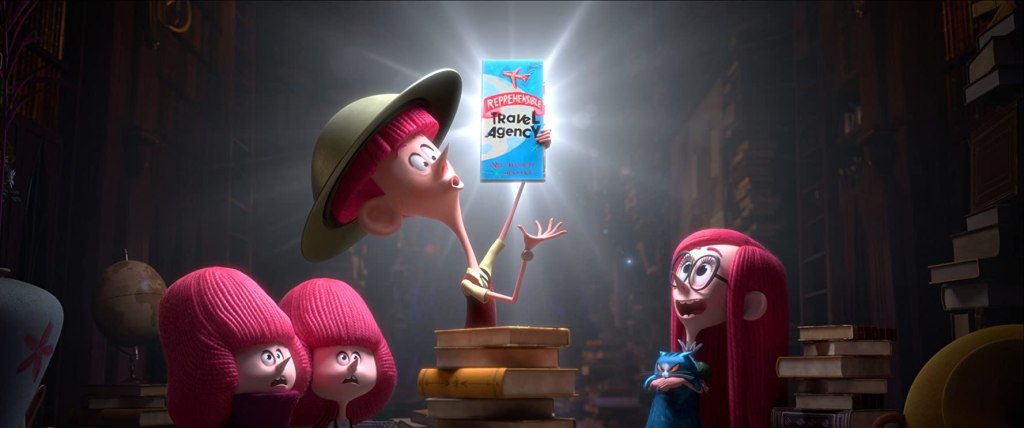
The Willoughbys come from a long line of impressively mustachioed ancestors as evidenced by the numerous oil paintings lining the hallowed halls of their “old fashioned” home. But the buck stops here, apparently.

Mother (Jane Krakowski) and Father (Martin Short) Willoughby love each other passionately. They are so consumed by their marriage neither can see anything outside it. No wonder Father has such a minimal mustache – and Mother none at all! They have four kids but not a thought to spare for any of them, never mind a care. Tim (Will Forte) is the oldest, but is still a young boy, unmustached and still attached to his head protector (you and I might call it a hat). He corals the other children – the golden-voiced Jane (Alessia Cara), and twin brothers both named Barnaby (Sean Cullen) with only a single sweater between them – and makes sure the kids don’t bother their parents with things like hunger or attention. They’re cold and they’re hungry but it’s all they’ve come to expect. Until they get a brilliant idea: to send their parents on a dangerous and frankly deadly trip cleverly disguised as a second honeymoon.

So off go Mother and Father and the children celebrate – finally, as orphans, they might fill their own bellies and occupy space in the house itself rather than the coal bin. But two strange things complicate matters: a baby gets left on their doorstep, and unable to care for her, they leave baby Ruth on the doorstep of the mysterious owner of a candy factory (best home ever!), Commander Melanoff (Terry Crews), and an unqualified but well-intentioned Nanny (Maya Rudolph) arrives. While the kids are initially wary of Nanny, she soon grows on them by providing the basic necessities of life and caring whether they live or die. It sounds a bit dire, I know, but worry not, this is a very family-friendly animated film by Netflix, and the kids are resilient and crafty, and their neglect never feels so serious that it cannot be overcome.

And of course, there are plenty of childish high-jinks, lots of pranks and booby traps and Nanny catapults, and a whole rainbow candy factory montage where a baby has the time of its life while narrowly avoiding death.

Oddly, and luckily, while the children have dismissed their parents, they learn valuable lessons about family. The Willoughbys may not land on the ending you’d expect, but they get their happy ending and they have an awful lot of fun doing it. This is a pleasant surprise from Netflix and I think your young kids are really going to like it.

Run This Town

I know Americans think they have the market cornered in disgusting, unfit politicians, but before Donald’s fated presidential run, Canada was home to a mayor who made headlines around the world – and definitely not the good kind.

With all this extra time at home, we’re supplementing our movie watching with series watching, and one that recently caught our eye on Netflix (though it has been there a while – it wasn’t interesting enough in a world where we could go outdoors, but it was just good enough for lockdown) is Daybreak. It’s basically like Ferris Bueller’s Day off, but it’s also the apocalypse, and in this one, Matthew Broderick plays the principal. And the protagonist is a student who has recently transferred from Toronto (Canada). Though the kid refers to it as a “small town,” the kind in which all fathers take their sons hunting, it is in fact our most populous city. There are about 6 million people living in the GTA, so someone didn’t do their homework. Toronto is a frequent filming location for big Hollywood movies, movies that pretend they’re actually shooting in NYC, or Chicago. Very rarely does Toronto get to be Toronto, and the one time it does serves only to remind the world of that time when we were the buffoons.

2013: what a simple, naive time it was, looking back on it now. There are basically two sets of shockingly young people behind the wheels of basically everything: the mayor’s “special assistants”, led by Kamal (Mena Massoud), and the eager newspaper intern Bram (Ben Platt). Kamal’s job is basically to babysit the mayor and to minimize the collateral damage as much as possible. Bram’s job, aside from listicles, is to try to convince the grown-ups that there’s a major storm brewing at the mayor’s office, and whoever breaks it is about to earn a tsunami of clicks.

Rob Ford. There, I’ve said it. In the movie he’s played by an unrecognizable Damien Lewis. Rob Ford was a “businessman” who simply inherited a family business that was quite successful. He nonetheless saw himself as a “man of the people.” He was a conservative who loved to shout slogans and cut taxes. And also do crack.

Are you remembering him now? Every late night host loved to skewer this guy and he just kept feeding the fire. While he may not have been the first crack-smoking mayor, he was certainly the most photographed-with-a-crack-pipe mayor. He was also a very heavy drinker, and when he was good and plastered he’d sexually harass, or assault, female staffers, and, well, female anything. He was a black-out drunk who always denied it the next day, and often offered too much information in his denials. And yet 2013 was certainly in the time of smart phones. Video evidence was plentiful.

Run This Town is THAT story. The story of Kamal, a brown-skinned young man with the unenviable job of sweeping some extra-large skeletons back into some very full closets, despite the fact that Ford constantly reminded everyone he was anti-immigrant even if he thought Kamal was “a good one.” And of Bram, who knew this was a whale of a story but never got enough professional respect to do anything about it. It’s a reminder that these millennials we’re always accusing of being lazy are actually just very busy cleaning up boomer messes. Massoud and Platt are both excellent in this, and so are many others. But Lewis as Ford was not my favourite. The performance got lost behind the extensive prosthetics, which didn’t even feel accurate. Yes, Ford was a big, sweaty guy, not unlike a Chris Farley while Lewis’ look is more reminiscent of Fat Bastard.

Rob Ford is a sore spot for a lot of Torontonians, some of whom still defend him. But it’s also hard to criticize him, let alone mock him, since he died of cancer shortly thereafter, only 46 years old. And now Rob’s brother Doug is the premier of Ontario, because people refuse to learn lessons. I will say though, that while I despise his politics, he’s doing surprisingly well as a pandemic premier, his response oddly rational, and he’s taken care to distance himself from Trump’s dangerous rhetoric. So maybe there’s hope for the Fords after all?

The good news is that Run This Town tells the story fairly. It’s not a personal attack, in fact it’s not an attack at all. Rather than shaming Ford for what turns out to be a monumental addictions problem, the movie focuses on the very young people who actually had their hands on the steering wheel. Remember, this is the generation who cannot afford Toronto’s astronomical real estate prices. They are over-educated and under-paid. They can’t afford to be picky about who they work for. Their parents who prattle on about avocado toast are the very people who voted a crackhead as mayor.


Run This Town is now available to own or rent across all digital platforms.

Once Upon A Time In London

Do you like the idea of a gangster movie, but find them too exciting, too violent, too sensational? Have I got the movie for you.

It’s based on real-life rival mobsters in London and my #1 takeaway from the film is: organized crime in London is boring as shit.

Jack “Spot” Comer (Terry Stone) and Billy Hill (Leo Gregory) are whiny little school yard boys. Comer elbowed out whoever was there before him and he can’t fucking believe that his own little protegee Billy Hill would do the same to him. So they piss and moan and act like bookmaking and racketeering are a god-given rights.

Old-timey Brit gangsters never had the benefit of seeing a Quentin Tarantino film. Or a Guy Ritchie one. So they basically have 2 moves: punching, and stabbing. Neither ever kills, so there’s just a lot of walking wounded, with dirty bandages on display (the NHS must not have been set up yet). They just keep beating each other up like they’re little kids, and they always live to bore me another day. It’s cruel.

Meanwhile, the newspapers treat the mob bosses like they’re celebrities. Everyone knows the deal and I guess there weren’t any police officers or laws to get in their way. No one seemed to really enjoy the lives they made; there wasn’t a lot of extravagance on display or good times to be had. Everyone was too busy getting blood stains out of white undershirts I guess.

The montages are brutal, the violence is half-baked, the power struggle is muted and uninteresting, and perhaps worst of all: the pauses. When gangsters aren’t punching their way down the street, they’re thinking deep thoughts. We aren’t privy to them but gosh the camera loves to dwell on quiet introspection. One such scene, taking place in a courtroom, feels like it goes on forever. Will it ever end? Not soon enough.

Real life isn’t all mink coats and gold chains and horse heads in bed. Sometimes it’s downright boring, just two blokes applying for the same job, even if that job is extortion. But the thing is, we can choose not to make movies out of uninteresting situations. Assuming you have stamps, please send director Simon Rumley a postcard saying just that.

Call of the Wild

This is the story of Buck, a behemoth St. Bernard and Scotch shepherd mix, a sweet pup enjoying a life of dog luxury in California when he’s dognapped all the way up to the Yukon during the Klondike gold rush. First he’s conscripted into a dogsled team for a mail delivery service, running across Canada’s northern frozen tundras until the telegraph makes his work obsolete. Next he becomes companion to John Thornton (Harrison Ford) who takes him out to the Arctic Circle where Buck can rediscover his primal roots.

Devoted fans of the 1903 Jack London novel will notice that neither Buck nor his dog colleagues closely resemble their characters in the book. In fact, the other sled dogs are also largely mutts, not the traditional Husky, and their personalities seem based upon the seven dwarfs. I’m not sentimental about the book so I don’t really mind the liberties taken with the literature so much as I mind the liberties taken with dogs. Because for a movie about a dog, and several of his doggie friends, there are no actual dogs in the movie. They’re all CG. And not only are they computer-generated, their expressions, especially Buck’s, are hyper real. Cartoonish. So they look out of place and they make it harder for me to relate to their characters. Buck and his pals get into some real danger. And of course, even out in the wilds, man is always any animal’s greatest threat. It’s likely too scary for very young kids, and yet it didn’t move me half as much as you’d expect from a bleeding heart with a recently deceased, dearly beloved dog. Because Buck’s movements and responses never feel real.

I have a slightly smaller pack now, but even with three dogs I’m very familiar with their methods of communication. If you live with a dog or a cat, and many times even a smaller pet, a bunny or a bird, then you’re likely pretty good at reading their expressions. You know what a tentative paw means, or a head tilt, or a lowered tail. You don’t need some ridiculous CGI eyebrows giving you Scooby Doo vibes. The constant reminder that these dogs aren’t real dilutes the story’s warmth and reduces our interest and empathy.

Ford is pretty solid, especially since he was almost always completely alone, perhaps acting only opposite a tennis ball on a stick that he had to imagine was man’s best friend. There’s a good story under all the effects, I think, but much like Tammy Faye Bakker, the message is lost, and the only story reported is the bad makeup.

Rising High

Sean called this movie Raising Hell for the first third of it or so, until we paused it and the Netflix screen helpfully cleared things up. Not that it helps to know the title, unless it helps you avoid it. And frankly, Rising High might have been improved with a little more hell raising.

It’s about con men after all. Greedy men who are money hungry and obese with ambition. Viktor (David Kross) is allergic to the poverty he experienced in childhood and is willing to do nearly anything to avoid it. He’s got the motivation and the slick good looks, and he runs into a guy, Gerry (Frederick Lau), who’s got the dirty connections. Once they bring in Nicole (Janina Uhse), a banker who values cash over morals, they’ve got themselves a perfect set-up. They screw over people like it’s going out of business. You only rise that high by stepping over other people. Generally, you have to be both skeevy AND charming to do those things. Just ask Leonardo DiCaprio, who’s cornered the market on playing skeevy yet charming. Before the fall (and there’s ALWAYS a fall guys), there’s usually a certain amount of gleeful over-indulgence. Viktor and Gerry go through the motions of course: coke, hookers, parties. All of it empty and unsatisfying naturally. And it’s not even fun to watch. Mostly because the movie’s just going through the motions too, copy-catting better films in the genre, nothing new to contribute and nothing charismatic in the copy.

This is a German film that’s as joyless as it is pointless. I was so bored that I spent most of the movie playing Dragon Squirrel. Don’t worry if you haven’t heard of it, it’s not the latest Angry Birds or Candy Crush or anything like that. Dragon is my shih-tzu Bronx’s favourite toy, though it’s really just the ripped open empty carcass of a stuffed blue and pink dragon at this point. Squirrel is the last of Fudgie’s (my Yorkie) trio of squeakie toy squirrels, also his favourite toy. The game involves me trying to steal their favourite toy, the dogs playing varying degrees of effective defense, and then some pretty epic tug of war once I have the toy in hand, me gripping the toy’s little ears, and the dogs clamping teeth down on their tails. Repeat, repeat, repeat. Usually I have a limit as to how much Dragon Squirrel I can play, and usually we make the squeaky Squirrel “disappear” about 10 minutes into any given film or series. This particular game of Dragon Squirrel lasted 94 minutes, uncoincidentally the exact run-time of Rising High. Because Rising High never rose above a whimper, never had even a tiny fragment of my attention despite the fact that Dragon Squirrel has now been played so many times the dragon no longer has a single tuft of stuffing left. The movie never gives you a reason to care for the characters, it never justifies its existence, and it never apologizes for being a weak copy of something better. I would have been more firmly engrossed by rewatching Catch Me If You Can for the 100th time, or even by rewatching Wolf Of Wall Street, which I don’t even like. So assuming you don’t have a rousing game of Dragon Squirrel to distract you, I’m going to go ahead and recommend you skip this one.

Sergio

When we first meet UN diplomat Sergio Vieira de Mello (Wagner Moura), he’s just been injured in a bombing of the UN headquarters in Baghdad. How did he get there and how will he get out? The film rewinds three years or so to trace his path as a high ranking special representative of the United Nations. Previously he’d worked to make East Timor an independent state, learning valuable lessons in open and honest communications with the very people he’s trying to help. It’s also where he meets Carolina (Ana de Armis), a woman so special that she’ll follow him to him to his next posting, in Iraq.

It’s 2003 and the U.S. has just declared war on Iraq. It’s a war neither Sergio nor Carolina believe in, but Sergio believes in his work and believes he has one last contribution to make before retiring to Brazil with his new love. Setting up headquarters in the Canal Hotel, he dismisses the U.S. troops guarding the building, taking pride in the fact that Iraqis would feel welcome to approach their offices. He was adamant that the UN remain neutral, unaffiliated with the US invasion. But this decision left the building vulnerable, and Al-Qaeda seized the opportunity, using a suicide driver to detonate a bomb under his office’s window. The blast injured over 100 people and killed at least 22. Sergio and Gil Loescher (Brían F. O’Byrne), a consultant to the UN High Commissioner for Refugees, are alive but trapped in the rubble. If nothing else, it gives Sergio plenty of time to reflect on his past.

Sergio de Mello is clearly important, if mostly unknown, and his peace-making ideals are admirable. It’s clear director Greg Barker wants to pay tribute to the man but in doing so, the story splinters. The love story is given equal if not more screen time than his storied political career, which inevitable gets simplified, complex situation distilled into soundbites, which actually seems to be the antithesis of what de Mello stood for.

Still, it’s an incredible performance from Moura and a competent one from de Armis. It is likely worth watching for that alone. It’s surprisingly slow at times for a movie that starts with an explosion, and I wish we knew more about the man and his motivations. But since this bombing resulted in a profound and lasting change to the way UN administers its practices globally, this event is worth commemorating.

Roped

Roped just recently popped on Netflix and what you need to know about it is this: it’s like Footloose, but for people who don’t like movies.

You see, the rodeo has come to the wrong town, a small but self-identified “progressive” town in which Councilman Robert Peterson (Casper Van Dien), a staunch vegetarian and animal rights activist, basically convinces the townspeople to run the rodeo out. But he doesn’t count on his teenage daughter Tracy (Lorynn York) undermining his efforts. First it’s a small rebellion at the local diner where Tracy openly orders a cheeseburger. Next she goes to the fair grounds and – if you’re under 16, you’d better not look at this next part, it gets ugly – she Instagrams some sheep (no, that’s not a euphemism). And you know what they say: it’s a slippery slope between cell phone snaps and murder. And wouldn’t you know it, Tracy falls in love with a rodeo cowboy named Colton (Josh Swickard). The worst has happened. He immediately infects her with his side of the story. Her father forbids the relationship of course, because the town is into animal rights, not women’s rights.

But just like Romeo and Juliet, their forbidden teenage love eventually inspires the two warring sides to consider each other’s positions – but only after tragedy.

Roped is a very cheaply made and flimsy feeling film in the Hallmark style of romance over substance. Which, frankly, might be what you’re looking for this quarantine. It’s undemanding, harmless, and wholesome. It’s not a good movie, but I bet it pairs well with a big glass of fruity wine with an ice cube or two floating in it. Cheers.

To learn more about this movie and others like it, find us here.

The Way Back

Jack (Ben Affleck) is a middle-aged man sleepwalking through his life, completely numb. Once a high school basketball phenom, he’s now working a shit job, drinking constantly, isolated from his family and friends, separated from his wife. His life is sad and stuck.

So I suppose Father Devine considers it a kindness to reach out with an opportunity. Jack’s alma matter is short of a basketball coach, and his glory days have not been forgotten (nor have they been repeated in the 25+ years since he left, but that’s another story). Jack tries out many refusals before grudgingly accepting, a win that is celebrated only briefly as the catholic school soon realizes that Jack is perhaps not an ideal role model, screaming and cursing his way through games.

Still, Jack seems to come out of his shell bit by bit, as his drills start paying off and his severely losing team becomes a moderately winning one. But alcoholism is a disease with deep roots, and Jack has more skeletons in his closet than we’d previously imagined.

The Way Back is a story about suffering. It’s not about redemption, but maybe just that very small first step, the most important one, the one that feels awful and aching and may or may not lead to success. The way back for alcoholics is much more complicated than most movies can show. Healing is not linear. It’s not pretty. It’s not easy. And getting sober is not a cure – not a cure for the suffering, and not a cure for the alcoholism either. Ben Affleck knows this better than most. He’s struggled with addiction himself. He’s been in and out of rehab more than once or twice. He’s seen it wreck relationships, including his marriage to Jennifer Garner. I don’t know Ben Affleck. I don’t know if he drank to ease the pain or if addiction was just in his genes. Many people who have alcoholism in the family will never succumb themselves. Some will suffer a catalyst, an event in their lives that leads to drinking. Many of us go through these hard times, but someone with a predilection for addiction won’t be able to start. I think for many celebrities, the lifestyle itself is a trigger. it can mean a lot of events, a lot of parties, and a lot of free drinks. People in the throes of addiction will do anything to feed it, including stealing from their dear sweet grandmothers or selling their own bodies. Celebrities don’t have to do this of course. Money is no object so they have no real obstacle to their using. In fact, they probably have many enablers, covering for their absences, making excuses, managing the bumps and bruises. It’s probably difficult for a celebrity to see their addiction because that’s usually done when “hitting bottom” but when you have millions of dollars and personal assistants, they form a very large cushion that keeps you from really going splat. Of course, when you have unending access to your drug of choice, you’re also at risk for a very sad death. We’ve seen those happen to many times, proving money can’t insulate you from everything.

So when you put someone like Ben Affleck in this role, you’re sending a message. Affleck carries a heaviness, a darkness within him. His anguish in this movie is real, and I can only hope it was some sort of exorcism for him. His performance has depth and authenticity, and though the story sometimes dips too far into sports movie cliche to be satisfying or worthy, Affleck more than makes up for it.

The Healer

I have been avoiding writing this review all weekend, and it was a long weekend. Which is kind of meaningless now since February 26th. It’s all been one looooong weekend. I didn’t even mean to watch this movie but Netflix crowned it #1 in Canada so I thought I’d better hop on the snow mobile (which is the Canadian expression for jumping on the bandwagon).

Anyway, it’s super bad.

It’s about a guy, Alec (Oliver Jackson-Cohen) who is both a womanizer and a gambler and he’s in quite a bit of a pickle over both of those things, but I’d hazard a guess that the Russian mobsters are the most menacing. So let’s call it convenient when a long lost uncle he’s never met (Jonathan Pryce, bewilderingly) shows up out of nowhere and offers him escape. If Alec agrees to spend one year living in tiny fishing village Lunenburg, Nova Scotia, the uncle he’s never met before will pay off all his debts, solve all of his problems. Alec isn’t super keen but is also out of options, so he hops a plane to Halifax and hopes for the best.

Once in Canada, this same uncle has a home already waiting for him, and a car, so all that’s left is to set up shop with the only skill he has, fixing electronics. But the next day he finds that the villagers have misinterpreted his intentions and they’re visiting in droves hoping ‘The Healer’ can repair not their VCRs but their ailments.

This movie is insulting on many levels, not least of which is the entire Atlantic ocean’s worth of suspension of disbelief you’ll need to swallow any of it. And then you’ll be insulted on behalf of Maritimers who are quite reasonable people and would make use of our excellent universal health care rather than lining up at a strange handyman’s house, begging for him to lay hands on them, unwilling to believe it’s a misunderstanding, furious that he won’t at least try.

It’s crazy and disappointing on many other levels as well. I’m not sure why good, salt of the earth, church-going people would gobble up what’s tantamount to witchcraft. I can’t imagine why parents would leave their seriously ill child with a strange man who has a strange reputation, unsupervised, for an entire weekend. Or why anyone would use sexual orientation as a shield. Or how anyone would so grossly misinterpret the lyrics and meaning of George Michael’s Faith.

But most of all, I can’t understand the motivation behind dedicating this seemingly random movie to the memory of Paul Newman. The director assures us it’s because Newman worked tirelessly and charitably for kids sick with cancer. And this movie…suggests that the cure may be in the hands of a sexaholic with a charming British accent who apparently is just withholding it from all but Nova Scotians…because why? It’s a dangerous message to put out there: it’s not science, it’s not religion, it’s just plain old fashioned magic, and if you don’t know a magician, you’re just shit out of luck.