It is sometimes difficult to separate the message from the movie. I’ve already braved backlash by confessing that I didn’t care for 12 Years a Slave. This is not the same as saying I love slavery or I hate black people, but some people will choose to hear it that way. I can see with my own eyes that 12 Years A Slave does have artistic merit. Steve McQueen has a stylistic sensibility I can’t ignore, and Chiwetel Ejiofor gave a riveting performance amongst a strong cast. But the movie felt derivative to me. In a crowd of slavery movies, this one didn’t have a distinctive voice and I was bored. How does Birth of a Nation compare?
Well, it’s both better and worse. The first two-third to three-quarters of Nate Parker’s movie is a lot of the same old. We get it: slavery is bad. I actually don’t require 90 minutes of convincing on that subject. But the last chapter of the story is when it finally comes alive: the slaves rise up. 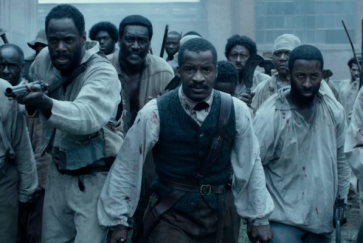 Nat Turner, a docile preacher, reaches his breaking point and leads a rebellion. A bloody rebellion. White slave owners will be slain in their beds. These scenes are so jarring that I can understand why one might think that 90 minutes worth of context are important. Those minutes establish that yes, slavery is bad. There were indeed lots of vicious slave owners who were just despicable human beings. But slavery movies often have a benevolent slave owner as well, one who is “not so bad,” I suppose so that white people don’t shout “They’re not all like that!”
As Samuel, Armie Hammer is this year’s Benedict Cumberbatch. He’s not too terrible. But his character’s arc is perhaps the most compelling of the film. As children, he and Nat are playmates. They aren’t equals, but maybe they’re friends. It is only as Samuel inherits the plantation and all of its chattel – which of course includes the human beings who work the land – that this relationship transforms. It is clear that Nat is not just his employee – there is a subservience to their interactions that is immediately repulsive. Times are tough in the south. Plantation owners are under a lot of pressure, and the slaves are of course the first ones to suffer, to work longer hours with less food. Samuel, being “one of the good ones” begins to drink, ostensibly to deal with the increasingly degrading things he must demand of his slaves. He slides from benevolent to aggressive, and it’s a great performance from the man you’re probably not watching as closely as you should. But that’s the problem with owning slaves. Once you accept that owning another human being is okay, of course it’s a slippery slope that leads directly to the rapes and whippings and deprivations we’re so used to seeing. There is no good way to own a slave.
As Samuel slides further down into the muck, Nat is rising from it, with increasingly radical ideas about his oppressors. So Nat Turner rises up. Samuel Turner gets cut down. Are we prepared to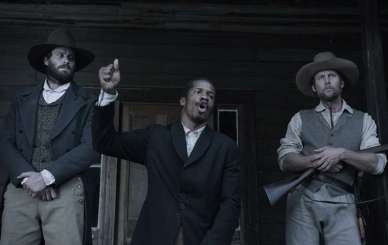 see this? Prepared to watch people be chopped up as they sleep in their homes? It’s brutal and shocking. And justified: the film has made sure of that. Of course this is a true story so you know there is no happy ending here. Nat Turner’s is a necessary voice in the story of slavery, and Nate Parker’s choice to make religion both a weapon, and salvation, are a fresh take on a crowded genre.
Nate Parker co-wrote and directed himself in The Birth of a Nation, and his passion is evident. I only wish he trusted his audience more. In the hands of a more competent director, we might have a Best Picture contender here, but instead he allows his slow build to be overplayed, turning his third act into a bit of a cocky circus act. It’s uneven. It neglects secondary characters – and with Aja Naomi King so damned good, it seems a crime not to give her more screen time.
Speaking of which. I would feel irresponsible if I didn’t bring up the skeletons in Nate Parker’s closet. The Birth of a Nation was a Big Deal at Sundance. Fox Searchlight eagerly bought it up and set an October release date, certain it would be on the path toward Oscar. But rape allegations in Parker’s past resurfaced. When he was a student at Penn State, he was accused and charged with sexually assaulting a woman along with his roommate and The Birth of a Nation co-writer, Jean Celestin. They stood trial; Parker was eventually acquitted but Celestin was found guilty before having the verdict overturned on appeal. The story gained traction when it was reported that the victim had committed suicide. Even with an acquittal to his name, an a newfound belief in god, Parker’s mea culpa press tour has been lacking. His remorse has been sparse. Gabrielle Union, the actress who plays a rape victim in The Birth of a Nation, herself a real-life survivor of sexual assault, has struggled to reconcile his past and her part in his present. Can we and should we separate the art from the artist? What kind of shadow does this cast over his film? As Union puts it, “As important and ground-breaking as this film is, I cannot take these allegations lightly.”
The Birth of A Nation is an important story and deserves to be seen and heard. I said before that I thought it was both a better and a worse film than 12 Years A Slave. What I meant was: it’s not as good a movie. It’s more formulaic, more conventional, less sophisticated, a little too obvious. But as a piece of art, it inspires conversation and controversy. I can’t discount it.

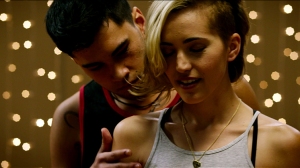 To Dance. The premise of Born To Dance is an overfamiliar coming of age tale. Tu is a young man born to dance. His disapproving father forbids it. Tu is perhaps a couple of years older than we’re used to in this role because instead of being threatened with military school, he’s threatened with the military, full stop. If Tu doesn’t get his act together during the summer post-high school graduation, the army awaits him. It occurs to me as I write this that Born To Dance might be Queen of Katwe in disguise, only replace the chess with hip hop, and the slums of Uganda for low-income housing in Auckland.
 off, director Davis gives the performers time and space to really show off their talent. This is a dance movie after all, and the moves are there to prove it. Choreographed by the legendary Parris Goebel, Born To Dance is the real deal. The movie’s smaller budget means there aren’t a lot of wires or camera tricks at play, just real dancers doing their thing. P-Money provides a stellar soundtrack with tracks that embody kiwi culture.
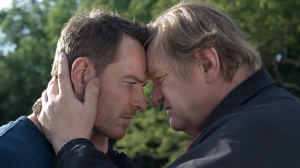 Chad Cutler (Michael Fassbender) is not as pleased with his father’s way of life. He sends his kids to school, a luxury he was never afforded. But as long as he’s living among his father’s little gang (and his father’s enormous shadow), he’s stuck. Saving his own son from a similar fate would mean trespassing against his father and the clan, and they’re not about to let him go easily.
 One night he finds a woman (Elisabeth Moss) in the shelter, covered in blood. It turns out the two have a lot in common; an abusive marriage can feel an awful lot lot like jail. To keep her safe, he risks his own freedom to hide her, but his crappy apartment makes for a terrible hideout, and the two have to go on the run to stay ahead of the law. And you know what? It’s a pretty sucky world out there.
 by JK Simmons, who will indeed play Commissioner Gordon in Affleck’s upcoming The Batman) or goes ballistic on their ass. But not crazy ballistic: he remains very cold and very calm in order to diligently murder everyone in his path. So autism becomes a super power and The Accountant is just Batman without a cowl. Although admittedly when I saw Ben Affleck marking up a window, I immediately though of the role as a little more Good Will Hunting meets Jason Bourne – Matt Damon’s territory, in other words.
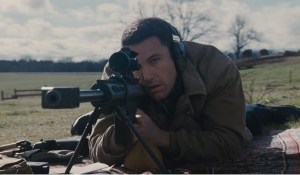 complete with stalky sniper Jon Bernthal (from Daredevil, just not THAT Daredevil) as the villain, only to emerge as a drama or worse yet, a quirkie indie romance with Anna Kendrick as the Mary Jane, I mean, the damsel in distress\love interest. And if this all sounds like a lot to keep track of, don’t worry, there’s a portion in the middle that’s perfect for taking a 20 minute nap and waking up feeling like you’ve missed nothing at all.
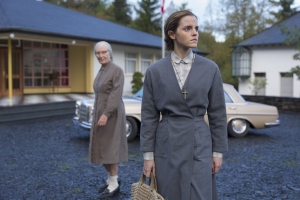 goes, putting herself at the mercy of a nutbar pedophile cult leader and his woman-beating cronies. This is the kind of movie into which you can never lose yourself entirely because you keep pulling yourself out of it to yell at the protagonists. You know in a horror movie the whole theatre is practically yelling “Don’t go in there” but of course she goes in there, even though we all knew better? And she gets diced into a million bite-sized pieces? Well this is one of those movies, except it isn’t a horror, and there’s no excuse for doing what it does. Bad writing, I suspect, and a movie that doesn’t really know what it wants to be when it grows up. With two idiot protagonists who keep making the dumbest decisions ever, you won’t care whether they live or die. And for a film that’s trying to shed some light on a pretty gruesome chapter in Chilean history, it’s also succumbing to the misplaced love story temptation. Because nothing overcomes a cruel dictator like True Love between nitwits.
 education, the ability to visit over 40 countries while still in his teens, and loads of opportunity. He sprinkled his good fortune with charitable acts for others. But in the movie we don’t see a lot of Dan Eldon, activist. Rather we see Dan Eldon, purveyor of white privilege, with a side of white saviour to further sour the milk.

 he’s a successful medical student. He’s content to have this repeat on an infinite loop, but the friends he shares an apartment with are not. They’re ready to sell up and move on – to girlfriends, babies, and different cities. Simon’s hitting the brakes hard but his friends’ growing-up momentum may just pull him over the cusp into adulthood, like it or not.
 by the way, I also lived here at the time, and yet: Rebecca BitchFace. I’m sure she’s a lovely girl.) Where was I? Oh yes.
 board but the result isn’t science at all. It’s conceptual; more contemplative than comprehensive. No science teacher will ever show this in class – but a yoga teacher might. Getting the gist? It’s a thing of beauty, often thoughtful, but far from educational.

 ASSHOLES WATCHING MOVIES