
Lucky is an old man, a washed up cowboy who’s living out his remaining years in a small town where his routine means everything to him: a daily glass of milk, some exercise, coffee and crosswords at the local diner, devotion to his game shows. Just because he’s alone doesn’t mean he’s lonely. But then a brush with his mortality reminds him that death comes for all of us, and he starts reevaluating a thing or two.
We missed seeing Lucky at SXSW this year; our schedule was packed and we had to 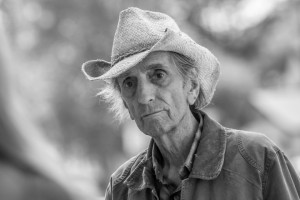 choose between several old-guy movies (we ended up seeing The Hero and The Ballad of Lefty Brown). We can’t regret seeing either of those movies, both are good, but there is one mitigating factor. Harry Dean Stanton, star of Lucky, died last month at the age of 91. And there is, I believe, a difference between watching an old man come to grips with his age and death’s proximity, and watching a man who we know was actually met his maker be confronted with his expiration date on screen and admit to us all that he is scared. Oof.
How does a 90 year old atheist feel about death’s encroachment? You’ll see it all on Stanton’s face. The years have visibly burdened him, he walks with a heavy but purposeful gait, his shoulders sloping under the effects of time and the weight of the unknown. And though he makes various connections, a surprisingly diverse variety of connections for a man of his generation, we’re very much aware that in the end, everyone dies alone. This film has moments of genuine warmth and delight, but it’ll also make you feel his emptiness, his isolation, his fear. And if that’s not enough to completely gut you, director John Carroll Lynch wrenches the very last drops of our humanity from us with the help of my favouritest favourite Johnny Cash song. So you just can’t help be hollowed out. But Lucky also fills you up. The script accounts for more than a few quirky characters, but it’s Lucky’s persistence and courage that fill us up with hope.
There aren’t enough words to say what a great performance we have here from Stanton. It’s superb. Lucky isn’t the talkiest of fellows but Stanton delivers a meditation on mortality that is the perfect legacy to his lengthy career. He’s magnetic. And we’re all a little luckier having seen this film.
 attracted the ire of a neighbour who reported him. A cease and desist letter from the city made him think twice – not about the rightness of gardening his own land, but about the rightness of this world. Never before motivated to activism, Finley took up the cause, providing free soil so that others could plant too. Now you’ll find the neighbourhoods dotted with planters, and if you think that’s interesting, just wait until you meet the people who are cultivating them.
 This documentary is not particularly imaginative when it comes to film making; it is straight forward, with few tricks up its sleeves. But Mankiller is a compelling subject, and a documentary shedding light on her story is important when it is omitted from so many history books. When Mankiller was first elected chief in 1985, it was to a male-dominant political structure that she broke into with patience and tact. She persevered, secure in the knowledge that the traditional Cherokee way was a more gender-balanced approach. She overcame a lot of obstacles in order to improve the lives of her people, and many believed her work with the federal government might have led to a national political career had her own health not stood in the way.
 es in this film, the latest from Ruben Ostlund, who previously directed
  inserts herself into cramped dynamics like she’s determined to put the Wicked back into Step Mother. Both throw out the red carpet when favoured son Matthew (Ben Stiller) makes a reluctant appearance. Harold has fostered a competitive streak between his children by different mothers but they otherwise aren’t close. So when their father’s life and career necessitate them pulling together, it’s a little awkward. Actually, it’s extremely awkward and kind of heart breaking. Because they aren’t bad people, they’ve just been starved of their father’s love and have no idea how to act like a family now that there’s no real chance that things will ever be different.
 options, so you can imagine some of the crazy things they do for money. It’s a destitute, desperate kind of life but you’d never know it to see Mooney adventuring around free-range with her comrades.
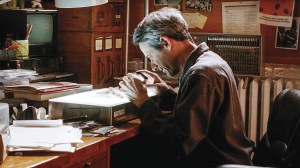 Nick’s marriage isn’t quite so solid. He and Alyssa (Chloe Sevigny) have been together a decade and there have been cracks before, so we learn from Alyssa’s sister Gwendolyn (Mary-Louise Parker). Plus, Nick’s life is so, so boring (SO boring he can’t help but repeatedly describe it as ‘thrilling’, without a trace of irony, and it never fails to break your heart).
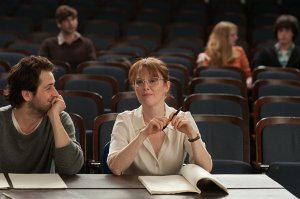 zone to help mount it at her school, with the help of drama teacher extraordinaire, Mr. Kapinas (Nathan Lane). Things do not exactly go smoothly. The play is costly; Mr. Kapinas is demanding; the leading lady (Lily Collins) is a temperamental trouble-maker; the school board objects to the violence. All the while Linda keeps clashing with Jason’s dad (Greg Kinnear), believing that the play’s dark themes have been inspired by their real life.
 worst Transformers movie yet, and the next one will probably be even worse.
 ASSHOLES WATCHING MOVIES