Nina

Nina Simone, born Eunice Kathleen Waymon, was a tour de force. She was a classically trained pianist who studied at Julliard. She applied at the prestigious Curtis Institute of Music in Philadelphia but was rejected despite an excellent audition because of the colour of her skin. Never intending to sing, she was forced to in order to make a living being a musician of the non-classical variety, the only option open to a woman of colour. She played a blend of jazz and blues, folk and gospel, and probably more besides. She changed her name to avoid embarrassing her family now that she played “the devil’s music.” And she became an activist, an outspoken proponent of the Civil Rights movement. Her music had always spoken to her roots, but soon she incorporated political themes there as well. A beautifully angry song “Mississippi Goddam” written in response to the bombing of the Baptist Church in Birmingham Alabama (that killed 4 little girls) particularly comes to mind, because how could it not? It’s spectacular and heart breaking. There was a great documentary made about her life not too long ago, but Nina is not a documentary, which means someone had to step into her shoes.
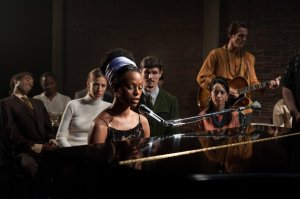
MV5BODk1NDY2MjcyN15BMl5BanBnXkFtZTgwNzkzNzM2ODE@._V1_SY1000_CR0,0,1502,1000_AL_Mary J Blige was originally cast but had to drop out. Nina herself had hoped that it would be Whoopi who’d portray her on screen. Instead director Cynthia Mort went with Zoe Saldana, and thus created a furor. With Dominican and Cuban ancestry, Saldana identifies as a black woman, but critics felt she was not black enough. Not black enough? The notion makes me queasy. But when Saldana said she was honoured to play Simone, the Nina Simone Foundation nastily replied “Dear Zoe, please keep Nina’s name out of your mouth for the rest of your life.”

Saldana’s talent is bigger than the criticism. She has a great voice, which you may have heard in The Book of Life, but no, she doesn’t sound like Simone. No one does. But she brings a lot of strength and dignity to the role, a mean feat considering the film focuses on the latter years of Simone’s life, which were turbulent to say the least. Mentally and financially unstable, Simone was committed to a psych ward, where she met a nurse she would later make her assistant, and then her manager. David Oyelowo plays the nurse. Biopics generally benefit from a narrow focus, but this one is perhaps unfair to her memory since Simone was so much more than just her struggles. See the documentary for a clearer picture of her life, but to see Saldana shine, this is one good role among many.


Two days before she died, the Curtis Institute of Music bestowed granted Simone an honorary degree.

One Week And A Day

When Eyal and Vicky Spivak finish the week of mourning for their son, their grief is a gulf between them. Vicky is ready to launch back into the comfort routine but Eyal seems lost, stuck, and unsure of how to proceed, or why. His stealthy rescue of a bag of medicinal pot from his son’s hospice room leads to a form of mourning unlike any other you’ve seen on the screen before.

In an odd way,  One Week And A Day is a comedy about grief. After a hilarious montage of Eyal’s inept failure to roll a proper joint, he recruits the young neighbour next door MV5BZmE0NGJjYzItOTExNy00ODI3LTljOWYtNWQ1NmMyN2NiZjU0XkEyXkFqcGdeQXVyNjA5NjAzMjI@._V1_SX1776_CR0,0,1776,960_AL_(an old friend of his son’s) and the two of them roll their way through grief and loss. Vicky is as disapproving as you might imagine, but she’s not exactly smoothly sailing through this period either. Her grief is just as bumbling, if more sober.

Turns out the neighbour, Zooler (Tomor Kapon), is an aspiring air guitarist, and his quirky, oddball demeanor is just what the doctor ordered, maybe not just for Eyal (Shai Avivi), but for all of us. The death of one’s child is a subject so sensitive, so awful to contemplate, that often we avoid it. Movies that dare to breach the topic are often morose and difficult to watch. In this case, writer-director Asaph Polonsky gives us reason, and permission, to smile through it. It’s a relief.

Which is not to say there isn’t something deeply emotional running under the surface. It bubbles up during a eulogy that comes late in the film, and it’s such a poignant moment that it stops you short. It gives balance to the film, and grounds us once again in reality.

Polonsky uses a wide lens to show the dynamic between Zooler, Eyal, and Vicky as the back and forth between them tends to be quite powerful. Everything in this movie feels casual and off-hand, allowing us to get closer to the subject, but this is due to careful orchestration behind the scenes. Afterward, recounting my favourite scene to Sean, tears sprung in my eyes. I hadn’t realized how moved I was by it because the movie doesn’t manipulate you into sadness. It very gently cradles you, but clearly even without the histrionics it’s capable of evoking feeling.

Hot Docs: Living the Game

The biggest change between grade 8 and grade 9 was that once I started high school I was allowed to leave school property on lunch. And leave I did. Every weekday from noon to 1, my friends and I walked to the nearest arcade. When I had quarters, I spent them, and when I was out, I watched others feed the machines. Many different games came and went during that year, but one of the mainstays was Street Fighter 2, in one flavour or another (it seemed every three months there was another version of it, from Champion Edition to Turbo to Super to Super Turbo). There was always a crowd around the Street Fighter console, and it seems that 20 years later, the crowd has only grown.

What is the appeal of watching others play video games? It’s hard to explain. The closest I can come is this:

Evo Moment #37, as it’s called, is an iconic moment in competitive gaming. If you have ever played Street Fighter, you know how insanely hard it is to parry one hit from a super move, let alone 15 in a row.  If even one of those kicks had landed then the match would have been over.  What a remarkable display of timing and hand-eye coordination!

The two players in that match were Daigo Umehara and Justin Wong. Living the Game is a documentary that follows them and a few other top players over the course of a pro gaming season. It’s fascinating to see this unique spectacle where two headset-wearing players look at a small screen while a thousand or more boisterous spectators watch on and cheer wildly.

These top players are doing well for themselves, earning sponsorships and salaries, supplemented by cash prizes of $100,000 or more for a big tournament win. Despite their success they are remarkably aware that this gravy train will not run forever and that their chosen profession is not well-regarded. That sort of honesty should make Living the Game an interesting watch even for those who are baffled by pro video gaming, elevating it beyond its subject matter. While there is no big revelation to be found within, it is interesting to get to know the players through this film, who as it turns out are not much different than you or me, except they happen to be ridiculously good at video games.

Living the Game screens as part of the Hot Docs Film Festival on May 2 at 8:30 p.m., May 4 at 8:45 p.m. and May 7 at 6:15 p.m.

Hobbyhorse Revolution

I was excited to review this film for Hot Docs because I’d heard of and was mystified by ‘hobbyhorsing’ and needed to know more about it.

Hobbyhorsing is a lot like the horse competitions you’re used to seeing on TV, or in Olympic events.  Dressage, an equestrian sport, is the highest expression of horse training. In the events, you’ll watch horse and rider perform a sequence of events from memory, including piaffe (a special kind of trot), and pirouette (a 360 degree turn). In the obstacle event, the horses will jump over poles. Horse and rider are judged on how smoothly they go through the movements, and how willingly and with minimal cues the horse performs.

In hobbyhorsing, the competitions are similar, except – NO SHIT – performed with a fake horse. A hobbyhorse: those toys for small children which consist of a horse head on a broomstick.

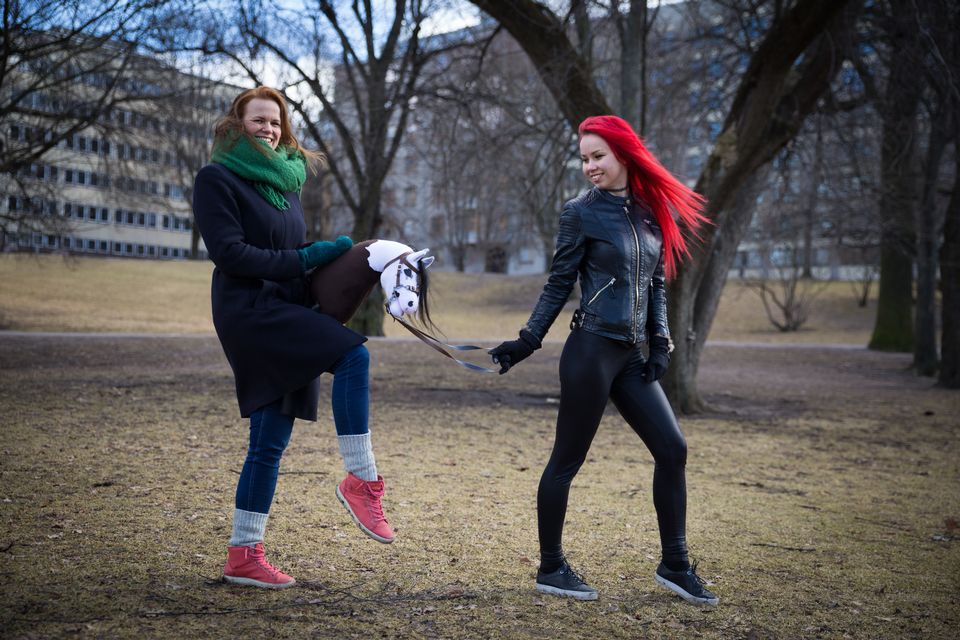
Hobbyhorse Revolution is a documentary that sheds light on this burgeoning community, and on the people who compete (they’re older than you’d think).

Competitors “train” extensively, but don’t forget it’s their own two feet doing all the work. The ‘horses’ get off pretty lightly but are still given starring roles. Their ‘riders’ talk about them as though they are real: this one is ‘energetic’, this one ‘well-schooled.’ They are ridden with whips and put away with stable blankets. You know, in case they get fake cold.

The teen-aged girls interviewed for the film are almost all troubled in one way or another and I can’t believe that’s a coincidence. Playing make-believe with toy horses is a blatant extension of childhood. In this light, hobbyhorsing is perhaps not simply a curiosity but a disturbing trend – 10 000 “hobbyhorseists” in Finland and growing. Unfortunately, the film maker fails to answer that most obvious of questions: why? What is happening to these girls that they’ve left their peers and retreated to the safe but immature world of racing fake horses? Interesting but superficial, Hobbyhorse Revolution is a hollow look at a surprising new safety blanket.


[Between you and I, I can’t really watch a 17 year old young woman prancing around with a stick between her legs and not wonder if it’s somewhat sexual. Or entirely sexual. Either way, something here is messed up.]


Winding

A quick Internet search confirms that the Yarkon River is a river in central Israel, the largest coastal river in Israel at 27.5km in length. It’s mouth is in the Mediterranean Sea and when the Reading Power Station was built close by to supply electrical power to the Tel Aviv District, the Yarkon became heavily polluted.

Winding is a documentary about the Yarkon but it is not a regurgitation of already-available facts. It tells a history much more personal, the river’s journey from symbol of hope to curse bringing death. The documentary shares archival footage, personal recollections, and more recent interviews to establish the interplay between a people and its land, between nature and man. It’s actually a little bit sad to watch a beloved river decline and it feels natural to draw parallels between the Yarkon and much larger global issues.

This film by Avi Belkin plays at the Toronto Jewish Film Festival Tuesday 9 May, 3:30 PM at Cineplex Cinemas Empress Walk 9. If you are unable to attend this screening, never fear, there are lots of excellent movies to choose from. 30 Years of Garbage and Operation Wedding are personal favourites, but do check out the programming guide – there’s lots more to see.


Guardians of the Galaxy Vol. 2

Guardians-of-the-Galaxy-Vol-2-wallpaperI have avoided writing this review since Thursday.  Guardians of the Galaxy Vol. 2 left me entirely uninspired. Was it the mediocre 70s music? The laughable indestructibility of the heroes and villains that only disappeared when convenient to a plot point? That we have seen this movie before, a thousand times? Or that these heroes, who seemed so fresh the first time around, had nothing new to offer?  Whatever the reason, this movie was missing the spark that made the first Guardians of the Galaxy so much fun.
“More of the same” is generally something that necessarily is tied to a sequel; after all, the reason the sequel exists is because we liked the first one and asked for more. But the sequels I most enjoy are those that could stand alone if the first one was somehow wiped from memory. I don’t think Guardians Vol. 2 passes that test. It starts strongly (as Jay said to me afterward, she would have preferred it if Groot had danced his way through the whole movie) but loses its way, sacrificing action scenes and momentum to rehash the first movie’s tale of outcasts forced together to save the galaxy.

Strangely, for a movie that I don’t think could stand on its own, Guardians Vol. 2 also does not really do anything to advance things in the Marvel Cinematic Universe as a whole. If it had, I might have felt better about the movie as then it would have had a purpose. Without that, and without any real progress from the first film, Guardians Vol. 2 felt like a throwaway franchise episode, another The Fate of the Furious, another blockbuster that will have been forgotten in six months. In other words, the polar opposite of how I felt after seeing Guardians Vol. 1.

As always, my hopes were definitely too high for this sequel but I think the main reason I was so underwhelmed by this movie is because what I liked so much about the first film was its originality, and this is a carbon copy of #1 in practically every way.

Guardians of the Galaxy Vol. 2 gets a score of five dancing Groots out of ten.


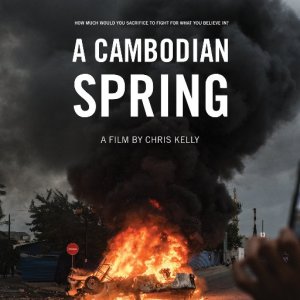
Hot Docs: A Cambodian Spring

Land rights are a super contentious issue in Cambodia, where the communist Khmer Rouge regime banned private property in the 1970s, destroying tonnes of land documents in the process.

As a result, at least two thirds of Cambodians, most of them poor, of course, don’t have proper deeds for the land they live on. Over the last ten years or so, thousands have been evicted and forcibly removed from their homes in various land-grabbing schemes, mostly perpetrated by their own government, referred to in his film as a “fake democracy.”

1L6PdFeXFilm maker Chris Kelly follows three people over the course of 6 years to get a grip on their experiences. Toul Srey Pov and Tep Vanny are two young mothers who allowed their land on the Boeung Kak Lake to be measured by the government, supposedly to receive accurate land titles. Instead, the government leased their land to a private company, Shukaku, which “happens” to have ties to the Prime  Minister. Shukaku is dumping sand into the lake, flooding the streets of Boeung Kak, forcing people from their homes. These women are too poor to abandon their homes. The compensation offered by Shukaku is laughable, insufficient to start over elsewhere. But those who stay risk their lives – already 3 have died by electrocution alone.
A Cambodian Spring shows how corruption and oppression still rule in Cambodia, but more than that, it highlights our own role in this: the failure of the World Bank to enforce its own resettlement policy, and the international complicity in allowing this to happen to regular people who believe they should be able to live in the homes they have purchased.

Although a bit overlong, A Cambodian Spring is an eye-opening and intimate portrait of citizens-turned-activists, and the cost, both personally and politically, that comes with fighting back.


The Book of Love

Truth bomb: I came upon this movie only because my friend Justin couldn’t stand it. And he tried. I mean, he watched a full 57 minutes, sweating profusely, pausing often to debrief his pain. The cause: Maisie Williams’ uneven accent. He couldn’t hack it. He also couldn’t place it. And good friend that he is, he thought I should have the chance to crack it. Since the film is set in New Orleans, I believe Cajun is the accent she was after. And since I don’t watch Game of Thrones (and Justin does), it wasn’t quite so jarring to me. But still kind of jarring. And hers isn’t the only one.

The premise: Jason Sudeikis plays a widower who works through his grief by a) growing a beard and b) befriending a troubled teenage girl (Williams) and helping her to build a raft out of garbage which she will then use to sail to the Azores. From New Orleans. Not symbolically.

Smothered with grief or not, I think it’s mostly understood that grown-ups are not allowed to help kids with projects that will certainly kill them. Right? But let’s cut poor Jason Sudeikis some slack. We’re not just talking about a dead wife, but one of those elusive COOL wives, the ones you don’t secretly loathe. His wife (Jessica Biel) was The Shit. Through extensive flash backs we learn that she was a manic pixie dream girl, except attainable, apparently. Way better than your wife. She was never not being crazy-awesome-cool. So it stung poor Jason Sudeikis really hard, guys. Really hard. It annoyed the fuck out of me, her constant perfection.

But anyway. If you’re a better person than I (and let’s face it, you likely are), this movie is about two people finding each other when they’re each at peak hurt and need. So that’s nice. Justin Timberlake does the music, which (sorry Jessica) is probably the only reason his wife gets asked to be in anything. The title of the movie is completely nonsensical except for the fact that they do play the song of the same name at some point. My sister danced to that song at her wedding, the Peter Gabriel version anyway.

Verdict. Don’t watch if you’re sensitive about accents. Do watch if you’ve just lost your Ultra Jiggy wife and you’re looking for reckless-child-endangerment ways to get over her. For the rest of you: it’s an okay watch. It doesn’t pack the emotional punch that it probably should, but hey: finally a movie about a dead wife and an orphaned kid where the box of kleenex is unnecessary!

Operation Wedding

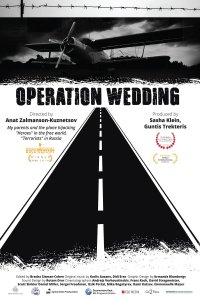
In 1970, Anat Zalmanson-Kuznetsov’s parents had tried to leave Leningrad several times, and several times they’d been refused. Out of legal options, they decided to flee. They and their friends dreamed up Operation Wedding, in which they’d fill a plane full of people ostensibly on their way to a wedding, and once in the air, they’d have the pilot change course. Lacking the 200 conspirators necessary for this plan, they set their sights on a smaller plane, and their group of 16 bought up all the tickets. They planned to leave the operation-wedding-2016-i-movie-posterpilots behind on the tarmac and would use their own pilot; the border was just 15 minutes away and the plane would be empty save for those wishing to escape. Anat’s parents never made it onto the plane, caught by the KGB mere steps from boarding. Her mother was sentenced to 10 years in the Gulag. Her father received a life sentence. This is their story.

The programmers at the Toronto Jewish Film Festival have done an excellent job of presenting some very interesting stories at this year’s festival, but this one may take the rugelach (I know-forgive me).

Even today, Russia remembers them as terrorists. But who were they terrorizing? They simply wanted to leave the USSR. that was their crime. They knew the risk they were taking and were prepared to pay the price if caught; most preferred death. In court, they openly declared their wish to leave, and refused to beg for mercy. Two of the sixteen were sentenced to be executed by shooting, the first time the death sentence has been invoked in a hijacking case, plot foiled or not.

Israel held protests: the entire state stood still for those who may be put to death for a crime they didn’t even commit in the end. Jewish organizations in other countries joined in. Hunger strikes were held. And behind the scenes, Golda Meir was secretly pulling strings so that Spain’s “Franco the Fascist” would commute the death sentences of 6 cop killers, thinking that Brezhnev the Communist would try to out-humane Franco the dictator.

The documentary uses archival footage and primary-source interviews, but it’s Anat’s family connection that really brings it alive. When she visits the gulag cell where her mother did time, the bleak reality overwhelms her, and it moved me to tears as well.

Operation Wedding screens as part of TJFF

Friday 5 May, 1:00 PM – Alliance Francaise

Sunday 7 May, 1:30 PM – Cineplex Cinemas Empress Walk 6

Director Anat Zalmanson-Kuznetsov will be in attendance.


Tumbledown

Hannah is deep in mourning for her husband. Her grief is complicated by the many strangers who share in it; he was a folk singer of some renown, perhaps memorialized more for his mysterious and untimely death than for his single album of songs. Friends and family think Hannah should be moving on but she’s frozen, paralyzed by the stores of love she has unused. She thinks the only way to exorcise his ghost is to write his biography, but it turns out it’s hard to write about the man you’re still in love with, in awe of, and angry at, for having left you.

MV5BMzcyODA4NDA2MF5BMl5BanBnXkFtZTgwMTE1MjU2NzE@._V1_Hannah (Rebecca Hall) has avoided fans and journalists alike but relents for Andrew (a bearded and bespectacled Jason Sudeikis), a brash professor in search of a tenure-assuring topic for his thesis. This reclusive, rarely written about musician fits the bill. And Hannah thinks working with Andrew will bolster her own writing. So they hunker down in a little cabin in the woods and set to work, pretending that their purposes aren’t at odds with each other.

I enjoyed this, the rawness of grief, the fallacy of closure, the importance of legacy, the obstacles to moving on. It felt sweet and tender. But it wasn’t spectacular. The two leads lack chemistry. And for a movie about the legend of a dead folk singer, there was a notable dearth of music. And though Hannah tells us that his death was the least interesting thing about him, we have to take her word for it, never learning much about him, not even the truth behind his sudden death. So there’s a third character who’s a third wheel in this odd romance, and he truly is a ghost. Without establishing his worth, we can’t really tell if Andrew is an adversary or a milestone in moving on. Despite Tumbledown’s themes, it makes a pretty light film – light but not necessarily easy.