Lauren (Erica Deutschman) and Colleen (Tianna Nori) have found a way to channel their mutual love of Christmas into a career: Christmas coaching! Between you and me, Christmas coaching seems terribly seasonal and not a great business model for year-round solvency, but it would defeat the purpose of a Hallmark movie to think too deeply about their business’s viability so let’s just pretend this makes sense as a career move. And in that spirit, we’ll also gloss over the fact that just days before Christmas they have no clients. I mean, if nothing else, it’s terribly convenient to the plot that when the “aristocratic” Anderson family engages their services, Lauren is extremely available to devote her entire season to their home. It’s a little unorthodox – usually she’d prefer to to coach people, but the home owners are overseas and have simply left her a list to deck their halls and plan a party for their return. Their son James (Chad Connell) is around but buried under work and dismissive of holiday merry making.
Poor Lauren has to make do with housekeeper Joyce (Jennifer Vallance), who’s warmer anyway, and a readier source of family tradition and expectation. Colleen finally has a client or two of her own, so Lauren and James are alone together a lot of the time, and Lauren’s persistence is pretty legendary. She badgers him into reliving some happy childhood memories and soon they’re bonding over the spirit of the season. It starts to look like the magic of Christmas may have worked its way into their hearts when an obstacle presents itself, and her name is Maryam.
Will Lauren fist fight Maryam for James’ heart? How many vintage hats will be sacrificed to snowmen? Answer these burning questions and maybe even see them skate down the Rideau Canal, identifiably the world’s largest skating rink, even though the film is not set in Ottawa. Who doesn’t want Christmas cheer forced upon them? All this and more, guaranteed by Hallmark, and presented by your favourite Assholes. `
Anna (Lizzie Boys) and her dad Ty (Dean Cain, yuck, I know) trek across the country to Bliss Mountain so that Anna can train with former Olympic skier Maddie Lastname. Anna’s eager to learn but isn’t really responding to Maddie’s tough cookie approach, so she seeks out Maddie’s less successful former teammate Kat (Kristy Swanson), who lives in town and teaches on the mountain. Teaches, not coaches, as in bunny hill novice skiers under 10. But although Kat’s still pretty gun-shy after her flameout on the slopes many years ago, she agrees to continue providing pointers and other fun lessons for technique. It makes her and Maddie a little competitive once again, but that’s not what this particular Hallmark movie is about.
First, Bliss Mountain is failing because its flashier counterpart Epic just 20 minutes down the road is drawing away all of its customers. Kat is chairing the Winter Fest committee, hoping to draw fresh blood and new dollars to town, and she’s not above drafting Ty to her committee even though he’s a paying customer. More importantly, of course, is the business of having Kat and Ty fall in love. Ty is a widower who lives on the other coast. Kat isn’t exactly splashing about in the dating pool herself. But honestly: how long can they keep telling us they’re just friends and expect us to believe it? We see the way he hangs banners for her. It’s hung at a pretty flirtatious angle if I do say so myself.
So. Kat will have to overcome her own fear of failure to train Anna. Anna will have to overcome her fear of wiping out to win an exhibition race. Ty will have to figure out how to commute all the way from New York. And Kat’s dad will just stand around wiggling his eyebrows at everyone. Sound good to you? Perfect. Winter’s Dream may be set on a mountain, but it will keep you nice and warm where it counts – right in the feelings.
Two years after we first met her, little Angela, an Irish lass living in the very early 20th century, is still known in her little town for having stolen the baby Jesus from the church’s nativity scene. It was pretty innocent, as far as thefts go; she only thought he looked cold lying there in his manger, and took him home to make him warm and cozy.
Nowadays the baby Jesus has a very nice knit sweater to keep him warm, but Angela still visits him in the church to pray and ask for help. With Christmas fast approaching, Angela has her eye on a fancy dolly in the storefront window, but her family is still largely impoverished despite her father having left for work in Australia over two years ago. Setting aside their own interests, Angela and brother Pat decide to use their Christmas wish to bring their father home – or rather, to go and get him. When digging to Australia doesn’t work, they start busking for a train ticket. Their plan is not the most efficient, but their hearts are in the right place.
Is there any chance that Angela’s family will find happiness this holiday? You’ll have to watch to find out. The characters are based on the writing of Frank McCourt. The animation is as sweet as it sounds. And at just 47 minutes, it’s a great little watch for a special pre-bedtime treat with the kids.
Jorge (Leandro Hassum) hates Christmas. Officially it’s because he shares his birthday with the baby Jesus, and he’s a pretty bad sport about it. Even though he’s a fully grown man now. But he also seems to hate everything else about the holiday too: the food, the gifts, the family. THE FAMILY. Fair to say it’s pretty irksome when he develops some sort of Groundhog Day disorder – or at least that’s the movie they’d love to be compared to. In fact, Jorge is not doomed to repeat the same day over and over; he’s merely only living on Christmas now. That sounds weird, and it is, but the Jorge we know wakes up and it Christmas morning. He’s technically lived a full year between each Christmas, but he never remembers it. He’s aged a year, and so have his wife and kids. It’s a weird amnesia and the Jorge who “wakes” up each Christmas doesn’t approve of the Jorge who makes decisions all year long. That Jorge doesn’t seem to share his same values and priorities, and “living” only one day a year seems to have really put things into perspective for him.
Jorge is not exactly a likeable guy so it’s hard to root for, or know what we’re rooting for. Plus, Brazilian comedy seems to be a little…obnoxious. Leandro Hassum is like Gerard Depardieux at his worst, and even his best is pretty intolerable.
Since Jorge only “wakes up” on (or remembers) Christmas, it’s not exactly a great time to get vital information as to his condition. His wife and kids are busy with preparations, and hosting parties, so we never the full picture. We just wake up as disoriented as he is, and try to piece together what’s happened over the last year based on how things have subtly changed since last Christmas.
It’s an interesting-ish premise but I didn’t enjoy its execution. Hassum is one of those people who confuses yelling with acting. It’s hard to pick up any emotional nuance when everything is shouted. And this particular conceit isn’t exactly condusive to personal growth. Even if he does manage to learn a lesson during this 16 hours of Christmassing, his other self won’t remember it come Boxing Day and will spend the whole year undoing any progress that’s been made. It’s a pointless exercise and it’s not even entertaining to watch. Verdict: sleep through it.
It’s like Groundhog Day, but for masochists.
Jorge (Leandro Hassum) hates Christmas. Officially it’s because he shares his birthday with the baby Jesus, and he’s a pretty bad sport about it. Even though he’s a fully grown man now. But he also seems to hate everything else about the holiday too: the food, the gifts, the family. THE FAMILY. Fair to say it’s pretty irksome when he develops some sort of Groundhog Day disorder wherein the Jorge we know wakes up
Eleanor (Jillian Bell) is the youngest trainee and the only person who’s bothered to apply in decades; fairy godmothering just isn’t what it used to be. But head mistress Moira (Jane Curtin) keeps on teaching the same tried and true formula: 1. glittery gown 2. true love 3. happily ever after. Except humans stopped believing in ‘happily ever after’ a long time ago. No fairy godmother has been on assignment in years – the school’s about to close, the godmothers to be retrained as tooth fairies. Eleanor is devastated. Godmothering is all she’s ever wanted to do and now she’ll never even get the chance to start, so she takes matters into her own hands and finds a neglected assignment, a request for a fairy godmother that was never granted. She heads down to earth to fulfill the godmothering duties, and hopefully prove that godmothers are still in demand.
Of course, when she eventually finds herself in Boston, she finds not a 10 year old girl, but a full grown woman named Mackenzie (Isla Fisher) (apparently the letter was a little dated). What a disaster: in what way could a single mother in a dead end job possibly need godmothering? Well, both Mackenzie and Eleanor are about to find out because Eleanor refuses to go back to the motherland a failure.
Godmothered doesn’t exactly skewer the popular Disney fairy godmother formula, but it expands on what was traditionally a pretty narrow definition of happily ever after. Welcome to the modernization of Disney. They’ve been rehabbing their image and redefining the princess genre in movies like Frozen and even Ralph Breaks The Internet. Godmothered asks whether magic, wishes, and belief still have a place in modern society, and if not, what should take their place. It doesn’t quite go all the way as a ‘message’ movie but it does get some pretty great mileage out of good old-fashioned kindness and cooperation, which never go out of style.
Eleanor is charming as a fish out of water, a magical being in the land of humans for the first time, not unlike Enchanted Giselle or even Elf’s Buddy the Elf. Jillian Bell is simply enchanting, more grounded than flighty, but with enough fairy dust on her performance to give her wings. Director Sharon Maguire delivers a warm and feel-good story that is perfect for cozy family viewing.
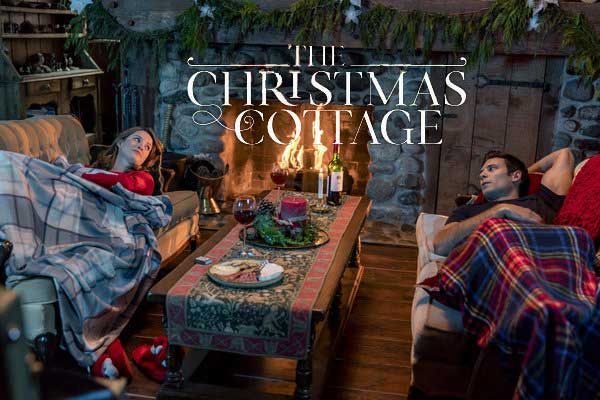
Lacey (Merritt Patterson) doesn’t necessarily believe in the same superstitions that her best friend Ava does, but since Ava’s the bride and Lacey the maid of honour, she’s going to decorate the heck out of the Christmas Cottage for Ava’s wedding night. Ava’s family have believed for generations that any couple who spends the night in the Christmas Cottage together will enjoy love everlasting – and they’ve got the long and happy marriages to prove it!
It’s not a great time to drop everything and devote an entire weekend to a wedding – the design firm Lacey co-owns with boyfriend Roger has a really big client on the hook but their proposal needs some last minute tweaks. Lacey is a workaholic so instead of taking the weekend off, she decides to juggle both, not counting on two very important factors. First, the best man, Ean (Steve Lund), who is both Ava’s brother and Lacey’s ex. And second, the blizzard that snows them in while they’re dutifully decorating the honeymoon suite as ordered. Imagine snow in Oregon at Christmas! It sure takes both Lacey and Ean by surprise, who are then forced to spend the night together in – yes that’s right! – the Christmas Cottage, the very one that forces people to love each other eternally against their will!
There’s no hanky panky in a Hallmark movie, unless you count tenderly draping afghans over each other when one inevitably falls asleep before the other after confessing their true heart’s desire without the benefit of a single drop of alcohol. It’s the magic of Hallmark. Meanwhile, the magic of Christmas may just be working its way into the hearts of Lacey and Ean, despite their rocky past. But aren’t they just too different to work? And doesn’t Lacey still have a boyfriend, not to mention a work thing?
All of these burning issues and more will be resolved before the film’s end, should you care to indulge.
December 3rd is the International Day of Persons with Disabilities. You may have heard some rumbling about disabled representation in the movies lately – Anne Hathaway took some flak for her limb difference in The Witches, and Sia’s movie, Music, has been criticized for casting a non-autistic actor in the lead role. Representation matters, and while the Oscars LOVE disabled characters, they don’t show the same love for disabled actors, who are rarely cast to portray themselves on screen, and almost never cast to portray anyone else. Although 20% of us live with some sort of disability, less than 5% of movie and TV characters are disabled, and of those few who are, less than 3% are played by actually disabled actors. That math is abysmal. Are disabilities the last place of the civil rights movement?
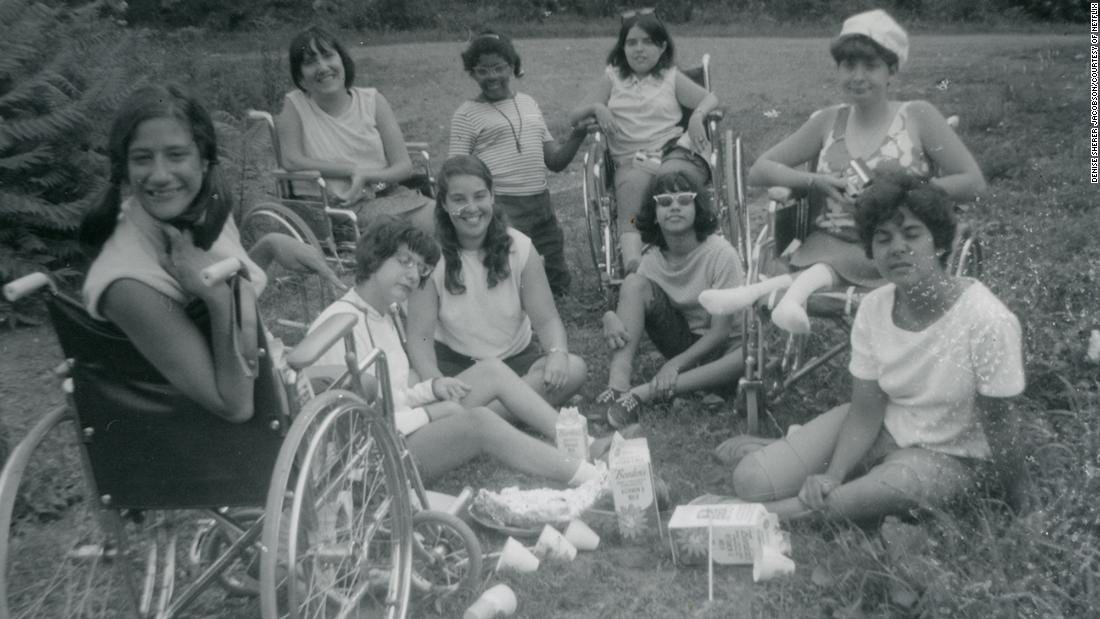
Camp Jened (its legal name), had actually been in existence for years, but in the early 1970s it was run by hippies who created an oasis of sorts for disabled teenagers. To anyone else, it would have looked like a run-down, ramshackle summer camp of nightmares, but to those who attended, it was practically utopia. In the 1970s, the world was not accommodating to those with disabilities. Most disabled persons lived in relative isolation, dependent on others, if not outright institutionalized. At Camp Jened, they were free. Not free of their disabilities, but free of the judgement and discrimination. In a camp where everyone was disabled, no one was; the disabilities virtually unnoticed, the campers were allowed to be defined by other things, perhaps feeling fulfilled as human beings for the first time. Like any teenager, they played sports, sang songs, smoked and made out – for many this was the only opportunity to “date.”
When they grew out of camp, this close-knit group stuck together, and started advocating and disrupting for disabled rights, inclusion, and accessibility.
Crip Camp is co-directed by filmmaker Nicole Newnham and former camper Jim LeBrecht, an overdue tribute to the place that ultimately changed the world for millions of disabled people.
Although the Americans with Disabilities Act was passed 30 years ago (in 1990: that is actually shamefully recent!), disabled people to this day are fighting just for the right to exist with dignity and anything resembling equality.
I myself live with several (mostly invisible) disabilities. 2020 has been a strange year for people with disabilities. On the one hand, the whole world has gotten a taste of what it’s like to be me. Because I am immuno-compromised, I’ve always battled against viruses, each one potentially very serious for me as I lack a basic immune system to fight them. With the pandemic, every Canadian across this country automatically got all of the accommodations I’ve had to fight to have at my own work: clean work stations, physical distancing, even the right to work at home, which seems a small ask when it’s potentially life saving. I’ve been in medical isolation at home since March. When restrictions were starting to ease up over the summer, many Canadians ventured out of their homes while I stayed in mine. Like many people with disabilities, it’s hard not to feel like life sometimes moves on without us, forgets the people still trapped in their homes. Now that the COVID numbers are increasing again, Canadian regulations have once again changed to reflect it, to protect the majority, while those of us in the minority try not to take it personally that our lives are not worth the same consideration.
Before COVID, I led a relatively normal life, at least to outside eyes. I went to work, I travelled, I spent time with family and friends. My life is permanently etched with pain, and my health is constantly compromised by every passing virus, but since I don’t have a choice, I deal with it. Sometimes I miss things. Sometimes I cancel. Sometimes I can’t get out of bed. But I lived. I made significant contributions to my field, I found joy, I was a presence in the lives of my niece and nephews, I hosted dinner parties and attended film festivals and fell in love. Every moment also in pain, sometimes unable to drive or walk or sleep, but doing my best, which was still pretty good. And now my life is on pause. It’s disconcerting, it’s unfair, but it’s not without its positives: 2020 was the first year I didn’t get pneumonia in at least a decade. How about that?
Because actual representation in film is so rare, this is a very short list of actors with disabilities excelling in film:
CJ Jones: he played Ansel Elgort’s disabled foster father in Baby Driver, stealing scenes and providing the film with warmth and heart. But for Jones, parts like these are almost unheard of. “It’s hard to find a black deaf role” although it looks like he’s found another in Avatar 2.
Kiera Allen: she recently played opposite Sarah Paulson in Hulu’s Run, a mother-daughter Munchausen by Proxy thriller. The role is extremely physically demanding, but Allen, who uses a wheelchair in real life, nailed the part and showed us all what she can do.
Adam Pearson: in Chained For Life, Pearson portrays an actor with facial deformities with whom his leading lady struggles to connect while working together. Pearson has neurofibromatosis, type 1 in real life and gives a formidable performance in this film.
Zach Gottsagen: he won hearts in The Peanut Butter Falcon, playing a young man with Downs Syndrome who escapes his care home to pursue his dreams of being a pro wrestler. Starring opposite Shia LaBeouf and Dakota Johnson, Gottsagen holds his own and proves himself more than capable.
Millicent Simmonds: who can forget the deaf actress’ stunning performance in A Quiet Place, a horror film in which monsters hunt what they hear, and one family survives thanks to their ability to communicate in sign language.
Is this the most ludicrous and offensive Hallmark movie plot ever? Check this and vote: two adult females, educated, employed school teachers, are so embroiled in a petty rivalry, one they’ve apparently nurtured since childhood, that when they’re both attracted to the same man, they turn a winter festival that’s supposed to be about the kids into their own bet-settling, bake-off showdown.
Although both these women sound equally pathetic, the script clearly plays favourites. Christie (Erin Krakow) is the one we’re supposed to root for. And the man she’s chasing, James (David Haydn-Jones), is the father of a new student in her class. Is that not…professionally if not morally unethical? Conflict of interest? Asking for trouble? A fireable offense? Penny (Miranda Frigon) teaches literally across the hall from her, so even their class raffle ticket sales become contentious, and may I just point out that they teach the SECOND GRADE. Anyway, Hallmark scripts are way too prim and proper to come out and say this, so I will for them: Penny is a real bitch.
I don’t know what’s so great about James, but Christie and Penny both throw themselves at him, and when that doesn’t result in any immediate, clear-cut winner, the bake-off scheme somehow becomes their method of settling things. The only problem is, Penny is a good baker and Christie doesn’t bake at all. She’s got only a couple of days to learn, to develop her own recipes, and to win not one but four different events, each of them judged by Alan Thicke. Or, well, Alan Thicke playing local restaurateur Chef Kroeger, who takes the daintiest bites of cookie you’ve ever seen, and still feels fit to judge the thing based on mere crumbs. A marriage is at stake here, Alan!
The rules of Hallmark clearly state that leading ladies are always fully covered, throat to knees (calves preferred, ankles optional); the clothes are ultra conservative, and usually topped with a cardigan, topped with a Christmas broach. Even Penny plays by these rules, but she does wear (the same) pair of 6 inch heels throughout the movie – yes, even while teaching. Six inch heels are clearly Hallmark for slut. Christie wears heels also, like a good little lady, but hers are at a modest height befitting a marriageable young woman of good breeding and virtue. Added bonus: they’re all the better for dramatically ripping off stupid whore garland from the Christmas tree when it fails to nail down a husband (Hallmark logic!), garland of course being the 6 inch heels of Christmas trees.
A movie like this probably sets feminism back at least a baker’s dozen years, and worse still, it sullies the good name of cookies, which, I assure you, are merely the innocent bystanders of this train wreck.
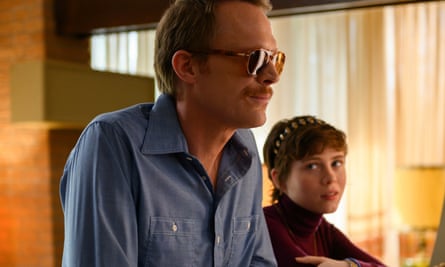
Growing up in Creekville, South Carolina in the 1970s, Beth (Sophia Lillis) has always felt like an outsider, even especially in her own family. The only relative to whom she relates is Uncle Frank (Paul Bettany), who seldom attends the various family functions meant to bring them all together. She feels surrounded by small minds and limited experience, and she’s not wrong. Which is why she eagerly follows in Uncle Frank’s foot steps to Manhattan as soon as she graduates.
Between college and the big city, Beth is growing up and expanding her world view, but nothing hits home like finding out that Uncle Frank is gay and that his roommate Wally (Peter Macdissi) is his lover and partner of many years. She’s never known anyone gay before. No; she never knew she knew anyone gay before. As if this wasn’t milestone enough, Frank’s father (and Beth’s grandfather) Daddy Mac (Stephen Root) has died, leaving uncle and niece to get reacquainted in the context of this new information during their road trip home for the funeral. On the one hand, it’s kind of a nice opportunity to meet each other’s authentic selves, but on other hand, they’re driving toward utter disaster and they don’t even know it.
South Carolina wasn’t the happiest place to be a gay kid growing up, and if Frank isn’t exactly choked up by his father’s death, going home does stir up quite a few traumatic memories, threatening his sobriety, his relationship, and even his life. Uncle Frank is both a coming out story of sorts for Frank, and a coming of age for Beth, two misfits from the same people and place finding out whether you can go home again or if you should have stayed in NYC where you belong. Writer-director Alan Ball seasons the script with achingly realistic family dysfunction, layers of hatred as well as opportunities for healing. Young Sophia Lillis has really hit the ground running in her career, starting out already on top with several leading lady roles in a row. She’s fantastic in this, but this movie belongs to Uncle Frank, and it’s Paul Bethany’s stoic and grounded performances that really see us through. Frank has navigated his life with careful precision but his father’s death is the one iceberg he couldn’t avoid. It feels like we’d tread uncomfortably close to melodrama, but Bettany’s performance is quiet, calm, and convincing, with not one shred of over-acting in a career-defining turn.
Uncle Frank has something to say about how things were in the past, but it also implies a lot about us now, 50 years in the future, and yet somehow still living in a world full of prejudice, where in some places and for some people, Frank’s experience is still the norm. For an unspoken statement, it’s pretty profound.
Allison (Aubrey Plaza) is a filmmaker who’s treating her writer’s block to a remote lake house retreat. There she finds a young, pregnant couple who have perhaps been living in isolation a little too long. Gabe (Christopher Abbott), a musician, and Blair (Sarah Gadon), a former dancer, seem to actively loathe each other; it’s an awkward situation I would never choose to take part in but Allison doesn’t just stay, she picks at the scabs. She even gets in a few fresh jabs herself. These frustrated artists release on each other with pretentious arguments. It’s awful for Gabe and Blair’s relationship but apparently that’s a sacrifice Allison’s willing to make, baby on the way or no.
That’s where Allison’s little game of muse-inducing desire and jealousy takes a turn for the decidedly meta. Blurring the line between autobiography and invention, the film divides itself between two chapters – perhaps both the inspiration and its result. Clearly the bears in the woods have dark companions.
Watching this film is like getting to peek behind the curtain at the Wizard of Oz manipulating all his levers and pulleys. It basically deconstructs itself right in front of us and we get to decide how much of it is fact or fiction, and where exactly it turns into a work of imagination. It is certainly an act of ringing art out of pain, telling the story in a brain-teasing sort of way. Writer-director Lawrence Michael Levine enjoys playing with us, and I admit, the game is addictive.
Props to Aubrey Plaza, who has transformed herself from prime time cable sitcom star to veritable art house indie queen. She has sought out many brilliant, risky, offbeat roles over the years, but this is one suits her and stretches her in new and fascinating ways. Her dark and caustic seems tailor-made for the part, which is actually at least two parts, subtly defined, and maybe more. Black Bear is a bit of a mind-bender, definitely not straight-forward story-telling, perhaps not to the taste of all, but a near-perfect morsel for true cinema lovers.
Available in select Canadian theatres as well as On Demand and Digital on Friday December 4th, 2020.
Canadian theatre openings on Dec 4th: Kingston, ON – The Screening Room Sudbury, ON – Sudbury Indie Cinemas Ottawa, ON – Mayfair Theatre Calgary, AB – Canyon Meadows Cinemas Leduc, AB – Leduc Cinemas Wetaskiwin, AB – Wetaskiwin Cinemas




 ASSHOLES WATCHING MOVIES