Tag Archives: Amazon Prime

Anna

Anna (Sasha Luss) is a young Russian woman selling tchotchkes to tourists in a market when a talent agent discovers her and makes her a model. She’s a working and indeed sought after model when she’s discovered by Alex (Luke Evans), an intelligence agent, who recruits her as a Russian spy and introduces her to their boss, Olga (Helen Mirren), a woman who attributes her successful career to being as meticulous as she is detached. Turns out, ‘beautiful model’ makes for a pretty good cover – she has access to an elite crowed and her fragile good looks make her seem innocent and naive. She is a deadly assassin but never suspected. Her goal is to work only long enough to retire to a simple life with financial security. But since when are spies ever allowed their own plans? American spy Lenny (Cillian Murphy) definitely has other plans for her – but how many times can one woman switch allegiances?

Anna is of course savvy enough to weaponize her beauty, but unlike Jennifer Lawrence in Red Sparrow, she uses sex to manipulate her own handlers. Unfortunately, this film invites too many comparisons to that movie and many others. The spy genre is prolific and writer-director Luc Besson has certainly drank from that well before, but it sort of feels like he’s run out of new things to say. He throws in so many crosses and double crosses you almost feel as though he’s making fun of them, and I might have preferred an out right parody (Paul Feig, I’m looking at you: we’re still waiting on Spy 2) to this twisty mess. Perhaps Besson is a little too comfortable and therefore a little complacent in assassin mode. Granted, the action is slick and well-choreographed, but you’ve seen it all before, and you’ve seen better.

Anna is as solid but bland. It won’t surprise you or delight you. It may mildly entertain you or distract you if you’re a fan of action/spy thrillers and don’t mind a little repetition. If you haven’t seen La Femme Nikita, see that instead and never mind this disappointing retread.
Crown Heights

Extrapolating from known DNA exoneration, it is estimated that conservatively, at least 1% of prisoners are wrongfully convicted, which works out to over 20 000 people. But these are estimates drawn only from overturned verdicts, not the ones that are never discovered. The Innocence Project called 2018 “a record year in exonerations” and while we applaud their efforts, what it really boils down to is another example of how the system is badly broken.

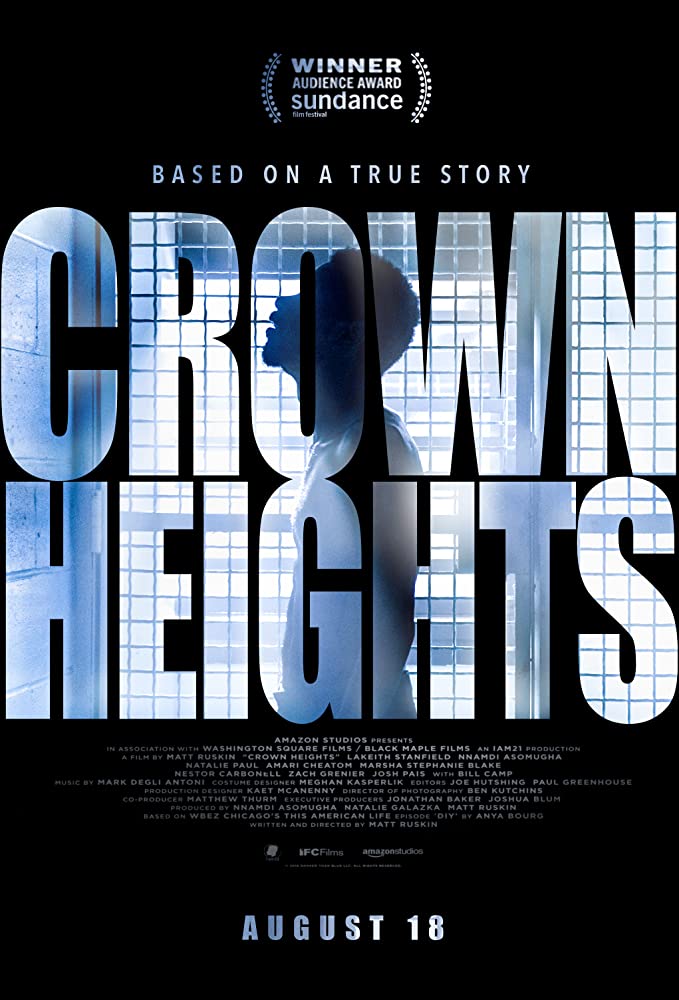
Crown Heights is the story Colin Warner (Lakeith Stanfield), a man wrongfully convicted of murder based on no evidence whatsoever, and pretty flimsy hearsay. Numerous people told the cops and the court that they had the wrong man, and in fact the right man had indeed been arrested, but his plea deal refusal meant Warner got tried beside him instead of released. What a technicality to get sent away to prison for. Even the presiding judge seemed to agree, sentencing Warner to the minimum allowable time (15 years to life), and the actual bad guy to the maximum allowable time (9 years to life, because he was just a few months younger). Despite his innocence, Warner languishes in prison for decades; the only reason he’s not completely forgotten is his best friend Carl King (Nnamdi Asomugha) who works tirelessly on the outside, with many personal sacrifices made, to free his friend. His wife feels like she and the kids play second fiddle to his crusade, but King knows that his friend is innocent, and does not know how to simply live with that.

Crown Heights is based on a true story. A true, very sad, very depressing story. We know this genre well by now, but it’s important to remember that behind every film are dozens of real people wasting away behind bars for crimes they did not commit. And of course these people are overwhelmingly likely to be black because the system simply does not work for those who cannot afford to adequately defend themselves. Innocence is a concept that can be bought; guilt and poverty are linked by circumstance.

When we say people die from racism, we don’t just mean the cops who keep killing black people. We mean that black people are 4 times more likely to die from COVID-19. Black people make up a disproportionate number of prisoner executions, and they’re more likely to receive the death penalty when the victim is white. America has created a ‘medical apartheid,’ with African-American infant mortality rates 2.2 times higher and black babies 3.2 times more likely to die from complications due to low birth weight, and Sudden Infant Death Syndrome (SIDS) (Incidentally, in Canada we have socialized medicine – it is free for everyone – while Americans have a privatized system which means if you can’t afford medical treatment, you don’t get it, but the truth is, the Canadian government spends less on health care per capita than the U.S. does! It makes NO SENSE).

Writer/Director Matt Ruskin first heard Colin’s story on the radio show This American Life. He was so moved by the story that he couldn’t stop thinking about it for weeks. I’m not sure his script quite gets to the heart of the story. To me, this is more than just another broken system story. It’s a real testament to enduring friendship and loyalty and I wish the movie had balanced things between the two a little more equally. But even if Ruskin doesn’t have much to add to the genre, he does present an affecting and effective film, mostly because he doesn’t overplay his hand. The temptation toward melodrama must be strong, but he avoids it in favour of a quiet kind of power. Nnamdi Asomugha shows us focus, determination, and steadfast support. Stanfield manages to find his character somewhere between anguish and apathy, rage and resignation, despair and desperation. The story earns our attention and rewards us with new trains of thought.

In The Line of Duty

Vice Captain Volk (Giancarlo Esposito) is running a pretty high-stakes operation which of course goes sour. With an officer down, the suspect takes off running, with Volk cautioning the other officers to hold back. Which doesn’t account for Officer Penny (Aaron Eckhart), a nearby cop on foot patrol, who hears the call and immediately gives chase. The suspect puts up a good chase too, nearly gets away in fact, but Penny corners him in an alley and when they both pull guns, Penny’s still standing, and the suspect is dead. Which is unfortunate for a couple of reasons: a) Penny’s got a trigger-happy reputation as it is, but worse b) the suspect was a kidnapper, and with him dead, there goes the only lead in the investigation. Oops.

Turns out, it’s Volk’s own daughter who’s been kidnapped, and they’ve got about 60 minutes to find her before she expires. Penny is immediately relieved of is gun and his badge, but by god, that’s not going to stop him from saving the day. Ava Brooks, however, might be a bigger impediment. Ava (Courtney Eaton) is a young woman armed with a live feed and a passion for truth. She sticks to Penny like glue and she’s live streaming this entire unsanctioned pursuit. Why Penny allows this to happen is about as puzzling as her cell phone’s amazing battery life, but let’s just be good sports about it and pretend these scenarios are likely.

Jeremy Drysdale’s script offers up a plot that’s drowning in clichés, and director Steven C. Miller doesn’t exactly have any tricks up his sleeve, but if you’re willing to overlook the increasingly unlikely (heck: ridiculous) events, Drysdale and Miller do deliver some wild and constant action. The Line of Duty (yes, there’s some confusion over its proper title) is a forgettable film but it’s oddly watchable in the moment. Eckhart and Eaton have little to no chemistry and in the long and storied history of buddy cop movies, this one isn’t going to make a dent in the genre. It may, however, help bridge the movie void left by an uncaring virus.

Guns Akimbo

I suspect Daniel Radcliffe may have perfected his American accent by watching Breaking Bad. He sounds so much like Jesse Pinkman (Aaron Paul), or indeed his Bojack Horseman character Todd, it’s eerie. In Guns Akimbo, Radcliffe’s character Miles doesn’t just sound like these guys, he’s also the lovable loser type, the sitting on his couch type, the unmotivated type. But sometimes despite your best efforts, life finds you, and it makes some demands.

Miles is sitting on his couch “trolling the trolls” as he calls it, stirring up shit with his keyboard with big bad words from an anonymous account. But when there’s a sudden pounding on his door, it seems that Miles has finally trolled the wrong troll, as the criminals behind world-wide sensation Skizm drag him into their deadly game. Skizm pits two people against each other as millions stream live to watch them fight to the death. It’s a viral murder game that Miles wants no part of, but when he wakes up with gun stigmata (guns literally bolted to his right and left hands), he doesn’t have much choice.

So we spend 90 minutes watching him get stalked by opponent Nyx (Samara Weaving), search ex-girlfriend Nova (Natasha Liu Bordizzo), try really hard not to die, and adapt to having guns for hands – which includes recruiting help from homeless crackhead Glenjamin (Rhys Darby) for every day needs such as unzipping to pee, and liking stuff on Instagram. You know, the basics.

As you might guess, Guns Akimbo is 100% about the glorification of violence and surprisingly, I’m not that mad about it, mostly because it’s pretty forthright and honest about it. You’re not going to stumble into this one thinking it might be about a close-knit family dealing with sudden onset Alzheimer’s, or a couple who find each other late in life only to have one of them die tragically and slightly heroically in their lover’s arms. No. Guns Akimbo sounds exactly like it is: bang, bang, bang2. It spends its first 5 minutes dropping hints of animation to prepare us for what’s to come. It briefly pretends to be a social commentary to justify the approaching onslaught, but honestly, who needs it? Finally, it gives up the pretense and indulges in the stylized and blood soaked violence it promised, with a fanfare of 80s pop. You’ll feel as if you’ve jumped into a video game that’s definitely rated M, though that can’t possibly stand for Mature. Maniac? Madman? Murderous rampage? You’re not here for satire or plot, you’re here to bear witness to the sheer volume of spurting GSWs, severed arteries, spent casings, and blatant disregard for human life. It is not a credit to anyone’s moral fiber and it does not improve the human spirit but it is a fun if gratuitous ride through our seediest impulses.

Other movies have gone here before – Nerve with Dave Franco and Emma Roberts was not bad if you don’t mind superficial thrills with a side dish of already outdated youth culture. These movies apparently find no irony in critiquing our voyeuristic tendencies while also capitalizing on them.

Radcliffe is fun, Weaving is a poster child for why you never bleach your eyebrows, and Darby is a welcome laugh in an otherwise very black comedy. The soundtrack, featuring “Citrus Hill” amidst covers of bright 80s tunes, provides a hyper backdrop for frenetic death and destruction. Nyx shoots from the hip, Miles tries not to shoot off his own dick, and the whole thing’s just a riot of violence and tribute to the games and shows and songs that promote it.

Look Again

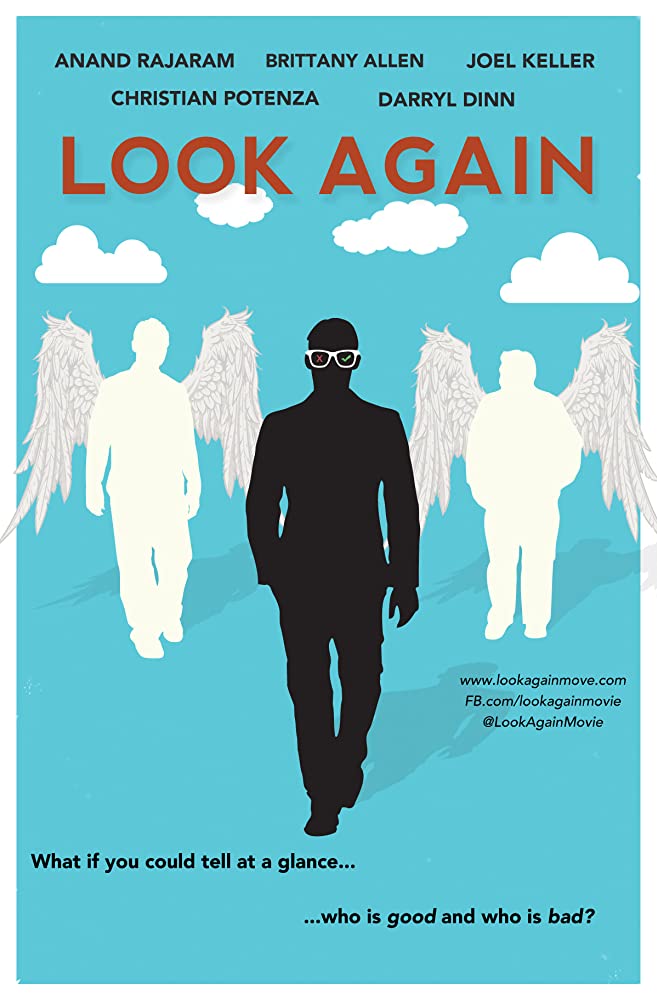
Amit is a terrible judge of character, and also a terrible problem solver. But anyway: his girlfriend cheated on him and his business partner stole from him so now he’s going to commit suicide by lying dramatically across train tracks. Which…are not in service. Two guardian angels fly down from heaven to tell him to stop embarrassing himself and they give him a pair of magical miraculous glasses that allow him to see a person’s true aura. Well, frankly, aura’s a little generous. The glasses operate on a strictly binary system: good or bad. Which is obviously not the most ridiculous part of this paragraph, but it’s up there.

I’ll admit there’s something to this premise. Not so much the judgy eye wear as the possibility that we may learn more from failure than from success. Anyway, Amit (Anand Rajaram) isn’t interested in learning from his mistakes, or honing his own instincts, or taking responsibility for his own poor choices. He’s all about using the glasses to fast-track himself to love and money. Which is pretty stupid, because if god went to the trouble of sending you some fabulous frames, you’d better make damn sure you use them for good and not evil.

Writer-director Daniel O’Connor makes some pretty severe misjudgments. Making Amit our protagonist just makes me wish an errant train had put us all out of our misery before the movie even really began. This guy deserves to be naturally de-selected, and instead he gets a leg up from the big man himself? Boo. Amit steadfastly waves away concerns and objections from people who care about his moral fabric, he refuses to learn a lesson, and his button-down shirts are atrocious. O’Connor’s second misstep is casting Rajaram, who is nowhere near as charming as either man thinks. He plays Amit as fairly dodgy, which leaves a funny taste in the mouth considering he’s “the chosen one.” His character never deserves the good things in his life, nor is he grateful for them. And he’s so frickin obvious! He doesn’t wear the glasses, he rather suspiciously slips them on, looks at a person, takes them off, and then either nods or shakes his head. SO FRICKIN OBVIOUS! Have a little respect for the game, dude! God doesn’t want you flaunting your superpower! You may as well erect a sign that says “Isn’t it curious how well I can suddenly predict whether a temp will fit in to our office culture?” Um, yes, yes it is, Amit! It’s a little goddamned suspicious! Might it have anything to do with those hideous white glasses you keep whipping on and off like they can, I don’t know, reveal a person’s true nature somehow in a very black and white way that dangerously categorizes people as either one thing or the other, with no context or nuance or chance at redemption?

Rajaram isn’t the only problem in the cast. In fact, it would be simpler and shorter to list all the not-horrendous actors: Darryl Dinn. He plays one of the guardian angels and he has enough personality and pizzazz to brighten the screen, although with O’Connor’s script, it’s still an uphill battle, if the hill was Mount Everest and the battle was 10 000 murder hornets with a taste for angel blood. It is clearly only with a very high degree of difficulty that someone in this film can unlock the achievement of not adding to the general suckage of this film, and so I award Darryl Dinn with the Didn’t Suck Award, which I’m sure is more meaningful to him than a personalized concierge team from GOD was to Amit. I can’t be too hard on these poor actors. Judging by the film, they were likely working for a slice of soggy pizza at the end of a 16 hour day, and you know what they say: you get what you pay for.

Official Secrets

“Just because you’re the prime minister doesn’t mean you get to make up your own facts.” It’s almost delicious how naive this sounds as Katharine Gun (Keira Knightley) utters the words unironically near the top of the film. This was in 2003. We, of course, that politicians were shady. That they lied routinely and weren’t even ashamed of it. But in 2003, things began to shift, in part because thanks to the internet, we had ready access facts and figures. So when a politician looked into our eyes (through television, but still) and said the words “weapons of mass destruction,” we called bullshit. With time we’ve been able to say that the war on Iraq was never about 9-11, or Sadam, or nuclear capabilities. It was about oil. It was always about oil. That was the beginning of the end; it’s been all downhill from there, rolling ever more swiftly from 2016 on when America’s T-bag president has us living in a post-truth, fake news apocalypse.

But let’s go back to 2003. After the tragic September 11 2001 terrorist attack, America mourned their 3000 lost, but then skipped through the other stages of grief and went straight to vengeance. The al-Qaeda terrorists were not from Iraq (they were from Saudi Arabia, primarily) but linking the invasion of Iraq to the tragedy provided convenient cover for America’s true intentions:  control over oil and preservation of the dollar as the world’s reserve currency. UK prime minister Tony Blair decided to cast his lot with George W., though he found it difficult to justify in the House of Commons where a record-high number of MPs rebelled against the vote and 3 resigned in protest. Still, they joined what was already an unpopular war with suspicious rationales. Katharine Gun (Knightley) was but one of many people glued to their televisions, skeptical of the reasoning they were being sold.

Gun worked as a translator for a British intelligence agency. She’d seen memos concerning a request from the U.S. for any kind of compromising information on diplomats from the UN Security Council who were due to vote on the prospective invasion, and for help in bugging their offices.

Outraged at their under-handedness, Katharine leaked the document which ultimately led to her arrest and being charged with breaking of Official Secrets Act. The movie is nothing new, and if anything it lacks punch since with hindsight we know that not only was Hussein not affiliated with al-Qaeda, no WMDs were ever found in Iraq. The war was a sham. The reason to watch is for Knightley, who reminds us that ordinary people can be promoted to hero or demoted to villain when they turn whistleblower. Director Gavin Hood’s success is that he doesn’t make Gun a martyr, he doesn’t make her soap-boxy or righteous. She’s just a citizen like you or I, frustrated by her government’s dishonesty, and when she has the ability to do something, she does it. She’s not brave or courageous. It reminds me of a quote from Spider-man: Into The Spider-Verse (random much?) (bear with me): “Anyone can wear the mask.” In early 2003, Katharine wore the mask.

Why watch the movie when we’re already familiar with the events? For me it was the court scene. Gun plead “not guilty”, saying in her defense that she acted to prevent imminent loss of life in a war she considered illegal. What happens next is eyebrow-arching stuff, almost too good, too perfect to be true (but it is).

Where Hands Touch

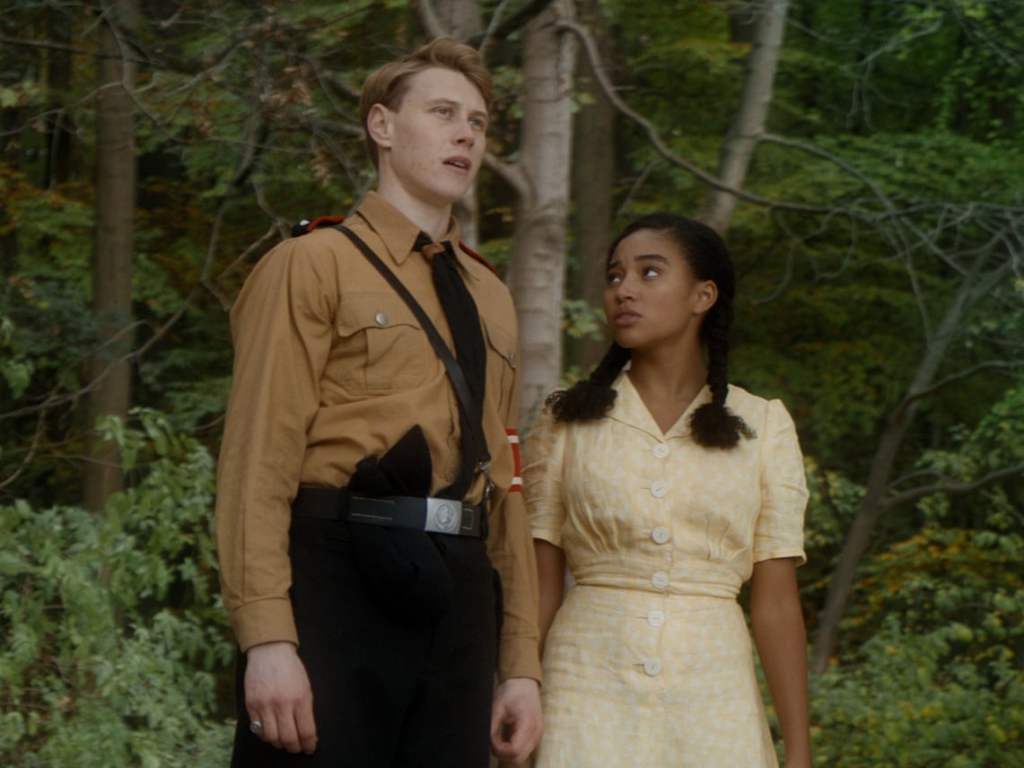
Leyna (Amandla Stenberg) is the only person of colour in her village. She’s aware of that fact, of course, all too aware, but it’s not until her 16th birthday when her difference starts to truly matter, so her mother packs her and little brother Koen up and takes them to Berlin where they can be ‘invisible.’ But Berlin isn’t any safer for a biracial girl in 1944. Leyna and her family live in fear, and Leyna’s mother Kerstin (Abbie Cornish) is so desperate she sacrifices her relationship with her own family to obtain some false papers for her daughter, papers that promise Leyna will never commit the crime of racial mixing with a German aryan, papers that claim she has been sterilized.

Koen joins the Hitler Youth, compulsory for every aryan boy, and his mother is trying her best to temper the hate he learns there with the values and morals of home. As for daughter Leyna, Kerstin is just trying to keep her alive, a feat made more difficult after Leyna falls in love with Lutz (George MacKay), himself a member of the Hitler Youth, and the son of a prominent SS officer. This could get them both killed – it has become obvious that the Nazis aren’t just hunting Jewish people, but anyone deemed “impure.”

There’s obviously an interesting story in there somewhere, but the script by writer-director Amma Asante doesn’t quite sniff it out. Possibly the best thread to follow would be that of Kerstin’s relationship with her children, both rebellious in their ways, and her struggle to balance her beliefs with what will keep the family safe, not unlike Scarlett Johansson’s Oscar-nominated turn in Jojo Rabbit.

Instead we experience the world from Leyna’s perspective. Amandla Stenbert does good work, but Leyna is a teenager, confused and confident at the same time. She insists she wants nothing more than to be treated like any other “good German,” which, considering the context, is kind of uncomfortable. Against the backdrop of millions of Jewish people being led to slaughter, it sort of feels like Leyna has shown up to a Black Lives Matter protest with a sign that reads “All Lives Matter.” Leyna’s youth sees only injustice against herself, and her lack of awareness or irony starts to feel worryingly tone deaf.

The increasingly improbable love story does little to recommend itself and its compassion feels miserly and misplaced. Sean and I recently watched Schindler’s List (he for the first time), a perfect reminder that there are plentiful and worthier movies on the subject, ones that manage to paint a fuller and more accurate picture.


The Handmaiden

During the 1930s Japanese occupation of Korea, Lady Hideko (Min-hee Kim) lives on a large countryside estate with her abusive uncle. A new handmaid, Sook-Hee (Tae-ri Kim) arrives in the house to assist her, only the two bond in unexpected ways.

But what Hideko doesn’t know is that Sook-Hee was raised in a den of thieves – and pickpockets, forgers, human traffickers, and so on. A fellow criminal, playing the long con and posing as Japanese gentleman Count Fujiwara (Jung-woo Ha), came to her with a proposal. Lady Hideko stands to inherit a vast fortune. If Sook-Hee agrees to help Hideko fall in love with him, they’ll rob her of her money and have her locked up in a madhouse. Sook-Hee accepts. But as she encourages Hideko’s seduction, she herself is falling for the lady, but her poverty and pride won’t let feelings get in the way of fortune.

The Handmaiden is an exceedingly beautifully-shot film with a score that sounds an awful lot like Downton Abbey. It’s loosely based on Sarah Waters’ crime novel, Fingersmith, but director Chan-wook Park (yes, the very same who gave us Oldboy) has his fingerprints all over this adaptation. His interpretation is visually luscious, of course, and the story more complex than it seems. This one too cleverly hints at the various power dynamics at play – between sexes, classes, and even colonized and colonizer.

While the erotic scenes are somewhat familiar and cliched, one bathtub scene involving a thimble will go down in the history books as a delightfully powerful lesbian maneuver. The Handmaiden is lush and decadent and often disturbing.

A Lego Brickumentary

Jason Bateman gets the mini fig treatment, and as the documentary’s narrator, he helps us discover aspects of the Lego culture we’ve perhaps not before considered.

I mean, someone has. Definitely not me. But someone. I grew up in a house of women; we were four sisters, close enough in age to swap clothes, braid each other’s hair, and influence each other’s tastes in movies and music and books. Eventually we got it into our pony-tailed heads to put Legos on our Christmas lists, not much caring who received the list as our entire basement was a communal playroom. But instead we got more Barbies. We had, literally, hundreds of Barbies. We had so many Barbies that we’d often get repeats of the same ones – we’d call them “the twins” or “the triplets” and carry on as usual. We loved Barbies. But we never got any Legos.

I didn’t really discover Legos until my oldest nephew was old enough to play with them. And by old enough, I mean old enough to last about four seconds before wandering away, leaving his dad to complete the project, who was the one who really wanted them in the first place. Sean would linger for an hour in the Lego aisle, sizing up each kit, weighing the options. I remembered Legos as a massive pile of plastic bricks to dump over your living room floor, from which to build the blueprints in your mind. But the Lego aisle of the past decade tells a different story: boxes with exactly the parts necessary to build the project illustrated on the cover, many of them heavily licensed to appeal to children. And many of them not. Lego has discovered a second crucial customer base: adults! My nephew’s dad, and Sean – they’re not outliers. Adults make up such a large portion of Lego’s customers they even have their own acronym: AFOL, adult fan of Lego. These are the people splashing out serious cash: $350 for 3898 pieces of Manchester United’s Old Trafford stadium; $400 for an authentic replica on a 1:8 scale of a Bugatti Chiron; $900 for a massive 7541 piece Millennium Falcon. People love the zen aspect of following precise instructions, but lots of AFOLs are building outside the box too, exhibiting their impressive creations at Lego conventions or submitting them to Lego to win the chance to see their design reproduced and sold in stores.

Whether you played with them as a kid or as an adult, or merely browsed them endlessly as an aunt who cares, Lego has maintained their hold as a top toy for decades. But they’ve transcended toy stores, they’ve been used in art and architecture, we’ve seen them in movies and museums. And now we can celebrate them in this Amazon Prime documentary too.

Tell us about your own Lego projects: do you like Technic, Creator sets, or licensed stuff? Have you built the Death Star, the Taj Mahal, the Simpsons living room?

7500

7500 is the emergency code for a plane hijacking. Fasten your seatbelts, passengers. This is going to be one hell of a bumpy ride.

Tobias (Joseph Gordon-Levitt) is the American copilot on a flight from Berlin to Paris. He and Michael, the captain (Carlo Kitzlinger) are going through the usual piloty pre-flight rituals: ordering their sandwiches, deciding whether they’ll wait for tardy passengers, saying the word “check” a lot, or, to changed things up, occasionally “checked.” Extremely banal shit is what I’m getting at. The fun in being a pilot is apparently in the strut through the airport. Inside the cockpit it’s mostly just paperwork and hitting the right button for autopilot.

But unluckily for Tobias and Michael, no one titles their movie 7500 and then fails to follow through with hijackers. We know it’s coming, but the waiting is agony. Right up until the improvised glass shiv comes out, Tobias and Michael are having an uneventful day at the office which just happens to be 35000 feet above ground, zipping through the clouds at approximately 900 km/hr. I’m having a worse flight than they are, but that’s because I know the title and they think it’s something like “gawd I can’t wait for the weekend.” I feel a tightness in my chest, anxiety in my breathing. And soon enough, so do they.

Emergencies are why we even bother to have pilots at all. Sort of. The autopilot can fly and land and even handle things like engine blow-outs. And arguably it would do better in situations like this. The cockpit must never be breached. The pilot knows that. He or she knows that her #1 priority in a hijacking/hostage situation is to keep the bad guys out. But there’s a difference between knowing that, training for that, and actually doing it when the hijacker has a knife to a passenger’s throat. Or, let’s say, to the flight attendant’s throat who is secretly your girlfriend/baby mama. The autopilot would have no problem obeying this rule, but human pilots are vulnerable – to fear, to compassion, basically to emotion. Which is both a feature and a bug.

So Tobias is in a pickle. A big fat pickle.

This is not Die Hard. We’re not here to have fun. This entire movie takes place in a cockpit, and very nearly in real time. You can’t actually smell the fear pooling in Tobias’s armpits, but you might think you can, and I wouldn’t blame you one bit. This film is intense. So intense I hit pause about 45 minutes in just so I could catch my breath. We are marinating in Tobias’ stress sweat and it is brutally unpleasant. But this is how Patrick Vollrath’s 7500 distinguishes itself from virtually all others in the genre. This is not about action, or heroics. We spend 90 minutes living in a terrified copilot’s shoes. It is neither glamourous nor dignified.

Such is Joseph Gordon-Levitt’s talent that he’s able to convey concern for his unseen passengers and crew – the way he blinks, the way he breathes, the way he hesitates or doesn’t. We can’t see past the cockpit door, but we think of them, and even of the people in the city down below, asleep in their beds, unaware that a terrorist plans for them to die before they wake. Beyond the opposing forces of the highjacker and the pilot, there is little else. We are meant to feel this event viscerally, painfully. It is unlikely to gain traction as a mindfulness exercise but boy oh boy does it force you to live in the moment.

I like 7500 about as much as I like flying, which is to say, not at all. This is not a movie to be “enjoyed.” But airplanes take you to a new and perhaps exotic location. They take you to places that are exciting and interesting to explore. A vacation allows you to try on a different sort of life for a while. Maybe you enjoy it, maybe you don’t, but either way, travel makes you learn things, about the world and about yourself. And sometimes you don’t have to travel any further than your couch to get there.