Tag Archives: based on a true story

Eddie The Eagle

everything-you-need-to-know-about-taron-egerton-s-new-movie-eddie-the-eagle-823764Dear god. Is this the cutest kid in the whole wide world? Little Eddie has Olympic-sized dreams. He’s not much of an athlete but he’s always a-training. He’s got a tin to hold all his medals but so far all it holds are the glasses he breaks while working out (did I mention he’s not much of an athlete?).

If they gave a gold for perseverance at the Olympics, Eddie would have a neckful. They don’t (I checked. And probably so did he.). But eventually he finds his niche: downhill ski. He’s still not Olympic material (so says a man with a friendly hand on his shoulder) but he does remain mostly upright. So if he’ll never make the downhill team, should he just get on with his life already? Not Eddie. Eddie’s a dreamer. And a finder of loopholes. Turns out, England doesn’t have a ski jump team. Know what that means? No competition! Even if he’s the worst, he’s the one and only, which also means he’s the best, which means automatic qualification! Kind of genius, eh?

Eddie Edwards is a real person and you may remember his story. As a character on the eddie_the_eagle_114967screen he’s incredibly likeable and his optimism is incurable and catching. If optimism was VD, he’d be positively syphilitic. But his country’s not behind him. Heck, even his coach is reluctant at best, and a bit of a drunk (hello, Hugh Jackman!). Meanwhile, Taron Egerton as Eddie is nearly unrecognizable but instantly warms you to the role.

Is this a feel-good movie? Yes it is. And normally I’d say that with a smirk. But this is the kind of feel-good that doesn’t make you want to poke your eye out. The movie avoids biographical truth in order to cling to sports-movie cliches and I still can’t fault it – it’s simple, it’s predictable, and by god is it endearing.

Frank and Cindy

When GJ returns home from school, his mother, Cindy, has a surprise for him: “I quit drinking!” An even bigger surprise than her 15 months of sobriety? She’s also spent all of his savings. So it turns out he’s home for good. Deprived of film school, he turns the camera on his fuck-up Mom and her has-been rock-star husband, Frank.

MV5BMTYyNTkwNjg4OV5BMl5BanBnXkFtZTgwNzUyNTM1ODE@._V1_This film is actually a dramatic reenactment of a documentary of the same name, by G.J. Echternkamp. And his parents are undoubtedly larger than life, which in this case is a kind euphemism for colourfully pathetic, hopeless losers. Rene Russo and Oliver Platt play the titular characters and you’ve got to admire their abandon. They each give strong performances, and you’ve got to give props to Russo in particular for her willingness to throw herself into such an unflattering role.

When GJ has enough of their codependent craziness he seeks out his biological father for some commiseration but he surprisingly turns out to be in Frank’s corner. It’s way too easy for GJ to blame his struggles on his underachieving parents, but when that’s not getting him anywhere, what then?

Watching this film and reminding myself that Frank and Cindy are real people makes this a particularly excruciating experience. And to be honest, the screenwriters trying too hard 2015 Features-FrankAndCindy1to stick to the source material means this movie has no real backbone. It ambles but doesn’t amount to much. And weirdly, GJ seems to be the least developed character – it’s his story but he’s a pretty passive player. And that feels ironic since Echternkamp himself helped bring this script to life, and he’s also sitting in the director’s seat, although at times he seems to forget about the advantages of feature vs documentary – he could make the scenes look amazing yet seems to enjoy filming in dank little corners.

At any rate, this is clearly a personal film for Echternkamp. There’s catharsis happening here. And self-indulgence. Lots of that. But Russo and Platt are good, good enough to make up for the film making foibles.

Tribeca: Elvis & Nixon

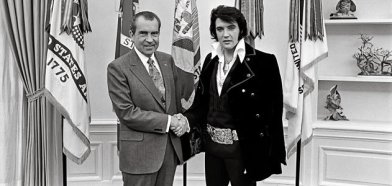
True Story: in December 1970, Elvis’s dad and his wife, Priscilla, were mad that he’d spent $100K on guns and Mercedes-Benzes for Christmas gifts, so he threw a fit worthy of a teenage girl, stormed out, and caught the next plane going anywhere. Anywhere turned out to be Washington. Elvis had a large collection of police badges, but his Moby Dick, the Indelible-Nixon-Elvis-631.jpg__800x600_q85_cropone he coveted the most but could never land was a badge from the Bureau of Narcotics and Dangerous Drugs (he believed having one would mean he could travel to any country with drugs and guns). Unable to convince the bureau, Elvis being Elvis went over their heads and straight to the top – to President Nixon. He showed up at the White House in a purple velvet suit with a huge gold belt buckle and his trademark gold sunglasses, and a white-house-warming gift—a Colt .45 pistol mounted in a display case, which was of course confiscated at the gate. Elvis got his badge though, and asked that the meeting be kept secret. But once he died, the Archives made a fortune selling the official photo, the most-requested Archive photo in the history of the world.

It’s a pretty fucking crazy story, so of course someone had the bright idea to turn it into a movie.  Joey Sagal, Hanala Sagal, and Cary Elwes share writing credits – yes, that Cary Elwes, who thought he might direct the thing, with Eric Bana as Elvis. That version fell elvis-nixon-michael-shannon-kevin-spaceyapart but Michael Shannon was soon onboard, maybe not the most obvious choice to play The King, but he waved his magic wand of executive productionship, and convinced Liza Johnson who’d previously directed him in Return to helm the whole damn thing. With Shannon filling the King’s rhinestoned shoes, it just made sense that Kevin Spacey would slide into the President’s shiny loafers.

Although there’s no official transcript of what happened inside the Oval Office, Johnson somehow captures the moment perfectly, both in tone and within the context of the times. It’s a trifle of a film, its only point to get these two towering and seemingly opposite figures in the room together. But with powerhouses like Spacey and Shannon, that’s more than enough. I took a lot of pleasure from the lack of prosthetics or makeup tricks on hand – neither of these men particularly look like the figures they are playing, and neither lower themselves to impressions. The script even pokes fun at how much taller Shannon is than Elvis. The script is generally pretty breezy, a little satirical, and heaps of fun. The director is quick to point out there aren’t any real jokes in the film, but the absurdist tone earns consistent laughs from the audience.

Let’s be real: Michael Shannon and Kevin Spacey are legitimately among the most talented working actors today. The film is worth if for their two names above the marquee. The fact that this offers up a bizarre little footnote in American history is just a bonus, and Elvis and Nixon – who is more fascinating or notorious than these two? Spacey and Shannon clearly delight in tackling these roles, and it’s beyond satisfying to watch them engage in a real battle of egos. Within the confines of the Oval Office, Shannon as Elvis has never been a more physical presence on screen, his every movement keeping the president on his toes but always one step behind. Shannon dominates the screen and keeps Nixon chasing after Elvis, and it’s a marvel to watch.

During the Q&A after the screening, director Liza Johnson said she was drawn to the Elvis-Nixon-Movie-Trailer-Billboard-650“tonally eccentric” script and wanted the film to match and “embrace the absurdism of the situation. Michael Shannon, describing Elvis as “mysterious”, relied on interviews with Elvis from right around that time to inform his performance, but the film also benefited from Elvis’s good friend  (played by Alex Pettyfer in the movie) Jerry Schilling and a White House staffer (portrayed in the movie by Colin Hanks) Egil Krogh to give invaluable insight. Johnson said that “Any day working with Michael Shannon is better than a day not working with Michael Shannon” and that Spacey was a natural fit being an equal in acting, and having previously worked  on a Nixon portrayal when he screen-tested for Frost\Nixon.

Bottom line: I enjoyed this very much. There was real spirit, it was a cracking good time, and I found myself making those little smirky-snorty noises, those  half laughs that you make unintentionally when you just can’t believe when you’re seeing. It’s unbelievable, but you’d better believe it.


Elvis & Nixon will be out in theatres this Friday, April 22nd – 22 years to the day of Nixon’s death.

Catch Me If You Can

My first encounter with the life of Frank W. Abagnale, Jr. was accidental.  I was about 5 or 6, poking around the house, when I came across a book cover that instantly imprinted on me:Catch Me

I didn’t read it then, because I couldn’t read a 50 page book before my short little attention span made me want to “look at” ants through a magnifying glass or something similarly fun.  And I never ended up reading it at any time in the next three decades.  It’s probably still sitting in my parents’ bookshelf, and as a kid I would have read it ten times over if I had just read a different page every time I picked it up instead of just looking at the creepy faceless man on the cover over and over again.  But really, the cover was enough for me to draw my own conclusions about how this “amazing true story” turned out.  And it was not until this week that I learned how wrong I was all these years.

My biggest mistake was thinking that this story centred around the fact that this guy actually had no face and that’s why he needed the pilot mask. Symbolism was lost on me then (and probably still is to this day).  It turns out that this guy had a normal face, wrote a lot of bad cheques, and for some reason the key to his scheme was pretending to be a pilot.

I found that part of the story absolutely amazing.  Most of all because I feel like it’s probably true.  Pilots in the 1960s were gods among men.  They were the paragon of success and reliability.  So much so that a pilot’s uniform changed Frank Jr.’s cheque scams from fruitless endeavours to an avalanche of other peoples’ money.  Can you imagine this happening today?  It seems as likely as an apparently successful model taking a cheque in exchange for turning tricks.  Which, as I learned, also happened in this true story.

Incidentally, that successful model was played by Jennifer Garner.  Catch Me If You Can is full of soon-to-be-stars making cameos, including Amy Adams, Elizabeth Banks and Ellen Pompeo.  Add Christopher Walken, Tom Hanks, Martin Sheen, and Leonardo DiCaprio, and you’ve got a pretty impressive cast.  And the director, Steven Spielberg, is no slouch either.

Maybe all these young faces are the reason that watching Catch Me If You Can felt doubly nostalgic.  As only a movie set in the good old days can, the movie puts a bright sunny face on $2.5 million worth of cheque fraud, where if you go big enough then inevitably the FBI will negotiate your release from prison so they can offer you a job.  And those good old days now seem to be either the 1960s, when this movie is set, or the early 2000s, pre-financial crisis, when this movie was made.

Catch Me If You Can is an entertaining movie that remains enjoyable mainly because it fully embraces its ludicrous premise.  If it took itself more seriously, it may still have worked in those good old days but by now probably would have lost its luster, as I think we are now too jaded to be charmed by ultra-rich assholes who think the rules don’t apply to them (with Donald Trump being an obvious and unfortunate exception).

But Spielberg and DiCaprio didn’t ask me to like Abagnale.  Instead, they gave me a kid who figured out how to do one thing really well but who was terrible at every other aspect of life, a guy I almost felt sorry for, and that was a brilliant choice.  Add Tom Hanks as an opponent/father figure who by the end of the movie sees right through Abagnale, and you get a movie I should have watched long before now, especially when it has been sitting on our DVD shelf since Jay and I moved in together.  Things might have been different if the DVD cover had a man with no face – because then I would undoubtedly have picked it up long ago.  That was Dreamworks’ one misstep.

Catch Me If You Can gets a score of nine giddy stewardesses out of ten.

The Lady In The Van

Maggie Smith’s Ms. Shepherd is “NOT a beggar!” although you could hardly blame someone for assuming so – she’s dirty, she lives in a derelict van, and her “self-employment” appears to consist of chalk imagesart on the street, and selling pencils. That van of hers is a neighbourhood nuisance; the people live in fear of when she might exercise her “Christian parking” principles beside their little bit of curb.

Alan Bennett wrote the screenplay,and is also  a character in the movie, portrayed by the excellent Alex Jennings. This is based on a mostly true story. This woman, who elicited both sympathy and revulsion in her “neighbours”, was a nutshell that fascinated and

THE LADY IN THE VAN

inspired both Alan’s decency, and his creativity, when he moved into Camden in the 1970s.

Bennett is moved to have the mysterious lady in the van move into his driveway to keep her legal, though her obstinacy insists it is she doing the favour for him. She is most ungrateful but Bennett cares for her as best he can (and “caring” he intones, “is about shit”), always battling internally over what’s right and what’s right for him. Bennett-the-screenwriter isn’t shy about telling us what really the-lady-in-the-van-4happened, and what just makes for a nicer story. In fact, Bennett has conveniently split himself in two, the one who goes out and lives, and the one who stays home and writes.

The lady in the van lived outside Bennett’s home for two decades, a noble  vagabond in greasy rags, living inside a grubby vehicle – one so convincing that the cast and director turned up one Monday morning to find that real homeless people had broken into it and spent the weekend inside, making use of it as two people might (the van’s video-the-lady-in-the-van-trailer-1-superJumbocontents had to be deep-cleaned before they could be made suitably grimy again for production). They filmed in the very driveway of the very home where Bennett lived at the time.

Smith’s performance is vital and infuriatingly nuanced. You haven’t seen Dame Smith like this before. This film is a feather in her already-decorated cap: not to be missed.


Testament of Youth

See Alicia Vikander before she was famous, Dominic West in his authentic accent, and Emily Watson being stellar as always in increasingly diminished roles.

Vera Brittain was a real-life independent spirit. She vied for and won a spot at Oxford and vowed “never to marry”, even if those sounded like famous last word when uttered just as a very cute boy enters the picture. Turns out, he has Testament-of-Youth_3141581ka thing for sharp and feisty young women, and the two are a love match and plan to be at Oxford at the same time (unchaperoned, even). But every great love story needs an obstacle and feminism wasn’t enough, so along came The Great War to shake things up.

Tag line: Divided by war. United by love. Did you just puke a little in your mouth?la-et-mn-testament-of-youth-review-20150605

Luckily the tagline writer was an aberration and the film itself is quite good. Vera’s mind expands and excels at Oxford, and no one is less grateful for her education than she. Women still have to prove themselves worthy of degrees and now she’s feeling left behind again, when her brother, her friends, and her love are all leaving for the front. But Vera’s not one to take a back seat – soon she’s giving up her beloved scAlicia-Vikander-as_3141524bhool to become a nurse.

Vikander (who replaced Saoirse Ronan) is every bit the revelation that Ex Machina proved she was. She’s poised and luminous, and while the movie doesn’t contribute much that is new to the war genre, Vikander makes it more than worth a look.

Her The Danish Girl co-star, Eddie Redmayne, also starred in his own WW1 eddieepic, called Birdsong (based on the Faulks of the same name). He plays a young man who goes off to war remembering the affair he had with his French (married) sweetheart. Clemence Poesy is beautiful as ever, but this one may leave you feeling faintly unsatisfied.

How to Change the World

From How to Change the World’s title, you may be expecting a self-help documentary or at least a few useful life tips. If that’s the case, look elsewhere. The subjects of this documentary do not in any way seem qualified to dispense that sort of wisdom, nor are they interested in doing so.

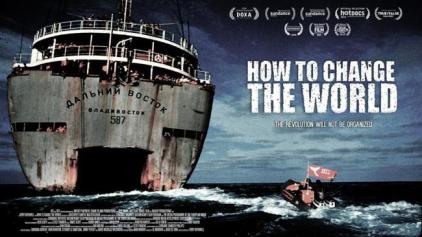
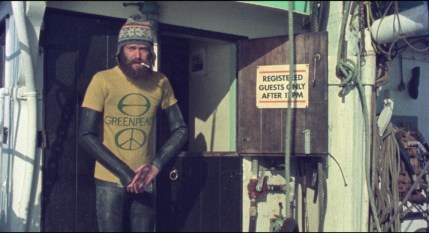
How to Change the World tells the story of Greenpeace’s founders. They were (/are) a bunch of hippies, 99% white males, and absolutely unqualified for the job. They couldn’t agree on much as a small group and then when film of their anti-whaling stunts gave them fame/notoriety, they how to change 1completely imploded. Protests are aborted, physical injuries are sustained, lawsuits are commenced (Greenpeace v. Greenpeace!), turncoats are identified, and shots are taken liberally at one another. Essentially, it’s an episode of Big Brother starring a bunch of 65-year-old grouches.

That sort of thing normally does not appeal to me. Still, I found How to Change the World very interesting for several reasons.

First, the amount of footage these hippies compiled in the 1970s is astounding and makes the film feel alive. We do not just hear interviews about their adventures, we see these escapades on screen, and that makes this movie extremely easy to watch (aside from the awkwardness of the in-fighting) as well as entertaining (possibly because of all the awkward in-fighting!).how-to-change-the-world-3

Second, the rise and fall of this branch of Greenpeace is a fascinating study of the effect of fame. Most of the conflict we see seems to arise out of the external attention and accompanying pressure this group faces after they hit it big. Not that they all get along at the start (they don’t, even then they fight regularly), but initially they can look past those disagreements because they are agreed on the bigger goal. But once there are no clear goals, or too many, the interpersonal issues take centre stage. It doesn’t help that none of these guys is remotely qualified to run a multinational organization, but it sure adds fuel to the fire!

Third, it is remarkable to see the different paths these characters take after their initial adventures. The conflict between the turncoat and the injured member in particular is given a whole new perspective by movie’s end.

Overall, I enjoyed How to Change the World even though I was frequently annoyed or exasperated by these characters, especially by the pseudo-philosophical musings of the journalist-turned-leader of this motley crew. The fact the movie overcame that annoyance says a lot about the content. How to Change the World is well put together and it feels very honest, which makes it feel real.

I give How to Change the World a score of seven bumbling hippies out of ten.

Black Mass

Jay here. I’ve been MIA for a while and most likely will be for a bit more. Back surgery and its sidekick  morphine have indisposed me for writing movie reviews.

Anyway, Black Mass has been kicking around for a while now, generally disappointing folks despite its all-star cast and generous dash of promise. It basically tells the incredible story of Johnny-Depp-in-Black-MassJames ‘Whitey’ Bulger (Johnny Depp), and how he ran Boston from the underground for years, in part because of a brilliant “alliance” with the FBI. An old childhood friend (Joel Edgerton) has conveniently made a name for himself at the FBI and he convinces his boss (Kevin Bacon) that Bulger will be a useful informant. The information flows both ways though, with Bulger constantly evading investigation, and Bulger divulging details already known to the FBI by other means.

Benedict Cumberbatch plays Bulger’s brother, Billy, a successful state politician. Suspicious? Well nobody at the FBI seems to think so, until there’s a new kid in town, Corey Stoll, who starts asking some incredulous questions, like how on earth has a notorious psychopath and criminal with ties to the IRA never ever been investigated? Why indeed.

So things fall apart for Bulger, although never as spectacularly as they do for everyone around 48091645.cachedhim (including Jesse Plemons, and can we just call him what he is: low-rent Matt Damon), and Rory Cochrane (bloated for this role, it’ll kill your Empire Records fantasies right quick), and Peter Sarsgaard (who once did an SNL skit where he was attending a pirate convention, and all the attendees really relished overpronouncing his name – PetARRRRGGGHHHH SAAAARRRRRRsgAAAAARRRRRRD, and now I am forever doomed to do it myself).

Maybe the biggest problem with this movie is that it crammed too many names under too small 62951a marquee. There just isn’t enough to keep everyone busy, and at the end of the day, this feels like a pretty standard mob movie, with Scorsese wannabe undertones. It fails to distinguish itself. The relief, though, is that Johnny Depp remembers how not to be a cartoon. It’s not any great relief though, since this is Depp’s fourth, FOURTH, time portraying a real-life gangster. Even my dogs have learned the trick by the fourth repetition.

You will not find a bad movie here, just a very tired one, but I guess it allowed a lot of Hollywood types to tick off MOB MOVIE on their SAG Bingo card, and if that’s not a good reason to make a movie, then I don’t know what is.

The Big Short

If you were one of the many Ron Burgundy fans who felt let down by Anchorman 2, the movie to blame is finally here. Adam McKay, Head Writer at Saturday Night Live during the late 90s and the director of all the most Will Ferrelly of Will Ferrell movies, was not the obvious choice to adapt such a serious book as The Big Short and reportedly only agreed to write a second Anchorman to sweeten the deal.

The Big Short, which I have not read, was written by Michael Lewis and documents the story of the small group of people who foresaw the collapse of the housing market in 2007 and took a giant gamble by betting against the banks. Now, I’ve seen Inside Job, 2010’s Oscar-winning documentary about the financial crisis and I’ve seen Wolf of Wall Street but still manage to get my dividends and my CDIs mixed up. With Inside Job going so far over my head, I couldn’t help but wonder how a writer best known for “Go fuck yourself, San Diego” would handle such potentially confusing material.

It turns out that McKay is the right guy to make a financial crisis movie for someone as financially illiterate as I am. He consistently finds creative ways to pause to explain the trickier concepts, often by breaking the fourth wall with outrageous celebrity cameos of which I wouldn’t dare spoil the surprise. There are enough jokes, often poking fun at the conventions of movies that are “based on a true story”, to hold our attention better than Inside Out or Wolf or Wall Street could hope to without ever abandoning the appropriate level of outrage at how so much greed could cause so much suffering.

How Hollywood could make a movie- a comedy no less- from Lewis’ book wasn’t the only reason to be curious about McKay’s film. It also boasts one of 2015’s most intriguing casts. Brad Pitt, one of The Big Short’s producers, has the smallest role of the four names above the title but stands out for his uncharacteristicallyy understated performance. I didn’t even recognize him in the preview. (I thought he was Peter Dinklage).  I couldn’t help noticing though that casting himself as the one guy who gets that “this is just not right” is becoming a bit of a self-serving habit of his. (See: 12 Years a Slave). Ryan Gosling, last seen in 2013’s Only God Forgives, makes his triumphant return to the big screen. As Jared Vennett, he channels all the handsome-and-he-knows-it smugness that we saw in Crazy Stupid Love and The Ides of March. Come to think of it, he’s versatile enough to have played pretty much any of the major characters so his talents may have been better served with a better part but he plays it well and has some really funny lines.

Christian Bale and Steve Carrell- believe it or not- are competing for the Best Actor in a Comedy or Musical Golden Globe. Bale plays Michael Burry, the brilliant hedge fund manager with Asperger’s who loves to air drum. He’s good but has been better. He plays the eccentric genius a little like he did the eccentric in American Hustle but he has some strong scenes, especially when he starts to let his humility show towards the end. It’s Carrell, though, who steals the show. With the other characters so impressed with their own coolnees or brilliance and so focused on how much money they’re going to make if their gamble pays off, Carrell brings the humanity. He plays money manager Mark Baum, based on Steve Eisman. He’s had it out for the banks ever since his brother lost all his money and jumped off the roof of a highrise. (I’m not sure if that happened to Eisman or not). His shock and anger is palpable in every scene. Because he’s played by Steve Carrell, he’s still funny. But McKay counts on him to remind us that, while laughing at the stupidity and recklessness of Wall Street can be a lot of fun, a lot of real people got hurt.

I’ll be cheering for him on Sunday.

Concussion

Concussion makes you sick with guilt for being an NFL fan.  As the movie unfolds, the names and stories of these tormented souls bring back memories of news articles you’ve read, and you know that even if some of the details are fictionalized, all the important ones are true.  And even though Sony’s leaked emails reveal they toned down the movie to avoid kicking the “hornet’s nest” that is the National Football League, the watered down version is horrifying enough.  Concussion makes you feel dirty for ever having watched a Super Bowl, let alone having bought a ticket, because involvement as a fan means you actively contributed to the destruction of so many lives.

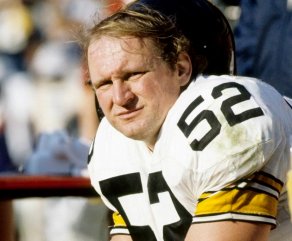
Mike Webster really died in his pickup truck.  Justin Strezelczyk really died in a fiery crash because he drove into oncoming traffic while being chased by the police.  Terry Long really drank antifreeze.  Andre Waters really shot himself in the head.  Dave Duerson really was an NFLPA executive who fatally shot himself in the chest so he could
US PRESSWIRE Sports Archive-Historical

The real-life Mike Webster.  RIP.

donate his brain to science (and Junior Seau really did the same).  All of these former players were 50 or younger when they died.  All have been diagnosed with chronic traumatic encephalopathy (CTE), which is a degenerative brain disease that causes symptoms of dementia including memory loss, aggression, confusion and depression.  The scariest thing is that these are just a few of the former players who have died from CTE, or are living with CTE-like symptoms (a CTE diagnosis cannot be confirmed until after death), and there are thousands more who almost surely are living with the same symptoms and/or other neurological conditions like Lou Gehrig’s disease, Alzheimer’s, Parkinson’s or dementia.

That alone would have been enough for Concussion to make me uncomfortable but a personal connection made these issues all too real.  Growing up, I was a good athlete but my brother Bryan was better.  He was good enough to be playing both basketball and rugby on provincial teams at age 16, and then it was time to make a choice.  He chose rugby because he loved hitting people (which makes sense because he’s kind of an asshole too).  Focusing on rugby made him even better at it, and after high school he went out west to play for the Canadian junior national team.

And then everything went south in a huge way.  His first concussion was well in the past, suffered at age 14 while playing quarterback.  We didn’t think of it at the time but as the hits piled up, every big hit hurt him more and took him longer to recover from.  By the time he was playing national-level rugby, and getting hammered repeatedly by other 6’5″, 240 pound monsters like himself, he was also experiencing blackouts, memory loss, chronic pain and who knows what else.  When he came to at the top of a mountain and had no idea how he had gotten there (turns out he ran the mile from his house then continued all the way to the top), it was a rude awakening in more ways than one.  That was the end of his rugby career but only the beginning of his suffering.  He lost years to pain, headaches, and nausea, he lost his desired career as a firefighter, and he almost lost himself.

Bryan’s story has taken a better turn lately, as he has found treatments and medications that help him manage his pain and live his life. But for me, Concussion was a terrifying reminder that Bryan could have been Mike Webster.  He may still be.  Bryan’s only 36, which is how old Justin Strezelczyk was when he drove into a tanker truck.  Mike Webster was still playing football at 36, so 50 is still a long way off for Bryan and countless others.

Will Smith is decent in the role of Dr. Bennet Omalu, the coroner who autopsied Mike Webster and brought a lot of these issues to light after so many years of darkness and denial.  His accent is not as distracting as in the trailer but I couldn’t escape the feeling that the script was designed to include the phrases that Smith was better at saying in an African accent (“Tell the truth.  Tell the truth!”).  The same accent probably would have been more palatable coming from an unknown actor but does this movie get made or seen if Will Smith isn’t starring?  So while I probably wouldn’t have nominated him for a Golden Globe, I can see how he got one.  He is obviously trying here and maybe that was the problem for me.  In my view Albert Brooks (as Dr. Omalu’s mentor) and Gugu Mbatha-Raw (as his wife) both gave better performances than Smith.

Concussion makes sure to note the similarity between the NFL’s treatment of concussions and big tobacco’s treatment of cancer, and the comparisons are apt.  They still ring true, especially when the class action settlement between the NFL and 4,500 former players was conditional on the NFL never having to admit what it knew about the danger of concussions, or how long it’s known.  It’s easy to read between the lines.

The hits these players took (and gave) are going to kill many of them.  And we watched and cheered.  For me, Concussion made me realize that I’m long overdue to stop cheering and stop pretending that any of this is okay.

For that, I’m glad I saw Concussion.  I’m not sure the movie works as well as it should, because it seemed at times to soften its message in an effort to not seem too preachy.  I’m thinking particularly of a speech Smith’s character gives where he says he doesn’t hate football after being persecuted by the NFL for his research, which to me rang false.  Still, despite that scene and a few similar missteps, Concussion got to me and made me think, and that’s worth something.

Concussion gets a score of seven (six for the touchdown and one for the PAT) out of ten.