Ron Stallworth is a young black man, proud to be Colorado Springs’ first African-American police officer, in 1972 (or 1979 in real life, but from these parentheses forward, please understand that though this is based on his autobiography of real events, I’ll be discussing the events in the film). He’ll be the Jackie Robinson of the PD, and like Jackie, he’s the impossibly perfect, flawless, magical black man who will need to constantly turn his cheek – not just to the racist public, but to racist colleagues as well. Life might be difficult for Ron walking the beat but he’ll never know because he’s buried in the basement records office being abused by his own fellow officers. He’s desperate to get some real police work but I bet he got more than he bargained for. When he’s partnered with a Jewish officer named Flip, the two of them together make a single perfect Klansman.
Wait, what? Yeah, true story, though it sounds like the setup of a joke with a cringe-worthy punch-line. A black guy and a Jew teamed up together, undercover, to infiltrate the KKK. Ron (John David Washington) says all the right things on the phone, all the way up to the Grand Wizard himself, David Duke (Topher Grace). Flip (Adam Driver) provides the requisite white face and trucker caps. Together nothing can stop them, except possibly guys in hooded robes.
Spike Lee directs this thing, based on Stallworth’s memoir. But the spin that Lee and the other writers bring to the movie is fantastic. While this would have been a remarkable story at any time, setting it is amidst blaxploitation movies and Nixon’s reelection 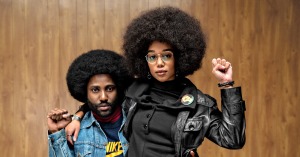 campaign gives it a crisp edge, and the constant allusions to Trump’s eventual win, thanks in part to his KKK ties, give it a sharp one. Damn it’s smart. And also depressing. And funny. Like, really funny. And so sad. Because as astutely-observed as this stuff is, it’s astonishing and disappointing to realize that 40 years on, we haven’t made much discernible progress. White people were horrified and baffled by 45’s election, which is funny because it was obviously white people who elected him. The two kinds obviously don’t talk. But nearly every black American I’ve spoken to was not overly surprised by the result (which is a far cry from being happy about it). They knew the country’s true temperature since they live with its consequences every day. And now those things have been outed, given permission to be voiced, and suddenly 2018 is resembling 1972 is some very uncomfortable ways.
John David Washington is really great in this role. He made his movie debut at just 6 years old, playing a school kid in a movie Spike Lee made with his father, Denzel called Malcolm X…maybe you’ve heard of it? If he’s getting acting lessons at home, they’re paying off. He’s subtle and natural and the movie’s success hinges on how well he underplays events that seem so impossible. Adam Driver does well too; he knows he’s second banana, but his character undergoes an interesting arc, from “it’s just a job” to really internalizing the hated for Jews that he constantly has to endorse as part of the klan. It has to mess you up to say things against your own people, to disavow yourself from a group that is part of your essential self – we feel that every time Flip denies his religion out loud to suspicious klansman, but it’s an interesting callback to Ron’s police department interview, where he basically had to do the same. And that should give us pause. And Topher Grace gets to play David Duke because Armie Hammer’s perfect Aryan face was presumably busy playing a slave owner in some other movie.
Ron spends the movie trying to prove to himself, to his potential girlfriend, and to his superior officers, that you can work from the inside to tear something down. His lady, the president of the black student union, is a proud agitator who doesn’t believe you should belong to the system you’re trying to destroy. “Black liberation!” she shouts at him. And we clearly see his own internal struggle because on the one hand he’s a first hand witness to the system being broken, and stacked against him, but he also believes he can be an agent for change. It takes guts to be the guy on the inside. I guess after being that guy for his whole life, joining the klan maybe didn’t seem so scary.
In fact, Lee does well subtly highlight the similarities between the two groups: kops and klan. Both seemed nearly identically racist in the 70s. But what got me is that in the film, both groups refer to themselves as “family.” Very recently I was telling Sean this theory of mine that any non-family member who refers to themselves as “family” is doing it for nefarious reasons. Work “families” tend to be abusive. It means, sure they’re internal fighting. It’s fine. It’s family. In the police department it means we don’t rat on each other. If some officers are abusing their position to harass people (spoiler alert: black people!) we turn a blind eye. There are so many clever, subversive little elements that they get under your skin incredibly effectively.
And just when you’re starting to feel cutesey about all the Nazi-salute foreplay and lynching pillow talk, Lee flips the script and reminds us of our present-day truth, where we cannot hide behind our smug sense of superiority. We are not better, and there’s no better way to remind us of that than with footage from last year’s white superemacist, neo-nazi, ‘white civil rights’ rally in Charlottesville. This weekend is actually the one-year anniversary, and tensions are high. This movie will likely never reach the hearts and minds of those who could really use it, but let it be both a balm and a rallying cry for the rest of us, perhaps even an emergency flare. We need movies like this to get us through these dark days.

 Malkin (Oscar Isaac) and company manage to pick up Eichmann (Ben Kingsley) thanks in part to his indiscreet son who still hates Jews all the way from Argentina. They sweat it out in a safe house. For safe travel they require Eichmann’s signature, and Malkin vows to get it. The interrogation is heated; Eichmann is emotionally manipulative and he knows exactly which buttons to push. The agents have agreed to bring him back to Israel for a public trial, but not killing him proves to be a very big challenge for almost every single one of them. Eichmann knows this trial is not likely to rule in his favour, so he delays endlessly, which is also to the benefit of the Nazi rescue party determined to find him.
 found male identities received more sympathy. Eventually she found a way to turn it into art, and several stories and books were published under the name. She wouldn’t be the first writer to write under an assumed name, but she might be the first to have gone to such great lengths to present a pseudonym as a real person. She recruited her boyfriend’s androgynous sister Savannah to “play” JT in person, granting interviews and posing for pictures as him – even signing the rights to a movie contract. Of course, when the truth comes out, as it nearly always does, the world was kind of mad about being duped, and there was a big backlash.
 Arjun (Dev Patel) is part of the wait staff at the prestigious hotel restaurant. He misses out on serving one of the night’s big spending VIPs, Vasili (Jason Isaacs) when it’s discovered by his boss that he forgot his proper shoes at home. Guest is God, Arjun is reminded, but instead of going home for the night, he borrows ill-fitting shoes and will spend the next 4 days regretting it deeply.
 make a handy queer dating service, as it is probably the biggest concentration of homosexual folk any of these kids has seen before, if it wasn’t so nasty and abusive. That’s what it really boils down to. The head instructor, Victor Sykes (Joel Edgerton), blames your “problem” on some member of your family who made you gay. He wants you to pick someone to focus your anger on. He wants you to learn to “act” “straight” (did you know that the triangle is the straightest shape?). He focuses on behaviour – if you stop playing football, you are no longer a football player. Problem solved.
 McCarthy only has her own skin to live in, face naked save for an inept smear of lipstick on only the most special of occasions (ie, when asking for money), hair constantly overdue for its next dye job, frumpy clothes in various shades of poop. But it’s Israel’s personality that poses the real problem. She’s abrasive and reclusive and just doesn’t really know how to exist among people, so she’s basically stopped trying. It’s just her and her cat – a daunting thought when it’s just her and a blank page. A once-celebrated writer of biographies, her agent nowadays can’t get so much as a $10 advance for a book on Fanny Brice that nobody wants.
 now because yes, that’s played as romantic in this twisted little shit of a movie, when in fact that’s the most disgusting thing I’ve ever seen on film, and I’ve seen Matthew McConaughey receive some poultry-related fellatio, so keep that in mind. Hot boxing farts is romantic? No. Holding it in until you’re in a bathroom is romantic. Sticking to turkey at Thanksgiving to avoid ham farts on the car ride home later (sorry for outing you, Sean) is romantic. Or, you know, basic human decency.
 I really like Jessica Chastain, and she tends to make wise and informed career decisions, so I lean toward giving this the benefit of the doubt. This could easily veer into white saviour territory, and maybe it defaults too much toward politeness, but I think it strives to be a respectful and faithful rendering. I just wish it could be entertaining as well. And I really wish it didn’t take one insignificant white woman to tell the story of an entire people, but if that’s how we have to frame it, then (I guess) this more feminist bent is at least an improvement.
 ASSHOLES WATCHING MOVIES