Tag Archives: Canadian content

Tammy’s Always Dying

Catherine (Anastasia Phillips) has spent a lifetime caring for her alcoholic mother Tammy, who has diagnosed herself manic-depressive thanks to the help of daytime television talk shows. Tammy (Felicity Huffman) isn’t a good person, but she is a good time, whooping and gyrating away in the bar where her daughter works, at least until the end of the month when the welfare runs out. Then there’s the monthly ritual of Tammy dangling off a bridge, threatening to jump, and Catherine rushing to her aid, assuring her that she’s loved and cherished and not a bad mother. Even though she kind of is, always demanding time, attention, greasy breakfasts, and cash, without offering anything back, like motherly love or pride or approval or even thanks.

Catherine is stuck in the same town where she grew up, tethered to a mother who is tethered to the bottle. She’s still fucking the same (married) guy from high school and working a dead-end job. Her only friend is fellow bartender Doug (Clark Johnson), who whisks her away to the city occasionally to live like other problem-free people for an evening. The cycle is starting to feel inevitable and unending, Catherine’s resentment growing, and she’s starting to feel like her mother’s suicide might not be the worst thing, except for the fact that it’s always been an empty threat just to elicit Catherine’s sympathy. So when Tammy is diagnosed with terminal cancer, it has a complicated impact on both of them, not to mention their dynamic now that Catherine’s become her full-time care-taker.

Tammy’s Always Dying gets off to a slow start but a strong lead performance by Phillips eventually sucks us into her world, which feels impoverished and inescapable. The mother-daughter bond is malignant, which makes for a painful reminder that we can’t always save the ones we love, or help loving those who can’t be saved. With confident direction from Amy Jo Johnson, Tammy’s Always Dying admits there are some things worse than death.

James vs. His Future Self

James (Jonas Chernick) is a geeky science guy who has largely buried himself in work. His parents are dead, he avoids his sister, and he’s too afraid to explore the outer reaches of the friend zone with the beautiful and equally geeky Courtney (Cleopatra Coleman), so there’s really no one to pull his body out from the avalanche of data he’s buried under. But one day an older man appears from out of nowhere, spouting nonsense that James has absolutely no chill for whatsoever, until the man whips out his dick.

Which, to be fair, would probably stop many of us in our tracks. But James does a double take, which under other circumstances might be rude, but in this case convinces him to listen up. Why? Because their penises (peni?) are identical, guys. Ipso facto, the old guy dropping trou is actually also James, but from the future. He didn’t initially recognize him because Future James (FJ) is older of course, and oddly also taller; time travel stretches you out, apparently. But since the penis thing checks out, and is of course a foolproof system for identifying past and future Yous, Present James (PJ) is willing to listen. He just doesn’t like what he hears. Future James (Daniel Stern) has traveled back in time to convince Present James not to invent time travel. To just drop it. Future James is responsible for the biggest scientific breakthrough in the history of literally everything, and has accomplished all of his wildest professional goals. But he’s begging Present James to choose another path. Because in the pursuit of his dream, he sacrificed everything else. Future James is miserable, and wants more for little PJ.

For a movie about time travel, it’s really kind of not about time travel. We’re not going to worry about portals or paradoxes or ripping a new one in the universe. Instead we’re going to debate whether the personal sacrifice required of any ground-breaking innovation is really worth it. And even if we accept that the best and most fulfilling path for James is to abandon his time travel research, does he perhaps owe it to the rest of humanity?

The discovery of two new elements in the periodic table and their development and application for the good of humankind made Marie Curie one of just 4 people to win a Nobel Prize in two different disciplines (chemistry and physics). Radiation therapy has saved the lives of countless cancer patients over the years, and many more have benefited from the x-ray. But Marie Curie paid with her life, dying of radiation poisoning she acquired in her lab. Would a Future Marie Curie have begged her to stop? And should she have listened? If not for her own sake and lifespan, perhaps for her daughter?

The performances are good and the direction uncomplicated. I delight in any film that makes me think, and the script, by Chernick and director Jeremy LaLonde, did just that. It manages not to come off as heavy-handed and remains fairly impartial. We wouldn’t all make the same choice, but that doesn’t mean it wasn’t the right choice for James. I do wonder, though, that if the Future version of You suddenly showed up in your home, how would you know them? Should we all devise a secret code right now, just in case? Not only do many of us not have penises at all, but even those who do might often find theirs to be relatively nondescript. Could you pick it out of a lineup? Whipping it out makes for an awkward first encounter, and is risky enough to make a second encounter a lot less likely. After all, if you’ve traveled all that way THROUGH TIME to deliver an important message, you probably want to get on your good side. But then again, a lot of other validation methods will also come off as creepy, and stalker-ish. There really aren’t a lot of good options for the time traveler. Usually a fair dose of skepticism must be overcome, and then there’s the challenge of authentication. Plus, time travelers always seem to be cutting things pretty close, don’t they? There’s always some urgent need, probably the very fate of the universe hangs in the balance. So go ahead. Work out your secret password now and save your Future Self a lot of trouble should the need arise.


Run This Town

I know Americans think they have the market cornered in disgusting, unfit politicians, but before Donald’s fated presidential run, Canada was home to a mayor who made headlines around the world – and definitely not the good kind.

With all this extra time at home, we’re supplementing our movie watching with series watching, and one that recently caught our eye on Netflix (though it has been there a while – it wasn’t interesting enough in a world where we could go outdoors, but it was just good enough for lockdown) is Daybreak. It’s basically like Ferris Bueller’s Day off, but it’s also the apocalypse, and in this one, Matthew Broderick plays the principal. And the protagonist is a student who has recently transferred from Toronto (Canada). Though the kid refers to it as a “small town,” the kind in which all fathers take their sons hunting, it is in fact our most populous city. There are about 6 million people living in the GTA, so someone didn’t do their homework. Toronto is a frequent filming location for big Hollywood movies, movies that pretend they’re actually shooting in NYC, or Chicago. Very rarely does Toronto get to be Toronto, and the one time it does serves only to remind the world of that time when we were the buffoons.

2013: what a simple, naive time it was, looking back on it now. There are basically two sets of shockingly young people behind the wheels of basically everything: the mayor’s “special assistants”, led by Kamal (Mena Massoud), and the eager newspaper intern Bram (Ben Platt). Kamal’s job is basically to babysit the mayor and to minimize the collateral damage as much as possible. Bram’s job, aside from listicles, is to try to convince the grown-ups that there’s a major storm brewing at the mayor’s office, and whoever breaks it is about to earn a tsunami of clicks.

Rob Ford. There, I’ve said it. In the movie he’s played by an unrecognizable Damien Lewis. Rob Ford was a “businessman” who simply inherited a family business that was quite successful. He nonetheless saw himself as a “man of the people.” He was a conservative who loved to shout slogans and cut taxes. And also do crack.

Are you remembering him now? Every late night host loved to skewer this guy and he just kept feeding the fire. While he may not have been the first crack-smoking mayor, he was certainly the most photographed-with-a-crack-pipe mayor. He was also a very heavy drinker, and when he was good and plastered he’d sexually harass, or assault, female staffers, and, well, female anything. He was a black-out drunk who always denied it the next day, and often offered too much information in his denials. And yet 2013 was certainly in the time of smart phones. Video evidence was plentiful.

Run This Town is THAT story. The story of Kamal, a brown-skinned young man with the unenviable job of sweeping some extra-large skeletons back into some very full closets, despite the fact that Ford constantly reminded everyone he was anti-immigrant even if he thought Kamal was “a good one.” And of Bram, who knew this was a whale of a story but never got enough professional respect to do anything about it. It’s a reminder that these millennials we’re always accusing of being lazy are actually just very busy cleaning up boomer messes. Massoud and Platt are both excellent in this, and so are many others. But Lewis as Ford was not my favourite. The performance got lost behind the extensive prosthetics, which didn’t even feel accurate. Yes, Ford was a big, sweaty guy, not unlike a Chris Farley while Lewis’ look is more reminiscent of Fat Bastard.

Rob Ford is a sore spot for a lot of Torontonians, some of whom still defend him. But it’s also hard to criticize him, let alone mock him, since he died of cancer shortly thereafter, only 46 years old. And now Rob’s brother Doug is the premier of Ontario, because people refuse to learn lessons. I will say though, that while I despise his politics, he’s doing surprisingly well as a pandemic premier, his response oddly rational, and he’s taken care to distance himself from Trump’s dangerous rhetoric. So maybe there’s hope for the Fords after all?

The good news is that Run This Town tells the story fairly. It’s not a personal attack, in fact it’s not an attack at all. Rather than shaming Ford for what turns out to be a monumental addictions problem, the movie focuses on the very young people who actually had their hands on the steering wheel. Remember, this is the generation who cannot afford Toronto’s astronomical real estate prices. They are over-educated and under-paid. They can’t afford to be picky about who they work for. Their parents who prattle on about avocado toast are the very people who voted a crackhead as mayor.


Run This Town is now available to own or rent across all digital platforms.

Call of the Wild

This is the story of Buck, a behemoth St. Bernard and Scotch shepherd mix, a sweet pup enjoying a life of dog luxury in California when he’s dognapped all the way up to the Yukon during the Klondike gold rush. First he’s conscripted into a dogsled team for a mail delivery service, running across Canada’s northern frozen tundras until the telegraph makes his work obsolete. Next he becomes companion to John Thornton (Harrison Ford) who takes him out to the Arctic Circle where Buck can rediscover his primal roots.

Devoted fans of the 1903 Jack London novel will notice that neither Buck nor his dog colleagues closely resemble their characters in the book. In fact, the other sled dogs are also largely mutts, not the traditional Husky, and their personalities seem based upon the seven dwarfs. I’m not sentimental about the book so I don’t really mind the liberties taken with the literature so much as I mind the liberties taken with dogs. Because for a movie about a dog, and several of his doggie friends, there are no actual dogs in the movie. They’re all CG. And not only are they computer-generated, their expressions, especially Buck’s, are hyper real. Cartoonish. So they look out of place and they make it harder for me to relate to their characters. Buck and his pals get into some real danger. And of course, even out in the wilds, man is always any animal’s greatest threat. It’s likely too scary for very young kids, and yet it didn’t move me half as much as you’d expect from a bleeding heart with a recently deceased, dearly beloved dog. Because Buck’s movements and responses never feel real.

I have a slightly smaller pack now, but even with three dogs I’m very familiar with their methods of communication. If you live with a dog or a cat, and many times even a smaller pet, a bunny or a bird, then you’re likely pretty good at reading their expressions. You know what a tentative paw means, or a head tilt, or a lowered tail. You don’t need some ridiculous CGI eyebrows giving you Scooby Doo vibes. The constant reminder that these dogs aren’t real dilutes the story’s warmth and reduces our interest and empathy.

Ford is pretty solid, especially since he was almost always completely alone, perhaps acting only opposite a tennis ball on a stick that he had to imagine was man’s best friend. There’s a good story under all the effects, I think, but much like Tammy Faye Bakker, the message is lost, and the only story reported is the bad makeup.

The Healer

I have been avoiding writing this review all weekend, and it was a long weekend. Which is kind of meaningless now since February 26th. It’s all been one looooong weekend. I didn’t even mean to watch this movie but Netflix crowned it #1 in Canada so I thought I’d better hop on the snow mobile (which is the Canadian expression for jumping on the bandwagon).

Anyway, it’s super bad.

It’s about a guy, Alec (Oliver Jackson-Cohen) who is both a womanizer and a gambler and he’s in quite a bit of a pickle over both of those things, but I’d hazard a guess that the Russian mobsters are the most menacing. So let’s call it convenient when a long lost uncle he’s never met (Jonathan Pryce, bewilderingly) shows up out of nowhere and offers him escape. If Alec agrees to spend one year living in tiny fishing village Lunenburg, Nova Scotia, the uncle he’s never met before will pay off all his debts, solve all of his problems. Alec isn’t super keen but is also out of options, so he hops a plane to Halifax and hopes for the best.

Once in Canada, this same uncle has a home already waiting for him, and a car, so all that’s left is to set up shop with the only skill he has, fixing electronics. But the next day he finds that the villagers have misinterpreted his intentions and they’re visiting in droves hoping ‘The Healer’ can repair not their VCRs but their ailments.

This movie is insulting on many levels, not least of which is the entire Atlantic ocean’s worth of suspension of disbelief you’ll need to swallow any of it. And then you’ll be insulted on behalf of Maritimers who are quite reasonable people and would make use of our excellent universal health care rather than lining up at a strange handyman’s house, begging for him to lay hands on them, unwilling to believe it’s a misunderstanding, furious that he won’t at least try.

It’s crazy and disappointing on many other levels as well. I’m not sure why good, salt of the earth, church-going people would gobble up what’s tantamount to witchcraft. I can’t imagine why parents would leave their seriously ill child with a strange man who has a strange reputation, unsupervised, for an entire weekend. Or why anyone would use sexual orientation as a shield. Or how anyone would so grossly misinterpret the lyrics and meaning of George Michael’s Faith.

But most of all, I can’t understand the motivation behind dedicating this seemingly random movie to the memory of Paul Newman. The director assures us it’s because Newman worked tirelessly and charitably for kids sick with cancer. And this movie…suggests that the cure may be in the hands of a sexaholic with a charming British accent who apparently is just withholding it from all but Nova Scotians…because why? It’s a dangerous message to put out there: it’s not science, it’s not religion, it’s just plain old fashioned magic, and if you don’t know a magician, you’re just shit out of luck.

Freaks

This is the kind of movie that throws you into a world and a situation we know nothing about, and writer-directors Zach Lipovsky and Adam B. Stein aren’t in a hurry to tell us.

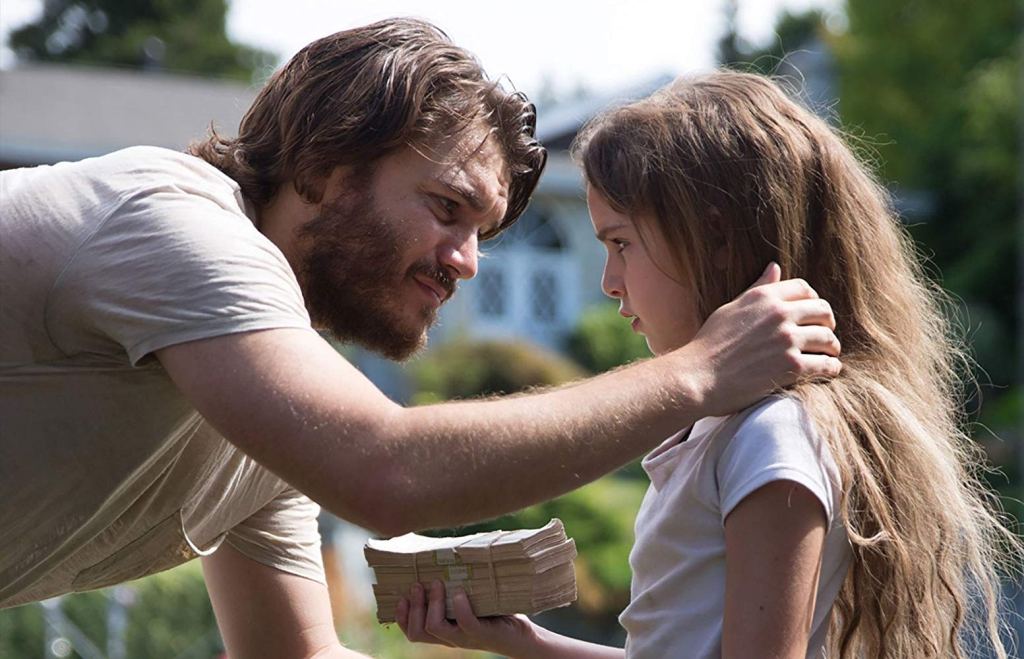
Dad (Emile Hirsch) has sequestered himself and his 7 year old daughter Chloe (Lexy Kolker) in their home. The drapes are duct-taped closed, the door is quadruple-locked, and no one is allowed in or out. They are preparing for or hiding from some ominous event, and the blood dripping from Dad’s eyes make me think it’s not just all in his head, no matter how paranoid and controlling this all seems.

Still, Chloe is a 7 year old girl. She wants to make a friend, to play in the park, to eat an ice cream cone. So when Mr. Snowcone (Bruce Dern) repeatedly parks directly in front of their home, Chloe can’t resist, and all she has to do is wait for Dad to fall into one of his sleeps to make her escape.

But on the outside, it turns out not everything Dad told her is a lie. There ARE bad people – it’s just harder than she thought to identify them. In fact, Freaks is almost the flip side to The Incredibles. I know, I know, that sounds like weird comparison, but you may recall that as we meet the Incredible family, we learn that super heroes have basically been outlawed and this family has been relocated and have to hide their powers to fit in. Chloe’s family also have powers of some kind, and public fear has meant that all the special people are either hiding or relocated or dead, and the government prefers the latter to the former.

The story keeps us firmly within Chloe’s understanding of her own powers and the circumstances in which she lives. She’s understandably frustrated with her confinement and she makes impetuous, chocolate-driven decisions. The directors have crafted a horror-sci-fi hybrid that keeps us guessing, unfolding at Chloe’s pace, not mine or yours or theirs.

Freaks is perhaps a little inconsistent, but it’s boldly directed and surprisingly well-acted. There’s more character development than a dozen other horror films combined and its message is as strong as it is relevant.

The Captive

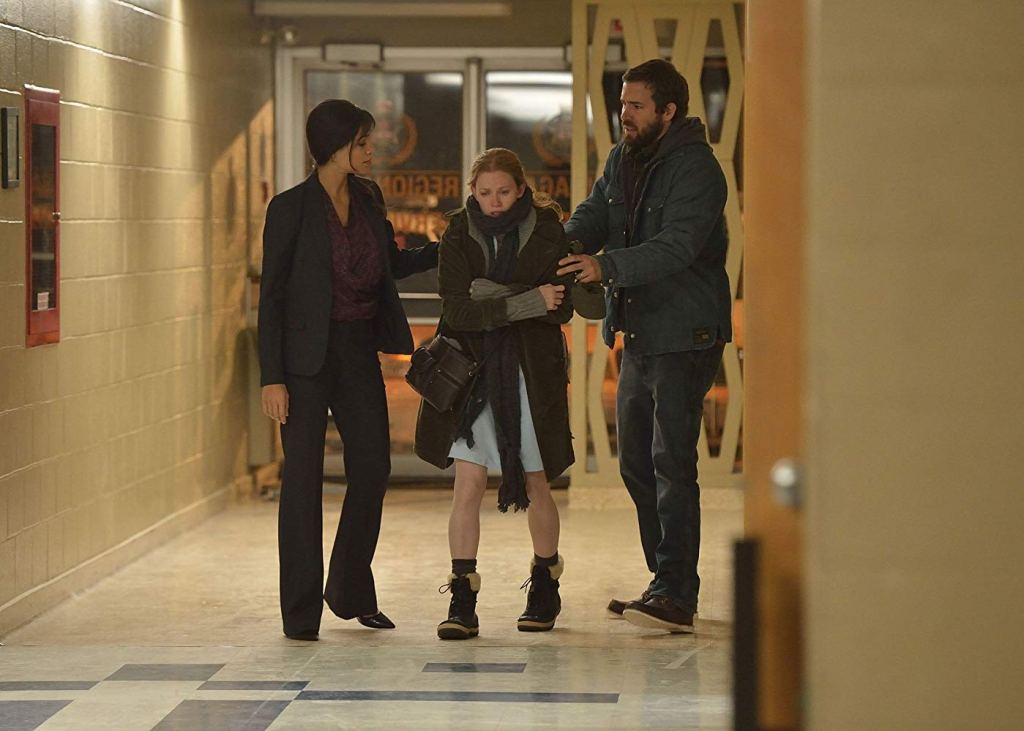
Matthew (Ryan Reynolds) is a loving husband and father who struggles to pay the bills since his business failed. He’s the one to pick 9 year old daughter Cass up from figure skating practice while wife Tina (Mireille Enos) cleans hotel rooms in Niagara Falls. One evening, he pops into the pie store off the highway for just a moment, but in the time it takes to pay for a cherry rhubarb, his daughter has disappeared from the backseat of his truck.

You and I have the privilege and the horror of knowing that she’s been snatched by sexual predator Mika (Kevin Durand), whom you’ll immediately be able to identify by his pedo mustache. But the police, including Jeffrey Cornwall (Scott Speedman), a detective newly appointed to the Child Exploitation Unit, and his boss Nicole Dunlop (Rosario Dawson), suspect Matthew to be involved. Though they never have evidence to arrest him, over the next 8 years, the strain and taint of suspicion eventually crumbles Matthew and Tina’s marriage.

Matthew resolves to find Cass on his own, which mostly involves driving slowly by every single teenage girl he comes across, while Tina is still in touch with the Child Exploitation Unit, who’ve been coming the dark web obsessively, Jeffrey posing as a fellow pedophile and trying to ease his way into a sex trafficking ring. After 8 years, he’s found an image that he suspects might be Cass, and indeed we know that even as a 17 year old no longer of any interest to pedophiles, she’s still be held and used as a friendly face to lure other unsuspecting children into the vans of predators. But since no one knows where Cass is being held, including Cass herself, a rescue mission is impossible. And as the days tick by, both Matthew and Jeffrey are losing touch with reality.

Director Atom Egoyan crafts a film that is deeply unpleasant to watch, while Reynolds’ performance adds up to heartbreak. However, the film remains difficult for other reasons, Egoyan’s murky jumps in time seemingly purposely obfuscating reality. Egoyan often plays around with time and memory, but the result is usually haunting rather than confusing. The twists and turns feel cheap and tricky and even though the outcome to root for seems painfully obvious, it also feels undeserved. Each frame taken individually is ridiculously and meticulously perfect in its composition but their combined effort is unconvincing and unsatisfying. As Dunlop says herself: “there are no happy endings in my line of work.”

#Cats_The_Mewvie

The Internet is: a) is a cat archive b) a world-wide phenomenon for cat enthusiasts c) a cat content generating machine, for cats, by cats d) now with 35% more cats. Even if you’re a dog person, sure there are cute puppy videos, but let’s face it: the internet is all about cats. Well, 96% about cats. Also 1% random ranting, 1% recipes and 2% butt stuff. At one point, when we were fools, we thought the Internet would be a treasure trove of accessible information and a geography-busting connection between humans. We were wrong. It’s all cats.

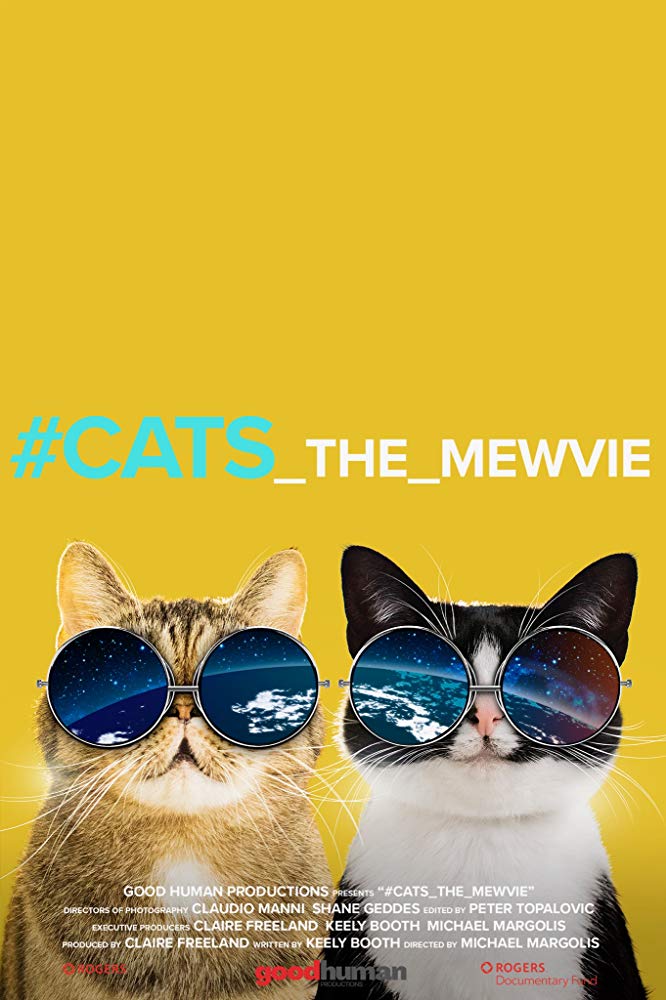
Not to be confused with Don’t Fuck With Cats, a true crime documentary on Netflix about hunting our own homegrown Internet killer, or Cats, a cinematic travesty that limped quickly out of theatres, tail between its legs, #Cats_The_Mewvie is a documentary that explores the whys and the hows of the feline domination of the world wide web.

Because I am on Twitter, I constantly hear people talk about how negative and soul-sucking and bleak the Internet is. And I often wonder: are we using the same Internet? Because I do not ever feel that way. Of course, I also don’t seek out disagreements, or start flame wars, or engage people who do. When I’m feeling sleepy, I pull up my favourite song. When I need cheering up, I watch puppies doing puppyish things. The worst thing that’s happened to me on the Internet this month is a comment I received on Youtube where Sean and I were referred to as “Handsome man and beautiful hairy lady.” I’m choosing to believe it was a problem of translation…maybe they meant beautiful haired? I’d buy that. In fact, I already have! Why thank you. Thumbs up. 👍🏿👍🏿👍🏿👍🏿👍🏿.

The Internet is filled with cats and people like to look at them so much that some cats are famous. Some cats have agents. Some cat owners have made millions of dollars. Of course, like any show biz parent, you have to be willing to harass your ‘asset’ and turn them into a product to continually be exploited. The rest of us are just taking occasional, amateur, jittery videos of our pets doing stupid or silly things. Those are the ones we post. Most of the time our pets stubbornly refuse to do anything insta-worthy the minute you have your camera out and ready.

Truly, the world is a beautiful place, the Internet is bursting at the seams with quality cats, and Netflix is a black hole filled with documentaries such as this.

The End.

Kuessipan

In northeastern Québec lies an impossibly small village, an Innu community where many band members still live off the land and almost no English is spoken. Two young girls grow up inseperable; Mikuan (Sharon Ishpatao Fontaine) has a close and loving family, while Shaniss (Yamie Grégoire), like too many First Nation peoples, is picking up the pieces of a fractured family and broken childhood. And while their girlhood games of midnight fishing may not feel familiar, their little girl giggles are universal. Best friends forever, they vow to always stick together.

But just a few years later, when the girls are nearly 17, life is driving them apart. Shaniss has an abusive partner and a baby to care for while Mikuan is learning to express herself and pay tribute to her community through poetry. She falls in love with a white boy (Étienne Galloy) and dreams of leaving the small reserve to go to school. Shaniss, already grieving the loss of her friend, starts to feel abandoned.

Kuessipan, which means “your turn” in Innu, is adapted from a novel by the same name written by a young woman from this same reserve, Naomi Fontaine, who helped directed Myriam Verreault write it for the screen. Shot in and around the Innu Takuaikan Uashat Mak Mani-Utena reserve, the film uses band members rather than professional actors, which lends an authentic but not amateur feel.

The film, wise beyond the 21 years of its young author, is about finding one’s voice and one’s path, and having the courage to do so even when it means leaving people, and the comfort of familiarity, behind. With beautiful Indigenous imagery and stark cinematography, it’s also a look at contemporary life on a First Nations reserve, an infrequent subject in film or in literature. With a history of oppression and colonization, many First Nations people in Canada are still living impoverished, wounded lives. And yet their culture survives and thrives in many small communities across the land, their stories told through art that moves and inspires not just their own people, but Canadians across the country and people beyond its borders as well. Kuessipan tells the story of not one but two young women succeeding in their own way, leading lives that will pave the way for generations to come.

Passengers

If you were looking for a review of Passengers (2016) about a dick named Chris Pratt who pulls the grossest act of total bullshit and gets away with it, click here. Otherwise, Passengers (2008):

Captain Raymond Holt, who of course only plays Capt. Holt on Brooklyn 99 (Andre Braugher), calls in a highly educated but personally rutted psychologist, Dr. Claire Summers (Anne Hathaway) to support a small handful of passengers who have just survived a plane crash. She holds group sessions for grief counseling and quickly finds that the 5 passengers disagree on what happened. Some remember a flash or an explosion that the airline aggressively disavows.

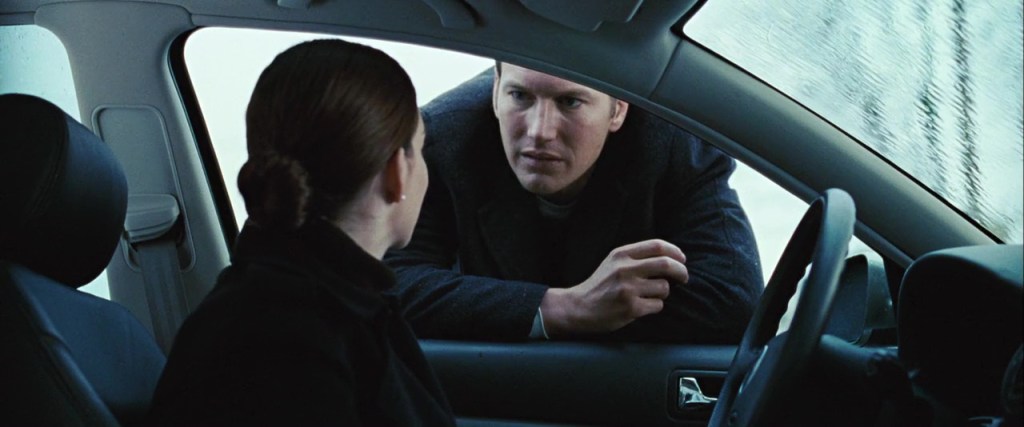
Despite several degrees that should tell her otherwise, Claire becomes personally involved, not only in untangling the mystery, but romantically with the most secretive of the passengers, Eric (Patrick Wilson). Eric’s reaction is strange in a different way. He’s almost elated, feels better than ever. But this little group of survivors has all kinds of inconsistencies to it, and Dr. Summers is practically tripping over herself to break all the ethical and professional boundaries that exist for a reason. Of course, when the members of her group begin disappearing one by one, it seems not even professional boundaries would keep them safe.

Passengers feels like someone conceived of a “twist ending” and then reverse-engineered the movie around it. It spends almost no time justifying or earning its end; instead it builds smoke screens around it, protecting an ending that then comes out of the blue because no one was clever enough to drop those juicy little hints that make your mind tingle and a surprise ending feel oh so tantalizing. An unearned ending feels more like a relief than a delight or a shock. It creates frustration instead of alleviating it. Because that’s the thing about thrillers: they’re supposed to build on themselves, creating suspense while leaving behind a subtle trail of clues. The mystery is an itch and it’s a flood of relief when finally everything comes together to scratch it.

Passengers is a bit of a mess in terms of logic and plot. The story is emotionally manipulative. Anne Hathaway is a bland leading lady. Are those things that might bother you? Or are you the kind of person for whom everything about the movie is incidental to the mere watching of it. In which case, Passengers is definitely a movie you can watch on Netflix. It begins, it plays for a while, and it ends. Thankfully.