
When I was a little girl, my school had an annual “read-a-thon” to raise money for MS. Finally, a “thon” that little unathletic Jay could win! And boy did I: hundreds of books read, and hundreds of dollars raised.
Film maker Matt Embry was diagnosed with multiple sclerosis when he was only 19 years old. A debilitating, incurable disease, both Matt and his family were devastated by it. His father, Ashton Embry, was frustrated at the paltry support offered by their doctors and with the lack of long-term results offered by any of the medication available. So he did his own research, and thanks in part to Judy Graham’s book about living with MS 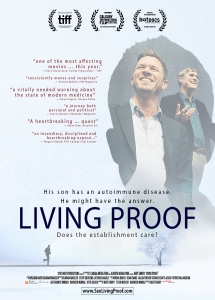 naturally, he developed a diet for his son to follow. Matt eats unprocessed food – no gluten, no dairy – mostly fruit, veg, and lean meats. And since MS occurs more often in northern countries, like Canada, he takes a big ole dose of Vitamin D, like sunshine in a bottle. Yes, it’s a strict diet and requires constant preparation and vigilance. But if you’ve known someone cut down by MS, their bodies just literally abandoning them, you’d probably find such a possibility to be suitably motivating. And thanks to this lifestyle, Matt is still symptom-free, TWENTY YEARS after diagnosis. He has never taken any medication, but he has had a procedure called CCSVI – many people with MS have significant blockages in their jugular vein, which means not enough blood flows through to the brain.
Staving off MS without expensive drugs is reason enough for a documentary. Though it’s likely not the answer for everyone, it seems harmless enough to try, so Matt and his family have been devoted to disseminating the information, free of charge. But MS patients must happen upon it themselves, because none of the official avenues will so much as suggest it as an alternative. People my age are confined to wheel chairs and nursing homes because big pharma is only interested in medical alternatives that will make life-long paying customers out of patients. Diet and exercise are not profitable.
But you and I expect no less of the pharmaceutical industry. It’s unconscionable. What really got my goat was the complicity of the MS Society of Canada, and its many chapters around the world. They raise millions of dollars, give a fraction to research, and literally suppress invaluable information from the people who suffer from MS and depend on them for resources. They accept donations from pharmaceutical companies, they endorse their drugs, and they funnel the money back toward research for medicine that will not cure MS. I am enraged to know that I ever gave\raised money for the MS Society. I was even more enraged to see them using the donations of well-meaning, hard-working people to sue the likes of Matt Embry. No wonder there have never been any significant advancements in MS research. It’s enough to make you sick.
 charming and sweet, handsome and approachable. Franky doesn’t question his identity, he just absorbs it as part of it. It doesn’t need a label or a judgement. But there is a complication: Franky’s father (Kyle MacLachlan) has recently left the family because he’s gay. Franky’s resentment is mostly due to the abandonment and not the sexuality, but his feelings are complicated and confused and it makes dealing with this just a little harder than it has to be.
 Ten years later, a grown-up Rupert (Ben Schnetzer) is releasing a collection of their correspondence as a book, and a skeptical reporter (Thandie Newton) is interviewing him. The truth of their friendship is revealed through flashbacks, as is Donovan’s life, which of course was not all rainbows and lollipops.
 found male identities received more sympathy. Eventually she found a way to turn it into art, and several stories and books were published under the name. She wouldn’t be the first writer to write under an assumed name, but she might be the first to have gone to such great lengths to present a pseudonym as a real person. She recruited her boyfriend’s androgynous sister Savannah to “play” JT in person, granting interviews and posing for pictures as him – even signing the rights to a movie contract. Of course, when the truth comes out, as it nearly always does, the world was kind of mad about being duped, and there was a big backlash.
 Our House is a retelling of the age-old cautionary tale about the dangers of science. As we all know, science experiments’ most common outcomes are monsters, ghosts, and superviruses, with temporal paradoxes or dimensional portals being all-too-common as well.
 Full disclosure: I was fortunate to watch this film with a ferocious guard dog on my lap, so I knew I could handle whatever scares were thrown my way. You likely will not have that same advantage, at least while Our House is in theatres. But even without the dog, the first hour of this movie will be bearable for everyone, including scaredy-cats like Jay. There’s not any significant tension in this film until the final third of the movie, but that last third contains a very suspenseful sequence that made me wish the intensity had been raised sooner, to allow for a longer showdown with the ghosts.
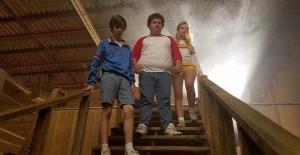 neighbourhood games of hell? Obviously someone must derive pleasure from being on the brink of abject horror, and at the beginning of Summer of 84, we meet 4 such young fellows. Davey and his friends are 15 in the summer of 84, mere shadows of mustaches playing on their upper lips, and haven’t yet outgrown their midnight game of “manhunt.” I think it’s creepy even before the big news is revealed: the Cape May slayer is on the loose in their community. With 13 confirmed kills and a preference for teenage boys, Davey and his buddies should rationally be concerned about this serial killer but they’re kids, hornily hovering about the precipice between childhood and growing up, and instead they think it’s kind of cool.
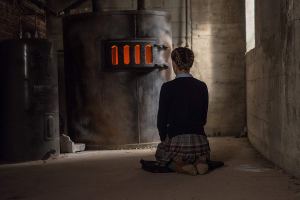 Upping the creep factor is a third young girl some distance away, perhaps an escaped mental patient named Joan (Emma Roberts) who gets picked up by an older couple who just want to help. Her destination: the very same boarding school where the first two reside…
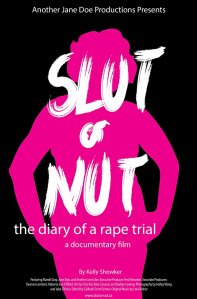 “unfounded” which seems to be a fancy word for the police not believing her, which is hard not to take personally when ‘unfounded’ is used exponentially more often in sex assault cases than for any other crime. If you’re a woman of colour, disabled, or a sex worker, your word is all but meaningless. But if you’re one of the small sliver of people not dissuaded yet, you may find, as Gray did, that your body is now a crime scene. A rape kit is a must for conviction, yet there aren’t enough rape kit nurses to go around. You’ll have to offer yourself, body and soul, as evidence, because for some reason it’s your responsibility to help catch the rapist. But the fun doesn’t stop there: next you’ll be revictimized in court in a discouraging, dehumanizing procedure that never grants any real justice because it’s the victim who seems to be on trial.
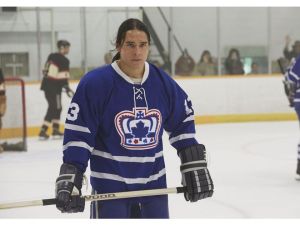 The residential school system is not the only black mark on our country but it has to be the darkest stain. We and our government could not have done worse by our indigenous people if we tried. We should have known from the start that this imperialistic plan would go horribly wrong. After all, we chose to put the Catholic Church in charge of many of these awful residential schools (and not just the Catholic Church, but a bunch of others share the blame, including the Anglican, Presbyterian, and United Churches of Canada), because it wasn’t enough to tear children from their families and literally beat their culture out of them, it seemed appropriate for some reason to facilitate child molestation too, feeding 150,000 potential altar boys and girls to more than a few insatiable priests over the lifetime of the program. 150,000!
 ASSHOLES WATCHING MOVIES