Tag Archives: disabilities in film

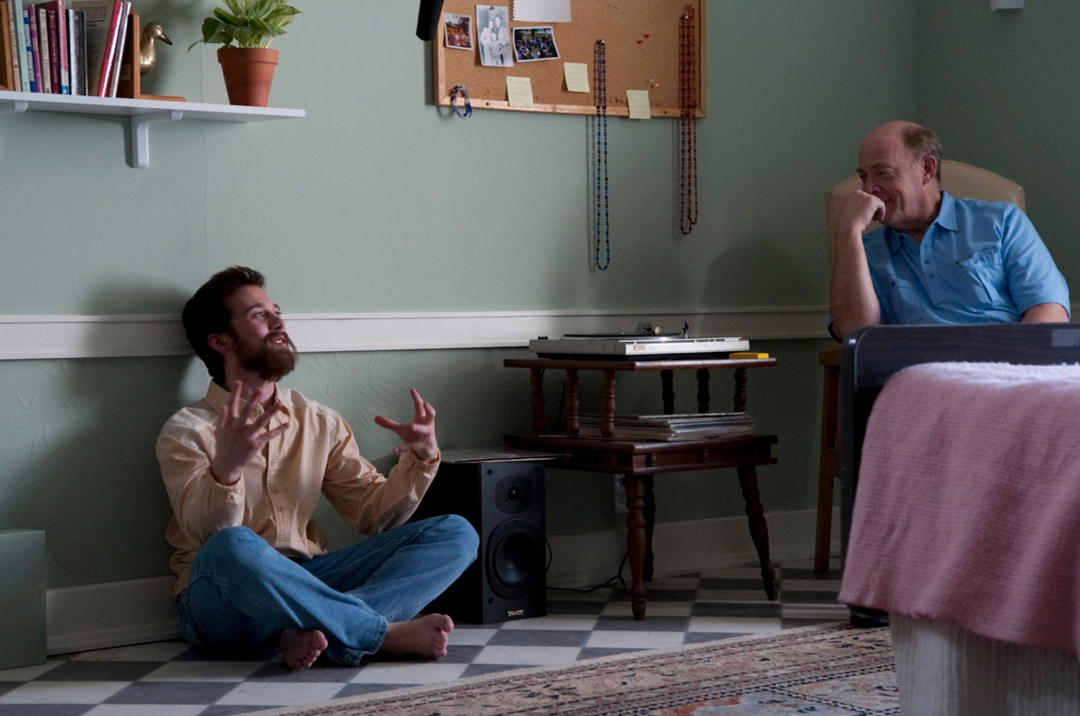
The Music Never Stopped

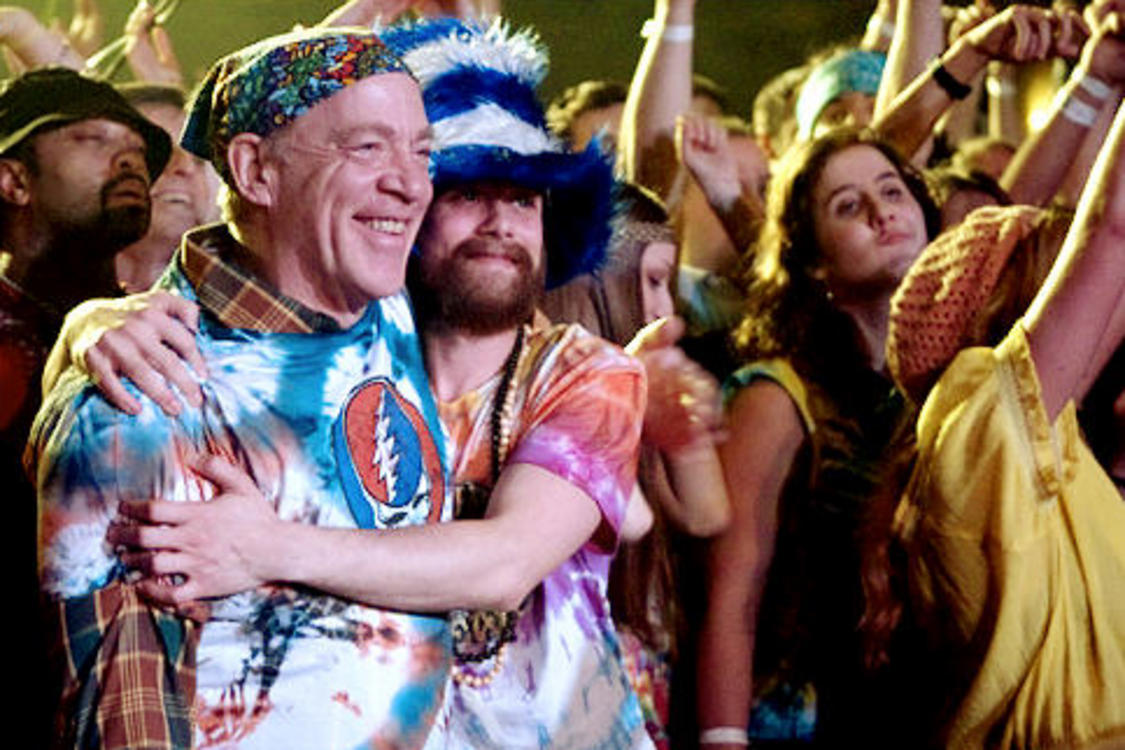
Henry & Helen hadn’t heard from their son Gabriel in 20 years until they get a phone call from the hospital – their son has a humongous brain tumour and even if the operation is successful, ???????????????????????????????????????????????????????????it’s already erased his short-term memory and a lot of cognitive function. There are two components to this story: the ongoing medical issue, which they try to resolve through the use of (and love of) music; the second, the family’s past issues, which is told through flashbacks.

I picked this movie because of JK Simmons, and he’s the reason to watch it. The movie’s predictable and sentimental, but Simmons’ performance really rises above. He’s just a father trying to bridge the gap between himself and his son – the brain tumour is actually the least of it.

It’s actually based on a true story and had the potential to be more than it is, but the newbie director plays it safe, injecting very little in the way of artistry. And there are holes in the The%20Music%20Never%20Stoppednarrative: what have any of them been up to in the intervening 20 years? But I enjoyed this movie, and was moved by it, in the expected places but also along the edges. JK Simmons has been trying to tell us for ages now that he’s capable of so much more than Hollywood’s been handing him, and I’m glad he’s getting his due. Character actor my ass. I hope to see his name front and centre on the marquee for a long, long while.

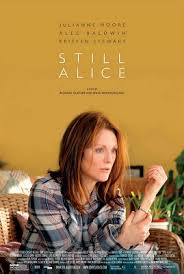
Still Alice

We wstill aliceouldn’t even be talking about Still Alice, about a world renowned linguistics professor who is diagnosed with early-onset Alzheimer’s disease, if it weren’t for Julianne Moore. Michelle Pfeiifer, Julia Roberts, and Nicole Kidman all apparently passed on the part before anyone got around to considering Moore, which is baffling to me. Who among Moore’s peers is more up for the challenge? Who can play confused just as well as they can play sharp or as vulnerable as well as strong. Or, as Jay was right to point out in her review of Maps to the Stars, who else is so unconcerned with how she looks while she’s doing it? Because there are so many sides to her persona, we believe her as a respected academic, as a mother, and as a wife which is just as important as believing her as an Alzheimer’s patient. Because of Julianne Moore, we’re talking about Still Alice as an Oscar nominated film (Best Actress in a Leading Role).

The movie, as written and directed by Richard Glatzer and Wash Westmoreland, may not be as beautiful as Away from Her or L’Amour but it gets it right mostly by not doing anything wrong. It’s never corny and doesn’t search for easy answers. This may not seem like high praise but I can imagine so many ways this could have gone wrong by being too pandering or by focusing on the disease instead of the person. I give it credit for not falling into these traps.

Julianne Moore is still the best reason to see Still Alice though. She’s been great since short Cuts but hasn’t had such a great opportunity to show it for years. Smart money is on her winning the Oscar.

If one asshole’s opinion isn’t enough, check out Jay’s review.

Before I Go To Sleep

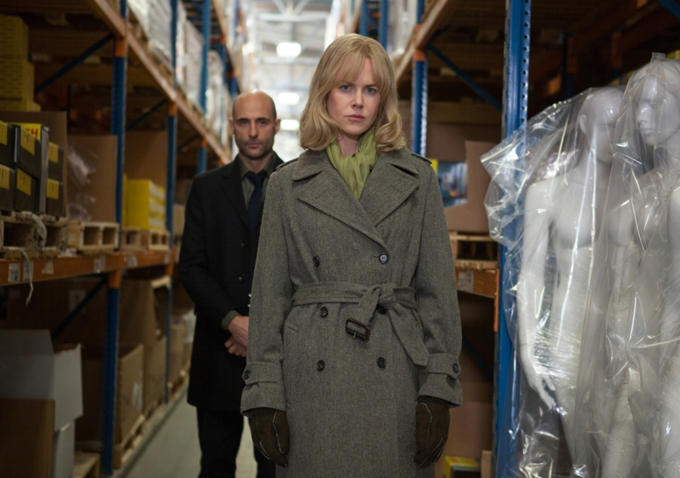
Nicole Kidman plays a woman who wakes up peacefully in bed with her husband (Colin Firth), only she has no memory of him, or how she got there, or, come to think of it, of the past several years. Turns out, she’s had an accident that stops her from making any new memories, so every time she sleeps, she wipes out the day before and wakes up a stranger in her own body.BIGTS-0408-0758.tiff

The most embarrassing thing about this movie is that I’d forgotten I’d already seen it. It’s bad news to watch a movie about an amnesiac and not realize you’re actually rewatching it.

Anyway, it sounds, on paper, a lot like 50 First Dates, except things aren’t as rosy for Nicole as they were for Drew. There are holes in her story that even someone with a brain injury can see through, so there’s a little Momento mixed in, just for fun. A mysterious doctor and a friend from her past show up to help her solve the question mark, but she can’t be sure who to trust, beforebannerand neither can you. The brain trauma thing is kind of overused for such a rare disease, but it does put the viewer on equal footing with our poor, disoriented heroine. Her confusion makes for an unreliable narrator if ever there was one and so the who-dunnit unravels in darkness for her like it does for us.

The genre is tired and this one’s not adding much to the mix. It feels like it’s taken a page from sleep-plasticGone Girl, but lacks Fincher’s balls with the follow-through. The story demands more of our attention while actually deserving less. It does silly, unforgivable things like using the old “I have something important to tell you, but not over the phone!” and even worse, the old, “I’m being attacked and fear for my life but won’t yell for help.” Plus, director Rowan Joffe has these little tells, like constantly showing us a close-up of Kidman’s blood-shot eyes, that get annoying real quick. It’s a thriller that’s so banal and (ironically) forgettable, I accidentally watched it twice.


Cake

I actually worried whether I was the worst person to review this movie, or the best, which would crush me. Jennifer Aniston plays Claire, a woman who suffers from chronic pain, a condition which is not unknown to me.Cake Movie

Claire attends a support group for chronic pain sufferers where the members are currently dealing with the recent suicide of one of their own (Anna Kendrick). Claire is unwilling to share in group but is haunted by visions of her dead friend.

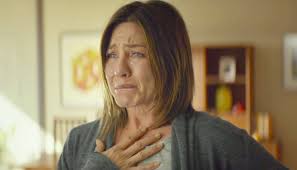
Jennifer Aniston is absolutely the reason to see this film. Her performance is very touching because it’s raw and real and visceral. It’s hard to watch, or it was for me. Soon we start to see that there’s a lot more to her pain than just the physical, though the script remains maddeningly vague on these parts. Actually, the story feels anesthetized, like it doesn’t quite want us to feel what we know must be there.

cakeI worried about what it would be like to see the private struggles of my life up on the big screen, but I came away not thinking of myself, but of my husband. In the movie, Claire’s husband (Chris Messina, love him) is estranged and it’s not hard to see how she’s managed to push away all the people in her life. Her pain makes her angry and acerbic, but it’s also a clever strategy for getting rid of people she doesn’t want to deal with. She wants to be in pain, be alone with her pain. Being in pain makes sense to her. Her maid, played lovingly by Adriana Barraza, is her only remaining caregiver, one with seemingly infinite patience for the pills and the bitterness and the constant setbacks. But the brutality of Claire’s expression weighs on her heavily, as it must. This is actually a very sweet and savvy exploration of the relationship between domestic and employer.

The story of what happened to Claire unfolds too slowly, and allows the audience to connect the dots before the big reveals, diluting their punch. But the full story is never wholly understood, so the emotional payoff, both ours and Claire’s, is lacking.

Still Alice

I first discovered Lisa Genova through her excellent book, Left Neglected. Wanting to read more of her work, I came upon Still Alice, an earlier work that she actually self-published. She’s got a great handle on neurological disorders but her stories aren’t clinical. They’re very human, and almost too relatable.

Julianne Moore is Alice, a 50-year-old woman with loads on her plate: she and her husband (Alec stillaliceBaldwin) are both ambitious, workhorse academics. She’s a Columbia professor who travels around giving talks on her research in the field of communication. They have three children, a son still in med school (Hunter Parrish), a daughter newly married and trying to conceive (Kate Bosworth), and a starving-artist daughter trying to make it as an actor (Kristen Stewart). It’s hard to see who’s more lost at sea when Alice is diagnosed with early-onset Alzheimer’s. There’s pain for everyone as they all come to terms with losing a vibrant, strong woman who’s been a big influence on each of their lives, but of course it’s Alice’s pain we witness the most, even as her disease progresses quite quickly.

It’s hard not to make this review just about Julianne Moore because of course she’s going to make or break this movie, and she’s made it. We see her go from competent, and sharp, and slide into more watered versions, more confused versions of her former self. Her gaze changes as her disease worsens, becoming flatter, disengaged, but it never goes blank. Maybe it would be better if it did; we still see hints of Alice and so feel the chasm between her old and current selves more keenly as she struggles to know herself, remember herself, lose herself.

It’s heartbreaking, but I have to give mad props to directors Wash Westmoreland and Richard Glatzer, who used a heck of a lot of restraint in filming this movie. The subject is pregnant with the potential to be self-pitying and cloying but it never even comes close. I still don’t Geneva’s work here is her best, nor does the script elevate it much, but it earned some tears and some thought and much admiration for a career-high performance.

The Madness of King George

I’m actually kind of partial to the films of 1994 because it was the 1995 Oscar ceremony, honouring the best of ’94, that got me hooked on all things Oscar. In honour of my upcoming 20th annual Oscar party, I decided to check this movie out- one of the few that I still hadn’t seen from that year.

In The Madness of King George, Nigel Hawthorne plays King George II during his struggle with mental illness (never so-called in the film for obvious reasons) in the late 1780’s. The pretty much always awesome Helen Mirren plays his wife Queen Charlotte who has no idea what to do with him. “It was something he ate!” she yells at no one in particular while the King derails a concert by storming the stage swatting away anyone trying to assist him.

The Madness of King George is quite well-done until the photo finish ending where the king races to Parliament to prove that he’s sane again before his son the Prince of Wales, played as a complete dickwad by Rupert Everett, can be declared Regent. I still have mixed feelings about this movie though, mostly about Dr. Willis, played by Ian Holm (old Bilbo Baggins). On the one hand, his theorizing about power’s connection to madness is interesting. All mad men think of themselves as kings, he muses. What fantasy then does a mad king take refuge in? It’s the feedback we get from others, including the insults and constructive criticism that shapes us so how can you keep a grip on reality when everyone around you looks to you as royalty? It’s a good question worth thinking about. Although, with medical hindsight being 20/20, they seem pretty sure now that the king’s madness was due to a rare blood disorder, not believing his own hype.

Dr. Willis’ answer to this is behavioural modification, basically meaning that the patient will be put in restraints every time he misbehaves (e.g. talking crazy, not eating, swearing etc.). Ok, I know that this is 1788 but, working in mental health myself, I was a little disturbed to see this practice potrayed as almost heroic rather than (again, hindsight 20/20) primitive. Compared to the king’s other doctors, of course, Willis was quite forward-thinking. One doctor is hilariously outraged at the impropriety of conducting a physical examination of the king while another just can’t get enough royal crap to examine.

It was hell to be declared mad in 1788. You can see it on the king’s face every now and then, when he becomes temporarily lucid enough to wonder what is happening to him. I would have rather the film focus on this more, instead of finding a doctor to declare as hero just because he is a little less incompetent or inhumane than the rest.

Rain Man

Sean and I watched Rain Man, me for the nine hundredth time, Sean for the first. The first!Can you believe that?rain

I’m not going to review it because I believe and I certainly hope that he’s the only idiot to have not appreciated this film until now. And he did appreciate it. This film holds up beautifully, except maybe for the synth over the opening credits. This movie could have gone wrong in a lot of ways, so I have to give credit to the brilliant director (Barry Levinson) who treated the subject so tenderly. He doesn’t go directly for the heart strings, he doesn’t’ cloud the relationship with a lot of outside help. He creates a bond and lets his two actors shine. And they do. The movie may be a little off-kilter in some places but Dustin Hoffman never is. His performance I think is the best of his career (the Academy agreed). Tom Cruise could easily have faded into the background of such a performance but instead he also delivers one of his best, a raw and unsentimental portrayal of a man deeply layered in pain, confusion, and selfishness. Despite the inherent heaviness, this movie manages to pull us in not with easy tears, but with well-earned laughs.

And so Sean’s education continues.

The Theory of Everything

Finally a movie that answers the age-old question: Does Stephen Hawking watch Dancing with the Stars?

Okay, no, it doesn’t answer that. But go ahead and assume yes.

More like, is Stephen Hawking kind of a dick?

You go into this movie knowing that, whatever else, there will be a sure thing on your ballet for this year’s Oscar pool: Eddie Redmayne has already won. You may be less prepared for the fact that at times this movie feels like a companion piece to Interstellar (and I mean that in a good way) and that when the lights come on during the end credits, you’ll be caught in a packed theatre with tears still wet on your face.

This movie is strikingly well-lit. I loved the lighting, the glow, it felt romantic, and helped you remember that in fact this is not so much a biopic as a love story between Dr Hawking and his first wife, Jane. Eddie Redmayne was fairly forgettable in Les Miserables but absolutely claims the screen in this role, capturing expressiveness even in stillness, and showcasing joy and wit not easily conveyed. Felicity Jones, as Jane, may take a back seat on paper, but her performance stands up every bit to his. It’s a subtle portrayal, but strong and sure. Stephen Hawking, the concept, the icon, belongs to us all, but Felicity Jones reminds us that he is a man, and once, he belonged just to her. And there’s so much vulnerability and heartbreak, as a couple once deeply in love are forced into the caretaker and reluctant patient role that chafes for both of them.

I haven’t read Jane Hawking’s book upon which this movie is based. She wrote an earlier one that was much less forgiving, painting Hawking as controlling and almost dictatorish, and you can kind of pick up hints of that even in this second, gentler version, his manipulation of events, his reluctance to express gratitude.

When Stephen and Jane are still a very young couple, Hawking’s father tries to warn her away, saying that this will not be a battle but rather a defeat. He’s wrong and he’s right. Because there is a battle. Stephen outlives the projection by 50 years (and counting). But love is simply not enough. We see love grow, and then wither. And so this movie works much better as a study of love’s ability to withstand challenges than as a traditional biopic. Because I have read A Brief History of Time, and though there are touches, this movie is really “science lite”. It glosses over some pretty major milestones if the measure is the man, and not his marriage. But this is not a story about the failure of marriage because even as it crumbles, it seems a triumph that it lasted at all, and certainly as long as it did.

I wondered what Marsh would make of this movie – he won an Oscar some time ago for his documentary, Man On Wire – but would his work translate? If this was anything other than a story of real, living people, of a living legend in fact, it would be less dazzling. Certainly we’ve got a couple of knock-out performances and some very pretty things to look at, period wise, and even a few well-timed chuckles and some gorgeous gothic backdrops, but pulled together, does it make a Best Picture? It’s hard to say, because of course this isn’t just another period romance, this is the Stephen Hawking story, or at least a piece of it, and it feels incomplete for having just skirted around the outside of his genius. The thing that makes him most remarkable is remarked upon the least, and that feels a bit hollow. I still liked this movie tremendously, and was moved by it, but I suppose I also mourn for the many missing pieces.

Ian

A 9-word synopsis for a 9-minute film: Even in his wildest dreams, they laugh at him.

A 9-word review for the 9-minute film: Inclusivity shines brightly through innovative animation and powerful story-telling.

You can watch the short and see for yourself here.

The Lookout

Joseph Gordon-Levitt (also appearing in 50/50) stars in the only bank heist movie screening at Healing Fest 2015.

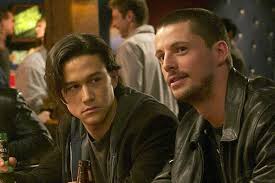
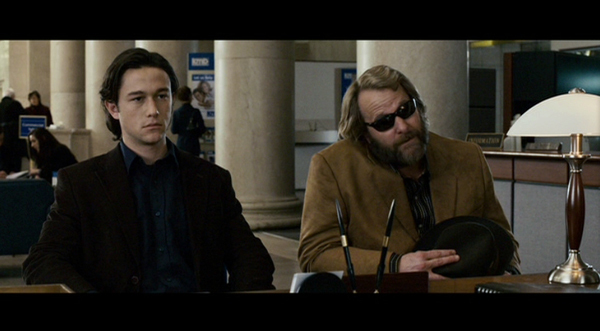
Chris Pratt (JGL) was hot shit back in high school until some reckless driving leaves him with a traumatic brain injury. Since the accident, he can’t concentrate quite like he used to and needs The Lookoutto make himself a list of instructions to even be able to do simple things like making himself a bowl of soup. After what seems at first to be a chance encounter with an old schoolmate, he soon finds himself in way over his head when he is manipulated into acting as accomplice in a bank robbery by a gang of low-lifes looking to take advantage of his disability.

The ski masks, shotguns, and double crosses only make up a small part of this indie thriller from writer-director Scott Frank. The Lookout tells the story of a young man who not only has to learn to live with a brain injury but with the consequences of his own actions. Two of his classmates didn’t survive the accident and Chris still can’t bring himself to visit his ex-girlfriend, the only other surivivor from the crash, who has lost one of her legs.

wlookout2

JGL apparently prepared for his role through sleep deprivation and strenuous physical exercise before filming to help give himself that confused and exhausted look. He’s made a career of playing likeable characters with more than their share of demons (Mysterious Skin, Brick, Looper) and his hard work pays off here. He keeps us invested in this story even as the plot twists start to seem implausible.