Tag Archives: female directors

Father Soldier Son

Let’s be real: this documentary is a super duper emotional watch.

We’re going to get to know the Eisch family over the next decade of their lives, but when we meet them, dad Brian is deployed to Afghanistan while sons Isaac, 12, and Joey, 7, live with uncle Shawn since their mother is out of the picture. The kids are proud of their dad, they think of him as a super hero, but they not only miss him, they worry about him. They’re young but they understand the consequences of his job.

In fact, Brian does return injured. He nearly lost his leg, so the dad they get back is not the same one that left them. He can’t do the camping and fishing and outdoorsy stuff that they used to enjoy together, but he’s also struggling just to be a loving and attentive father. War sucks.

Brian is lucky; besides having some very helpful relatives, he finds love again, a saintly and patient woman who’s willing to abide his mood swings and care for his children as she cares for her own. Brian’s pain is such that he finally agrees to an amputation, but healing post-surgery isn’t as swift as he’d hoped and his prosthetic the answer to all his problems. As depression sets in, a war video game becomes his sole focus. Brian is grappling with his new limitations and his sons are adapting to a family constantly reacting to the aftershocks of war.

Directors Catrin Einhorn and Lesley Davis capture some truly stunning and intimate family moments. Brian of course goes through some major transformations mentally and physically, but I found the young sons to be much more compelling. And remember: we’re with them for an entire decade. We literally watch them grow up, something they perhaps do a little too quickly. Juvenile ideals of patriotism and valour melt into questioning the real cost of war and whether it’s really worth it. As hard as it is to hear a 7 year old say “You shot my dad, I kill you,” it’s even harder to watch him learn the true meaning of sacrifice.

The Eisch home matches their wardrobe completely: plaid and American flags adorn both. Brian coaches his sons to “be tough” and to hold back their tears. Meanwhile, he’s wrestling with his own sense of masculinity, purpose, and self-determination. He’s a third generation soldier who’s no longer mission ready. Is the fourth generation destined to walk in his boots, or has this family paid enough?

This family portrait is painted with generational tragedy but it’s not asking for sympathy. It’s serving real, raw moments of joy and sorrow and we are their solemn witness.

MILF

Three middle-aged best friends are on vacation, more or less. They have left behind children, lovers, and burdens to spend some quality time together, although they may not all agree to which degree they are technically vacationing. Elise’s (Axelle Laffont) daughter is spending time with her father, Sonia (Marie-Josée Croze) is planning to meet her married lover in Spain, and Cécile (Virginie Ledoyen) is hosting them at her former family home. She hasn’t been there in 3 years but finally intends to clean it up and put it up for sale. She has mourned her husband and will now mourn the house. Elise and Sonia, however, are a little more open to fun.

In between packing and dusting, Elise and Sonia lure Cécile to the beach where they catch the eyes of some handsome young men who are leading a junior sailing expedition. Desperate to be noticed, Paul (Waël Sersoub) deliberately capsizes a child in his care so he can showily strip off his shirt and engage in some heroics. Most seasoned ladies would be wary if not downright insulted by such an obvious pick-up scenario, but Elise and Sonia are at least down for some harmless flirting. When they are spotted by the same guys at a club later that night, it seems like the vacation god Tequila is determined to make a match. Elise pairs off with Paul, while Sonia, still waiting to hear from her married boyfriend, spends time with shy and sensitive Julien (Matthias Dandois), who is easily smitten. The next day the boys bring a third friend for the ladies’ third friend, though Cécile, who is already scandalized by the age difference, is horrified to recognize Markus (Victor Meutelet) as her children’s not-so-long-ago babysitter.

The world has long since come to expect May-December romances and is usually fairly tolerant of them, so long as the December is male. In this case, the ladies are the more mature (and for their sake I feel compelled to point out that the boys are April-ish at best, and the ladies are perhaps late August to mid September). Is such an age difference the end of the world? Surely not. Has it the makings for an exciting summer fling? God yes: boys in their 20s are in their sexual prime – athletic, energetic, full of lust and dripping with stamina. Nearly a perfect match for a woman in her mid to late 40s who is just now hitting her own sexual peak; unburdened by the fertility aspect, she’s learned what she wants and how to get it. There may be fireworks in bed, but considering how women already mature faster than men, can this dynamic really work outside of the bedroom? MILF doesn’t really have an answer. It lacks purpose, and frankly, even passion. When Stella got her groove back, both Angela Bassett and Taye Diggs brought the heat. Their Jamaican romance may be partially responsible for global warming. MILF doesn’t come close, except as a cautionary tale for young men to get the fuck off of YouPorn before it ruins you for good.

The movie thinks MILF is a compliment (as opposed to cougar, which suggests that the older woman is purposely hunting), but for most of us, it leaves a bad taste in the mouth, and even isn’t accurate since one of the women isn’t even a mother.

Axelle Laffont’s direction isn’t particularly inspired, a fine pairing for a decidedly lacklustre script, though it must be said that she’s certainly not afraid to objectify her own body through a camera lens. There was no need to convince us: these 3 ladies are hot and could believably land any man they wanted. What of it? Well, no one’s really thought much beyond the sex, and if nothing else, these experienced ladies should have known better.

The Old Guard

Andy (Charlize Theron) is one weary warrior. She leads an elite team of mercenaries but when they’re called for a new job, she hesitates. She once believed they were doing ‘good’ but as she scans the news channels and her friends’ faces, she can no longer find any proof. The world isn’t getting any better. Is it even worth it? But client Copley (Chiwetel Ejiofor) is insistent: a bunch of young girls are being trafficked and only the very best team – her team – can save them. So Andy swallows her cynicism and leads Booker (Matthias Schoenaerts), Nicky (Luca Marinelli), and Joe (Marwan Kenzari) once more into battle. Except Andy’s instincts were right: it’s a trap.

Copley’s been secretly tracking her team all along, on behalf of “the youngest pharma CEO ever” (Harry Melling). Eager to make a splash, not to mention a billion dollars, he wants to study Andy and her team to see what make them so special – and to replicate it, of course. Because humans are both greedy and vain and we never, ever learn a lesson.

This could have been a fairly by the numbers action movie, even if the action is pretty impressive. Of course, it kind of has to be these days; John Wick went and raised the bar on that, and now even a fairly trash movie like Extraction needs some intensely choreographed and inventive sequences. And of course, somewhere along the way, Charlize Theron has become a bonafide action star. But what makes The Old Guard stand out from the rest is its philosophy, director Gina Prince-Bythewood’s instinct to slow things down and instead of asking ‘what’s next?’ asks ‘why?’

It’s hard to know whether to categorize The Old Guard as a sci-fi movie or a super hero movie or a straight up action adventure. But like Wonder Woman, a film easily among the best in any of those genres, this movie doesn’t just explore the extent of their so-called super powers, it wonders when to use them, why to use them, and if they should be used at all. If Andy’s Guard isn’t quite human, the people they fight, and the people the save, are. The cost is high and the price is grief; Andy’s body may be strong but so is the emotional toll. And when new Guard member Nile (Kiki Layne) is discovered, the whole group has to decide whether it’s all been worth it.

The Old Guard isn’t a perfect movie but it dares to depict heroics occurring somewhere between survival and sorrow. It shows us not just its true cost, but both the weighing of it, and its weight.

Desperados

Wesley (that’s a woman’s name now) is just beginning to realize that all of her failed relationships and all of her failed careers have one thing in common: her. A blind date rejects her after about 10 seconds, and an extended job offer is rescinded after she runs her mouth for a bit. Wesley (Nasim Pedrad) resolves that her personality is “an acquired taste” and vows to suppress it, and thanks to a head wound on her first date with Jared (Robbie Amell), she’s actually able to follow through, and Jared takes the bait!

After a blissful month together, Jared ghosts her out of the blue. Five days go by and not a single word. She and her friends hit the rose a little hard, and one thing leads to a rambling, raging email telling him what he’s missed out on, and shaming him for his ultra thin dick. So it’s a little awkward when he finally reaches her from Mexico, where he’s had an accident and been in a coma these past several days. I think by now we’ve established that Wesley isn’t the best decision maker, so she begs pals Brooke (Anna Camp) and Kaylie (Sarah Burns) to accompany her to Cabo so she can delete the offending email before he gets discharged from the hospital. It’s a fool proof plan!

Obviously the unfoolproofness of the plan is supposed to be the source of comedy, but you’d have to be pretty generous to give it even a chuckle (pedophilia is a recurring theme). But even if Desperados had what you might call traditional jokes (ie, funny ones), this movie still wouldn’t work because Wesley isn’t just a flawed character, she’s a terrible human being. I don’t want to saddle anyone with this woman, not even Jared, who, to be honest, kind of deserves her. He’s not exactly a great guy himself; he falls for “blank slate” Wesley and actually praises her for being the last “normal woman” in L.A. Exsqueeze me? Jared wants a woman with the personality of a potato, and we’re supposed to like him? And then there’s the problem of her two weird friends. Both are in their 30s and yet somehow have so little going on in their own lives that they can, at a moment’s notice, fly to Mexico on any given day of the week, for something as lame as one wonky email sent to a dude Wesley’s been seeing for less than a month, and who we already know has a disappointing dick. And yet they can also easily afford to do it. We don’t know how because each woman only has one trait that she’s known for: Brooke is going through a divorce, and Kaylie is desperate for a baby.

This movie was disappointing even for a Netflix movie I’d never heard of before starring decidedly second-tier (third tier?) actors. I wish I had the temerity of Wesley’s first blind date, who’d had the courage to walk away after just 10 seconds. No matter how desperate, Desperados isn’t fit for anyone.

Where Hands Touch

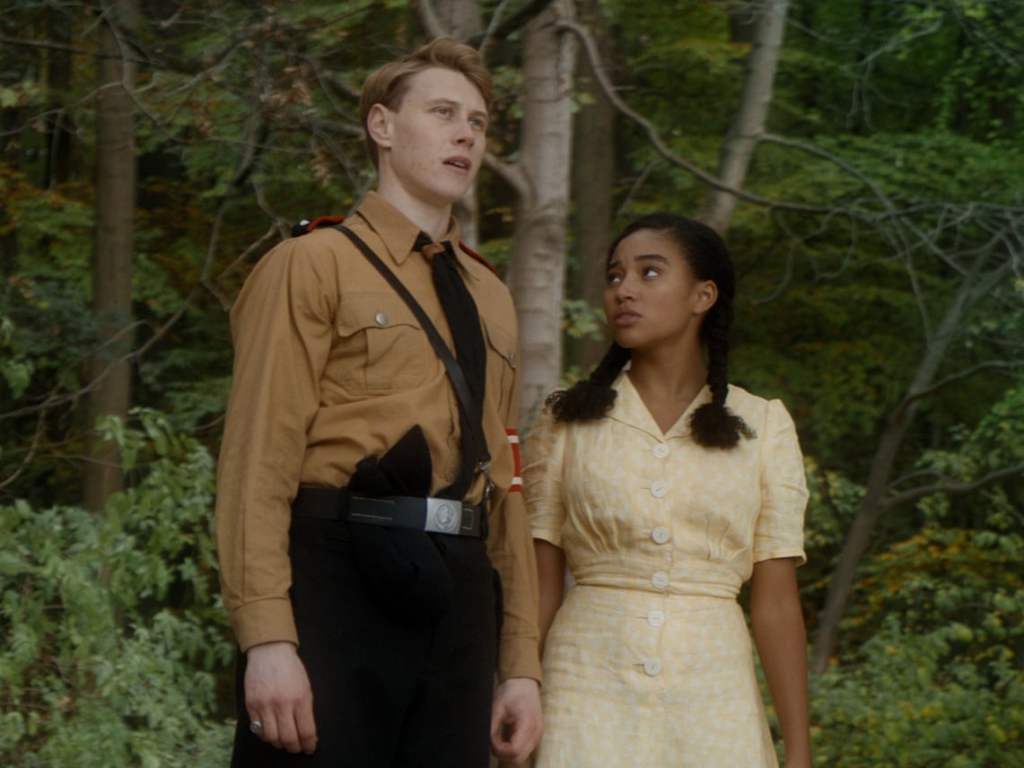
Leyna (Amandla Stenberg) is the only person of colour in her village. She’s aware of that fact, of course, all too aware, but it’s not until her 16th birthday when her difference starts to truly matter, so her mother packs her and little brother Koen up and takes them to Berlin where they can be ‘invisible.’ But Berlin isn’t any safer for a biracial girl in 1944. Leyna and her family live in fear, and Leyna’s mother Kerstin (Abbie Cornish) is so desperate she sacrifices her relationship with her own family to obtain some false papers for her daughter, papers that promise Leyna will never commit the crime of racial mixing with a German aryan, papers that claim she has been sterilized.

Koen joins the Hitler Youth, compulsory for every aryan boy, and his mother is trying her best to temper the hate he learns there with the values and morals of home. As for daughter Leyna, Kerstin is just trying to keep her alive, a feat made more difficult after Leyna falls in love with Lutz (George MacKay), himself a member of the Hitler Youth, and the son of a prominent SS officer. This could get them both killed – it has become obvious that the Nazis aren’t just hunting Jewish people, but anyone deemed “impure.”

There’s obviously an interesting story in there somewhere, but the script by writer-director Amma Asante doesn’t quite sniff it out. Possibly the best thread to follow would be that of Kerstin’s relationship with her children, both rebellious in their ways, and her struggle to balance her beliefs with what will keep the family safe, not unlike Scarlett Johansson’s Oscar-nominated turn in Jojo Rabbit.

Instead we experience the world from Leyna’s perspective. Amandla Stenbert does good work, but Leyna is a teenager, confused and confident at the same time. She insists she wants nothing more than to be treated like any other “good German,” which, considering the context, is kind of uncomfortable. Against the backdrop of millions of Jewish people being led to slaughter, it sort of feels like Leyna has shown up to a Black Lives Matter protest with a sign that reads “All Lives Matter.” Leyna’s youth sees only injustice against herself, and her lack of awareness or irony starts to feel worryingly tone deaf.

The increasingly improbable love story does little to recommend itself and its compassion feels miserly and misplaced. Sean and I recently watched Schindler’s List (he for the first time), a perfect reminder that there are plentiful and worthier movies on the subject, ones that manage to paint a fuller and more accurate picture.


Athlete A

USA Gymnastics knew that Dr. Larry Nassar was routinely and repeatedly sexually assaulting the many young girls in his care. They knew and they did nothing. They knew and the covered it up. They knew and they kept him in the position, kept sending child gymnasts to him, kept inviting him into their midst. They had a duty to protect their young charges. They had a duty, morally and legally, not only to remove him, but to report him to the police. Rather than doing so, they continued to feed victims into the hands of a known pedophile.

In Jon Stewart’s recent political satire Irresistible, he talks a bit about about the pundit economy, how the news has largely been replaced by talking head opinion. These aren’t journalists, not by a long shot, but they sit behind anchor desks as if they are, injecting issues with their own agendas. It’s a dangerous trend, especially when you consider it took reporters from the Indianapolis Star to expose these crimes and trigger a police investigation. Once the newspaper made the allegations public, women started coming forward. In droves. Hundreds. Newspapers are nearly extinct, but can we afford to lose the last few people dedicated digging for truth and informing the people?

Because USA Gymnastics was never going to do the right thing. In fact, they’d fostered a culture of abuse with coaches like Bela Karolyi who believed dominating and terrorizing young gymnasts was the key to success. USA Gymnastics wasn’t just looking the other way, it was enabling abusers and suppressing evidence because that’s how they kept the sponsorship dollars rolling in.

This is a difficult film to watch, obviously. But directors Bonni Cohen and Jon Shenk deliver on a sense of hope, too. And hope? She’s female. Called Athlete A in the documents, in court, woman after woman stood up, identified themselves, and spoke to the man who’d abused them, and to the judge who would sentence him. And also to all of us. They showed us there is power and dignity in being able to name the crime, and the perpetrator. It takes real courage to do that, but it made me want that same thing for every woman. Many, many, many sexual assault victims don’t get justice. They don’t speak up because they don’t feel they can. Or they are not believed. It took years for these gymnasts to see their day in court, but isn’t justice the very least we can do for these victims?

Feel The Beat

Not only did I fail to feel the beat, I couldn’t even find a pulse.

But that’s me, discerning movie viewer, critic without a cause. I won’t deny that it may hold some cachet as a family-friendly offering for the tween set. For the rest of us, it’s exceedingly missable.

April (Sofia Carson) is a hometown success story, having left for stardom on the Broad Way. She didn’t find it, of course, and slinks back home, tail between her legs. Luckily the small town where she’s from is sufficiently square that their twitter feeds have sme sort of hillbilly 3 day delay (a mild scandal brews on social media). To them, she’s still Impressive April, and the (very) humble dance studio where she got her start fawns over her terse, uninterested, one-word replies to their burning questions. This they call a “master class.” But when April gets a whiff of redemption (ie, a national dance competition with a handy dandy “teacher feature” which could put her in front of a judge’s panel including a top Broadway producer), suddenly she’s interested. Sure her interest is self-serving and mostly takes the form of verbally abusing an eager if unskilled dance troupe. They’re a bunch of misfits, as dictated by the trope, with a lineup including a deaf girl, a chubby girl, a poor girl, and a boy.

As you might venture to guess, the road to nationals is predictably paved with teachable moments and personal growth for our girl April, who never quite got to likable with me, which is just fine since I also found her unwatchable. Absolutely nothing personal with any of the cast, who were dancing their little tushies off. This is merely a trite script and a small budget and a green, though not necessarily untalented, crew. Which adds up to a harmless but ultimately subpar, forgettable movie that I did not need to see.

Judy & Punch

If your memory needs refreshing, Punch and Judy are traditional puppets who have been entertaining crowds in the UK and beyond for over 400 years. They started out as marionettes in Italy; Punch was derived from the Neapolitan stock character of Pulcinella, which was anglicized to Punchinello and eventually just Punch when the show made the jump over to Great Britain, and the marionettes became hand puppets out of convenience or laziness or both.The show costarred Mr. Punch’s wife, Judy, and a cast of rotating characters. Much like a soap opera, the story wasn’t fixed, but it always featured some key elements: their baby, mishandled by Punch, a hungry crocodile, an officious policeman, a prop string of sausages, a generic hangman named Jack Ketch. The show was a series of scenes in which various foes come for Punch, but each is eventually victim to his slapstick (note: though Mr. Punch does an awful lot of clowning around, his slapstick is indeed a large stick used for slapping people, often to death). Mr. Punch will then utter his famous catchphrase “That’s the way to do it!” which is how the expression “pleased as punch” was derived – from his sense of gleeful self-satisfaction. Despite the numerous murders, a Punch and Judy show is a comedy, often provoking shocked laughter.

Cut to 2020 when writer-director Mirrah Foulkes re-imagines the show’s origin story in her own sordid tale, called Judy & Punch. In the tiny 17th century English village of Seaside (actually nowhere near the sea), Punch and Judy entertain the villagers with their weekly puppet show. The violent show is right at home among these people, who satisfy their bloodlust with public “stoning days” where their anarchic mob rule interprets random coincidences as witchcraft, condemning their neighbours to die – unless of course the crime is though to be particularly heinous, wherein they might just be hanged immediately.

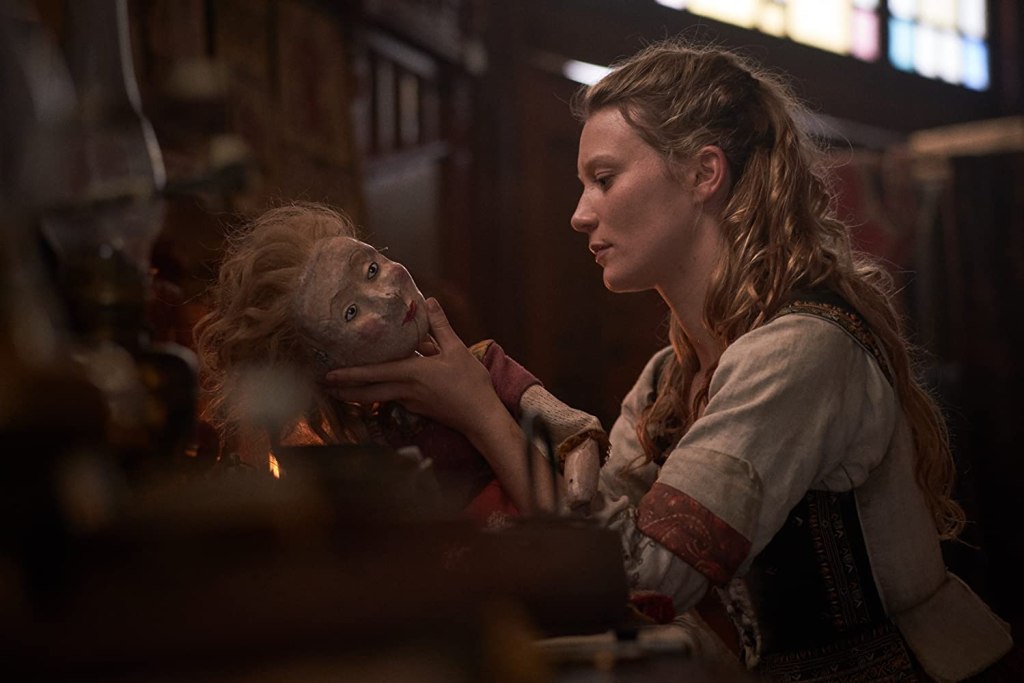
At home, Punch (Damon Herriman) is a drunk and Judy (Mia Wasikowska) his hard-working and long-suffering wife. One day while she makes a quick trip to market, Punch accidentally kill their baby during a drinking binge. Judy has been gone but an hour and is understandably heart broken to find her baby murdered but her sobs only enrage Punch, who then makes her a victim of his slapstick. He disposes of both bodies.

Allow me to interrupt myself here to say this: when the baby dies, it is under circumstances so perfectly orchestrated, so perfectly designed and directed that I uttered a single “Ha!,” followed by a horrified silence as I processed that the baby is in fact dead. If you were not familiar with the particular and very specific brand of dark humour found in a traditional Punch and Judy show, you might think that this movie has a serious problem with tone. But understanding the history means you cannot fail to admire Foulkes’ ability to find what has to be the very slimmest of veins wherein a baby’s death can be both funny and cruel, and executing it to perfection.

In the film, Judy narrowly survives the beating, unbeknownst to Punch, and hides among a band of outcast heretics while she heals. Together they plot revenge not just on Punch but indeed on the whole town who have so successfully driven out or eliminated anyone with a difference. In this way, Foulkes is able to explore the kind of atmosphere where such a show could have proliferated. Punch is undoubtedly a bad man. Each show usually includes a scene wherein Punch lays out the bodies of each and every one of his victims for the audience to count, yet they still cheer when he bests the hangman, or indeed even the devil himself. These were cruel times fueled by fear: if not them, then us.

Mia Wasikowska delivers a strong performance as a woman with talent, brains, and resources, yet so few options that she must hide in the forest for fear that her survival may be interpreted as witchcraft. Herriman pulls off an even harder feat as damned Mr. Punch: a fool, a predator, a charmer, a pretender. The thing about puppets is that whether dancing with their wives or bludgeoning them, their expressions never change. Perhaps a painted-on grin helped the audience swallow his violent attacks. But our Mr. Punch is a man, a puppeteer. Herriman has to be believable as both the bumbling buffoon chasing after a dog who’s stolen his sausages, and mere moments later, a father who has not only charbroiled his own baby, but pinned her murder on elderly innocents. And he is!

I am reminded of a time back in 2016 when I reviewed a “black comedy” that I felt was SO black it merited a whole new category, so I invented the Vantablack comedy, Vantablack being in fact a colour that is blacker than black, absorbing all but 0.035% of light; a black so black our human minds can’t actually perceive it. I would like to unroll this categorization once again, in honour of Judy & Punch, Mirrah Foulkes’ audacious directorial debut.

Judy & Punch is available digitally on Apple/iTunes as well as VOD services.


The Photograph

Reporter Michael Block (LaKeith Stanfield) flies to New Orleans to interview Isaac (Rob Morgan) about his first love, celebrated photographer Christina Eames (Chanté Adams), recently deceased. Back home in Manhattan, Michael follows up with an interview with her daughter, Mae (Issa Rae). Mae is a successful art curator, and doing a retrospective on her mother’s work is a way to get in touch with her grief; the only love that Christina could express was that for her work. Mae and Michael pool their resources to better understand the enigmatic artist, but after a while it’s pretty clear that this is just an excuse to spend more time together. Mae and Michael are falling for each other.

They don’t intend to, of course – she’s focused on her career, he’s about to move to London – but when has intention ever stopped cupid’s arrow? So we’re really getting two love stories for the price of one – young Christina and Isaac before she moved away to pursue her passion, and Mae and Michael, who are in the middle of pursuing theirs.

Writer-director Stella Meghie doesn’t quite figure out how to co-mingle the two stories satisfactorily, but the chemistry between Rae and Stanfield is so electric it almost doesn’t matter. Issa Rae was of course recently seen dazzling in The Lovebirds, and in The Photograph she proves that wasn’t a one-off; 2020 is the year of Issa Rae, and we can only hope that 2021 will be too.

Meghie’s love story is modern and grown-up: sensitive, vulnerable, unapologetically sexual. Rae and Stanfield have an easy and smart flirtation that draws us in too, rather intimately, as if we’re rooting for our own friends to finally find the love they deserve. Of course, adult love stories make one thing obvious: finding love is the easy part. Keeping love, maintaining love, nurturing love, sacrificing for love – those are the difficult, unglamourous things often left out, simply brushed under the rug with the mother of all euphemisms, “happily ever after.”

The High Note

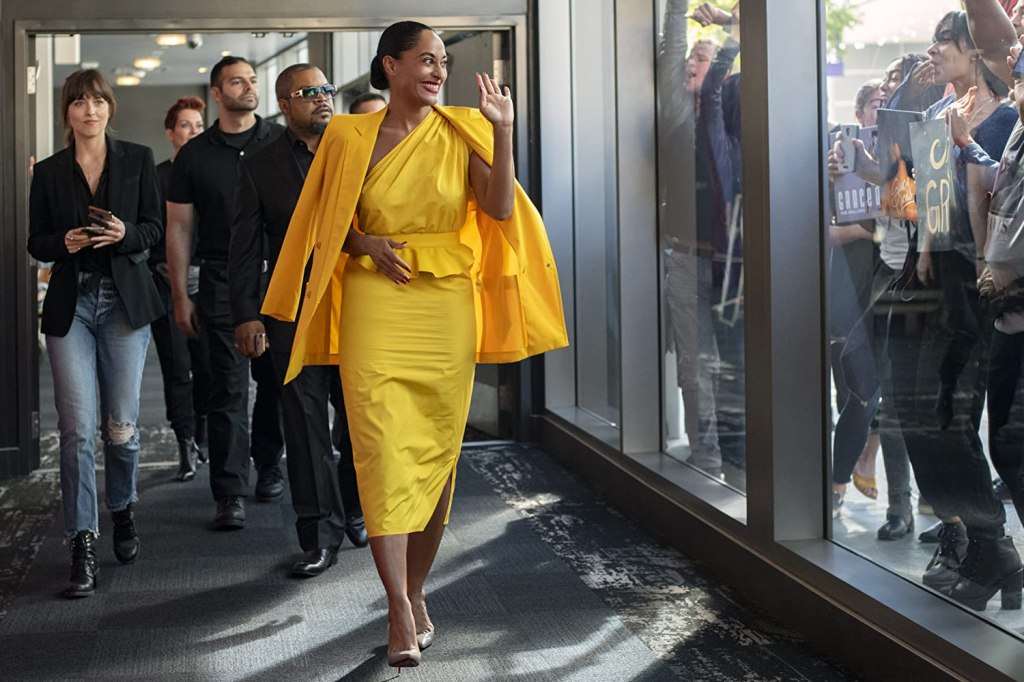
Grace Davis (Tracee Ellis Ross) is a mega music star. She’s touring the world, selling out stadiums, and she’s not slowing down. But she’s not recording new music, either – not in a decade. She’s a middle-aged woman of colour, not exactly the stuff of 2020’s Billboard #1 artists, as her manager (Ice Cube) and label guys keep not-so-gently reminding her. The safe bet is to keep playing those same beloved songs to her ever-fervent fans, maybe do a nice, safe Vegas residency, and every so often repackage those hits into a “new” greatest hits album. Grace Davis is a fictional star but I’m sure these credentials are reminding you of more than one of yesterday’s top recording artists. Maybe even of Tracee Ellis Ross’s own mama, Ms. Diana Ross.

Grace’s personal assistant Maggie (Dakota Johnson) has been fetching her green juice and dry cleaning thanklessly for the past 3 years. Maggie keeps hoping her role will be a stepping stone to where she’d actually want to be – a producer – but not only is Grace not recording music, she’s adamant that Maggie stay in her lane. So when Maggie bumps into David (Kelvin Harrison, Jr) on an errand for Grace, she’s pretty open to following her dream in another direction. David’s playing the grocery store’s parking lot, but his talent is legit so she fudges the details and convinces him to let her produce his album.

Does the moonlighting go well? It would be a crummy movie if everyone just lived happily ever after forevermore. There’s going to be some major bumps. Ellis Ross is terrific as Grace, but she’s definitely not just channeling her mother. She’s made Grace the hardest of things: a pop icon, and an actual woman. She’s worried about staying relevant, about aging, about work-life balance, about being the only woman in a room full of men trying to determine her future. Meanwhile, Maggie is trying to break into a male-dominated field that tries to discourage her by having her fetch coffee. Thematically, this film is the perfect follow-up for director Nisha Ganatra, who gave us Late Night last year.

The Dakota Johnson arc is a little pat, a little too rom-commy; The High Note actually shines when Ross is on screen stealing scenes. I almost wish we could have just stayed with her and lived in her skin, a true testament to Ross and the layered character she crafts. Still, the ensemble is talented, and if at times the script veers toward formulaic, the film is glossy, the songs are catchy, and Ross is indeed a star.