Tag Archives: female directors

Little Women

Writer-director Greta Gerwig has a clear feminist point of view when retelling the classic tale Little Women. She doesn’t deviate much from the novel penned by Louisa May Alcott (two novels in fact – more on that later) and doesn’t need to. Alcott was surprisingly modern unconventional for her time (1832-1888), writing about domesticity and women’s work but making it clear that they all had minds and passions and ambitions of their own, even if society was set up to constrain their use.

The novels are largely classified as autobiographical or semi-autobiographical fiction, with Jo March standing in for Alcott herself as she pulls stories from her own life to illustrate herself and her sisters transitioning from childhood to womanhood. The first novel was such a success that Alcott quickly wrote a follow up which she titled Good Wives, telling more about her characters are their lives as grown women. An avalanche of fan mail had poured in, much of it demanding a happy ending for Jo, happy meaning married of course, so Alcott wove that into her own story, but bucked against the traditional and created a second option for Jo, one she hoped would appease readers (she was, after all, needing to support her family on the earnings from her work) but would still honour the true spirit of the character she and so many others had come to love. But 150 years later, Gerwig restores Alcott’s true intentions, bending the ending just a bit, leaving it not a little ambiguous so that we may choose which of the paths was truly more important to Jo.
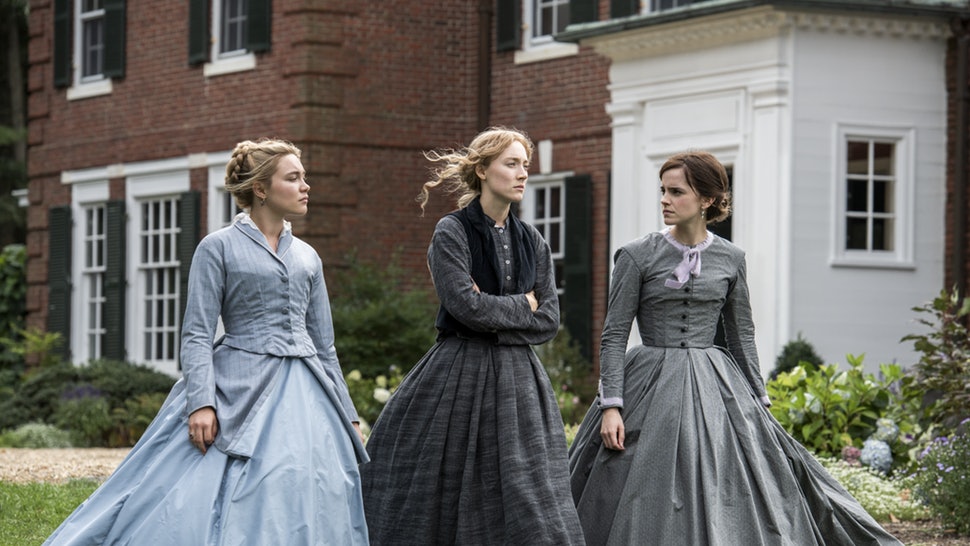
As a writer with 3 sisters myself, who often put on plays together in the basement (we had no attic) of our home, you can probably guess why I loved this novel from a young age. It wasn’t its radical (for the time) point of view, it was the wonderful bond of sisterhood so deeply felt within its pages. Even as the sisters fight (sometimes physically, as illustrated in the film), their attachments are secure, their love never wavering. Modern sisterhood is often portrayed as catty and competitive but we too were a home of Little Women with big personalities and are close to this day, as our Snapchat can attest.

Jo (Saoirse Ronan) is the writer, not just of their childhood productions but also evidently of this retelling. Big sister Meg (Emma Watson) is the actress, Amy (Florence Pugh) the dreamer and youngest Beth (Eliza Scanlen) the sweet, shy musician. Marmee (Laura Dern) presides over her family with unending patience and affection even as she spreads the family’s resources thin taking care of others in the community. The next door neighbours are almost as rich as they are irresistible; Mr. Laurence (Chris Cooper) cuts a sad figure from the window of his large but empty house, and young Laurie (Timothee Chalamet) clearly feels stifled as its only other occupant. Both men will get folded into the March family home in their own ways. Mr. Laurence is fond of young Beth, who reminds him of his own departed daughter, while Laurie and Jo get on like a house on fire, often to the exclusion of Amy who feels on so spurned.

The brilliance of Alcott is that even as some of these sisters settled into marriage and domesticity, the work never seems to judge them. Their paths are held in equal esteem to that of Jo’s. Alcott, who remained unmarried herself, was revolutionary in her thinking, in painting love and career in equal measure and equal worth. 151 years later, we still haven’t truly caught up, still trying to balance those wants and needs in a way that feels satisfying and right. Although I loved the spirit of this adaptation, I suppose I thought Gerwig might have a little more to say on the matter. I imagined that she might have stamped just a bit more of herself into the proceedings.

Saoirse Ronan and Florence Pugh are the stand-outs among the cast; as this is the seventh movie adaptation I suppose by now we know these are the plum roles (Jo having been played by the likes of Katharine Hepburn and Winona Ryder, and Amy by Elizabeth Taylor and Kirsten Dunst). All great directors have their muses and it seems Ronan may be that for Gerwig, playing her leading lady twice now, and likely to secure an Oscar nomination. Pugh has already had a dizzyingly successful 2019, and she certainly makes the most of her scenes in this. As Gerwig must, she trims many of the novel’s excesses, choosing scenes for plot and character development and losing many of the fun and funny anecdotal ones that make the novel feel so lively and warm. But Gerwig’s adaptation is both faithful and wise. It’s only that I admire her unique voice so much that I wish she had respected her source material a little less and allowed her own perspective to shine through a little more. If it is possible to love something while being just the tiniest bit disappointed, then that’s my verdict. Gerwig gives Little Women 100% but I unfairly hoped for 110%. Still, it’s a pleasure to see a female story be so lovingly preserved through the years, in timeless and timely ways.
The Sky Is Pink

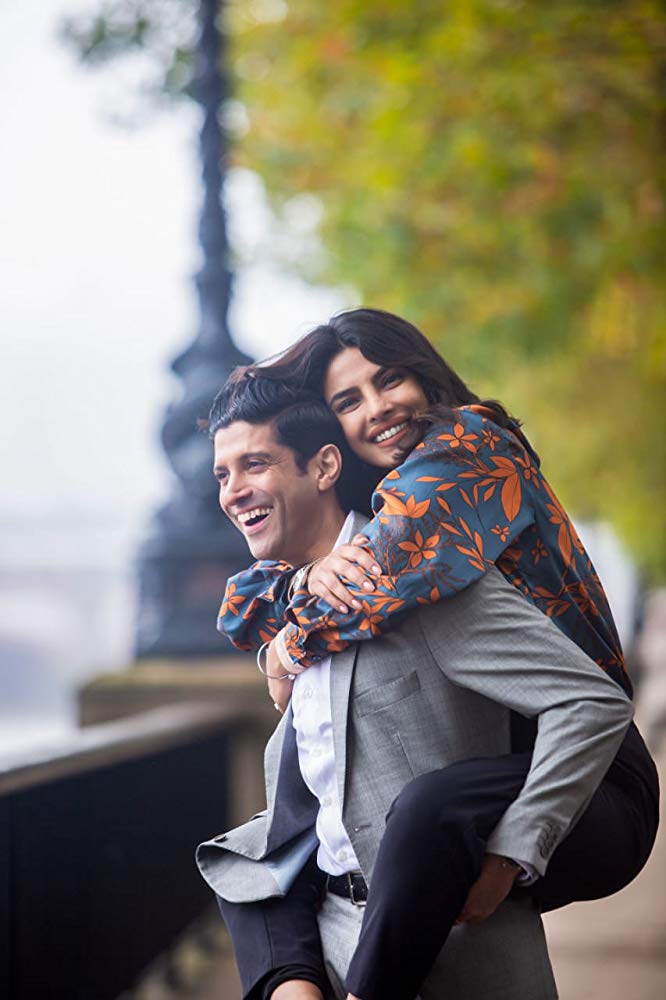
When Aditi (Priyanka Chopra) and Niren (Farhan Akhtar) Chaudhary find themselves pregnant for the third time, it’s not exactly a happy occasion for everyone. They have a son, Ishaan, but lost a daughter and are afraid of it happening again. Niren doesn’t want to risk it but Aditi, once a Muslim now a Christian, won’t abort. But Aditi and Niren both carry a tricky gene that runs a 25% chance of passing SCID (Severe Combined Immunodeficiency) on to their child, which means the baby would have such a compromised immune system that he or she would be prone to severe infections with no ability to fight them off. Such babies rarely live to see their first birthday. Their baby, a daughter, is born, and they name her Aisha, which means life. But a trip to London confirms that Aisha does in fact have SCID and without very expensive bone marrow and stem cell transplants, she will die.

Despite all this drama, Aisha (Zaira Wasim, who is narrating this from some point in the future) insists this is a romantic film, about her parents. Married 8 years at this point, they are suddenly in a long distance relationship, with Aditi in London with Aisha, and Niren back home in India with Ishaan. They had married out of caste, a true love marriage. But having a sick kid and being away from everyone you love is a real test on any relationship. But a worse test is coming: Aisha the narrator has already told us she is dead. What will losing a(nother) child do to Aditi and Niren?

Priyanka Chopra is stunning, even in late 90s mom jeans. More than that, she’s really good in this, even as she shifts between mother caring for her daughter’s health to caring more for her happiness. And as one half of a complicated couple, She’s got great chemistry with Akhtar, who brings his best to the film as well. This film is based on a true story, and it feels very much like the actors respect their real-life counterparts while also making the characters very much their own.

At the end of Aisha’s life, Aditi and Niren are faced with impossible choices and they don’t agree. The strain is of course further complicated by the loss of their first baby, who Niren has tried to forget. The death of a child is…unfathomable. Many couples separate in their grief. What will become of Aisha’s mom and dad, who never stop being exactly that? Writer-director Shonali Bose makes great use of flash backs and flash forwards to lighten the mood or break up the bleakness. The movie is overlong but keep going, it’s worth it. It’s emotional and trying but ultimately rewarding.

Bikram: Yogi, Guru, Predator

I don’t mind stretches and poses but I’ve never bought into yoga culture. I don’t like the body shaming or the forced spirituality or the merchandising juggernaut it has become. Some yogic schools of thought actually believe that yoga should be a gift to the people; teaching yoga is a seva, a blessed service, so teachers shouldn’t charge. And yet yoga studios pop up in every gentrified corner of the world ready to take hundreds of dollars from their affluent customers, with a LuluLemon around the corner ready to charge exorbitant rates for a see-through pair of pants.

Bikram Choudhury arrived in Beverly Hills (where else?) and immediately set the yoga world on fire – and some would say, created the yoga world, at least in America. He claims clients in Elvis, Nixon, Frank Sinatra, Barbra Streisand and more. He built an empire, franchising some 600 studios and embracing the nickname McYoga as some kind of distinction of honour.

Bikram was a celebrity and loved his Hollywood lifestyle. Sure his acolytes saw “red flags” and signs of “megalomania” and acknowledge that humiliation was part of the training. People were fat-shamed routinely. “The best food is no food” was a popular mantra. All part of the fun. Yoga was a cult and his followers were clearly brain-washed – some of them still today, scrambling over all kinds of logical fallacies to excuse away his transgressions, one lady basically saying they won’t say anything negative about him because thanks to him, her back bends were deeper. The man referred to himself as a blood sucker and literally told women “put a cork in your pussy, you’re not allowed to pee” and still people cover for him, “he has his own truth.” Yes, he certainly does.

This documentary covers all manner of sin in the Bikram Yoga Studio. “Separate the man from the teacher,” they said, but you’ll notice nobody says “separate Jim Jones from Peoples Temples”; I’m pretty sure we’ve agreed that everything that comes from an evil cult leader is also evil.

Were you surprised to learn that Bikram Choudhury is a sexual predator? That his yoga studios were basically an excuse to have a constant rotation of sweaty women in bikinis parade their flexibility in front of him so he could pick who to rape next. Bikram yoga was a conveyor belt feeding a hungry rapist.

And let e tell you: if anyone refers to themselves as your family who is not actually your family? Run. RUN. Normally this happens at work, and it’s almost always done to cover up some kind of abuse. They’re about to make you work weekends. Or not pay you for overtime. Do it because “we’re family” though it never EVER works both ways.

And another little hint from your friendly neighbourhood Jay: a man who shows up dressed only in a Speedo and a Rolex? Not a good guy.

It breaks my heart to see so many of his followers turn a blind eye to some really awful stuff. Bikram the man is a monster, but how many of his followers are complicit? Hundreds. Thousands. More? He has fled the country but he’s still doing teacher training and studios are still sending girls to him in Spain and Mexico. Shame on them. The only effective inoculation is information, and this documentary is a powerful dose.

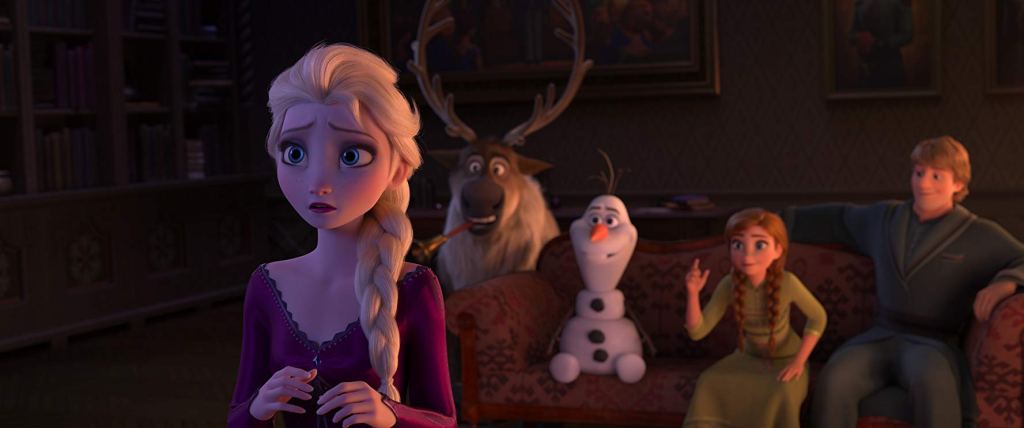
Frozen II

Reviews for Frozen 2 were a bit mixed and I confess I didn’t exactly love the first one (was I the only one on the entire planet not to?). I didn’t hate it, but it was just okay for me. I didn’t even love the song. On our recent trip to Disney World, we met pretty much the whole Frozen crew but needed to attend a sing-along (where people definitely, enthusiastically sang along) to even remember some pretty big plot points from the movie, which came out in 2013 (for example, not one of us remembered trolls). Still, we dutifully brought back an Elsa dress for our 3 year old niece, who has caught Elsa fever (not the kind that produces snow boogies) like pretty much every little girl under 10 has at one time or another.

So of course we went to the see the film. The trailers looked…well, astonishing, frankly, real marvels of computer animation, if a little light on story. We tempered our expectations and emptied our bladders (it’s not really that long, just long for kids – nearly 2 hours with previews) and took our seats in a theatre packed with kids.

And you know what? I can’t speak for the kids, but I freaking loved it. Yes, the animation is, well, staggering. There was more than one moment when I had to convince my eyes that they were looking at cartoons, not real life. The cinematography is top-tier; the light design is dazzling. But, okay, throw all that aside: what about the story? You may have heard that it doesn’t reach the heights of its predecessor, that it lacks drama because it doesn’t have a distinct villain. That the songs are a bit on the forgettable side. I think that’s all a bunch of hogwash.

Frozen II is more interesting, more complex, and more satisfying than the first one, perhaps because its themes are more mature, perhaps because instead of battling a bad guy, it turns inward, introspective. An enchanted forest is calling to Elsa, and though everyone fears what will happen if she opens Pandora’s box, she opens it anyway, exuberantly, after obsessing over it. Though she and Anna vow to go forth together, as a team, they inevitably part ways and both will be tested.

I laughed. I cried. I was surprised on several occasions by its bold and curious choices. There’s a musical number performed by Kristoff (Jonathan Groff) that inserts what I can only describe as a 1980s-style power ballad into the proceedings for no apparent reason. The number is done as if it’s an early MTV music video, all hokey and cheesy and wonderful because of it – clearly not aimed at children who will never know that the M in MTV once stood for music.

I felt that the first film espoused a fake kind of feminism – people applauded it while apparently failing to note that lots of male characters were still propping up the sisters. But in this film they simply do, and they do well, all by themselves, without anyone needing to point it out. You can tell the ladies are genuinely getting down to business because Elsa’s beautiful dress, already being marketed to little girls in stores, comes with slacks, making it easier for her to kick butt. Elsa seemed moody and bratty in the first, but here she’s a woman full of confidence, full of competence. And Anna knows her worth, magical powers or no.

Do any of the songs rival the powerhouse Let It Go? from the first film? How could they, really? Let It Go was an anomaly, one in a million. And then horribly overplayed and quite tedious. Still, several of the songs were quite good, if not quite as memorable, and performed by Broadway’s best, well, it’s nothing to sneeze at.

I don’t know what kids think of it (yet – my 5 year old nephew and 3 year old niece will see it tomorrow – and in 2 weeks, when that 3 year old niece turns 4, her aunt Jay will bring an Elsa cake to her birthday party) but I do know that I was impressed by it, entertained by it, moved by it. I said previously that the first Frozen felt more like a merchandising tool than a movie, destined to spawn straight-to-video sequels, so this is a rare occasion when I admit my mistake, and am humbled by it. Just a bit. 😉

This is my nephew Jack, who’s providing the kid perspective.

And my other nephew Ben.

It’s okay. You can tell me their reviews are better than mine. I know it. And I’m the proudest aunt.

Ben also has something to add to my Detective Pikachu review.

The Knight Before Christmas

We know Brooke (Vanessa Hudgens) doesn’t believe in fairy-tales because that’s what she flat-out tells a student at the very top of the movie. Making such bold and inflammatory statements practically invites the supernatural, so when a knight from 700 years ago suddenly turns up in her life, it’s pretty much her own fault.

Sir Cole (Josh Whitehouse), the transplanted knight, was just going about his 1300s life when he meets an “old crone” (not my words, believe me, and not exactly an accurate description either, even, I suspect, by 1300s relativity) in the forest who gives him a quest to be completed before midnight on Christmas Eve. Next thing he knows he’s in Ohio. In the winter. He pops up in the middle of a Christmas village where his armour seems like it might just be another merry costume, and the fair Brooke doesn’t think much of her run in with him….until she later hits him with her metal steed car and has to take him to a hospital, where his ye olde claims of identity are mistaken for head trauma.

Brooke does what any intelligent young woman would do when she meets a crazy homeless person: she invites him into her home, to stay. You have to be quite a handsome crazy homeless person to merit such an invitation, I’d imagine, armour or no armour. Only her trusty best friend (and possibly her sister?) Madison (Emmanuelle Chriqui) is the voice of reason here, but she is too easily hung up upon, if you ask me.

Meanwhile, Sir Cole (as he insists on being called) gets his 21st century lesson from – where else? – the magic picture box, ie, Netflix itself, which continues to astound me with its ability to be, um, self-referential (by my count he watches Holiday In The Wild and The Holiday Calendar…had he kept scrolling he might have run into last year’s Vanessa Hudgens holiday offering, The Princess Switch; watch for its sequel, The Princess Switch: Switched again, a real honest to goodness thing, I kid you not, in 2020).

What will happen, then, when they inevitably fall in love? I mean, these two are kneading bread together in a way that makes me blush. Guys, I must be slipping. It is WAY too early in the Christmas season (in fact, I’d argue that it isn’t even the Christmas season yet) for me to feel this benevolent toward a holiday romance. Have I gone soft as the marshmallows in my hot chocolate?

The answer may be yes: I am an ooey-gooey puddle of movie-watching goodwill and kindness. I may have lost some self-respect, I may have lost your faith, I may have to change the title of this site, but the truth of the matter is: I didn’t fully hate this movie.

The Kitchen

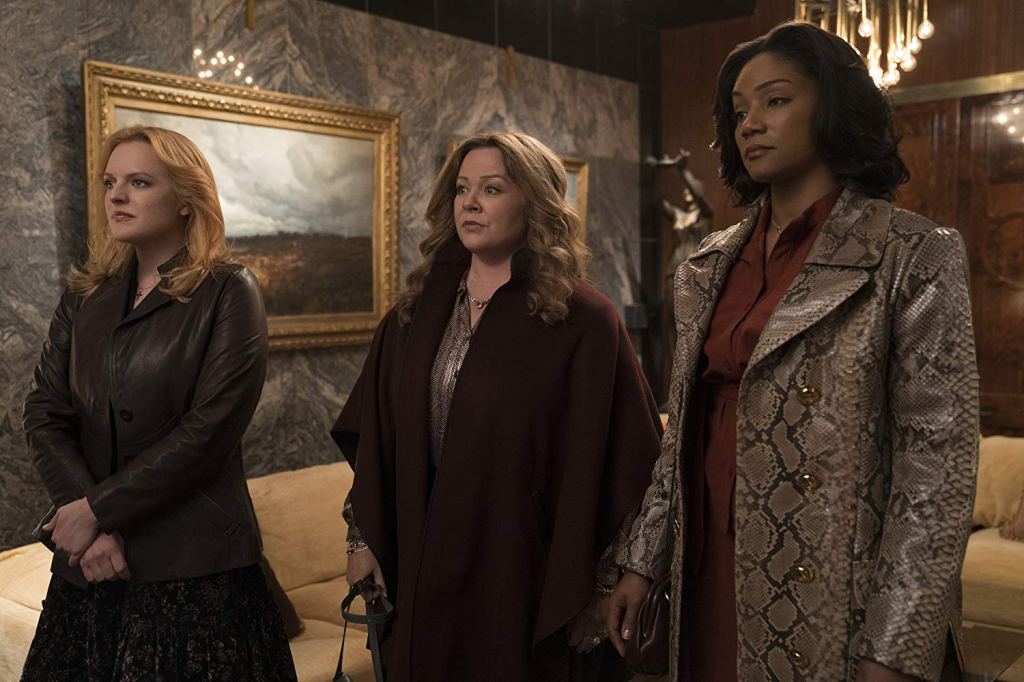
When a bunch of gangsters get put away for terrorizing Hell’s Kitchen in the 1970s, their wives are left up s creek without a p. Oh sure The Family says it will provide for them, but the measly few bucks isn’t even enough to pay the rent. And we’re talking several years of jail time. So Kathy (Melissa McCarthy), Ruby (Tiffany Haddish), and Claire (Elisabeth Moss) grab their own p and conquer s creek.

Okay, that’s a bit reductive because as you can imagine, absolutely no one was thrilled to have the women take things over – not the people paying them, not their rivals, and especially not the leftover male members of their own mob. And I do apologize for having said ‘male member.’

This is exactly the kind of story you want to get behind 1000% and I can still recall seeing production stills from when they were filming and being extra hardcore jazzed about it. But as you can tell by the timing of this review, I didn’t even bother to see it in theatres. And that’s because try as they might, these 3 exceptional ladies can’t make up for a story that just isn’t there. It’s generic and bland and boring. I expected to see some ass kicking and clever one-up-womanship and salty language. But instead it’s just a bunch of hand-wring and counting money into neat little piles. That feeling of empowerment seems to be missing entirely – and so is the point.

I don’t fault anyone in the cast because they’re all churning out great work, but their characters are underdeveloped and at the end of the day, without character investment, the stakes are very low.

The Kitchen is a disappointment. A disappointing disappointment. I only finished watching it because I’d already paid the rental price, and even then I seriously contemplated a “pause” that we just never came back to.

Tall Girl

Sean is a Tall Boy. He is 6’6. Yes he played basketball. And rugby. And volleyball. And he swam, actually. All the things a lean tall boy should do, including nearly eating his poor mother out of house and home – his poor, moderately sized mother had 3 Tall Sons actually, and it seems a testament to her budgeting that she never had to take out a second mortgage to feed them. He expected to date a tall woman. Preferred to date a tall woman. I am not tall. Well, horizontally tall, maybe. Vertically: certainly not. I tap out at 5’3 when at my most erect. My little younger youngest sister likes to poke fun at my littleness by calling me “funsize” like the bullshit tiny Halloween chocolate bars. She is half an inch taller but it burns me and she knows it.

Anyway. Sean is tall. Jay is not. That’s a 15 inch difference between us. Yikes. But I made my peace with my height a long time ago. I’ve had plenty of time; I stopped growing in the fifth grade. I can’t reach the tall shelf and in most chairs my feet dangle without touching the floor but I clear a lot of tree branches without ducking and fit into all the sports cars that Sean has only seen the outside of (I did cram him into a Mazda Miata once but couldn’t bear to pull the trigger and sentence him to 5-7 years of Sean-origami. Sean deals with the back pain that leaning down to kiss me induces and I deal with the fact that my eyes are inconveniently located exactly at elbow height for him (“the danger zone” I call it). He lies diagonally on the bed and I fit in the triangle space on either side quite neatly. My shopping expertise means for the first time he has the right inseams and size 14 shoes that don’t suck.

Being a Tall Boy is actually a very nice thing, I take it. Like in the movie, people often ask him “How’s the weather up there?” (mostly old men) to which Sean gamely replies “Terrific!” But being a Tall Girl is a lot harder, especially a Tall Teenage Girl. Jodi is only 6’1 but fears her height defines her. She feels all too visible. Even boys her own height are intimated, but those who are shorter, who make up the majority, have zero interest. So whether or not the weather “up there” is nice, it’s awfully lonely. Which makes me feel a tiny bit guilty for taking a Tall Boy off the market when technically speaking a dude who is 5’7 is Tall Boy to me.

Of course Jodi (Ava Michelle) is also a bit oblivious because her best friend Jack (Griffin Gluck) has always been interested, if only she had cast her gaze slightly downward. Instead she looks only up, and eventually meets the eyes of the handsome (and tall, needless to say) exchange student Stig (Luke Eisner), who is sort of already taken. But with expert advice from her beauty queen sister Harper (Sabrina Carpenter), Jodi hopes to achieve Tall Couple status. Anyway, it’s easy to find sympathy for Jodi, who is indeed Going Through Something (and it’s not a growth spurt) (and so what if it was?) even when she’s not being her best self. It’s less easy to find forgiveness in your heart for some pretty lazy mean girl tropes and some random and unnecessary shaming.

For some reason boy-girl couples are supposed to have a height differential that only works in one direction. It’s arbitrary and nonsensical and yet deeply culturally ingrained. But you guys: it’s bullshit! It’s as stupid and useless as those teeny tiny chocolate bars. We don’t need to abide by rules that don’t make sense: reject that shit. Kiss people because they’re nice and smart and do good things in the world. My grandmother was (is) taller than my grandfather, and yeah they’re miserable but they’ve been married for 67 years and there’s every chance that at least the first 5 were crazysexycool (he had a motorcycle!).

Tall Girl makes tall girls feel seen, even if that’s the last thing they want. It’s not a great movie, but since it streams on Netflix there’s little investment and little to lose, in inches or dignity or any other measure.

How To Bee

Naomi Mark has set out to make a documentary about beekeeping. Her father Don kept bees for a time when she was a child but gave it up for lack of time. Her fascination, and his, has continued.

Don left America and came to Canada’s Yukon in search of wide open spaces and adventure. He trapped, ran dog sleds, and worked in fire towers: the whole northern Canadian experience. And then, a little late in life, he settled down with Ruth and had a family, one he hoped would be self-sustaining. Now that the kids are grown and he’s retired, Don has taken to keeping bees once again and now has one of the most prolific apiaries the Yukon has ever seen.

Naomi’s documentary, shot over three beekeeping seasons, is a way to pass Don’s knowledge on to his daughter. Naomi believes this to be a documentary about beekeeping until it becomes clear that it’s actually a way to keep her dad alive and spend time with him in his dying days.

Don has been living with COPD (Chronic Obstructive Pulmonary Disease) for longer than anyone knew. Naomi begins to realize that there’s more than one reason for her father pullig away from his beloved bees.

The documentary isn’t always my favourite kind of doc; too much melancholic staring silently into the camera, too many flowery narrations. But it’s hard to deny the real, raw emotion behind the film’s original premise and how deeply affecting it can be to watch someone lose a parent, even when many of the people involved are in pretty deep denial. It’s also interesting to watch Naomi, a novice beekeeper at best, struggle to keep her hive alive when we know important bees are to our environmental well-being. Meanwhile, her father, crucial and vital for so many years to her family’s well being, is also in decline. It’s a downward trend that perhaps gives the hive an elevated status in Naomi’s mind since she has some control over the life of her bees if not that of her father. At any rate, with such a loving film, it’s nice to know that honey won’t be Don’s only legacy.

Los Reyes

Well, I’ve never seen anything like it before, that’s for sure.

I’m not even sure what to call it – documentary seems inaccurate and also somehow inadequate. “An enchanting nonfiction portrait of canine companionship” is what the Planet In Focus film festival has settled upon, and I’m game enough to go along with it. Set in a Chilean skate park, the film somehow makes 2 stray dogs its focus.

Chola is a sweet, proud girl who finds joy in chasing cyclists and is endlessly fascinated by dropping her beloved tennis ball town the skate park’s many ramps. Futbol, on the other hand, is more sedate, more stoic perhaps, but is rarely seen without some ‘toy’ to chew on, though that toy is most often garbage and if all else fails, a rock.

Besides the dogs, the skate park is often full of skaters, mostly teenage boys, slight no-goodniks, young rebels who are just learning to navigate an adult world they aren’t quite ready for. But there are no human faces in this film, just occasional body parts, the merest hint of human, as if the dogs don’t quite care to pay them full attention. More likely to be on screen: patches of sky, blades of grass, close-ups of bugs – whatever might be considered a dog’s eye view. The film is laconic. There is a lot of laying about in the sun, or obsessively sniffing a suspicious mound of earth. Perhaps mimicking the mind of a dog, there’s a lot of open space in the film, room to contemplate individual things but rarely a larger whole.

The film fest posits that Los Reyes will “delight dog- and doc-lovers alike” and while that may be the case for some, I’d guess that it won’t be for everyone. Largely silent, the film only occasionally picks up snippets of conversation from the nearby youth who seem to always have a domestic situation or a drug deal going down. The dogs remain uninterested. Two years into filming, the dogs are also surprisingly comfortable with the cameras, allowing for extremely up close and personal explorations of their bodies and the other inhabitants of their fur. It is not always pleasant viewing, especially because the lives of stray street dogs are probably not exceptionally long. I love dogs, but I love them to have homes and be cared for, and for me, this movie never shed its inherent melancholy.

TIFF19: My Zoe

If you love Julie Delpy, as I do, you probably love her talky scripts, her hyper-verbal, over-analytical characters who leave no thought unspoken. She has a knack for combining drama and comedy and elevating both with intelligent commentary. My Zoe is quite a departure. Which isn’t to say that it’s not smart or insightful. But it is very, very different.

Isabelle (Delpy), loving mother to Zoe (Sophia Ally) is going through a divorce from her husband, James (Richard Armitage). Their daughter’s custody is their battleground. They both love and want her desperately, but they might also have the need to hurt and wound each other however they can. It hasn’t been easy. Zoe is a sweet little girl who is too young to understand the animosity. When James notices a bruise on Zoe’s arm, he is not un-accusing of Isabelle. When Isabelle hears Zoe sneeze, she is not un-accusing of James. They are suspicious of each other’s parenting, determined to be the Best and Most Devoted One. I wish I could say that all dissolves when it turns out Zoe is gravely ill.

A mystery illness strikes quickly, and severely, and the waiting room where the two parents wait is a literal tiny glass box where their tension just bounces off the walls and back into their bodies, ratcheting up the hostility with each allegation lobbed. Is it love gone sour that has them at each other’s throats, or just fear and frustration? Truly, to be the parent of a sick child is the most helpless one can feel. It’s no wonder they seek their scapegoats. Up until this point, the movie is riveting: emotional and raw, full of anger and spite. But then it makes a u-turn.

The next half is so materially different that you might wonder if you’d fallen asleep and woken up during an entirely different movie. It’s still Julie Delpy, still playing a devoted mother, obsessed, even. But everything else has changed: the characters, her surroundings, and most of all: the tone. It’s disorienting trying to get your bearings in this new reality.

Delpy is of course quite good – sometimes astonishing, sometimes vehement, often dangerous and despairing. Her performance is a wail heard by mothers everywhere. But it also reaches beyond the normal, natural borders of motherhood and asks: what else? The answers are not necessarily comfortable.