Tag Archives: female directors

TIFF19: Abominable

Yi, a young woman with serious cankle problems, is grieving her father – not just his loss, but the music they shared and the adventures they’d planned but never went on. She spends less and less time at home, with her mother and grandma Nai Nai. Which is why her absence doesn’t raise any resounding alarm bells when she disappears suddenly.

Where has Yi (Chloe Bennet) gone?

Excellent question! The answer may surprise you! Unless of course you’ve seen the trailers, or the movie, in which case, the answer will be quite obvious.

A Yeti squats on the roof of her apartment building. He’s hiding out from the collector, Burnish (Eddie Izzard) who found him, and the scientist Dr. Zara (Sarah Paulson) who is determined to get him back. But poor Yeti (who Yi names Everest) just wants to go home – to, well, to Everest. So yeah, Yi sucks at naming pets, but the quest is clear: return Everest from whence he came, escaping bad guys in a series of escalating near-misses.

Along for the ride: next door neighbour and perennial cool guy Jin (Tenzing Norgay Trainor) and his rambunctious little cousin Peng (Albert Tsai).

[And just to satisfy your curiosity and save you a google search: yes, he is the grandson of  THE Tenzing Norgay, first man to reach the summit of Mount Everest alongside Sir Edmund Hillary. Nice reference, Abominable.]

Anyway: cue some effusively pretty animation of Chinese landscapes and countrysides, beautiful rivers and fluttering flowers. In fact, even the city scenes are pretty astonishing what with the attention to detail regarding lights and architecture and even advertising (I see you, McDonalds). And great use of music. It all works together to create something magical, and this movie wasn’t exactly short on magic, what with a yeti who speaks to nature with specific requests, and nature responds in creative yet helpful ways. But the script doesn’t sit back and let the animation do all the talking. There’s a sweet story in here about valuing what’s most important. “Sweet” is often a synonym for simple and perhaps minor, and that may be a fair assessment here. It’s most a movie for kids, with a King Kong reference or two thrown in for the grown-ups. And while it’s not really showing us or telling us anything we haven’t already seen, it is inherently endearing.
TIFF19: Honey Boy

Oh man. It’s already been more than a week and in many ways I’m still digesting this.

Honey Boy is an autobiographical movie that Shia LaBeouf wrote. Deep breaths.

Now we know a couple of things about Shia LaBeouf: he has suffered a pretty lengthy and public meltdown, and he has continued to put out some pretty worthy performances, albeit in smaller vehicles (American Honey and The Peanut Butter Falcon recently). In a review for Charlie Countryman, I attempted to parse the nature of his problems and his pain, but of course from the outside, you can only guess, and wish him well (or not). But Shia is at that point in his healing where he is letting us in. He is performing an exorcism here. The ghosts in his closet have been let loose – but will they haunt him less?

“Selfishly,” he told us, “I made this movie for 2 people: me, and my dad.” Let’s unpack that a bit.

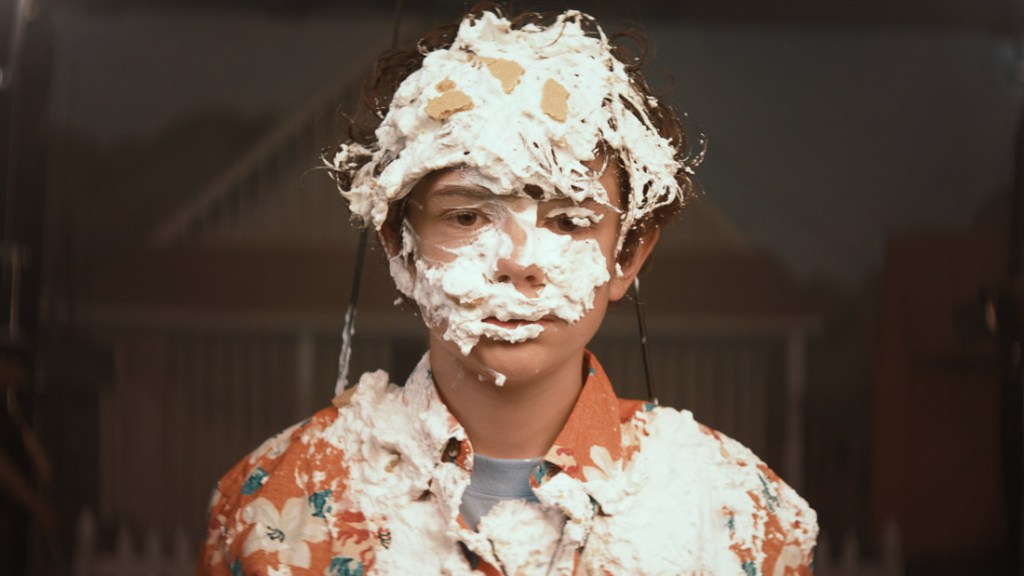
First, you need to know that in this movie he wrote, Shia plays his father. His own father. Noah Jupe and Lucas Hedges play young Shia and older Shia, though the character goes by Otis in the film. What does it mean that he’s written this painfully intimate autobiographical film, but called his character by another name?

Shia’s father James was (is) an addict, an ex-con, abusive to both Shia and his mother. And yet when we meet young Otis, who is hard at work on the set of a show not unlike Even Stevens, he is living in a dingy motel with his dad. His dad is not just acting as a parental guardian, but as a paid one. James doesn’t work. He takes money from his kid. Which doesn’t stop him from neglecting the son he’s being paid handsomely to watch, or from hitting the child who is technically his boss.

This makes for a complicated relationship and a complicated childhood. And though Otis’s mother is seldom heard from , you do have to wonder – if it’s dad who has custody, just how bad is mom?

So you start to realize that this little kid has no parents. Or, actually, that he’d be better off without the ones he does have. But what he does have is a full-time job and more money than most adults. But he’s also got family obligations and staff who are also relatives but virtually no one telling him how to navigate these complex situations. So by the time Noah Jupe magically transforms into Lucas Hedges, Otis has PTSD and his own struggles with addiction and no idea how to take time out from his busy career and the pressures of Hollywood to deal with them. Until a court gives him very explicit directions to do so (and thank goodness).

But maybe his best therapy has been writing this screenplay. Clearly troubled after the TIFF premiere of Honey Boy, Shia is quick to reassure us that he’s happy to be here with us, but he’s quiet, introspective, quick to deflect to his costars and the director he so admires, Alma Har’el. As his struggles have become increasingly public and undeniable, he is coping with the tools he has available: creatively. But will his creation be his catharsis? And is any of this interesting or entertaining to those of us who have to personal stake in his recovery?

Resoundingly: yes. The absolute best bits are between young Otis (Jupe) and his father (LaBeouf). Mostly stuck in a crappy motel room, the anger between them is never at less than an aggressive simmer, and it’s ALWAYS on the verge of boiling over. Even the quiet is not to be trusted. The tension is awful and soon we too are responding like an abused kid, ready to flinch at the least provocation. If you come from a conflict-filled background yourself, you won’t fail to identify the triggers. Be gentle with yourself.

Honey Boy is a moving, emotional movie-going experience. I also hope it brought a certain amount of closure to a young man still wrestling with his demons.

TIFF19: Harriet

Harriet Tubman was born a slave named Araminta “Minty” Ross in Maryland. She suffered all the usual indignities and violence inflicted upon slaves, but one injury in particular left her with permanent brain damage, which gave her, as she described “premonitions from God.”

According to a legal will, she was supposed to have been freed long ago, but when she eventually went to plead with her owner, it wasn’t for her own freedom but that of her unborn child. She had married a freeman who visited her frequently, but he didn’t want to have a baby who would be born a slave, and I suppose you can guess how her masters answered her.

So that’s when Harriet got it in her head to run away. I mean, it must have been in every slave’s head every day of their lives, but finding the courage and the opportunity to do it was prohibitive. Runaways were brought back and tortured before being put to death, to set an example for others. It would have been a powerful motivator for staying put, to say nothing of having to leave behind your loved ones. Of course, when your loved ones can be sold away without notice, it is perhaps not such a big risk after all.

At any rate, Harriet did leave one night, alone. She traveled to Philadelphia on foot, 145km, evading slave catchers and bounty hunters, hiding by day, guided by the north star at night. Eventually she made it to freedom: she survived.

In the film, Harriet (Cynthia Erivo) arrives in Philadelphia and meets William Still (Leslie Odom Jr.), a member of the Pennsylvania Anti-Slavery Society and conductor on the Underground Railroad. He is a meticulous record-keeper and Harriet’s is but one of many, many entries in his logbook. She then meets Marie (Janelle Monae), a black woman born free, who owns the rooming house where Harriet lives. Marie teaches Harriet a different kind of life. Of course, posing as a free woman is an improvement, but not exactly without risks or complications. People are still looking for her. Harriet could spend her whole life looking over her shoulder. But she doesn’t.

Instead, Harriet chooses not only to look back, but to go back. To rescue family, friends, and in fact dozens if not hundreds of strangers. To go back for others, and free them as well. If it’s hard enough to understand how someone could endure so much pain and torment, and then find the courage to escape, it’s darn near impossible to picture the kind of person who would risk it all to go back. But she does.

In fact, she went back 13 times over a period of 11 years, though each trip only put her more at risk. She became an esteemed conductor on the Underground Railroad, never having lost a soul on her midnight runs. Every successful conductor had a network of friends and allies, and though some were white abolitionists whose participation was a great risk, there were also many black people along her route who risked much more but did it anyway.

It’s about time someone put Harriet Tubman up on the big screen for all to admire, and director Kasi Lemmons seems to understand the weight of her responsibility. The incredible thing is, she chooses to do it without the usual trappings of the slave film. Of course, those are largely understood by now, and their threat is still heavily felt. Instead Lemmons focuses on Harriet’s repeated runs, and though their repetition does make each one feel less of a thrill, their sheer number begins to impress. Harriet is not a slavery movie. Harriet is a freedom movie. It is a showcase for resilience, and hope. It’s also a reminder of the kind of impact one single person can have.

To that end, Cynthia Erivo shines as its star. Harriet may not be a complete biopic, but it is a fascinating origin story for one of history’s greatest super heroes. If Erivo isn’t talked about at Oscar time, it would be a crime.

TIFF19: How To Build a Girl

I first came to know Caitlin Moran when her publisher sent me a copy of her book, How To Be A Woman, to review (Jay trivia: I did in fact review books before movies – scandalous!). That’s all it takes to be a Moran convert. She’s so…I mean, likable is both the right and wrong word. She does not asked to be liked. She does not write to be liked. But her don’t-give-a-fuck-edness is extremely likable. She is the role model we deserve: bold, brash, body-positive, full of piss and vinegar. She isn’t someone else’s shitty idea of a woman, she is a REAL woman, no apologies given and none necessary. She may have been new to me then but she was already a well-respected journalist and popular TV personality in England. But over here we’ve mostly had to make due with her books.

Lately she has embarked on a semi-autobiographical trilogy, the first of which is How To Build A Girl. It follows Johanna Morrigan, an educationally-uninspired, council-estate-abiding, overlooked teenage daughter in Wolverhampton who one day just decides that the best ticket out of there is one she writes herself. So she reinvents herself as the fast-talking, confident Dolly Wilde, music journalist extraordinaire. With a top hat and some swagger, Dolly trips through life, interviewing Britpop’s biggest bands at the beginning of their journey to fame, and swashbuckling through bedrooms as a Lady Sex Pirate (Moran’s words, but god I wish they were mine). Is it easy? Fuck no. The music industry is notoriously sexist, and Johanna/Dolly is, after all, still a teenage girl.

The movie has a lot going for it, but I’m going to start with its star, Beanie Feldstein, whom you might already love from Booksmart or Lady Bird, and with whom you will fall certainly and mightily and madly head over heels in this. Johanna Morrigan is the kind of character every actor wants and few will ever find; the personal grown charted on screen is nearly immeasurable. Johanna is every kind of dichotomy you could hope for in a character study of a young woman: brave and nervous, self-conscious and audacious. We see every attempt to ‘build’ her up by the men in her life – father, boss, boyfriend, brother. But then we get to see her break away from all that bullshit and start to build herself. And the ingredients for building a self-possessed girl are all here. It is glorious.

Caitlin Moran’s signature style is all over this film, which she helped adapt to screen. The humour is self-effacing, witty, rude, clever. It is amazing and liberating and just such a relief to see a young woman’s actual sexual awakening be told (though I think it may be slightly watered down from the book, if you can imagine). And that’s what will punch you right in the face: director Coky Giedroyc has given Johanna permission to be a real person, whose inner life and outer trappings are just as full and fully-realized as any man’s. Yes, she’s ambitious. Her peers find her intimidating and confusing. Her life isn’t perfect. She swears like a sailor. She likes her body. She likes sex. She wants more. Have we ever seen a better representation of a female character, ever? EVER??? Everything I like about this movie makes me dislike every other movie just a little bit. How To Build a Girls is vital and necessary – easy to fall in love with, because it’ll make you fall in love with yourself.


TIFF19: The Sleepwalkers

The Sleepwalkers is about 3 generations of a family spending a holiday at their summer home. The matriarch is contemplating the house, which angers at least one son and pits the siblings against each other. But it is a daughter-in-law, Luisa (Érica Rivas) who has it worst.

Luisa doesn’t want to be there. Unhappy in her marriage, she vents her frustrations to a brother-in-law rather than her husband. There is not enough space in the house for a relationship that’s falling apart. But most of all she’s worried about her daughter, Ana (Ornella D’elía), who is young enough to be getting her first blood, but looks considerably older. She’s already caught the attention of an estranged cousin, Alejo (Rafael Federman), recently resurfaced and apparently without boundaries. Even more concerning, Ana is a sleepwalker like her father. She has recently been discovered sleepwalking nude in her own home, and her mother is understandably concerned about what this may mean in a strange house full of people. But Ana doesn’t take kindly to restrictions, and her moody temperament causes her to lash out at her protective mother, and question just which one of them is truly sleepwalking through her life.

Director Paula Hernández has something to say about the pressure and position of women in the family, but for me it was obscured by camera work that literally made me sick. Almost always, only one main character would be in focus, while everyone else had constant blur. At first it was merely frustrating but after 107 minutes it made me physically uncomfortable – sick. And that’s unfortunate because there were some good bits, some very interesting stuff to be examined, but I felt unable to truly concentrate on it. Perhaps, by taking away my choice in what to look at or concentrate on, Hernández wants to put me in the shoes of a young, stymied woman. But that just makes me feel like she doesn’t trust enough in her script. It left me feeling angry and frustrated and ready to bolt. The two lead female characters keep looking for safe space to unleash, to vent, but I felt denied that myself. I never had the space to orient myself or digest what was happening. I felt like a horse with blinders on.

Luisa and Ana are going through some tense and important times. Their performances are good, restrained, even. Hernández makes their inner turmoil obvious without being obvious. I just wish she could do it without creating so much in me.

TIFF19: No Crying At The Dinner Table

Director Carol Nguyen interviews her own Vietnamese-Canadian family, mining them for secrets.

Mostly they share their losses, their grief. The short film explores the cultural and generational differences in how her father, mother, and sister have experienced loss, from physical expressions of sympathy to regret and shame and forgiveness. It’s incredibly personal and soberly realized. What Nguyen accomplished in just 16 minutes is a veritable portrait of grief, and a moving, and living, family history. Her precisely-composed shots reflect the range of emotions, from raw to repressed, and her unobtrusive camera allows us a spot at the dinner table, preferably close to the tissues.

I love how we get to experience the difference between old country new country for this immigrant family, but the truth is, all families are different. Nguyen’s mother shares that she only kissed her own mother once, when she was very ill. Just once. She’s fairly matter of fact in the recounting, but her eyes betray some anguish.

I come from a very physically affectionate family, though I wouldn’t have described us as such until I met Sean’s family. We don’t necessary feel the urge to hug and kiss all the time, but I think our casual touches are actually a testament to our closeness. We might stroke each other in jest, or pinch each other with affection. Rarely does a family gathering go by without someone’s hair getting brushed, or braided. Or perhaps feet rubbed or nails painted. And we might sit very close together, even touching, even lying on top of each other if someone needs the cuddle, or sitting atop each other, if someone’s being a pain. Sean is not naturally a physically affectionate person. I call him a robot all the time, and he assures me that he has feelings, and I pretend to believe him. We just didn’t grow up the same way. It’s fine. We’ve just had to get used to each other. But now he’s the one always reaching for my hand, and he gives me a backrub almost every night before bed (of course, he mislabels this as foreplay, but that’s another story for another short film whose review I’ve highjacked). With coaching, I’ve even gotten him to admit to his mother that he loves her right before hanging up the phone. That’s huge for him. And occasionally he and his father have exchanged a hug rather than a handshake.

And that’s kind of another great revelation hidden inside this film’s 16 minutes. People do change, even just one generation to the next. We learn. We do better. Trauma changes us, but life goes on, and maybe next time, we do it differently. That’s a beautiful thing.

TIFF19: A Beautiful Day in the Neighborhood

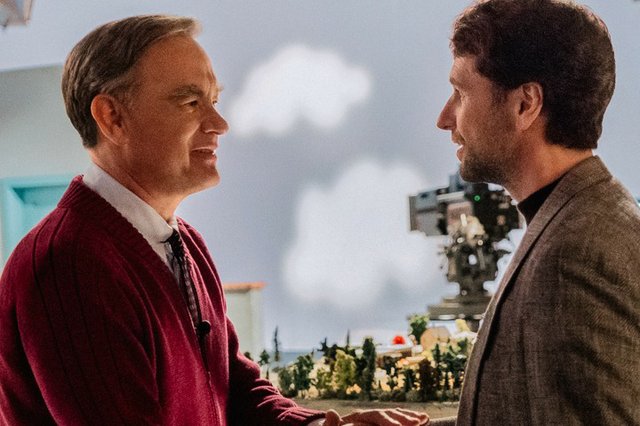
A Beautiful Day in the Neighborhood is a beautiful excuse for a movie, but it is not a Mr. Rogers biopic.  It’s more like if this week’s episode of Mr. Rogers was tackling the theme of Lloyd Vogel (Matthew Rhys), who just happens to be a journalist who meant to write a Fred Rogers profile once.  And he didn’t really succeed – he wrote 10,000 words, mostly about himself.  But it was meeting Mr. Rogers that inspired and enabled him to start to process his childhood trauma and deal with his feelings.  The movie ends up being a 70-30 split, and not in Mr. Rogers’ favour.  Which isn’t a bad thing necessarily, it’s a reminder of the profound impact that Mr. Rogers’ love and Beautiful-Day-TIFF2019acceptance had on all of us.  Above all, he taught us it was okay to feel.

Lloyd Vogel is a cynic.  He normally writes about a broken world.  He’s not thrilled to be writing about a children’s television show, and he’s determined to see the star’s mask slip.  To see that Mr. Rogers isn’t a goody-two-shoes character but rather Fred Rogers’ honest expression of his best self is hard for Vogel to accept.  Meanwhile, Mr. Rogers sees through him – sees his anger, recognizes it for pain, and has a healing effect, despite Vogel’s resistance.  With a newborn baby at home and an estranged father who’s reappeared only to announce he’s dying, Vogel’s life is perhaps in need of some friendly ministration.

Director Marielle Heller finds exciting and innovative ways to frame the story, except she stole them all lovingly and conscientiously from Mr. Rogers himself.  It’s a way to honour what was truly special about his show – everything way thoughtful but low-tech, without fuss or flash.  The continuity was comforting.  Of course, the most incredible coup is the casting of Tom Hanks in the iconic cardigan.  He’s wonderful, channeling Fred Rogers’ sense of calm and peace.  His signature style of slow, deliberate speech is such a balm to those he’s talking to – it is rare to feel the scope of someone’s focus.  It’s also hilarious to watch his producers lose their shit as the time and attention he gives each guest means their show is constantly behind schedule.

It’s a Beautiful Day in the Neighborhood isn’t exactly the movie I expected, but it took me through all the feels (weep count: 3) and left me feeling like a very valued neighbour indeed.  Mr. Rogers has always said that he tried to look through the television into the eyes of one individual child.  Today I was that child, and I think you will be too.

TIFF19: Hustlers

It’s hard out there for a ho.  You’ve got to be a certain kind of broke, maybe a certain kind of desperate, to take to the pole.  When Dorothy (Constance Wu) a.k.a. “Destiny” does it, she’s saving her Nana from debt.  She makes money but not loads – the club takes a big cut, and maybe she’s just not that good.  So call it Dorothy’s lucky day when stripper extraordinaire Ramona (Jennifer Lopez) takes Destiny under her wing.

Ramona makes it rain.  Er, well, money rains down hard on her.  The stage is coated so thickly in cash it looks like it’s been blanketed in snow.  After rolling around in it, Ramona clutches the bills to her like it’s fur.  Ramona IS money.  But then the recession hits, and with Wall Street hit hard, the strip club’s big spenders disappear.

hustlers_0HERO-ForWebsiteONLYThat’s when Destiny and Ramona make a little luck of their own.  Both single mothers, they are struck with the entrepreneurial spirit.  Sex, money, drugs – they’re a match made in heaven.  Or in a gentlemen’s club.  Where the men are ANYTHING but gentlemen.
You can try to extrapolate themes of…friendship, greed, revenge?  Sure.  Let’s call it a rebellion where the poor and disenfranchised rise up against the rich, entitled assholes.  But the truth is, the film is rather light on theme but heavy on girl-on-girl action.  Lots of skimpy costumes that mostly just consist of strings with which to cling dollar bills to glitter-streaked bodies.  There’s lots of booty shaking and titty popping and hip gyrating and pole humping.  Which, let’s face it, is what the people want.  On that score, you couldn’t possibly be disappointed.

Is it hard to root for the protagonists?  Absolutely.  Is it even harder to feel sorry for their victims?  Darn tootin’.  Is it morally murky?  Of course.  It’s a movie about strippers who want more and get it.

Should we bother objectifying the women?  Let’s not.  Jennifer Lopez: you’ve seen her.  She’s amazing.  And she’s 50.  That woman works the pole like her thighs are made of margarine.  So while this isn’t the most fervent review of Hustlers, it’s a 1000% endorsement of J-Lo’s fitness regimen.

TIFF19: Murmur

Donna has just been convicted of impaired driving and is sentenced to hours of community service. She lives alone in a serviceable apartment, her only company empty bottles of wine, and regret. Her grown daughter wants nothing to do with her.

Serving her time at an animal shelter, Donna gets the grubby, grotty tasks, which she performs uncomplainingly. She moves through her day, from mopping up shit, to alcohol counseling, back home to her wine, with little fuss, and little connection. It’s not until a mangy scruffball named Charlie is scheduled to be put down that we see Donna’s softer side. She begs her boss to allow Charlie to come home with her instead; Charlie is old, and sick, but she vows to take good care of him for his remaining days.

Her relief is obvious. Estranged from her daughter, isolated in her little apartment, Charlie is the first sign of affection we’ve seen from Donna. They bond. Are they maybe kinda sorta two of a kind? Both rejects? At any rate, the arrangement is so satisfying that Donna doesn’t stop at just one. Pretty soon she’s popping puppies like Pringles (no, she doesn’t eat them), her small apartment brimming with pets and still she can’t stop bringing them home.

Shan MacDonald is wonderful as Donna. She doesn’t try to pretty her up, or make her more likable. Donna is tough, and MacDonald rises to the occasion. I don’t imagine it’s an easy role to play, but there’s a universality in the loneliness that really resonates.

Murmur was a little slow to engage me as Donna’s life is bleak, and has so little personal interaction. But the dogs open her up in a lovely, tragic, humane way. It becomes easy to guess at the many ways in which Donna may relate to the dogs, may see herself in them. She certainly seems to find companionship easier with animals that with humans, and you know she’s not the first or the last to do that. Her social isolation is heart-breaking, and the film really manages to say something meaningful about addictions – empathetic without letting anyone off the hook.

TIFF19: Black Conflux

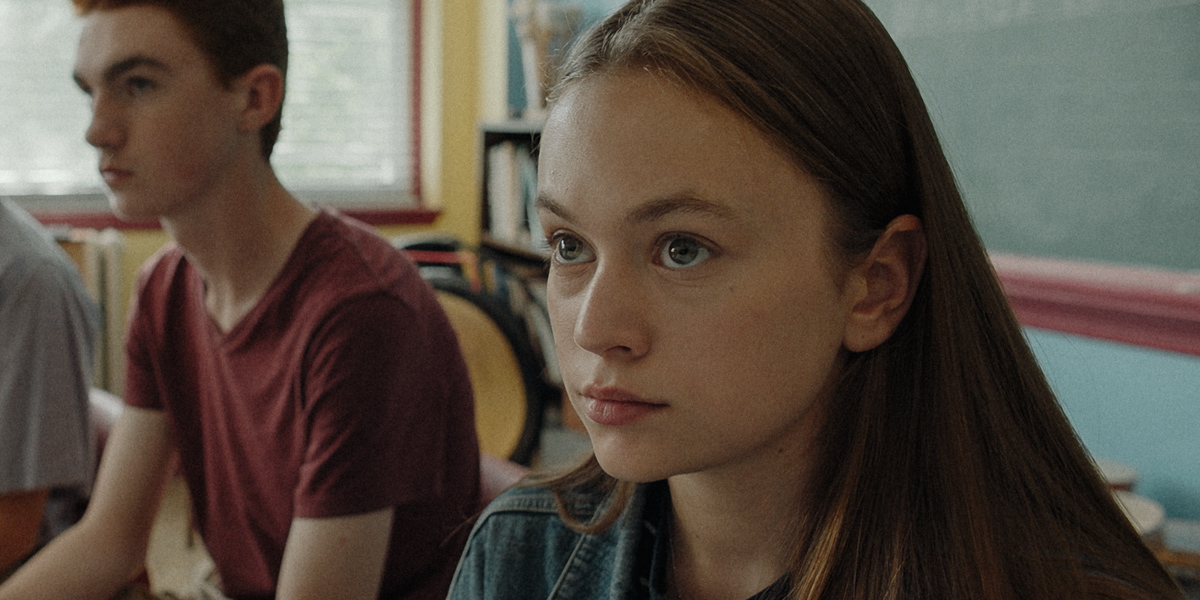
Set in 1980s Newfoundland, Black Conflux has an air of inevitability, and a foreboding sense of dread. There can be no doubt that this story will end badly. It seems certain that Jackie (Ella Ballentine) is going to cross paths with Dennis (Ryan McDonald). It also seems certain that if she does, it will not go well. You see, Dennis is an incel, or he would have been if that term had existed in 1987. He has a beer truck full of imaginary women who worship him, but he has nothing but contempt for the real women he meets. Jackie is a high schooler who has somehow caught Dennis’ attention, even though the two don’t seem to ever have met before. The more time we spend with Dennis, the more we come to think that the women in the beer truck might not be imaginary. They might be ghosts of other women that caught Dennis’ attention, and it seems like Jackie could be next.blackconflux_0HERO

Writer-director Nicole Dorsey’s talent and confidence are on full display in her first feature-length film. She has written two great characters in Jackie and Dennis. We quickly feel like we know them and can predict them, and Dorsey uses that to generate a great deal of tension in anticipation of the convergence (/conflux) of their stories. Adding to the tension are the slow pacing and the atmospheric shots of Newfoundland’s wild beauty, which reminded me there are plenty of places on the rock to hide a body or two or ten.

Dorsey is aided by two great performances from Ballentine and McDonald, who make their characters feel real. We care what happens to Jackie because we like her and we can relate to the teenage world she is trying to navigate, having been there ourselves. And while we don’t really like Dennis, we feel a bit sorry for his struggles to navigate the world he inhabits, even though he’s clearly making things more difficult than they need to be. Jackie is the more sympathetic one (mainly because she is not acting like a serial killer) but despite Dennis’ issues (or maybe because of them) I found myself fascinated by both characters.

It’s not that Black Conflux keeps the audience guessing, because a confrontation between Jackie and Dennis seems inevitable (after all, it’s in the title!). What makes Black Conflux so enjoyable is that it keeps the audience engaged, invested and interested in the journey to the climax. It’s a great debut feature for Dorsey and a great start to my 2019 Toronto International Film Festival viewing.