Tag Archives: female directors

All About Nina

Nina is an acerbic stand-up comedian who boasts on stage about not dating because it sounds a lot better than admitting the affair with the married cop who hits her (Chase Crawford). She barfs after every set. So it seems like the perfect time to flee New York and purse her dream in L.A. of landing  a role on Comedy Prime (an SNL stand-in).

Nina (Mary Elizabeth Winstead) has some professional success there, but her personal life suffers – and we know it didn’t have far to fall from. For the first time in her life, she lets a good guy (Common) get close to her but she’s flailing. Her new roommates (Kate del Castillo, Clea DuVall) model a new and healthy way of living but Nina can’t reconcile it MV5BZTE4ZjUxODEtNmNmZS00ZWU5LWIzODgtNTU1MjNhNzM1MzNiXkEyXkFqcGdeQXVyMTY4NjI3Mzg@._V1_SX1777_CR0,0,1777,999_AL_with her own life, and I’m not sure she believes she deserves that level of happiness anyway. In fact, the closer she gets to good things, the more she sabotages them. Ultimately she’ll have a bit of a meltdown on stage that results in a viral video of some powerful truth-telling that her audience may not be ready for. Just about the only thing that video doesn’t threaten is her strength.
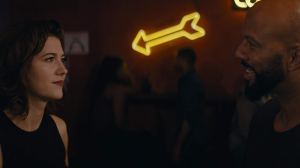
Director Eva Vives pulls together a terrific female-forward ensemble (Angelique Cabral, Camryn Manheim, Mindy Sterling),  to achieve this thoughtful look at what it means to live an authentic existence, especially for a woman in 2018. As her new boss Lorne Larry Michaels (Beau Bridges) tells her, the audience only thinks it wants truth – in reality they need it to be heavily curated.

[This reminds me of the very best stand-up comedy I’ve seen this year – Hannah Gadbsy, who has a special called Nanette. It’s on Netflix. It’s spectacularly funny but also very raw and angry and honest, which makes it a breath-taking, astonishing piece of art. Seriously. You should watch.]

Nina’s passion is motivated by pain. We are certain that her anger is covering for something, but she allows so few cracks that we don’t easily find a way in. Mary Elizabeth Winstead has a long cinematic history of being wonderful and this performance in particular is a brave kind of perfection. It’s like watching a pot boil, with its own internal tension despite knowing what’s coming. Vives sets up these emotionally intense scenes and allows Winstead to smash them out of the park. All About Nina will live to its name. It distills all the frustrations and rage we have as women, every struggle we have between delicacy and strength, independence and cooperation, self-interest and support. It’s a messy road, but beautifully walked.
Blame

A trio of high school girls. Already it sounds like trouble, doesn’t it?

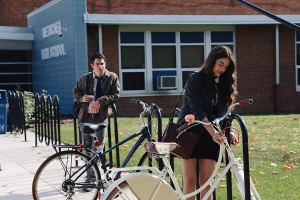
Bad girl Melissa (Nadia Alexander) arrives to disrupt the cozy duo of Ellie and Sophie. Melissa’s influence is immediate on Sophie – well, on both, since Ellie is quick to distance herself from Melissa’s cruelty. A fourth student’s arrival makes an even bigger stir. After a 6 month absence (psych ward stay, it’s rumoured), Abigail (Quinn Shephard) walks the halls, eyes downcast. Melissa senses prey, and the bullying is brutal and relentless. Slut or psycho, there’s no consensus, so both slurs are hurled her way on a regular basis.

Their drama class is studying The Crucible thanks to a new substitute teacher, Mr. Woods (Chris Messina). The parallels between the play and the plot of the film are hard to miss MV5BZjZiMjdiZGEtNTA5NS00NDBhLTlkZGEtMWY4ZGQ0NzEyNDNlXkEyXkFqcGdeQXVyMTYyMDk1MjU@._V1_SY1000_SX1500_AL_with the ostracizing and vilification of Abigail. Mr. Woods sees a lot of quiet talent in Abigail, and his singling her out for praise and attention only drives Melissa to more cruelty. But it’s ice to see Abigail being appreciated by someone, even if it’s her teacher. Until it’s her teacher’s, um, lips doing the appreciating, and that becomes problematic. Mostly for Melissa, oddly, who is insane with jealousy. To be clear, Melissa has every guy in school running after her, and she doesn’t want Mr. Woods. She just doesn’t want Abigail to have anything except Melissa-inflicted misery. And maybe she can’t stand to have anyone choose someone besides her. You’d have to invent a word above self-involved for the likes of Melissa.

Nadia Alexander is all kinds of hateful in this part. Melissa is perhaps not without her motivations, but Alexander is unwavering in her snarl and sadism. Quinn Shephard is also very confident and comfortable in Abigail’s skin, as she should be as she directs herself in a role she co-wrote.

Blame uses familiar high school movie tropes to construct a larger framework. Shephard uses the imagery and inspiration from The Crucible to build Blame to a heightened emotional intensity. We may not always know what it is, but it’s clear that danger lurks ahead. Abigail begins to identify more and more with her fictional counterpart, and it’s fascinating to watch her wardrobe transform as a result, her clothes reflecting both the puritanical and the temptress, and then to see the other girls’ outfits start to compete, heels getting higher, hemlines getting shorter. Only Ellie serves as a link to the audience and our growing discomfort. Chris Messina does an exceptional job with a tricky character. Mr. Woods clearly makes some bad decisions but Messina doesn’t brand him a predator. His girlfriend thinks he’s a loser so of course he puffs up under Abigail’s admiration and devotion. It makes him weak. And the girls, they perform, and I don’t just mean the Arthur Miller. I mean their sexuality is performative. Largely inexperienced, they project sophistication beyond their means, competing with one another for things they don’t fully understand yet, and may not even want. Placing The Crucible within hallowed high school halls makes it clear it belonged there all along.

TIFF18: High Life

The interesting thing about High Life is the negative space – it’s all the stuff it cleverly carves out. At some point in the future, Earth is sending young, death-row convicts to outer space to “serve science” by allowing their bodies to be experimented upon. What kind of Earth is this? We never see it. What kind of crimes are we talking about? We’re never told.

Monte (Robert Pattinson) is one such prisoner. The film’s first scene shows him alone on a space craft save for a baby – his daughter? Cut to: an undisclosed time before, when he is just one of many prisoners under the scrutiny of Dr. Dibs (Juliette Binoche). Ostensibly they’re gathering information on black holes, but there’s also fertility experimentation being done – and what we know and they don’t is they’re never coming back from this mission. They were never meant to.

The male prisoners masturbate alone in a ‘fuck room’ and Dr. Dibs then fertilizes the female prisoners, which makes for near-constant space miscarriages. She herself A45FC0CD-D445-49D6-8783-5FC5F4E28DBA-thumb-860xauto-72637enjoys a solitary go at the fuck room, riding a contraption reminiscent of Burn After Reading’s dildo chair. She enjoys a little solo S&M, her white skin framed by the black walls, the room feeling as dark and blank as the space outside, though rarely glimpsed, must also be.

There’s a lot of silence in space; so too in Claire Denis’s High Life. It’s disorienting and confusing and filled me with dread. In contrast to Interstellar or Gravity or The Martian, High Life has very little in the way of special effects, and actually doesn’t bother much with what’s outside the walls of their ship. If you’re a fan of Claire Denis, don’t worry, she’s as inaccessible as ever – bleak, subversive, full of fleeting, nightmarish impressions.

There’s a lot of ritual in this movie but no purity – Claire Denis puts bodies through hell. Body horror? Sort of. A horrific degradation of bodies. Of consent. Of dignity. In Monte we find a different kind of prisoner, and a stubborn will to persist. There’s a special kind of stress, and madness, to be found in the voids but always Denis refers back to what these 9 represent: humanity? What does their treatment mean for the humans back on Earth, and how does it feel to be utterly forgotten and abandoned by society?


I Think We’re Alone Now

Everybody in the whole world dropped dead on Tuesday afternoon. They seem to have  died suddenly, no pain or suffering or foreknowledge, on the toilet or in front of the TV. Del (Peter Dinklage) was asleep when it happened. When he got up to work his night shift at the library, everyone else was dead. He is alone, utterly alone.

Del has spent the last however many months or years methodically cleaning out the houses in his town. He is respectfully burying all 1600 residents. He tidies their homes, scrounging commodities like batteries and gas, and empties their refrigerators. Entropy is why: one less case of chaos in the universe. Then he searches for unreturned library books, marks the house, and leaves it behind, unsentimentally, ready for the next one. Sure he’s alone but so, apparently, was he in his life before.

MV5BMTk4MjM3NDUyMV5BMl5BanBnXkFtZTgwNTU4MzgyNDM@._V1_SX1777_CR0,0,1777,744_AL_You’ll never guess what’s coming. Okay, I bet you already have, more or less. Grace. Grace (Elle Fanning) is coming. She careens into his town one night and refuses to leave. That he wants her to is interesting, isn’t it? They make a grudging peace, but his solitariness is destroyed, and Grace, of course, is a big ole blob of chaos herself. But she challenges him in unexpected ways. He’s been able to manage this post-apocalyptic world because he didn’t lose much. Grace has lost everything – family, friends, lovers. She thinks Del is cold.
Of course, Grace is not as forthcoming as she’s presented herself. Who knew the end of the world could get so complicated? I wasn’t crazy about the tonal twist in the end and I’m not sure why the screenplay by Mike Makowsky veers off so dramatically when it’s been so low-key up until then. I like a script that has he space to leave some questions unanswered. And Peter Dinklage is very good at filling in the gaps. The opening scenes, largely dialogue-free, are not unreminiscent of a human version of Wall-E. But we get a sense of our solitary man, how comfortable he is with the routine. He’s alone, but he’s not lonely.

If I had some problems with the story, I had none with how I Think We’re Alone Now looks. Director Reed Morano, before she got her Emmy for directing The Handmaid’s Tale, was a cinematographer on films like Frozen River. She was the youngest person admitted to the American Society of Cinematographers and 1 of only 14 women (out of approximately 345, yuck). Morano’s the real deal, and so much of Del’s world looks incredible. I love what the camera will linger on, I love which colours are emphasized and when. I just wish the story delivered on the film’s promise.


Nappily Ever After

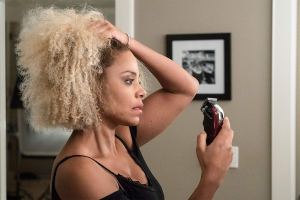
Violet sets her alarm extra early so she can sneak out of bed, fix her hair, and sneak back into bed so her boyfriend thinks she wakes up like this. She does not. An exacting mother made sure that Violent has spent her whole life hiding her true hair. But even with all the tools and chemicals and salon appointments in the world, Violet is still Cinderella waiting for the clock to strike midnight. When it rains, or is even humid, the magic disappears and her hair reverts back to its natural state. So her life revolves around monitoring the weather and keeping her boyfriend’s hands away from her head.

On her birthday, Violet’s hair is perfect (though not without some drama). She is MV5BOTNhMWM0ZDUtZDI0Ny00OTVjLTgzMDctZTk4NWQwZmM3YmFiXkEyXkFqcGdeQXVyODQzNTE3ODc@._V1_SY1000_CR0,0,1500,1000_AL_expecting a ring from her boyfriend of 2 years and instead gets a puppy. Boyfriend accuses her of being “too perfect” so a breakup tailspin ensues, including stops at ‘fuck you hair’ and ‘drunkenly buzzing it all off.’ But can Violet change her attitude and values to reflect her newly bald head?

So, okay. I’m white. Violet is black. I am not the best person to review this film. I mean, on some level, many if not most women will relate. So much of our identity is tied up in our hair. But it’s different for Violet, for women of colour. Black hair, for some unknowable reason, has been viewed as…inferior? Is that the right word? Even very young girls may feel that their hair is somehow ‘wrong.’ A black woman who wears her hair naturally may be viewed as unprofessional at work, unkempt at school, perhaps even viewed as her making a political statement to the world. Culturally, hair may serve as a bonding tool, a thing that unites black people (even black men – there’s a whole franchise of Barbershop movies) but it can be misunderstood outside the culture. Black women make up 70% of the hair care market, but the marketing always features white women with long, straight, glossy locks. As do TV shows and movies and magazine covers. So to attain white standards of beauty, black women blow through time, money, and PAIN to achieve the kind of hair that grows naturally out of white heads but not their own. They’ve felt the need to suppress the natural texture of their hair not just to look attractive but to be accepted at work and in the world. But it takes a toll. Viola Davis said in an interview recently how nice it was to wear her hair naturally in Widows (which had a black director, Steve McQueen). She’s used to wigs, weaves, and chemical relaxers just to present ‘the right kind of black’ to Hollywood and audiences. As you know, there’s still a huge gulf to be overcome in terms of media representing people of colour, but even when a film does hire a black actress, she will often arrive on set to find that the hair and makeup team have not thought through her particular needs. They may be unequipped, in terms of tools and experience, to deal with her hair. It is rare to see a black woman on screen rocking her own natural hair. And that’s okay if it’s a real choice. I don’t wear my hair natural either. But for me it’s a matter of style and personal preference. For a woman of colour it may not feel like any choice at all.

So yeah, Nappily Ever After is a romance, but it’s one tied into culture and identity and hair and femininity and acceptance. Sanaa Lathan is really terrific in it, and relatable too. Even though the script itself is very much about the black woman experience, there are universal themes of authenticity that anyone can appreciate. There’s something very powerful about having the courage to be yourself – but I think there’s something even more powerful about living in a world where that wouldn’t be discouraged in the first place, even if that doesn’t exist yet.


[Women of colour, feel free to correct me or to add to the conversation. And to anyone interested in the topic, Chris Rock (yes, THAT Chris Rock) has a cool documentary about it called Good Hair.]


TIFF18: Viper Club

Helen’s son is a war photographer who’s been missing in the middle east for the past several weeks, perhaps months. Well, not so much missing as kidnapped and held for ransom.

The CIA and FBI are ‘helping’ Helen by telling her to keep this a secret, but a heart-pounding, nausea-inducing secret like this can really make triggers out of  literally everything and anything, and it’s hard to keep her ER colleagues in the dark when they know her so well.

The U.S. government doesn’t pay ransoms, and keeps reminding her it’s illegal for her to do it also. Not that she has any money. Selling her house would provide only a fraction of the demanded sum, and a real estate agent grimly informs her it’s a tear-down anyway. With few options and increasingly hostile communications from the kidnappers, Helen (Susan Sarandon) turns to the only person who can possibly help MV5BNjY5N2I2N2MtYmI0My00OGJiLTkwOTQtYWVlN2FlYTgwMGUxXkEyXkFqcGdeQXVyNzg3Mzc4MDQ@._V1_her – Charlotte, the mother of another kidnapped journalist who was successful in getting her son returned home. Off the record, Charlotte (Edie Falco) fund-raised the ransom among her wealthy friends and had someone walk it across the border for her in order to evade detection. They’re planning the same for Helen’s son, with a friend and colleague of his, Sam (Matt Bomer) willing to make the actual transaction. Helen can scarcely believe her son might actually come home, and isn’t sure what kind of broken man he’ll be if he does. But her focus remains on getting the work done, all of it underground, away from the unhelpful but watchful eyes of government agencies.

Director Maryam Keshavarz makes some choices that make the movie feel a little cold and distant. While I believe whole-heartedly that Helen was committed to getting her son back, we never see her cry, we never see her crack. Yes,  she’s hardened by her ER nursing, but she’s got a soft spot or two, so why no cracks in the facade? And why only drop us in on the action when the son’s been missing for several months? I feel we miss a vital part of the story by omitting Helen’s first contact with the kidnappers, or the moment she realizes she hasn’t heard from her son in too long a time. Instead we only meet her when she’s navigating bureaucracy, which is a bit dry and made me feel removed from any urgency.

There might be a bit of an awards push to get Sarandon a nomination but I’d be fine if it didn’t amount to anything. The story is upsetting but not nearly moving enough. It feels diluted. Viper Club delivers a small still where its title promised a deadly bite.

TIFF18: Quincy

Quincy Jones is an icon, a man who needs no introduction from the likes of me. He’s worked with the best because he is the best – not just at composing music or creating trends, but at transcending them, and transcending culture itself. If you listen closely, this movie is about a man who consistently allows his talent to break down barriers. He’s accumulated a lot of “firsts” in his life (the first African American to be nominated for an Academy Award for Best Original Song – and the first African American to be nominated twice in one year as he was also named in the Best Score category; the first African American to hold the position of vice president of a white-owned record company;  the first African American to be the musical director and conductor of the Academy Awards ceremony) but as far as I’m concerned, he’s also a man with a lot of “onlies” to his name – the first, and the only, because this man is a trail-blazer of incomparable talent and drive.

With his daughter Rashida Jones co-directing the film, they skate lightly over the more scandalous periods of his life and focus on his love of family and his impressive musical career. He composed for Frank Sinatra and for Sidney Lumet. He MV5BYzZhMTY1YjQtNWRjNi00YzVkLWEwODAtNzk1MjMzNzZiMWE1XkEyXkFqcGdeQXVyNTc5OTMwOTQ@._V1_wrote movie scores and TV theme songs. He traveled the world making music, and he’s given back to the community by mentoring young musicians and passing the baton, literally, to new composers. He met Michael Jackson while working on The Wiz, and went on to produce Off The Wall, Thriller, and Bad with him. Oprah credits him for ‘discovering’ her for The Color Purple, which he scored and produced. He also composed the music to Will Smith’s Fresh Prince theme song – he was a show producer, and Will Smith auditioned for and signed a contract at Quincy’s 57th birthday party.

Between his art and philanthropy, there isn’t a corner of culture the man hasn’t marked and this documentary offers an excellent overview of his accomplishments while also providing insight to the life he lives at home. I love the many Quincy-isms up for grabs in this doc. There aren’t many topics where he doesn’t offer some bit of wisdom. But neither he nor his daughters (he’s got 6 – it’s almost biblical) believe him to be without flaws, but perhaps at the age of 85, we can afford to concentrate more on his activism and artistry, and the terrific impact he’s had on music and pop culture. You can check Quincy out right now on Netflix.

TIFF18: What They Had

Ruth is confused a lot of the time, most of the time. Some days she wakes up not knowing who the old man in her bed is, determined to get home to her mother and father, who must be worried. The old man in her bed is Burt, her husband of many years. She’s his girl and he can’t stand being separated from her, so he keeps her at home despite it not being what’s best for either of them at this point.

One Christmas Eve, Bridget (Hilary Swank) gets a phone call from her brother Nick (Michael Shannon). Their mother (Blythe Danner) has left home in the middle of the night and their father (Robert Forster) can’t find her. Anywhere. In California, Bridget is dealing with her own empty nest, estranged daughter, and failing marriage, but she’s What They Had - Still 1been insulated from the problems with her father, who’s recently had a heart attack, and her mother, whose Alzheimer’s is only getting worse. It’s Nick who’s been dealing with them in Chicago and now he wants and needs her support in getting Ruth into a memory care facility – a suggestion he knows Ruth can’t consent to, and Burt will oppose vehemently.

What They Had is a tender movie about memory and family, and what it means to lose a loved one in increments. There’s no one in this family you can’t relate to, and it’s painful to watch them fail to unite, even in their grief. They are all, in fact, playing for the same time: each wants Ruth to be cared for. Burt think she should be cared for by the man who has spent a lifetime loving her, even though no single person can provide the round-the-clock care she requires. Nick worries that Burt caring for Ruth puts them both in danger, and is eager for professionals to take over and give him some respite. Bridget wants to avoid conflict and plays both sides, unwilling to see her mother neglected or her father alone. This is a choice that many families will face, and the film reflects our pain and reluctance so clearly it can be hard to watch.

Throuh it all, Blythe Danner shines her light. Ruth may not have her memory, or even a stable sense of self, but Danner always shows her humanity and her dignity, and even glimmers of humour and comfort. Robert Forster is wonderful, gruff and gentle, unwilling to let go of the love of his life. He is the movie’s anchor, and his family’s anchor, though not always a benevolent one. Is he a bit of a bully? Certainly he continues to treat his children like father knows best, and the dynamics are accordingly unhealthy. Bridget spins her wheels of indecision and Nick internalizes his anger. Shannon is terrific, as always, a kooky, rude, intemperate git who feels like everyone’s pain in the ass brother.

The film gives you permission to laugh. It feels uncharitable to do that with someone who has reduced capacity, but sometimes the jams Ruth gets herself into are quite funny. And sometimes they’re so egregious all you can do is laugh. Laugh or cry – and this movie will have you do both.

TIFF18: The Land of Steady Habits

Anders is mid-life-crisis-ing, hard. He left his wife, quit his job, sleeps with strangers he meets in Bed, Bath & Beyond while shopping for knick-knacks to fill his empty shelves. BUT HE’S STILL NOT HAPPY! Can you believe that abandoning everything you spent your lifetime building is not the path to true happiness? Can you imagine that the real problem was him all along?

I mean, those thoughts haven’t occurred to Anders (Ben Mendelsohn) yet. He’s a man. He’s not that quick. In fact, he’s slow and dumb enough to get high with someone else’s son. Charlie (Charlie Tehan) barely survives an overdose but shows up at Anders’ new bachelor pad looking for…friendship? Anders should know better; his own son PrestonMV5BMWZlMjZiMGItMjBhZS00YTlhLTlkMDgtNDc3Y2NkOTc2OGViXkEyXkFqcGdeQXVyODI4MjAzNjU@._V1_ (Thomas Mann) has been to rehab and apparently still has a problem that isn’t quite addressed. But if his own son isn’t really his problem, why should someone else’s be?

So that doesn’t go well. Nothing does. The Land of Steady Habits is drenched in suburban angst, dripping with the failure of men, both young and old. Director Nicole Holofcener has a knack for eliciting career-best performances from her actors, and Ben Mendelsohn is no exception. His little idiosyncrasies, that devilish grin, they keep the character just shy of being unforgivable. Still, Anders is not meant to be liked. He gambled on the grass being greener and it isn’t. His discontent seems to poison those around him. Ah, the listlessness of the wealthy. It makes it so easy to sit back and judge, guilt-free.

Holofcener makes some interesting choices – notably, that Anders has already shed his previous life when we meet him. And he’s already finding the new one to be hollow. And we experience his search for meaning to be quite petty and superficial. Mendelsohn subverts his usual simmering anger to suggest an inner tension as he navigates relations with his son, ex-wife (Edie Falco), and new love (Connie Britton), with bitter, sometimes humourous results.

The Land of Steady Habits is a good character study that’s a bit uneven as a dramedy. Holofcener tends to be restrained. Sometimes that’s wonderful, and sometimes it’s a little frustrating. This movie seethes with ennui, shame, and regret, and nobody gets a free pass.

TIFF18: Destroyer

Mere minutes into this film, I was ready to hand Nicole Kidman her Oscar. We meet detective Erin Bell, LAPD, as a broken down woman limping up to a murder scene looking no better than the corpse. The reek of booze preceding her, her colleagues roll their eyes behind her back and do all they can to get rid of her so she doesn’t impede the investigation. There is no love or respect for her on the force, except maybe from her partner, who she is expertly avoiding.

But flash back to when she was a young FBI agent. She and partner Chris (Sebastian Stan) were placed undercover with a gang that dealt in a little bit of everything: drugs, theft, whatever. Like any good undercover agent, they melted seamlessly into the gang, became their friends, even got together as a couple, which more or less bled into their real lives. But when the gang plans a bank heist, the operation goes south.

MV5BMjAzMDU5ODU3MV5BMl5BanBnXkFtZTgwMjMwMzcxNjM@._V1_SX1777_CR0,0,1777,999_AL_Cut back to present day: Bell is washed up, an alcoholic, estranged from her family. She looks like hell, smells like she’s pickled, practically lives in her car since that’s where she most often passes out. But when that murder scene turns out to be related to her old gang, she realizes its leader, Silas (Toby Kebbell) has resurfaced and she’ll have to dive back down the rabbit hole in order to make things right.

You might be picking up on Nicole Kidman’s incredible performance. It’s not just that she’s nearly unrecognizable – her gait, her posture, the shadow behind her eyes – her performance is so holistic and encompassing it’s a shock to our system. Contrasted with the “before” years, before she knows how life can hurt you, she looks wholesome and free, like the world exists to bloom with possibility.

Director Karyn Kusama has a very dark outlook on the world, and she’s not afraid to bring her protagonist down the narrowest, most bleak passageways to get where she’s going. Erin Bell is tortured and unlikeable, which is unusual for a female character, and it’s certainly not what we’ve come to expect from Kidman. I’m glad that Kusama doesn’t try to soften her, but I also thought that Kidman’s haggard look was a little extreme, Bell’s complete collapse perhaps not quite explained by the trauma in her past. Everything hints toward something far more sinister, and when the pieces of the puzzle come together, it’s bad, but it’s not as bad as you expect. In fact, it’s a little on the expected side. Destroyer has a great female protagonist that pushes the envelope, and Kidman’s performance is nothing short of incredible, but this movie won’t be remembered for anything more than that.