Tag Archives: female directors

Battle of the Sexes

In 1973, a tennis has-been named Bobby Riggs thought of a great way to become relevant again: he challenged current champion Bobbie Jean King to a game. No, not just challenged her: assured the world that he would win, because he was male, and that was enough. Bobby Riggs probably didn’t truly believe in most of the chauvinistic slogans he chanted, but he knew they’d get him attention in the era of “burning bras” and “women’s libbers”, and he was right. He was a Kardashian of his time; he knew how to work the media and how to gain attention for himself. It just so happened that the women’s movement generally, and women’s tennis particularly, needed exactly this kind of opportunity.

Battle-of-the-Sexes-posterSteve Carell does an excellent job of making the buffoon Riggs more than just a brash loud mouth; in fact, Carell was probably my favourite part of the film. And that’s maybe a little sad considering this really should have been Billie Jean King’s story to tell. And to some extent, it is. It’s just that I thought Emma Stone’s version of her was pretty beige. She’s more than just a prominent pair of glasses with a side of closeted lesbian.

But at least the film is layered and tries to establish the game within the context of its time, not just within the characters’ lives but societally as well. The film may bear the name of The Battle of the Sexes but directors Jonathan Dayton and Valerie Faris seem to know that the most interest part of the conflict happened off the court.

This film hit theatres in a very timely fashion – a reminder of how incredibly not very far we’ve come. Now that it’s available to rent, why not watch it as a drinking game, and take a shot of female empowerment every time a Grand Slam title champion is referred to as a “little lady.” On the press circuit, the real Billie Jean King reminded us that at the time, a married woman couldn’t hold a credit card in her own name. But here we are in 2018 (happy new year) and you just know this movie didn’t get made without someone getting sexually harassed. In 40 years, what will the #MeToo movie say about us?

Utter Christmas Crap

Christmas Inheritance

Ellen is set to inherit her father’s ambiguous “gift” business but first she must prove she’s worthy by travelling to a small town and hand-delivering a letter to a man who isn’t there. She leaves her grinchy fiance behind, all the better to fall inappopriately in love with the good-hearted jack of all trades who drives the town’s cab and serves as the hotel’s bell boy, played by a face you’ll recognize if not the name – Jake Lacy was on The Office and in Girls, and has starred in real, legit movies like Carole, Miss Sloane, and Obvious Child. I’m guessing this movie was a last-ditch effort to save his knee caps. But what then is Andie MacDowell’s excuse?

Anyway, this movie hits all the Christmas movie check marks: baking montage, helping the homeless, fake snow that looks suspiciously like shaving cream. Plus the plot never makes a lick of sense. Not a lick.


Christmas in the City

Wendy moves to the “big city” in order to save her dead father’s candy store by working a minimum wage temporary job in a failing department store where she’s terrorized by the new “marketing” expert who hates Christmas as much as she hates Wendy, who she deems a romantic rival. I think.

Ashanti stars as the “witch” and believe it or not, she’s the only one in the movie who doesn’t sing. She also throws a mean wreath – and every time she does, the extras react like she threw a baby right on its soft little fontanel. The mere suggestion that Christmas is somewhat about presents brings literal tears to their eyes despite the fact that they all work in a DEPARTMENT STORE.

Oh, and if the ending where everyone joins hands and sings their hearts out in the direction of the one person who lacks Christmas spirit feels familiar – I’m pretty sure it’s lifted directly from The Grinch.

Christmas Crush aka Holiday High School Reunion

Georgia is “on the verge of her first milestone” (which I take to mean she’s pushing thirty) and barely feels like she has time to find Mr. Right with the pressure to settle down and marry breathing down her neck (or is that her mother?). When she goes home for Christmas, she finds that her old high school is also hosting a reunion and lo and behold, the torch she’s been carrying for her high school boyfriend Craig is reignited. And this time she won’t let anything come between her and the one that got away – not even true love, played by the guy who was also in the unfathomably necessary Christmas Kiss 2, and the glorious A Dog Walker’s Christmas Tale and also featuring a dude from the above Christmas in the City, plus Harry Hamlin and Merilu Henner, all of whom embarrass themselves as you know they must. But if your idea of a holiday classic involves slutty dancing to Christmas hymns (which are, not coincidentally, royalty-free!), you’re in luck.


Home Again

If I have anything akin to weakness, and I’m not saying I do, but if I did it would be Reese Witherspoon. Is it because her name reminds me of my favourite candy? Or just because she’s nearly too cute and blonde and perfect to be a real human woman? Or because she’s a goddamn clothes horse who always looks stylish and flawlessly put together but isn’t trying too hard? Or because she’s a self-confessed perfectionist who run her own business like a boss? At any rate, I am not accustomed to missing her movies because I lurv her, but this time, I did. Now, in my defense, Home Again was released in September, somewhere between the Venice Film Festival and TIFF, which means I saw about 50 movies in 12 days and none of them were Home Again. Sorry, Reese.

Legendary producer Nancy Meyers is responsible for putting this script in Witherspoon’s hands, but it’s her daughter, Hallie Meyers-Shyer, who writes and directs. The movie follows Alice (Reese), newly separated from Austen (Michael home-again-20170006Sheen) and newly single mother to two girls who are having a hard time with their transition to L.A. Their adjustment period gets both better and worse when Alice brings home not one but three very young men on the occasion of her 40th birthday (it’s not nearly as slutty as it sounds). Aspiring film makers, they’re thrilled to crash on her couch while they take “meetings” about their “project” but even more psyched when they find out the house belonged to her father, a famous movie director, and that her mother (Candice Bergen), muse and movie star, often hangs around to make them breakfast.
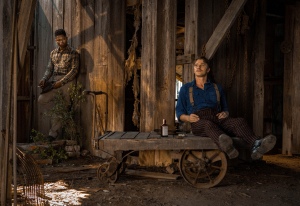
And of course you don’t put the rom in rom-com until the estranged husband shows up to find three beef cakes vying for his wife’s attentions. To be honest, this isn’t really a great movie. The story won’t surprise you and isn’t really trying to; it’s got some moments of wit and charm, plus that little fireball Reese, and that’s good enough, right? That is, if you can overlook the privilege, which, let’s face it, takes some doing. White privilege, it goes without saying, considering the monochromicity of the cast. It’s the cinematic equivalent of an old pair of slippers, but if you’re a fan of Witherspoon’s, you might just find it passable – or better yet, enjoyable.

Mudbound

Two soldiers, equally scarred by the war, return to their homes in the South, and to their families who await them. Their shared experience bonds them but the colour of their skin keeps them wholly separate. Rural Mississippi sucks the big one.

Jamie McAllan (Garrett Hedlund) goes home to stay with his brother Henry (Jason Clarke) and his new wife Laura (Carey Mulligan), who he basically saved from spinsterhood, because that’s what we call 30 year old unmarried women in the 1940s. The marriage is not exactly a romantic one, but she bears his children and lives in a hovel raising them while putting up with disgustingly judgy side looks from her creepy father in law (Jonathan Banks).

Meanwhile, just down the road, Ronsel (Jason Mitchell) goes back to the shack where his family is eking out a living helping out the McAllans. It’s hard to really 170123-stern-mudbound-embed1_wdoplhdistinguish between different levels of abject poverty, but there’s no question that the white McAllan family will always be in a better position than the black Jacksons (yeah, I feel weird writing that, so go ahead and feel weird reading it). Ronsel is having trouble adjusting to this country that demands that he risk his life defending it but then will spit in his eye the moment he’s back on American soil. Tough blow.

And Jamie’s only doing nominally better because his budding friendship with Ronsel is particularly irksome to his daddy, who’s a clansman. So yeah, shit gets real. This is not a pretty movie. I didn’t have much of an opinion of Hedlund before this but I found Mudbound to be well-acted: Mulligan, Mitchell, and Mary J. Blige as Mitchell’s mother are stand-outs of course, and Jonathan Banks made me want to spit nails. Into his eyeballs. Or nutsack. Or both. Rusty ones.

This movie says a lot about race and inequality but is largely unsentimental. The setting is sparse but the characters are rich, with great performances fleshing out mudbound existence. Director Dee Rees paints a stark portrait, accurate but not antiquated.

One Of Us

Oh, Facebook. You’re so full of junk. Tonight my colleague hustled Matt out of the rtrthroom because she wanted to share something for “just the ladies.” Turns out, it was a GIF she’d seen on Facebook: Name your vagina by using the last movie you watched. Of course, instead of being boring and truthful (and smart and scrolling by without comment), women (and men) are falling over themselves to come up with the best titles they haven’t recently, or ever, seen: No Country For Old Men, Lethal Weapon, Sausage Party. Feel free to take you best shot in the comments section. As for me, well, I couldn’t quite remember the name of the last movie I’d seen – only that it was a documentary on Netflix about Hasidic Jews. I was a little worried.

Turns out the title is quite ordinary: One Of Us. But the watching of it is quite extraordinary. I mean, I really love documentaries that open the door to a world I know little about, and this one definitely does that. The Hasidic Jewish community is insular, secretive, closed. And that’s exactly the way they want it. They believe it’s what keeps them safe. They believe it was the only way they could rebuild after the Holocaust, and maybe they have a point. But what it means today is that the community is strictly guided by “laws” written by old, male rabbis that everyone must adhere to, or be excommunicated by all the friends and family they’ve ever known. The Hasidim live as their ancient peoples lived, and you can imagine that’s not easily accomplished in 2017. Though most sects have their own particular rules, no internet and no TV is usually a no-brainer; they don’t want to be “contaminated” by secular (ie, the rest of us) society.

And don’t even get me started on the oppressive rules for women (instead, let the documentary get started, it’s quite a bit more knowledgeable than I am). One of Us gleans its knowledge from 3 ex-Hasidim who have left the community with varying degrees of success. A young woman left her abusive husband but the community won’t let her children escape with her. One man dreamed of being an actor and left for L.A., and hasn’t seen his kids since either. Another, much younger, is struggling to find acceptance in a world he knows virtually nothing about. The very existence of Wikipedia was a watershed moment for him.

The film will make you shake with rage and empathy. The courage to leave, and then to come forward, must be abundant. The consequence is ostracism of course, but there are darker threats too. Made by Heidi Ewing and Rachel Grady, directors of another favourite, must-see documentary, Jesus Camp, there’s a lot of truth uncovered here. There are still some questions left unanswered though: why are these crazy unfair Orthodox courts even legal? I get religious freedom and cultural sensitivity, but what about keeping kids safe?

One of Us is well made, with well-chosen subjects. It tries to be fair and open, but mostly it just tries to engage us, the viewers, and it definitely, definitely succeeds.

Woodshock

In the wake of her mother’s death, Theresa’s grief manifests itself in complicated ways. Her fragile emotional state is pushed off a cliff thanks to some powerful drugs she can’t help but mess with. The result? A film that is haunting, surreal, and hypnotic.

Brought to you by first time directors Kate and Laura Mulleavy, whose names  you may be more familiar with as the sisters behind the clothing and fashion accessories _DSC8956R3label, Rodarte. They’re not the only designers to make the leap to film: Tom Ford made the jump rather successfully not to mention stylishly with A Single Man, and Nocturnal Animals. As for the Mulleavy effort, I’m less convinced. In parts it is absolutely stunning to look at, and they certainly have an eye for what lingerie will best highlight the nipples of the film’s star, Kirsten Dunst. But it’s not quite enough, and perhaps not enough by a long shot.

I will give them this: they create a dreamy, half-conscious state where we’re not entirely sure what’s ‘real’ and what isn’t. The mood is heavy and stays that way. Woodshock is visually assured but that’s the only assurance you’ll get. Everything else is a negotiation game you’ll have to play with yourself, because neither the film nor the filmmakers (some of whom were in attendance at its New Hampshire Film Festival screening) are providing answers or even clues.

The story is as gauzy and ethereal as Rodarte’s 2018 spring collection. Woodshock is high on visual impact but the plot, which probably is a misnomer here, is more like aKIM_0049 series of impressions – you get whiffs of what might be going on, and if you’re nose is good and you’re super motivated, you might even convince yourself the story has bones. But if you’re the kind of movie-goer who likes things like Neon Demon where themes are explored and drama runs high if not in any specific direction, you might count yourself a fan of Woodshock. Crazier things have happened.
The Archer

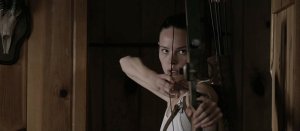
Lauren is a nice kid, a good student, a champion archer whose post-medal celebrations turn sour and result in her arrest. The judge has all the reasons in the world to go easy on this first-time offender, not to mention the extenuating circumstances that all but exonerate her, but instead he throws the book at her. Off she goes to an open-ended sentence at a “reform school” that looks and feels a lot more like a sadistic prison.

There she finds dozens of girls just like herself, imprisoned for very minor offenses. But it’s their jailers that cause the most concern: there are no checks on their behaviour. They can get anyway with anything, and do. But the cruelty, humiliation, MV5BNDU1ZWYyN2UtNGY5MS00NjE2LTk1N2ItNGE5MDcxZmEzMTY3XkEyXkFqcGdeQXVyNDM4NTU5Njc@._V1_SX1776_CR0,0,1776,778_AL_and sexual perversion isn’t just for kicks, it’s also serving a purpose. Because every time a girl fights back, her sentence is extended. And that’s very good news when you’re running a corrupt, for-profit scheme.

So one day Lauren (Bailey Noble) and her new friend Rebecca (Jeanine Mason) decide to make a break for it. No one has ever escaped successfully, but desperation drives their attempt. But to protect the prison’s ugly secrets, its warden will literally hunt them like animals to make sure he doesn’t get exposed.

This film has an incredibly strong female in its lead, and Noble was the perfect choice to play her. She’s got grit and determination but we still believe her as a somewhat naive high school student. Their flight into hills is tense and taut film making, and though the prisoner on the run thing’s been done before, this one is a fresh enough take to grab and hold your attention.

The Archer is inspired by the 2011 conviction of two judges in Pennsylvania when a federal investigation uncovered millions of dollars in kickbacks for their sentencing teenagers to a for-profit youth detention centre.

Laundry

Kids ruin everything. They especially ruin sex. Carly is a happily married woman who just wants 10 minutes alone with her husband for some quality time.  He’s definitely on board for the same. But try as they might – and they do try – the kids are always interrupting. Eventually Carly finds pleasure rather by surprise, making a sharp point of what exactly a mother might find…orgasmic.

Director Becs Arahanga is a mother herself so the inspiration behind this short film is quite personal – and what parent could possibly fail to relate? Although only 9 minutes start to finish, New Zealand’s Arahanga images her film as a rom-com, and there’s a definitely will-they-or-won’t-they appeal. Her direction is jaunty and to the point. She manages to give us a sense of Carly’s family even as she makes the greater point of the universal yearning for intimacy, and the finding of pleasure in unexpected places. Carly is instantly relatable and her struggle looks and feels authentic. Without a second’s lull, Laundry is never less than fun. It’s an ode to marital horniness and the little fuckers who make it all impossible.


Can You Dig This?

Inspired by the OG gangster gardener, Ron Finley, film maker Delila Vallot gets to know the people taking up gardening in South Central Los Angeles and follows them for a year to see if the simple act of growing things can in fact transform someone’s life.

Can You Dig This? is Planet In Focus Film Festival’s closing night film and it’s one you’ll enjoy watching as much as you enjoy learning from it.

Compton is a food desert – the neighbourhoods are packed with fast food joints and liquor stores, but the sale of healthful food is rare. Ron Finley thought it reasonable that he should therefore get to growing some right in his very own yard, but doing soslide-1 attracted the ire of a neighbour who reported him. A cease and desist letter from the city made him think twice – not about the rightness of gardening his own land, but about the rightness of this world. Never before motivated to activism, Finley took up the cause, providing free soil so that others could plant too. Now you’ll find the neighbourhoods dotted with planters, and if you think that’s interesting, just wait until you meet the people who are cultivating them.

The film follows a high school dropout cum drug dealer, a woman who is gang-affiliated, a little girl who wants to grow greens for her diabetic dad (and wouldn’t mind making some cash on the side!), and a few elderly men living in a halfway house after extensive prison sentences. These are terrific subjects, each one revealing a little bit about their neighbourhood. You might not expect something as innocuous as gardening to stir up a lot of emotions, but when the film starts unpacking issues like the legacy of slavery contributing to the black community’s loss of contact with the soil, you start to realize how impactful this seemingly small act can be. Gardening as subversion? Yes, actually.

Not only is this documentary well done, it’s a fun and funny watch too. And inspiring, I don’t mind saying.
CAN YOU DIG THIS? plays at the Planet In Focus film festival in Toronto
Sunday 22 October, 7:45pm ­ Hot Docs Ted Rogers Cinema
Ron Finlay will be in attendance

Mankiller

Wilma Mankiller: you may not know her name, but you should.  She was the first woman elected Chief of the Cherokee nation but her story is more complex than any list of her achievements would imply.

Born to a Cherokee father and European mother, she was raised with  sense of her culture but was influenced by a lot of things. She married young but continued her studies, and upon leaving her husband (with 2 small children in tow), Mankiller underwent a cultural and political awakening that led her down the path that would cast her as a role model and inspiration to her people, and to women. But she started out in an entry level position, only wanting to “help her people.”

Mankiller-DocumentaryThis documentary is not particularly imaginative when it comes to film making; it is straight forward, with few tricks up its sleeves. But Mankiller is a compelling subject, and a documentary shedding light on her story is important when it is omitted from so many history books. When Mankiller was first elected chief in 1985, it was to a male-dominant political structure that she broke into with patience and tact. She persevered, secure in the knowledge that the traditional Cherokee way was a more gender-balanced approach. She overcame a lot of obstacles in order to improve the lives of her people, and many believed her work with the federal government might have led to a national political career had her own health not stood in the way.

Mankiller has a legacy worth notice. If the story-telling by director Valerie Red-Horse Mohl is a little bland, Mankiller’s message of empowerment and equality still resonates.

A film like this can be difficult to get off the ground, and a Kickstarter campaign was necessary to secure the least bit of funding. Luckily, the “First Lady of Sci-Fi” Gale Anne Hurd was on board as a producer. Her career was launched when she produced and co-wrote The Terminator but followed up with Aliens, The Abyss, Armageddon, The Incredible Hulk, Dick, and more. Today she’s the executive producer of The Walking Dead, which means she had lots of famous friends to call upon for lucrative Kickstarter rewards. Creator Robert Kirkman signed comic books; composer Bear McCreary contributed copies of the score; the costumer Eulyn Womble designed special tshirts; Norman Reedus volunteered a custom voicemail message; Hershel himself, Scott Wilson, offered up a spaghetti dinner; showrunner Scott Gimple signed scripts. I think it’s really special when people come together to back a project like this. And I think it’s a credit to Mankiller’s memory that this documentary came together under the supervision of two strong and capable women. You can see this film when it screens at the ImagiNative film festival, Saturday October 21st at TIFF Bell Lightbox.