
Katie Holmes directs herself in All We Had, and proves she isn’t afraid to paint herself in an unfavourable light. Rita Carmichael is good at loving men but terrible at picking them. When another loser reaches his expiration date, it’s her daughter Ruthie (Stefania Owen) that knows it’s time to cut ties and get the hell out of dodge. The problem is that Rita and Ruthie are chronically broke. Rita self-medicates for her crappy childhood with  cheap booze. Between men they live out of their piece of shit car. They have almost nothing going for them but Rita makes keeping Ruthie out of child services her top priority, and so far, she’s always succeeded.
This time, though, it’s going to be extra difficult. Their car breaks down literally in front of the greasy spoon where they just dined-and-dashed and it looks like they’re stuck in whatever crummy small town this is.
All We Had is not a great movie, but it’s not bad. It’s just that Katie Holmes is so hellbent on making this an inspirational story of redemption, she leans heavily on tired formula schtick. Addictions, childhood trauma, financial crisis: this movie has it all, everything except focus. All We Had is the kind of movie you’ll make excuses for – “it means well” you’ll say, and mean it. But that’s not quite enough. There’s not enough skill here to pull meaning from the good intentions. But if you’re willing to watch Katie Holmes try, All We Had is good for 1 hour and 45 minutes of trial and error and smudged eyeliner.
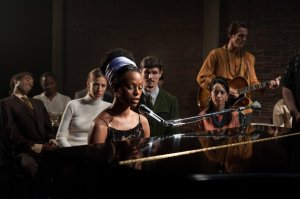 Mary J Blige was originally cast but had to drop out. Nina herself had hoped that it would be Whoopi who’d portray her on screen. Instead director Cynthia Mort went with Zoe Saldana, and thus created a furor. With Dominican and Cuban ancestry, Saldana identifies as a black woman, but critics felt she was not black enough. Not black enough? The notion makes me queasy. But when Saldana said she was honoured to play Simone, the Nina Simone Foundation nastily replied “Dear Zoe, please keep Nina’s name out of your mouth for the rest of your life.”
 who have very little else going on. In a tanking economy, middle aged men find themselves with poor jobs, little money, and even less confidence. It’s no wonder they’ve stopped dating real women and have shifted their fantasies toward little girls, who run no risk of rejection. The Idols host “meet and greets” where their fans will of course pay a lot of money to have a minute’s worth of childish conversation and a handshake – in a culture where the handshake still has a sexual component to it, having been completely taboo between the sexes until only a few decades ago.
 The Mother, Patsy Ramsey, seen by many as suspect #1 since the kidnapping note was determined to have been written on her stationary with her pen from inside the home. Was she jealous of her beauty queen daughter? Frustrated by another bed wetting episode? Did she accidentally kill her, then try to cover it up? Interviews with the press were defensive and unsympathetic. Do you identify with her grief or crucify her for her mistakes?
 She plays the mother of sons, a hard thing to be in 1942; Marcus, who is off to war (played by Jack Quaid, Ryan’s actual son), Homer (Alex Neustaedter) who struggles with being the 14 year old man of the house now that his father (Tom Hanks) is gone, and little Ulysses (Spencer Howell) who doesn’t remember anything different.
 Shiners gives a good sense of the universality of pride in one’s work. However, it is also clear that the profession is not viewed the same from one country to the next. In America it is being reclaimed by hipsters who deride the neglect of older crafts. In Japan we see a lot of honour in the skill, in making something old new again. But in other places, it’s seen as degrading work, and the shiners work on the street, earning little money and even less respect.
 He had an unconventional childhood and perhaps not a happy one, travelling extensively with his parents who exposed him to culture and glamour while largely forgetting he existed. Food became his friend and companion, and he’d gluttonously study the menus of all the great restaurants he visited, making friends with the kitchen staff in all the best dining establishments in the very best of hotels.
 In The Whole Truth, Keanu does indeed play a lawyer who is defending the son of a former colleague and longtime friend. The son is accused of killing his father, that very same former colleague and longtime friend. I’m sure Keanu would like to believe that his client is innocent, but his client isn’t talking. And his client’s mother (Renee Zellweger) is mostly weeping, and begging Keanu to save her son’s life.
 Shortly after we are introduced to Master of Fine Arts candidate Noelle (Francesca Eastwood), she is raped by a classmate. When she confronts him the next day, he denies doing anything wrong and winds up dead in a mostly-accidental way. Somewhere during the events that caused Noelle to be a victim of sexual assault and a murder suspect, she snaps. Formerly introverted and a loner, Noelle starts going to frat parties in order to seduce and murder other rapists who, due to a faulty system, got away with their crimes.
 ASSHOLES WATCHING MOVIES