Tag Archives: female directors

Frozen – reviewed by the last man on earth to see it.

I saw Frozen for the first time last night. Jay knew I hadn’t seen it and since all our nieces and nephews want Elsa dolls for Christmas, it seemed the time was right. I generally enjoy animated movies (or cartoons as I will probably always call them) and Wreck-It Ralph is one of my recent favourites. Since Frozen is Disney’s follow up to Wreck-It Ralph (at least chronologically) I thought Frozen might be quite enjoyable. As it turned out, there was a little bit of truth to that but not as much as I would have hoped.

The problem for me was that Frozen is basically another princess movie geared toward selling new dolls and dresses and direct-to-video sequels. And clearly it has been a massive success on that front, but it struck me as a very hollow movie. I think there were a few good choices made in its creation, mainly that Elsa did not become the bad guy (which Jay tells me was originally going to happen until they realized they were going to have a huge hit in “Let it Go”) and that the guy with the reindeer did not really end up saving our two princesses.

I shouldn’t complain too much. I don’t want to be unfairly critical or hard on Frozen. After all, it is a cartoon and a princess movie at heart and on those levels I can understand why it is beloved by all my little relatives. It’s just a big step down from Wreck-It Ralph, which really lived up to Pixar’s legacy as a movie that was designed for people my age as much as it was for kids (see Up, Toy Story, the Incredibles, etc.). It’s a high standard and a tough mark to hit but there have been some great animated movies produced in the last ten years (some not even by Pixar) and I hope most people making movies, animated or otherwise, are aiming to match or beat what has come before. Frozen had a few moments where something new and exciting seemed like it might materialize but I think it just ended up being too easy for them to stick to the tried and true princess formula instead of really making something original and memorable.

Hopefully Big Hero 6 will be a stronger continuation of Pixar’s best efforts, or at least be more exciting. That’s probably a safe bet because it seems to be about robots and superheroes so there should be very few princess cliches involved. And for whatever reason, robot and superhero cliches do not bother me at all; I will happily watch the same basic plot over and over if Batman is involved, but if you put a singing princess (or two) in the starring role and tell a generic story then I’ll call your movie unoriginal. So don’t be surprised to see my Guardians of the Galaxy review assign a final score of 21 out of ten space guns (or something equally clever) but in the meantime I am not ashamed at all to give Frozen a rating of six talking snowmen out of ten.

(Check out the comments for Jay’s rant on Frozen’s supposed feminism.)
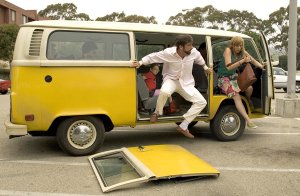
Little Miss Sunshine

This is my jam. A movie I can watch again and again and it never gets old. It’s well-constructed and absorbing and there’s always some small detail to catch and enjoy.

The Hoovers are having a hard time. Sheryl brings her suicidal brother Frank to her home where he’s scarcely the most damaged. Frank (Steve Carell) has just been rejected by his lover and is suffering from acute profession angst as he watches his rival in Proustian studies get recognized while his own work languishes. Sheryl (Toni Collette) takes him in but barely has a thought to spare for him, poor guy, no matter how fresh the bandages on his wrists are. Her husband Richard (Greg Kinnear) has a self-help technique for attaining success that nobody wants. He’s a loser, and his starry-eyed MV5BNTUyNzk4NjA0Ml5BMl5BanBnXkFtZTgwOTYzNDA2MjI@._V1_SY1000_CR0,0,1526,1000_AL_confidence is waning by the minute. Their teenage son Dwayne (Paul Dano) has taken a vow of silence. He can’t wait to leave his family behind to pursue his dream of becoming a pilot. Dwayne’s grandpa Edwin (Alan Arkin) has just been kicked out of his retirement residence for selling (and taking) drugs. The family’s a mess, and Sheryl’s beginning to feel emotionally bankrupt, so it’s under these circumstances that the family rallies around its youngest member, Olive (Abigail Breslin). Olive may be an unlikely candidate for the beauty pageant circuit but she’s an enthusiastic one. On a whim, the family decides to leave their troubles behind and hit the road from Albuquerque to Redondo Beach, California, in pursuit of little Olive’s dream of pageant glory.

Little Miss Sunshine is about dreams, and I guess, their inverse – illusions.  This family of fuck ups needs so badly for one goddamned thing to go right. But for some of us, happiness, or contentment, needs to be found in small moments of unity. Triumph found in trying. Not everyone is a winner at life, and that’s what makes this film so funny, and so heart breaking. It’s what makes it feel real despite some increasingly absurd twists of fate.

Family dynamics are made clear to us during a long scene around a bucket of KFC. My goodness. Toni Collette has long been a favourite of mine but she’s determined with each performance to win me over again, astonishing me with her willingness to let ego go and embrace the honest dregs of each character. Steve Carell was an unknown when they cast him, and producers worried that he wasn’t famous enough to help their little movie along. But in the short time between filming and the movie’s release, Carell burst onto the scene in a star-making turn in the 40 Year Old Virgin, and then introduced himself to all of America as everyone’s favourite boss on The Office. He is quiet and introspective in Little Miss Sunshine, but his underplayed pain and ennui have a presence that take up space in the family’s forever breaking down VW bus. Little Abigail Breslin did not make her acting debut in Little Miss Sunshine (she was in 2002’s Signs) but she did become the first person born in the 90s to get a Best Supporting Actress Oscar nod for her role; she was 10 at the time. She lost but Alan Arkin won in his category. His snatching of the Oscar from Mark Wahlberg was the only one of 5 categories that The Departed lost that night.

This family’s dysfunction is perhaps a little more urgent and layered than most, but almost everyone can see a slice of their own family somewhere in this script. We laugh, we cry, we have a good time, and we leave better people because we’ve witnessed someone’s pain and empathized.

The Virgin Suicides

Mid-1970s Detroit: 5 beautiful, blonde sisters are all but cloistered in their home, kept safe and sheltered by their strict, religious parents. A group of neighbourhood boys become obsessed with these rarely-seen girls, and their intensity and curiosity is only heightened when the youngest sister, just 13, commits suicide.

One of those boys, now grown up and middle aged, recounts the story for us – is he a reliable narrator? He can only piece together the story with the rare glimpses they got from the outside. Even among his friends, he admits, they still argue about what exactly happened. But it says something that they still talk about it in such detail all these years later. It’s a morbid fascination that comes to include us.

Writer-director Sofia Coppola (based on Jeffrey Eugenides’ novel) loves to hide what her leading ladies are thinking, but they never remain as mysterious as in The Virgin Suicides, where the sisters are unknowable not by choice, but by the restrictive actions of their parents. In fact, they are desperate to communicate with the world, and in the 1970s, given all the barriers around them, this was in games of telephone, hand-written notes, even a lamp flicked on and off – morse code, perhaps.

The movie is ostensibly about the sisters (the next-youngest, Lux, played by Kirsten Dunst, especially), but the story really belongs to and is told by the people – the boys and the men – on the outside, trying and failing to make sense of it all. This sense of the outside looking in is often visually represented through Coppola’s shots of the house outside. We peek in through the windows, through cracks of the front door. When a little girl is taken away by ambulance, all the neighbours gather on their front lawns to watch. The cinematic voyeurism only magnifies what the characters do on screen. Short scenes in living rooms and beauty salons assure us that gossip is as rampant among adults as the teenagers who can’t stop watching, even through a telescope, if that’s what it takes. And when one boy, on the cusp of manhood really (Josh Hartnett), finally achieves the impossible and sleeps with the unattainable Lux, she wakes up the next morning to find him gone. He’s left her because once he’s pierced the soapy bubble of her elusiveness and mystique, he finds that she is, in fact, an ordinary girl, and is no longer interested. The sisters’ mythos has largely been constructed by others and is ironically fueled by the strictness of their parents.

This is a tragic story, one that manages not to have heroes or villains, simply victims and witnesses. The boys, in their youth and inexperience, are never held accountable, nor even judged. And the girls remain aloof, forever lost, reduced to a mere absence, a wistful grief.

Nowhere Boy

Nowhere Boy is about John Lennon’s early years – adolescence toward young manhood, which as we know is not a normal coming of age tale since the nowhere boy was well on his way to becoming the most famous man in the world.

The film shows the influence of two women on John’s life: his mean Aunt Mimi (Kristin Scott Thomas) who raised him, and his absent mother Julia (Anne-Marie Duff), who re-enters his life at a crucial bit, extracting pain but also possibly inspiring artistry.

MV5BOTI2MDM0Mzg5M15BMl5BanBnXkFtZTcwNDI0OTQ0Mw@@._V1_SY1000_CR0,0,1505,1000_AL_Lennon (Aaron Taylor-Johnson) knew Mimi wasn’t his mother, but did not learn his mother’s identity until his uncle died and she showed up to the funeral. He was shocked to learn that all this time, she’s lived in the neighbourhood, must have been watching as he grew up. Julia is the younger, prettier, more outgoing, easier to love sister of Mimi’s. John and Julia’s relationship feels a little like a romance as they get to know each other in a little bubble.

But remember, during this time he’s also meeting George, and Paul. The world Beatles is never uttered, though, because this isn’t about the birth of the band. It’s about one ordinary teenager’s life, and the family secrets and tragedies that ushered him into adulthood.

It constricts the heart a little to know that the man who sang All You Need Is Love didn’t always get it. And if he had, we might not have him, or his beautiful lyrics, or his search for truth and meaning.

Sam Taylor-Johnson directed this film, with input from Paul McCartney and Lennon’s half sister, Julia Baird. It is her feature length debut. Her style is unpretentious, and she knows where her focus should be: on John. On the many Johns. The lesser-known Johns. It’s satisfying, as a biopic, because of its narrow scope. We all know who John became; this film tells us how he became. It’s fresh, and that’s very hard to do when we’re talking about one of the most recognizable human beings on the planet. It leaves behind the expected trappings and delivers only gleeful hints of what might be on the horizon. It’s thrilling to watch because of where it does not go.

Casting was obviously going to be a huge part of the film’s success or failure. Taylor-Johnson admits she was most nervous about finding the right Paul, as he’s still alive to see it. Instead of look-alikes, she went with a sweet-faced actor known to us as the drummer kid from Love Actually, Thomas Brodie-Sangster. But John, of course, makes the movie thrum, and Aaron Taylor-Johnson was its beating heart. With no overt mimicry, he embodies John’s spirit. It’s beautiful to watch.

Winter’s Bone

Ree is not your average high school student. With her mother semi-catatonic and her father in prison, she’s the one who cares for her mom and her younger siblings. But resources are scarce and times are hard – Ree (a young Jennifer Lawrence) is used to making do, but there’s very little you can make with nothing, and the doing’s getting thin. So things aren’t great and that’s BEFORE the law comes knocking on her door. Her father’s been released but is MIA and of course he’s put up their house and the little they own as bond. If he doesn’t show up to court, they’re out on the streets. And I don’t even begin to know what that means in the middle of rural, frigid, hostile Ozark Mountain.

So Ree takes it upon herself to go looking for him. The neighbours are vaguely MV5BMjIzNDI4NTc2MF5BMl5BanBnXkFtZTcwODU1MjM0Mw@@._V1_SX1500_CR0,0,1500,999_AL_threatening, heck the landscape is vaguely threatening, but her uncle Teardrop (John Hawkes) is outwardly threatening, and let’s take a moment to remember that it’s his SEVENTEEN year old niece we’re talking about. Everyone’s a little nervous about the specter of her father and nobody’s above slitting the throat of a teenage girl if it means upholding the code of silence that seems to permeate local culture.

Jennifer Lawrence was originally turned down for the role for being “too pretty.” She showed up unbidden to the next audition looking decidedly less so and won the part for her chutzpah. Most of her costars, however, were real locals with no prior acting experience. The costume designer exchanged new clothes for the locals’ own old pieces, and that’s what was worn during production. Shooting on location in Missouri, Lawrence got her hands dirty for the part, learning to skin squirrels and chop wood and shoot a gun. She received an Oscar nomination for her trouble (age 20 at the time, she was then the 2nd youngest to receive one). So did John Hawkes.

Ree seems to have sprung up out of nowhere, espousing values in a moral void. She is not your typical hero. She’s quiet and unassuming an wishes she could afford to disappear. Joining the army is the dream she abandons. It’s a pretty humble way to be a hero, but needs must, and director Debra Granik keeps the movie grounded among its people, never above.


Somewhere

Johnny Marco (Stephen Dorff) is a Hollywood actor ensconced at the Chateau Marmont Hotel. He’s between movies so his days are filled with booze and women and fast cars and while that sounds kinda hot, it’s really a metaphor for how empty his life is, but that’s okay, because for now it’s just enough to stave off the kind of boredom that makes us turn inward and draw some uncomfortable conclusions about ourselves. So far, Johnny has remained introspection-free and what passes for happy. Good enough.

And then his 11 year old daughter shows up. Cleo (Elle Fanning) inexplicably grows fond of him, and her persistent sweetness eventually jostles him out of his ennui. To his MV5BMTkxNDAxNjY4Ml5BMl5BanBnXkFtZTcwMTQxMzQ3Mw@@._V1_surprise, alien, paternal feelings start to surface. Not only does he care for his daughter, he wants to be better for her. It’s a bit of a wake-up call. But then she goes off to summer camp and finding himself alone again, Johnny isn’t sure who he has become, or if he can sustain any of the positive changes. But we have reason to hope.

It’s a little hard to sympathize with Johnny’s privileged moping, so for me, the movie really gets juicy with Cleo’s arrival, which grounds him and helps him to redefine both happiness and success. Director Sofia Coppola tackled themes of success and isolation in other movies too, but this time she’s doing it from the male perspective, where depression looks a lot like hedonism, minus the enjoyment.

Cleo is a clever child and an interesting character. In some ways, it is she who parents and nurtures him, and we get the sense that she probably understands more about what’s gone wrong with his life than he does. But she’s still young and can’t help but look up to him, troubling as that may be. Fanning and Dorff have some pretty charming chemistry together. It’s very telling how the film only feels alive when she’s on screen with him. When she’s gone, it’s not just her father who misses her. She leaves a void.

Coppola is particularly qualified to provide this less-than-savoury look at celebrity. Johnny is working, but he’s not doing his craft, he’s doing the annoying, soul-crushing stuff like press and publicity. Anyone else might appreciate the free vacation to Italy, but for him, Venice is just another obligation. Sure this might be a bit of a retread for Coppola, but there’s a sweet melancholy to this film, at times almost hypnotic, plus her classic eye for detail and style – irresistible, really.

The Hurt Locker

Like everyone else, I watched The Hurt Locker the year it came out. It was dutiful, really. The subject matter didn’t interest me but its female direction was like a monkey with a typewriter. That sounds awful, I know, but honestly, it was a bit of a sideshow. Just 10 years ago, you rarely if ever heard about a female director, period, let alone one who was taking on a project so classically masculine. A war movie, for christsakes. But Kathryn Bigelow didn’t just ‘take it on’, she was so fucking good at it, even boys had to admit it was great. “A near perfect movie,” one had to admit. “A full tilt action picture” said another. Gosh. It was so undeniably good that the biggest consortium of white men ever, the Acamedy, could do nothing but award in 6 Oscars (of 9 nominations), including Best Picture AND Best Director for Ms. Bigelow. Fuck yeah!

But I didn’t like it.

MV5BNzkzZDFhZTUtMWQwYi00MzNhLThiODItNmRlMDhlODZjZDMzXkEyXkFqcGdeQXVyNTIzOTk5ODM@._V1_SY1000_CR0,0,674,1000_AL_Rewatching it, I get why. Jeremy Renner plays hot shit Staff Sergeant William James, a…bomb guy. Pretty sure that’s the technical term. He gets all dressed up in a quasi-astronaut outfit and defuses bombs (ideally). His unit has only about 30 days left in their Iraq rotation when he’s assigned to them (their last guy got blown up) and they immediately want to throw him right back. He rushes into combat like he’s got a death wish, and worse, he puts his fellow soldiers at risk too. Sergeant Sanborn (Anthony Mackie), his subordinate, is particularly disturbed to be working so closely with what appears to be a straight-up crazy, reckless person.

This movie is rife with unapologetic toxic masculinity, and it was fucking hard as hell for me to make it through. In the army you don’t get to choose not to follow a whackerdoodledoo into combat, but from the comfort of my bed (it’s on Netflix atm), you betcha I was yelling obscenities at my TV.

Grudgingly, I can appreciate some of the craft in this movie that I was probably willfully blind to a decade ago. Bigelow uses hand-held cameras and an incredible 100:1 shooting ratio to make this film feel real – almost like a documentary. It’s also relentless. One scene barely ends before the next bout of trouble is upon us, usually already in motion.

I like the ending, what it reveals of James’ character – namely, that he’s happiest when he’s staring a ticking bomb in the face. But that’s essentially also my problem with the film. That his disregard for his own life is going to get everyone else in his company killed along with him. That their only move toward self-preservation is to kill him. Imagine being in Baghdad and contemplating that. That his risk taking and complete indifference to the rules somehow make him this bomb cowboy action hero when in fact, in real life, it makes him a moron and a liability. Personally I rooted against this guy, this “hero” because as much as I don’t really love watching people get turned into jam, at least it would give the rest of this unit a fighting chance. War is tough enough as it is. We don’t need to “up the ante” on a bomb squad in an active war zone. That should have been enough. Crazed war junkies intent on obliterating themselves likely would have been weeded out back in basic. The Hurt Locker is just punishing, and I get that the Academy didn’t want to give Best Picture to Avatar (I haven’t seen that one at all), but, ahem, I do believe Up was also in the running that year.


Laurel Canyon

Sam and Alex are on their way to a picture perfect life. He’s a newly minted psychiatrist about to start his residency in L.A. She’s a brilliant academic finishing up her dissertation. All Alex (Kate Beckinsale) needs is a little peace and quiet, and Sam (Christian Bale) has the perfect place in which to star their new life: his mother’s house in Laurel Canyon. The only problem is that his mother hasn’t cleared out yet. Jane is still there, producing an album for her latest boy toy. She’s a successful record producer whose rock n’ roll lifestyle wasn’t exactly conducive to raising a son. Now that they’re all trapped in a house together, our straight-laced couple is going to clash wildly with Jane’s wanton ways, and they might even be corrupted…

There’s something to this movie about self-discovery, freedom of expression. It’s non-judgmental by 2003 standards and it’s a little wet 17-CTEK-1908-LC_McDormand2-613x463and wild, in a having a threesome with my mother-in-law and her skeevy boyfriend kind of way. Don’t think about that too hard. Christian Bale is doughy and passive but ultimately more believable as a psychiatrist than Kate Beckinsale is as a nerd. Which, granted, is not saying much. But man, is she a bad actress or is she a BAD actress? In this she whispers and slides her glasses up and down her nose, and confuses that with a character.

Fine. The real reason, the only reason to go back in time 15 years, is to watch Frances McDormand do her thing. She does all the things! We genuinely do not deserve her, how could we, but until she figures that out, we must hoard all of her performances and allow movies like this to just become another car on the runaway, unstoppable, Frances train. Toot toooot, all aboard!


The Bling Ring

In this week’s edition of stupid criminals: teenagers who take selfies of themselves committing crimes, at the scene of the crime, during the crime itself. The balls though. The fucking balls.

You may know that Sofia Coppola’s The Bling Ring is based on a real-life band of teenaged criminals who robbed celebrities blind. Although, considering the type of criminal, let’s qualify the type of celebrity: mostly reality stars like Paris Hilton and Audrina Patridge. And while most of us have trouble feeling sympathy for the Haves having a little less, the kids aren’t exactly Have Nots. Of course, you can always Have More. The crazy thing is, they’re just stealing because they can, because it’s there and they’re entitled, and they don’t give a fuck. They want for nothing…except maybe a good lawyer.

Most criminals are eventually caught. All stupid, blatant, idiotic criminals are caught. But even a brush with the law, strike that, several brushes with the law, doesn’t humbleMV5BZGQ5MzIxMTgtNmM3Yi00YmQxLWI1OWMtMWNmM2YwOGQ0Y2QzXkEyXkFqcGdeQXVyNjQ4ODE4MzQ@._V1_ them. The more, More, MORE monster must be fed and soon our band of merry robbers are graduating to the likes of Megan Fox, Rachel Bilson, and Orlando Bloom. The gossip magazine lets them know when someone’s away, and Google offers up their address. The drugs and their hubris make them sloppy. Their egos make them indiscreet. It’s not so much that they wanted to be caught, but that they genuinely thought they were invulnerable. And for a time they were.

This film is beautifully shot. A stand-out for me is a particular robbery of a glass-walled house in the hills. The camera is set far back, and we’re observing the house from some distance. We witness the intruders moving from room to room, turning on lights one at a time. It’s a beautiful, well-plotted scene. And like all Coppola films, this one maybe more than most, the sound track boasts a lot of great songs.

However, not unlike its protagonists, The Bling Ring ends up being kind of superficial. I get that production probably spent a pretty penny recreating Paris Hilton’s boudoir. But scene after scene of theft that looks like Christmas morning should not come at the expense of motivation. Who the fuck are these kids? Who gave them such a sense of entitlement? These perpetrators are so self-absorbed that they gave interviews on how hard it was to do prison time with one of their victims – Lindsay Lohan. How hard it was to stay strong in the face of her tears. It’s hard, as a viewer, not to feel the bile rise. And while I don’t want to glorify these terrifyingly stupid, self-centered criminals, I’m not sure what good this movie is if it doesn’t offer up insight.

Lost In Translation

Two Americans in Tokyo. Charlotte (Scarlett Johansson) is there for work – her husband’s work. Neglected, she spends er time gazing down upon the city from the cloisters of her hotel room. Elsewhere in said hotel, Bob (Bill Murray) is suffering the indignity of doing foreign commercials ow that his movie work has dried up. It’s a nice pay day but a blow to his ego. His wife nags him long-distance, via middle of the night faxes.

When Charlotte and Bob meet, they are immediate kindred spirits. Lonely and 0-JQ8-nKevwyF6_c5L.pngAmerican, they form a bond that mimics intimacy. In their glowy little bubble, they experience the quirks and sights of Japan; its foreign-ness feels less daunting and more adventurous when they’re together. When they’re apart, it emphasizes their aloneness. But they always revert to the comfort and familiarity of their luxurious but non-descript hotel. In he hotel, they could be anywhere. They develop such a strong sense of we vs. them that even other Americans seem wrong to them, are laughable. Of course, their friendship is a little dangerous: it won’t be good for either of their marriages.

Bill Murray is good – Oscar-nominated good. His improvisations are so good you can literally see extras cracking up in some scenes. Scarlett Johansson was only 17 when this was filmed, so she’s more of a blank slate, having not yet picked up a lot of the acting crutches and mannerisms upon which she’s come to rely. Actually, in 2018, Lost in Translation is 15 years old, which is almost as old as she was when she made it. That’s something to think about, isn’t it?

Writer-director Sofia Coppola probably made her biggest splash with this film. It pulses with life because she threw so much of herself, her own insecurities and worries, into it. Both of these characters travel to an alien land to truly realize how isolated they’ve become. They are disconnected from their spouses, and communication back home is sporadic and brief. There’s a longing for connection that’s an evident, live thread woven into the tapestry of this film. So many small details add up as proof of their passionate friendship, which is far more effective in this context than a sexual relationship would have been.

The film’s sparsity of dialogue speaks volumes to language not being the greatest barrier between people. Communication happens on all levels, and Coppola signals this in her final scene, with that elusive yet beautiful ending in which Murray whispers something unintelligible to Johansson, and they share a tender kiss. What did he say to her?  We may never know the words, but ew unddertand the meaning.