I saw Mustang, as I see most foreign language films, surrounded by baby boomers. In Ottawa, the Bytowne is really the only place to go for foreign, documentary, and most independent films. The other thing about the Bytowne: Old people love it, partly because it’s reasonably priced but also because they can ask each other “Who’s she again?” without fear of getting shushed because their neighbours were most likely wondering the same thing. So I wondered at some points whether the hearty laughter coming from the audience during this tale of female oppression was the reaction that the director was hoping for.
To be fair, I’m not at all confident that I know exactly what reaction Deniz Gamze Ergüven was going for with her debut feature. Mustang can shift tones pretty quickly and, for once, I don’t mean that as a criticism. We first meet Lale (Güneş Şensoy, who’s just wonderful) and her four sisters on their way home on the last day of school in their small Turkish village. When they run into a group of boys, it’s off to the beach to sit on their shoulders and splash each other. In a Hollywood movie, this would just be a throw-away scene for a Best Summer Ever montage but, in this time and place, it’s enough to set in motion a chain of events that are just plain infuriating. Word spreads fast about the sisters’ scandalous behavior and their livid uncle immediately pulls them out of school and keeps them home to learn to cook, clean, and be good future wives. Worried that their reputation as corrupted girls would get worse, he rushes to marry them off as soon as possible.
They’re just good kids who like to have good silly fun. To see them oppressed in the name of sexist religious fundamentalism is an outrage. Ergüven’s trick is that she has made a film that effectively captures the cruelty of the situation but is always watchable -sometimes even entertaining- and almost never unpleasant. She is as committed to portraying the girls’ resilience in the face of oppression as to the oppression itself.
There are occasional scenes of very broad comedy in which I’m sure the Bytowne crowd’s laughter was exactly what Ergüven was hoping for. In the ever-escalating battle of wits between Lale and her mean uncle, I can’t be sure. I couldn’t laugh at Lale’s increasingly clever plots to sneak out of the house. The cost to her freedom and, eventually, her safety once she’s inevitably caught made me way too nervous.
It’s a credit to Ergüven that she’s made a film that could affect audience members so differently. Mustang calls attention to gender inequality and injustice that is as hopeful as it is frustrating. Through her faith in one young girl’s fighting spirit. her feature debut is a worthy nominee for the Best Foreign Language Film Oscar.
Last month, we got a Facebook message from a very brave filmmaker. Jaschar L Marktanner invited us to watch and review his short film, voluntarily facing the wrath of not one but three admitted Assholes. How fun it would be to pan AUFDRUCK (LABEL in English), from a writer-director so boldly putting themself in the hot seat.
Imagine my disappointment when I actually enjoyed it. LABEL is only four minutes long so a spoiler-free description is a unique challenge for me as a reviewer. I think (and hope) that Jaschar won’t mind me telling you that it’s shot in black and white, which is an excellent choice, partly because it adds to the French New Wave feel. In their first IMDB credits, Kira Mathis and Mary Krasnoperova play two women in a coffee shop describing a mutual acquaintance as a “son of a bitch”. Labelling and complaining with a friend over coffee may seem like a pretty universal experience but it soon becomes clear that these women use the label pretty liberally, as the conversation becomes more and more absurd.
LABEL is funny, gradually upping the ridiculousness as it follows the structure of a really good comedy sketch. Marktanner’s film has more to offer than just laughs though with what I read as an effective critique of modern fatalism. I am happy to report, however, that he has generously given this Asshole one thing to grumble about. Speaking no German, I was forced to watch LABEL with English subtitles which were colour-coded depending on who was speaking. I found the dark red to be difficult to read against the black and white background. Once or twice, I had to pause it to avoid missing a single word. There, I said it.
Overall, LABEL is well worth your time and I am grateful to Jaschar for sharing it with us.
I love the movie Fargo. Like, LOVE the movie Fargo. I recently likened The Legend of Barney Thomson to a Scottish Fargo, and believe me, that’s the highest compliment I know how to pay.
Kumiko lives in Tokyo. She is an “office lady,” working a demeaning job for a patronizing boss. She’s an extreme introvert and doesn’t seem to have any hobbies or outside interests other than hunting for treasure to escape her dreary life. Her most recent acquisition, found buried in a cave, is a VHS copy of the movie Fargo where she “discovers” buried treasure. You know – the bag of money that Steve Buscemi buries in the snow? Yeah.
So poor confused Kumiko embroiders herself a treasure map and flies to Minnesota with “I want to go Fargo” as her only English and a stolen company credit card her only money. Do things go well? No they do not.
Rinko Kikuchi is nothing short of fantastic as Kumiko and director David Zellner elevates the somewhat silly premise with beautiful things to look at. But I can’t say I loved this movie. It’s offbeat in a way I want to like, but I was so turned off by Kumiko that I couldn’t really surrender to the movie. Kumiko is stubborn and subservient and child-like and capable of tantrums. You just want to shake her, but no one ever does. I found myself wondering if perhaps she is mentally challenged, and I can only surmise based on her thoughts and actions that she is, but that doesn’t seem to concern the script very much. Instead it just launches her into absurd and dangerous conditions, and best of luck to her – and to us, for sitting through it. Because I most certainly did. There was so much potential that I kept willing it to be just a bit better, to see just a little bit of character development from her, any growth at all. I was willing to take anything.
Instead, any satisfaction I got was not from Kumiko but from a friendly cop (played by the director) who seemed to sense if not feel our frustration, and provided some much-needed laugh-out-loud moments that broke up the beautiful imagery dotted with the annoying Japanese woman.
While I can’t quite embrace it, I am a little fascinated by it, and would love to hear from anyone who saw it. Did you find a way to connect with it? Or did you survive it by delivering constant mental slaps?
Amerika: A documentary about a Canadian grad student who goes over to the Czech Republic (where her parents immigrated from) to discover “tramping” and have an adventure. The film fails to introduce us to our two main characters. She, we come to know, is the Canadian, and he…well, he’s just there. No word on how they hooked up or how they came to be travelling together. Tramping is an alternative way of life for Czechs. It’s leaving everything behind and hitting the road, living on the land, sleeping in the open air. Some live like that permanently, off the grid and housed in a forest that feeds them. Others tramp on weekends and go back to their white-collar jobs during the week. It’s an idealized but dying culture, and interesting enough I suppose, but I felt pretty disconnected from the film, and not just because I really loathed the Canadian, applauding silently in my heart when she got dunked into a river. Of course the Canadian was on hand at the screening to answer all of our burning questions (I did not ask “Why couldn’t you have gotten eat by a bear?” or even “Does the Czech Republic even have man-eating animals in its wilderness?”) and it was revealed that the random travelling partner was in fact the film’s director. We didn’t notice that ourselves because he uses a “character” name in the movie. He recruited her for this film and set up all of their itinerary, and arranged for the tramps to be met along the way, the “cast” and crew sleeping in hotels at night while pretending to hike during the day. The whole thing was contrived and while I struggle to call it a documentary, I have no qualms at all about calling it bad.
Angry Indian Goddesses: This one won runner-up for People’s Choice at TIFF this year (Room nabbed the title) but we didn’t get to see it then and are happy to take it in now. Billed as India’s first female buddy movie, it’s a comedy-drama about the wild, bachelorette-style female bonding rituals enacted after one woman announces her engagement…and then it gets turned on its ear. Actually, that’s putting it too mildly. The shifts in tone in this movie are JARRING. On the whole I really liked this movie. It’s a lot more grown up than what Bollywood usually offers. The women are all compelling and we get to see a side of India not normally presented to us. But when the movie goes dark – and it goes DARK – there’s little warning. It’s pretty abrupt after the hijinks and singing and dancing. So steel yourself. But do see it. There’s not a lot out there like it.
Chasing Banksy: After Katrina, street artist Banksy arrives surreptitiously in New Orleans and leaves behind some mysterious pieces of art on the city’s abandoned, derelict buildings. Anthony, a starving artist in New York, knows that Banksy’s work goes for upwards of a million, so he plots to track down the artwork and retrieve it. He and a couple of buddies take the road trip of a lifetime to see if they can become rich stealing art. This movie appealed to me because its concept is really interesting. Is art that’s made for the public allowed to be taken by the public? Is it meant to be transitory? Should it be allowed to rot or be demolished? Or should it be preserved, even if preserving it means stealing it? Can you steal something that doesn’t belong to anyone? Does it belong to everyone? And should you monetize art that’s meant to be free? So many interesting questions and this movie just killed me because it failed to really wonder about any of them. It’s not a good movie no matter how you define the terms, and that’s a real wonder since the star and co-writer actually went to New Orleans to steal some Banksy art. Why, then, is he so bad at pretending to be himself? I’m not sure, but this movie really let me down.
This day ended up being nothing like the one we had planned. It was supposed to have been crazy in a 4-movie kind of way, but as you’ll see it ended up being crazy in an unanticipated kind of way.
The Life and Death of an Unhappily Married Man: This ultra-indie (made for less than I have in my bank account on any given day), a dark comedy written and directed by Josh Hope, tells the tale of Riley (Tommy Beardmore), perpetually irritated by his wife and miserable at his job. The opening scenes of the movie don’t exactly make you sympathetic to his plight, however – could it be that Riley himself is the architect of all his pain? If every single facet of your life is going wrong, the only common denominator is you, Riley. It’s hard to watch a movie having no sympathy whatsoever for the main character; it’s even harder to do so when the man who wrote and directed the film, based on his own real-life experiences, is sitting next to you in the theatre. Matt and I agreed afterward that we couldn’t decide if it was bad writing or bad acting that made whole scenes fail. It felt like it was trying too hard to be a quirky movie while actually being ridiculously unimaginative. Sean had a slightly kinder outlook, but here’s what it boils down to: nobody died. And I think there has to be a rule that if you announce in the title there’s going to be a death, you bloody well better go through with it. And furthermore, if you’re going to create a character this irritating, then you’d better reward us with his destruction. Anyway, we’re very happy that the director got to exorcise some demons in the making of this film, while also convincing lots of young actresses to remove their tops (needlessly, sure, but there is no balm to the divorced man’s soul like young, nubile, goosepimply tits). Kudos to him.
How To Plan An Orgy in A Small Town: Like the previous one, this independent film was crowd-funded, made on a teeny budget, and vied to be crowned ‘Most Awkward Title 2015’ . It’s about a “town slut” turned successful sex columnist who has to go back home for her mother’s funeral only to encounter the awful people who chased her away, who are now begging her to organize an orgy for them. This little Canadian gem is written and directed by Jeremy Lalonde and I’m happy to report that while there’s also heaps of nudity in this one, the whole thing was pulled off an awful lot better than the one we saw before it. It’s probably not fair to compare them, but we’re at a festival, we’re watching movies back to back, and it can’t be helped. We rated this movie better on every score: the writing was better, the acting better, the score was better. The jokes landed. In fact, the jokes were funny to begin with, and then well-executed. The scenario was a bit of a stretch but it asked you to go along with it, wink wink, and so we did. Matt thought it was a little “low-brow”, which is frankly probably what won Sean over. It’s not arty. It’s not putting on airs. It really is the kind of weirdos you’d expect to show up to a small town orgy, and you kind of love it for that. If you’re familiar with small towns at all, you’ll find something to relate to in this movie. The lead actress, Jewel Staite, looked awfully familiar to all of us without any of us being able to say why. She must be one of those Canadian staples that just floats around in everything, but I can tell you this: we’ll be deliberately looking out for her from now on. I loved her sarcasm, her cynicism, her naiveté. This character is interesting, and she pulls her off with a wry, shy charm. The cast as an ensemble was actually very solid, and we had fun discussing our favourite characters over dinner – and nearly all of them were mentioned at one point or another. So this is how you assemble a successful indie film: you work and rework the script; you find great talent. And you don’t start filming until you have done both those things. And when it comes time to film the nude scenes, you film quickly, and without permits. Is it weird that the director of both these movies told about illegally filming public nudity? Should we be worried about our film selections? Nah. I think we’re cool.
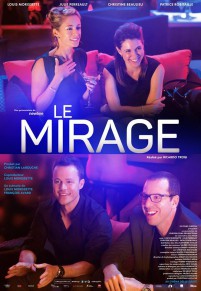
Le Mirage: This one garnered some controversy when it was released in its home province of Quebec earlier this year. It’s about a 30-something man who seems to have it all – a successful business, a beautiful wife, an impressive home, great kids. But things aren’t as swell as they seem and instead of telling his wife about the trouble they’re in, he turns, instead, to her best friend, newly implanted with ginormous tits, the new object of his fantasies. It doesn’t sound all that out there, but there’s … an aggressive kiss. A kiss aggressive enough that some people were calling sexual assault. I’d like to give you my take on it, but the truth is, for first time in Asshole film festival history, we missed a screening. Entirely our own fault. Sean decided last-minute that in fact, he could not come all the way to Whistler and not ski the mountain. But he’d in no way prepared for this, so we scrambled around to rent all the necessaries, and that cut into our movie-going time. I’m sad to have missed it, but not sad that life got in the way. We love movies, but they’re only a portion of our happy lives, not the entirety.
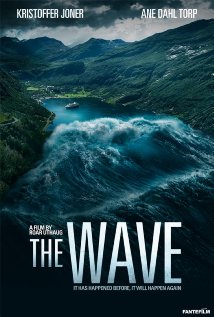
The Wave: This is Norway’s official entry for Oscar consideration in the foreign film category, and it’s Norway’s first disaster movie. The mountain pass of Åkneset is constantly moving and could fall out at any time. This movie imagines that it does, and creates a huge tsunami that’s going to threaten the lives of anyone who gets in its way. Sean and I were very excited to see this one but alas, we were told that there were “technical difficulties” and it would be delayed by at least 90 minutes. People dispersed to kill time alcholically (I’m assuming) but we stuck around long enough to hear that in fact it was cancelled altogether and so we parlayed our useless tickets into another screening.
Gaspar Noe’s Love: What better way to end the day than with graphic, unsimulated sex. That’s right: it’s not porn, it’s not acting, it’s just sex, up on the big screen (and possibly in 3D, if you’re lucky – just watch out for that money shot!). Murphy is an American studying film in Paris who hooks up with unstable,erotic Electra. Their sex life is turbo-charged, and then one day they get the very good idea to invite their pretty neighbour to join them, because why not? So yeah. If you thought our day was jam-packed with sex and nudity already, let me tell you, that was only a little light over the clothing petting compared to this. Two and a half hours of graphic, penetrating, relentless sex. You don’t even realize how unsexy sex is until there’s such an onslaught of it: every inch of Murphy’s constantly turgid penis, the sloppy wet noises of fervid humping, the moans of ecstacy, the sighs of agony (or were those just mine?), the slapping of balls, the scrunched up orgasmic faces, the curled toes, the semen. Oh, the semen. There is literally a cum shot that will make you flinch as it spurts toward your eye. No detail is spared when it comes to Murphy’s cock, but only dark, hairy triangles of mystery where the women are concerned – and why is that? You haven’t seen this much hair on a woman since 1974 so I can only assume its point was to obscure. And while we clearly see every last bit of Murphy’s erection as he plunges balls-deep into one woman or another, we never get a single glimpse of anything pink and glistening while he eats her out, or fucks her with his thumb. The vulva is a beautiful flower but apparently not worth showing. So I hated this movie for its singularly male experience, but since I hated this movie for many reasons besides, it seems unfair to dwell on this one thing. But since my laptop reminds me that it’s 4:06am back home, I might save those other reasons for another day. We have to attempt some sparse sex acts of our own now before dreaming in 3D.
I haven’t been this shaken up by a movie in a long time.
Lucas works in a daycare. He is accused of touching one of the little girls in his care.
He says she’s lying. She can’t quite remember the details. Soon, though, the whole class is recounting the same story. They’ve all been touched inappropriately. They can all describe his basement, his couch and tables and rugs, in fine detail. But Lucas doesn’t have a basement.
The thing is, we know the little girl is lying, right from the start. She’s just a kid and I felt no real ill-will toward her. She even tries to recant, but the problem is, her parents and teachers are already caught up in the persecution of a pedophile. His best friends, his girlfriend, his ex-wife – everyone is prepared to believe the worst. Gossip gets out of hand in this small Danish community in about 10 seconds flat. He loses his job, gets arrested, custody of his son is revoked. His whole life is turned upside down. The town is vehement about his guilt, and if the law won’t prosecute them, they will.
It’s absolutely awful to see this man wrongly convicted of the absolute worst thing you can accuse someone of. It’s fucking brutal. But I couldn’t quite hate the parents as much as I wanted. They aren’t really villains; they’re protecting their children. There’s some mishandling along the way, but of course there is. We are talking about very small children, and of course things will get heated when we believe the worst has happened. This movie gave me such a heavy heart that I needed there to be a villain, but I think even Lucas struggled to entirely blame his tormenters – after all, he too is a father. The Hunt (English Subtitled) is very skillfully assembled, and all the more disturbing because it feels entirely too possible.
But what happens to Lucas? Even if he’s proven innocent, even if all the kids recant, even if all the parents are convinced…can his life ever recover?
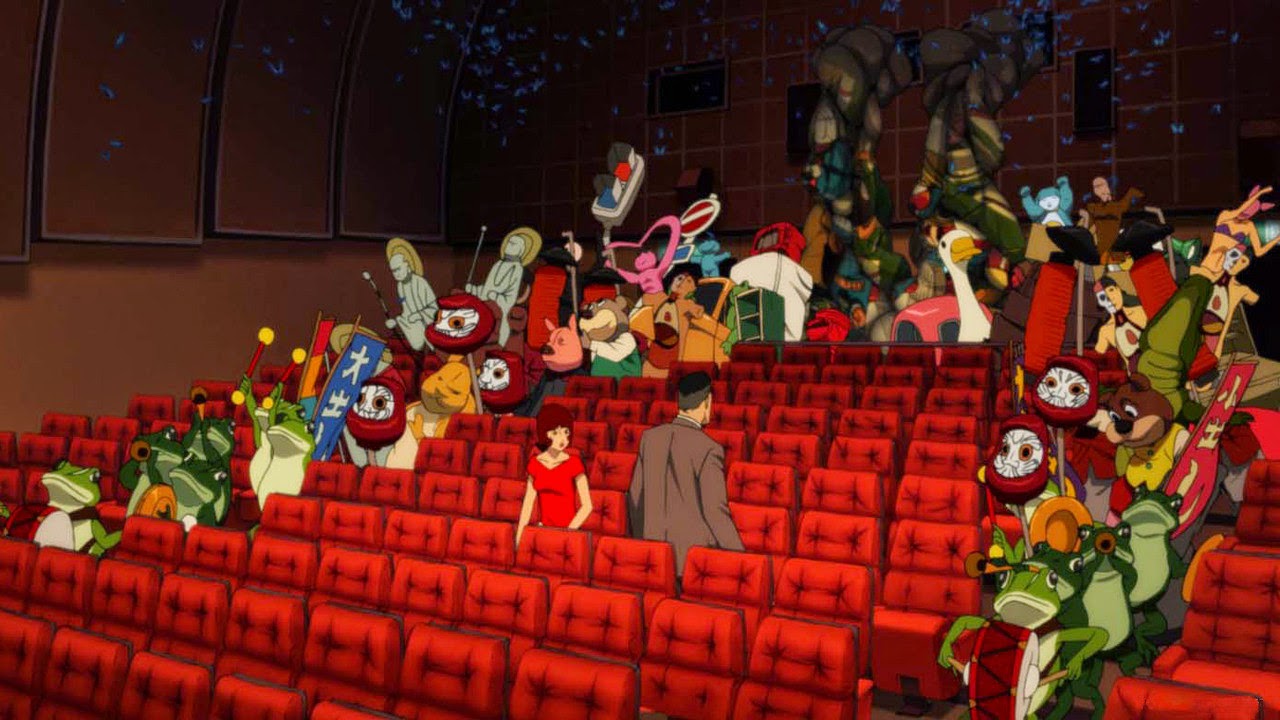
In the near future, a device called the DC mini will allow a new kind of psychotherapy, whereby a person wearing the device during sleep will allow his or her therapist to view their dreams. The DC minis aren’t quite ready yet, but Dr. Chiba is already using them outside the facility to help her patients, like Detective Konakawa, who has recurring nightmares, by assuming her alter-ego Paprika in the dream world, and guiding him through the source of his anxiety.
Despite secrecy, the lab is broken into, and the DC minis fall into the wrong hands. Still in their early stages of development, the devices lack access restrictions, so when they’re stolen, they allow anyone to enter anyone else’s dreams. Soon the scientists at the lab seem to be falling prey to dream invasions – bad dreams being implanted by the thieves of the device – which have real-world consequences.
As dreams and real life start to merge, does the film get confusing? You betcha: kind of like the best dreams do. It’s surreal, of course, fresh and fantastic, but trippy, and rife with the problems of translated-from-Japanese dialogue. You might get a brain bleed trying to make sense of this movie, which I suspect is meant to be experienced more than understood anyway. If it sounds a little like Inception, you’re not wrong. Christopher Nolan was influenced by Paprika, but while Satoshi Kon’s film is able to play with the fluidity between dreams and reality more recklessly, Nolan’s film irons out the incongruities and presents something a little easier to follow and swallow.
Satoshi Kon is not just a film maker, but a film lover as well, and he uses the dream sequences in Paprika, now watchable and movie-like, as an homage to his own favourite films. There’s a parrallel between dreams, movies, and how we use both to construct narrative in our own lives. The imagery is truly like nothing you’ve seen before, and paired with a very unique soundtrack, it lifts you out of, and beyond, the usual movie going experience.
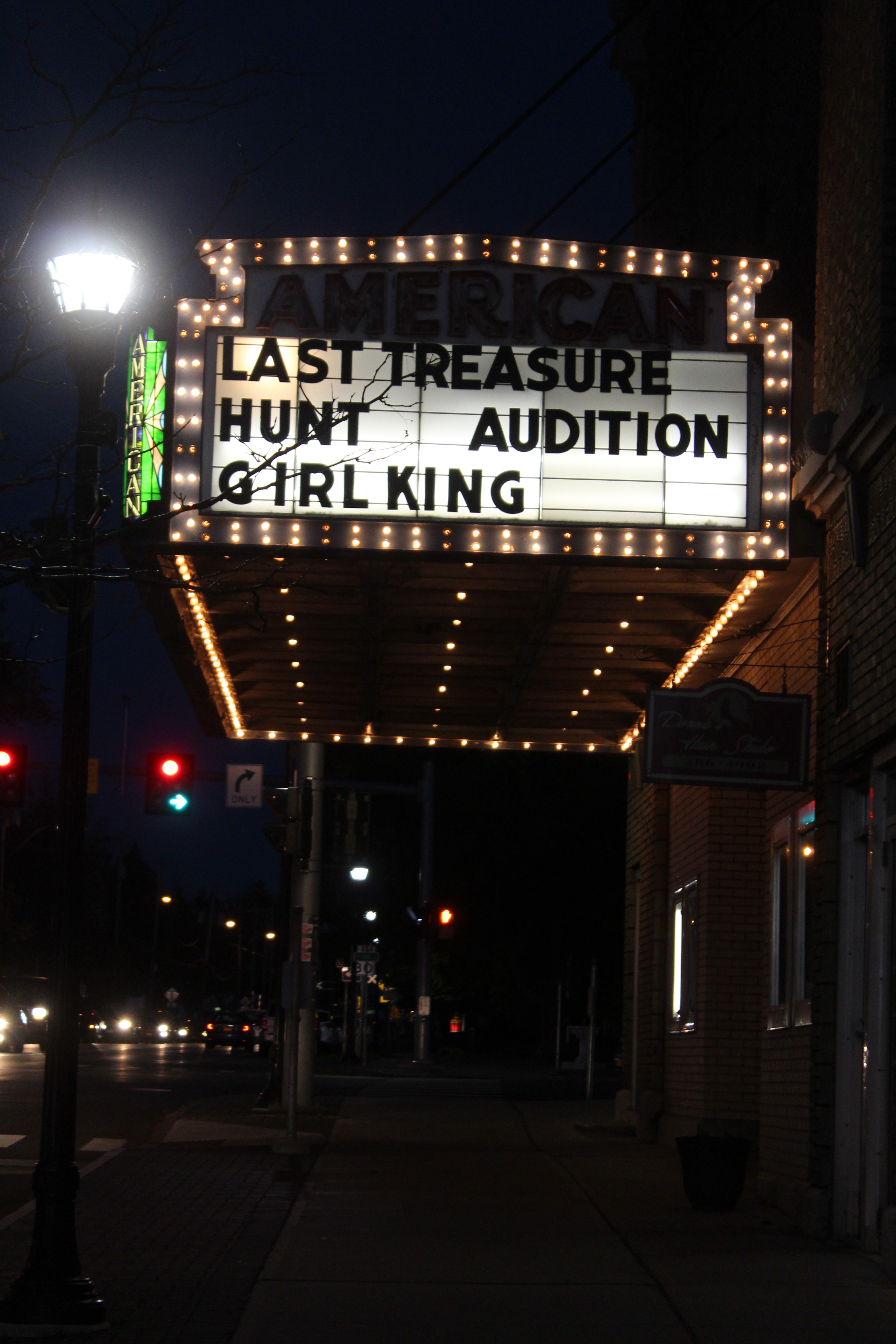
The St. Lawrence International Film Festival is nothing if not ambitious. It’s hosting movies in four different cities this weekend, in two different countries: Ottawa and Brockville in Ontario, Canada, and Canton and Potsdam in New York state, USA. This is its inaugural run and it has not been without wrinkles. The website and handbook tend to disagree an awful lot. On Friday night we took in a movie that was slated to run until 9:06pm, according to the internet, which meant that a second movie at 9pm was a no-go. The program told a different story and indeed we were out by 8:40 and could have made the other film. We saw another instead. The next day the internet had us at Snell Theatre at SUNY college when in fact the movie was in another auditorium altogether. We discovered this mistake before it was fatal, but the run-time was again amiss (and it didn’t help that they started late) so we missed our next movie. When you’re asking people to travel to different countries, which in fact we had, it’s a long way to go to be disappointed. Fortunately, this festival has been a lot more than just its mistakes. We already told you about the fabulous opening night gala with Dan Aykroyd at Gatineau’s beautiful Canadian Museum of History. where we screened an anniversary edition of Blues Brothers but guess what – we actually saw some movies that are not older me!
At the American Theater Canton, NY:
The Girl King: tells the incredible (true) story of Kristina, Queen of Sweden since age 6 (roughly 17th century, I believe), who fought against the conservative values and religion of the time to modernize her country, to make it a mecca of wisdom and curiosity. And she also happened to be a lesbian, which would have been frowned upon anyway, but when your first job in life is to produce a royal heir, it’s a crazy scandal. Malin Buska is stunning and gives a great blank stare (and also, she’s like 78% legs, so when she gallops about it’s kind of a thing to see) but she’s most dynamic when lady-in-waiting cum royal-bed-companion (Sarah Gadon) shares her screen. At times the film is quite lush and there are certainly lots of costumes fit for a queen, but the film betrays its limitations; there’s a low-budget filter over the thing, and the production values just aren’t there, especially considering it’s a period piece. But it’s a pretty great story with an interesting philosophical bent, and it’s refreshing to see a historical female figure for once.
The Break-In: about a couple going through a rough patch in their marriage who seem to bond anew over a shared trauma when they accidentally murder an intruder. The film starts with the break-in and subsequent concealment of a dead body in their freezer, and then unravels backward in time to let us know how exactly we ended up at this awkward point in time. Even though you know about the murder in advance, this movie still managed to keep me on tenterhooks almost the entire time. The director has these agonizingly long shots that keep us watching beyond what’s comfortable. We feel the tension; we become complicit in it. Betrayal and failure waft throughout this thoughtfully quiet film, leaving lots of room for the morality of the thing to seep into our bones. It’s interestingly ambiguous, with neither a true villain nor hero, and guarantees a lively discussion during the car ride home. Director Marcus Ovnell and leading lady Jenny Lampa, who gave a restrained but strong performance as the disconnected and discontented wife, were both on hand at the screening, and Ovnell said of casting both his wife and Lukas Loughran, that you hire great actors and “hopefully they do something interesting.” And I believe that in this small and humble way, they have.
At the Proscenium Theater, SUNY Potsdam, NY
The Hunting Ground: an intensely riveting documentary from the people behind The Invisible War spotlighting the troubling epidemic of rape on college campuses across the country. Unflinching in its approach, it bravely puts a face (in fact, many faces) to the overwhelming statistics: nearly 1 in 4 female college students will be sexually assaulted during their studies. 1 in 4. Think about that. Do you have a daughter going off to school soon? Is that a number you can live with? It’s a tough one to swallow, so the schools are all complicit in massive cover ups to massage those numbers down. They revictimize the victims by discouraging reporting of any kind. If a woman cannot be intimidated into dropping the charges, the schools hold disciplinary committees that are a joke – out of the 259 reported rapes at Stanford during the past couple of years, only 1 of the rapists was expelled. So now your daughter has not only been raped, she’s forced to attend class with her rapist, eat meals with him, see him on campus, maybe even share a dorm. And she’s likely receiving death threats from her fellow students, especially if she’s accused a BMOC. The big men on campus, namely fraternity brothers and student athletes, are completely insulated from consequences by the universities because the schools’ main priority is not student safety but fundraising. And scandal doesn’t pay. So rapes are constantly swept under the rug, women feel violated by administrators who won’t support them, and not a single thing is being done to remove predatory repeat offenders from campuses that provide them a steady stream of young, ripe victims. The film’s scope is quite impressive and paints the villain as not just institutional but societal. It’s high-impact and unapologetic and I hope it gets an Oscar nomination not only because it’s very effective film making, but because this cause needs to get as many eyeballs on it as possible. Executive producer Sarah Johnson was on hand to tell us that it is the activism and the outreach behind the film that is most important to her – check out the website to find out what campuses are screening it now, and how to get a screening at yours.
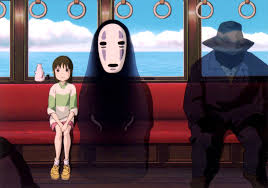
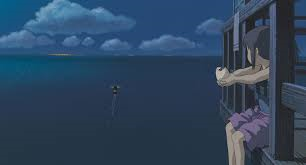
I don’t know if I need to turn in my Asshole card for saying this but I’m not into Japanese animation. To be fair, I don’t know much about it. All I know is that Howl’s Moving Castle didn’t do it for me and neither did Ponyo, even though I know they should. Part of the problem, as Jay pointed out, is the rock and hard place in which we’re caught between reading subtitles or enduring bad dubbing. Recently though, I was on a date with someone who said that I absolutely had to see Spirited Away and next time- in the event of an uncomfortable silence- it would be nice to have “So, I finally saw Spiritied Away…” in my back pocket.
I was a little discouraged to discover (shows how little I know about the wonderful world of Japanese animation) that both of the above-mentioned films I had so little interest in were from the same master of the medium (Hayao Miyazaki) as Spirited Away. Not a great sign that this was going to be the movie that finally turned me on to anime.
Even though most who have seen it tend to regard it as a modern masterpiece, I was still surprised how much I enjoyed it. I chose to watch the dubbed version, which being supervised by Pixar’s John Lasseter wasn’t nearly as distracting as usual. I made the right choice, partly because the English-language script was specifically written to match the lip movements on screen and was supported by well-cast voice actors. Mostly though, the images are often so bizarre, so imaginative, so exquisite that I would have hated focusing my attention to just the bottom of the screen even more than I susually would.
The plot centers around a bathhouse where dirty spirits can come to relax and the cast of characters include talking forgs, giant babies, stink spirits, and dragons. What drives it though is one human child’s journey into the unkown as she confronts her many fears to save her parents who are stuck in the spirit world. It’s like Finding Nemo in reverse set in a brothel.
Oh yeah, the brothel. Apparently Miyazaki saw Spirited Away as his commentary on prostitution in Japan. Even at a glance, the parallels are hard to miss but, after reading up on it, the metaphor is even clearer. I’m still not as enthusiastic as I am about movies like Wall-E or Up but it’s nice to see an anime film for once where I can understand what all the fuss is about.
Apparently I’m a bit of a masochist this week – after watching a bunch of foreign movies, I’m watching a few more, including the last Oscar-nominated animated movie on my list, The Tale of the Princess Kaguya, because why watch any old cartoon when you can watch one that’ll make you work hard reading subtitles?
And if you’re thinking that a subtitled cartoon doesn’t sound like much fun, then let tell you about the animation, which is very minimalistic and quite drab, and the story, which is goddamned depressing.
Okay, the truth is, it is quite beautiful. Yes, the lines are simple, hand-drawn, but it is quite lovely. And the colours might more optimistic be described as soft, like water colours. It certainly makes for a stark contrast from the Pixar fare we’re more accustomed to, which doesn’t make it bad, just different – and for me, less engrossing.
The tale is this: an old man, a bamboo cutter, finds a tiny person in a bamboo shoot. He brings her home and when he and his wife decide to raise her, she changes into a baby, but one who grows rapidly. The old man is convinced she is a beautiful princess, so when he finds gold in the bamboo patch, he moves his family into the city and buys her a title, along with everything else that money can buy. The princess is unhappy. She preferred her simple life back home. She’s saddled with a tutor who teaches strict lessons in civility and the etiquette of nobility, while the princess just wants to laugh and play.
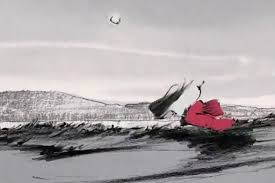
The most interesting scene for me was when the princess decides to run away from a fancy party where she’s meeting suitors – the animation goes to black and white, with a shot of red that really speaks to her fleeing. It was so much stronger a visual than anything that had come before it that it was arresting, and kind of woke me up out of the stupor that I’d been in.
I was watching, as I said, the original Japanese version, with English subtitles, but there does exist a dubbed version James Caan, Mary Steenburgen, Chloe Grace Moretz, Lucy Liu and Darren Criss provide the voice work, and I wondered if maybe that would make it more approachable and help me to get lost in the story. I normally find dubbing to be unforgivably distracting but about half way through the movie I switched over and, well, yeah – lots of white voices behind traditional Japanese characters? Not working. Either way, it felt very abrupt and cold. And if there were times I felt I was picking up on some social satire despite the fact that this is a retelling of a Japanese piece of folklore many centuries old, I still failed to connect with a message in any meaningful way. The translation is so stiff and awkward it earned chuckles from me it never asked for.
The Tale of the Princess Kaguya has a 100% rating on Rotten Tomatoes. Those are some FRESH tomatoes, but me? I thought it was ketchup. Generic ketchup. Sundried, generic ketchup. I promised myself on a previous review not to feel guilty anymore when I disagree with the critics’ consensus. Where others saw beauty, I felt mostly boredom. And with the exception of a beautiful scene under cherry blossoms, I never felt done right by this movie.




 is very skillfully assembled, and all the more disturbing because it feels entirely too possible.









 ASSHOLES WATCHING MOVIES