Tag Archives: foreign films

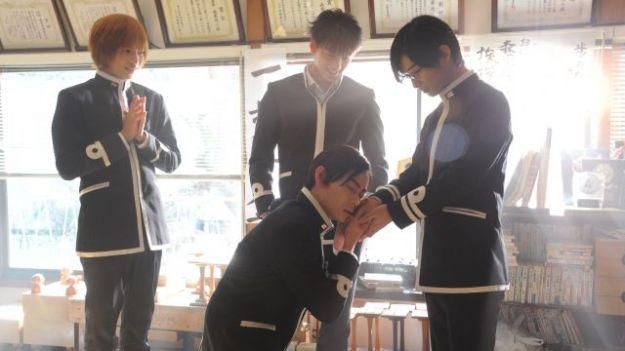
Teiichi: Battle of the Supreme High

teiichi hand

Don’t ask me how this happened but in 2006 I found myself reading an interview with Chris Klein. You all remember Chris Klein, right? He was Oz in the American Pie movies and, according to IMDB, Brad on a 2015 episode of Motive. Well, he was also in one of my favourite films of the 90s and this is the one I found him reminiscing about in this 2006 interview. Klein good-naturedly admitted that he was too young while filming 1999’s Election to really understand what was funny about it.

If you haven’t seen Election, it’s a subtle but hard-hitting satire about an ambitious overachiever’s quest to win her high school election. And the best way that I can describe Teiichi is it’s the Japanese version of Election that the 19 year-old Chris Klein would have loved.
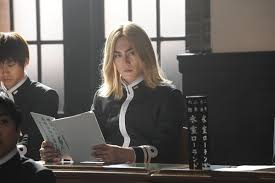
teiichiTeiichi has only one ambition: to become Prime Minister and to build his own empire. Luckily, he’s come to the right place. The prestigious Kaitei College is the place to be for future world leaders and all Tiichi needs to do is be voted in as chairman of the student council and he’ll be well on his way to power and glory. Trouble is, his longtime rival Kikuma wants it just as bad as he does. So the battle for Kaitei College gets pretty intense where everything, including wiretapping, sabotage, nipple pinching, and merciless tickling is fair game.

Teiichi, based on the manga “Teiichi no Kuni”, goes for bigger laughs than Election did and isn’t afraid to go pretty lowbrow to get them. Almost every situation is taken to the wackiest possible extreme and the performers overact in the best way possible. What impressed me most was the impeccable comic timing of the physical comedy, which went a long way in helping me forgive all the exaggeration. teiichi drum

Somehow I still couldn’t help feeling sad for Teiichi, his inner circle, and his rivals. There seems to be way too much on the line for such young boys. For Teiichi, losing the student council election would almost literally mean that his life is over. Everything in his young life has been leading up to this one moment and he seems to have no idea what he would do if he were to lose.


In general, I will always prefer the subtlety and bite of Election to the slapstick comedy and mostly heavy-handed satire of Teiichi: Battle of the Supreme High. But somebody needs to be making movies for 19 year-old Chris Klein and Teiichi is extremely entertaining and even a little thought-provoking once you get used to its zany sense of humour.


Free and Easy

To be honest, it took me a while to adapt to the pace of this movie. It is slow, deliberate, and very measured. There’s no getting ahead of yourself. But the unusual story and glimmers of humour hooked me and I was glad I stuck it out. Free and Easy is genuinely something that feels new and unique.

It’s about a “soap salesman” who never sells a single bar but does encourage people to sniff his product (“a different scent on all 4 sides!”) because doing so induces loss of consciousness. Once his would-be customers are asleep on the ground, he frisks them for money and valuables. So he’s really a thief, posing as a salesman.

1_22_free-and-easy1-676x450Director Geng Jun shows us a side of China rarely seen: crumbling, bleak, all but abandoned. This cold, deserted, post-industrial town in northeastern China is dotted with rural characters, and they’re all as shady as the salesman.

It almost watches like loosely connected vignettes, a series of petty crimes where corruption and lawlessness is the new normal. But whenever these criminals encounter each other, you can’t help but laugh. The humour is deadpan but it landed surprisingly well for a movie that runs the risk of being lost in translation. There’s some slap stick, which I suppose is universal, but really it’s just the contrast between this totally depressing setting and the buffoons that populate it that just works.

The film is minimalist but that doesn’t mean there isn’t a lot of attention to detail poured into each shot. Out-of-focus details often sharpen into the butt of the joke. You have to stay alert to small gifts planted by the director along the way. Sure the subtext of the film is a little depressing, but it’s delivered in such an obliquely funny way, the message presented by sliding it in sideways, that you’ll laugh appreciatively at things that aren’t even overtly funny. In a film full of grifters, it’s the cops who are the dirtiest  of them all. That’s the lens through which contemporary, provincial China is explored in (ironically titled) Free and Easy, and the film stays remarkably on-brand.

Museum

Detective Hisashi Sawamura (Shun Oguri) of the Tokyo Metropolitan Police is having a rough go. He’s tired. His overworking, long a point of contention in his marriage, has finally culminating in his wife and young son leaving him. And now he’s got a serial killer on his hands.

A few things about this serial killer, because he’s unlike anything you’ve seen in film GAGA_C&C_A4_frontbefore, and yet draws from many familiar sources. The serial killer only works in the rain. He plans elaborate, gruesome kills that seem to be some sort of punishment to his victims. And – how do I put this – he also appears to be a man with a frog head. There. I said it. Moving on…technically, the source material here is the manga, Museum: The Serial Killer Is Laughing In The Rain. But you’ll find the movie remind you of Seven, Saw, and maybe even Oldboy. I can’t say that Museum is that caliber of film, but it’s plenty bloody.

The first half works much better than the second does. Once the serial killer is “unmasked,” for lack of a better word, a lot of the fun and the sizzle leeched out of the movie for me.  I worried that the frog head would seem cartoonish and silly but I did find it rather sinister and regretted it when we lost it. Some of the acting, though, veered toward cartoonish, and that’s particularly hard on North American audiences who are more used to subtlety.

Still, the Assholes managed to enjoy this one, more or less. It has a frenetic energy to it thanks to manic editing. And if you just give in to the weirdness, the slight foreignness, it’s a little fun to watch the whole thing go down. Montreal’s Fantasia Film Festival focuses on “genre” selections, which means you always get something special. We get exposed to titles we’d otherwise struggle to find, and it’s honestly a lot of fun to be pushed out of our comfort zone once in a while.

A Man Called Ove

There is indeed a man called Ove. He is a crotchety old man who rules his condo tenement with fierce rigidity. He’s aged out of his job and his wife has left him (well, died, but he’s such a grump I can only assume it was purposely, to escape him). I shouldn’t joke; his wife’s grave is the only time and place where he’s a little tender. Does he list her a litany of complaints? Of course he does. But only because the world’s gone to MV5BNTgzNDcxYzEtZDljOC00NDZmLTk2ZTAtOTVhM2Y1MWI1YzUyXkEyXkFqcGdeQXVyMDc2NTEzMw@@._V1_SY1000_CR0,0,1581,1000_AL_shit without her. The only reason he hasn’t committed suicide yet is the damn neighbours, who need constant monitoring and discipline, and who else would take it upon themselves to mete it out?
It turns out that Ove has had a pretty interesting life. It’s just that no one knows it because he isolates himself, sequestered in a condo that’s still a shrine to his dead wife. It’s only because some boisterous, needy new neighbors draw him out against his will that we learn the ups and downs that have contributed to his current thorny state. If you’re feeling like this sounds a little sentimental, well, it is. But it stays just shy of saccharine thanks to a nuanced performance by Rolf Lassgård in the title role. He never lets Ove go full-martyr, he keeps the role alive and flawed and beautiful. Ove’s may not exactly be a unique character arc, but it’s charmingly irresistible in Lassgård’s hands.

The film is a little predictable but so sweetly executed that I’m finding it hard to fault it. It’s surprisingly funny at times, mixing genres fairly deftly, making for a lovely, bittersweet, and humane character study that’s a pleasure to watch.

My Life As A Zucchini

Zucchini goes to live in an orphanage after his alcoholic mother dies. The orphanage is not a bad place. This is not a bad-orphanage movie. It’s about the broken children who live inside. The kids are there for many reasons (deportation, mental health, abuse, poverty, etc); some can dream of one day returning home, while others know they never will. For the most part the children band together and support one another as they cope with loss.

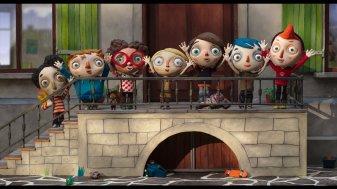
MV5BMGU1ZDI5Y2ItOTY2OS00ZjBiLThkYzEtZDIxOTA4NmVmMjE3XkEyXkFqcGdeQXVyMjUyOTI5MQ@@._V1_SX1777_CR0,0,1777,999_AL_My Life As A Zucchini is stop-motion animated in a very compelling way. It’s a simple story with colourful characters and a strange title but make no mistake, there’s little silliness awaiting you. It’s a pretty bleak story.

I watched the version dubbed in English, which features voice work by Nick Offerman, Will Forte, Ellen Page, and Amy Sedaris. But even with all this wonderful adult interference, director Claude Barras keeps the story firmly within Zucchini’s corner. The story is told through the eyes of children, almost without taint from the adult world. It is heartbreaking but also tender and compassionate. By focusing on the resilience of children and the difference even one caring person can make, hope shines its rays even on this dark little tale.

I enjoyed this very much. It’s not as heavy on the heart as it sounds, and Barras manages to wrap things up in under 70 minutes. I’m always a fan of the loving work that goes into stop-motion and this one is no exception – perhaps it is exceptional. The expressive characters and honest story give My Life As A Zucchini a sensitivity, like a spoonful of sugar to help the medicine go down. I’m very taken by this and am heartened to see animation tackling such complex characters so deftly. Definitely worth a watch, tissues at the ready.

Train to Busan

Seok-Woo (Yoo Gong) is a busy hedge fund manager who thinks mainly of himself, and his success. He’s pushed away his wife, who has left him, and he’s letting his mother raise his young daughter, Soo-an (Soo-an Kim). When a Wii fails to impress Soo-an for her birthday, Seok-Woo reluctantly agrees to take her on a trip to visit her mother. They board a trail from Seoul to Busan, and their timing is impeccable (although, to be honest, I’m still not 100% if it was impeccably good or impeccably bad. You decide). Just as their train is pulling away, a very fast-spreading zombie infection overtakes the station. Has the train gotten away cleanly? Well, no, not entirely.

Like Snowpiercer and Murder on the Orient Express, the train setting gives a unique twist on the genre in question, in this case, the good old zombie movie. A train, as you MV5BMGUyZDQ2NzEtZDIwMi00ZTA4LWEyM2EtNTIyZDdlZjBmNmY3XkEyXkFqcGdeQXVyNjEwNTM2Mzc@._V1_SY1000_CR0,0,1494,1000_AL_know, is basically a big metal tube and while it’s travelling, you’re all but locked inside. There’s no where to go. All the players, good and bad, and all the answers, good and bad, must be found within the train.

Seok-Woo is intent on protecting his daughter. It’s sad that it takes an apocalypse for this father to finally dedicate time for his daughter, but there it is. For better or worse, their fates become intertwined with those of the people in their compartment: a pregnant woman and her aggressive husband, a couple of elderly women, a vagrant, a high school baseball team, an arrogant businessman.

Director Sang-ho Yeon makes brilliant use of the cramped quarters. The action sequences are taut. He’s less confident about the wobbly social commentary he sometimes wants to make, and the zombies’ abilities do waver a little bit depending on what will service the plot, but it’s never very long before another burst of action is upon us. The characters have actual personalities; some you’ll root for, some you’ll cheer for when they get eaten.  Sure dad’s character arc is a little predictable, but when’s the last horror movie that even bothered with one? Train to Busan is a little overlong but very watchable, even for a chickenshit like me. Zombie outbreaks tend to bring out the worst in us but Yeon reminds us that we’re still capable of compassion and sacrifice as well. He elevates the film from its generic genre; though its roots are still evident, this film is as fresh and unique as it filled with spilled brains.

Devil’s Bride

A new judge arrives in the small village of Åland, Finland to modernize it. The villagers are a superstitious people. They cast spells for love, search dreams for omens, use herbs to induce abortions when the priest rapes them, seek revenge through the evil eye, and ask the local beggar woman to “divine” the perpetrator of crimes. Judge Nils (Magnus Krepper) believes in higher things: judicial evidence, unbiased law, proper trials. But also, you know, witches. When his mother gets sick, someone must be blamed. And of maxresdefaultcourse his new and improved judicial system could use a steady stream of accused. Why not a good old-fashioned witch hunt (although to be fair, in 1600, it was simply just “the fashion”)?

Nils’ mother has a charming 16 year old chambermaid named Anna (Tuulia Eloranta) who’s in love with a married man. 16 year old girls who are in love for the first time are kind of jerks, but she’s at least kind and patient her charge. But she’s not oblivious when the mother’s stroke is blamed on the local healer, who is then banished as a result. Sure that’s kind of tragic, but Anna can see the benefits. After all, her lover does have a pesky wife, and it now seems that a few easy accusations do a pretty good job of getting rid of someone. And that is how a witch hunt starts.

Devil’s Bride is very atmospheric, playing up the tension and paranoia that ruled the day. Based on real historical events in Finland in the 1600s, the witch hunt snowballs as they always do, not just because of jealous young girls, but because of the church’s tacit encouragement. The film probably would have benefited from choosing either love triangle or witch drama. Instead if lets the two themes fight each other, and that weakens the overall effect. There’s not exactly a lot of new things to add to the witch hunt genre, but it’s fun enough to see Finnish pilgrim hats.


Tunnel

On his way to his young daughter’s birthday party, a man becomes trapped in his car as a tunnel collapses around him. There’s no telling when or if help with arrive, and all he’s got are 2 bottles of water and a birthday cake to see him through. His wife finds out in the worst way imaginable and the Korean news is pretty ruthless in reporting the failure of a newly-built piece of infrastructure. The damage is so encompassing that the rescue will be a long-term affair and there’s no guarantee that a little water and cake will be enough to keep him alive until help arrives. Of course, that’s not even considering whether the panic and isolation might get him first – or if the poorly and hastily constructed tunnel might further deteriorate.

Jung-soo (Jung-woo Ha) is the man in the tunnel so of course this movie is his. As blunders delay the rescue and the national media loses interest, this poor guy is as alone fullsizephoto731941on this earth as anyone will ever be. He isn’t just going through a physical hardship, but a psychological one as well. Occasional glimpses of the rescue effort reminds us just how bleak his situation really is. Dae-kyoung (Dal-su Oh) is the only member of the rescue team truly dedicated to Jung-soo’s survival. Politicans are turning their backs and resources are drying up – are being redirected, in fact, to the construction of yet another tunnel. Meanwhile, Jung-soo’s wife, Se-hyun (Doona Bae) treads the fine line between hope and realism. This trio of actors give very fine performances. Tunnel ends up being more character-driven than action movie, and that’s a good thing. When the script demands it, the visual effects are there, but it’s Jung-woo Ha and co-stars who drive the story forward. It’s a story we’ve seen and heard before but writer-director Kim Seong-hun injects this with satirical elements that bring renewed interest to the genre.
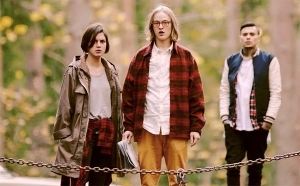
Tunnel is perhaps overlong and could have benefited from some fat-trimming but I still really enjoyed it. It’s got some juicily angry scenes (Kim Seong-hun obviously has something to say about bureaucracy in general and his nation’s government in particular) and some surprisingly dark humour. You might not expect to chuckle through a disaster flick, but this one’s got a little bit of everything.

SXSW: Lake Bodom

True story: in June 1960, four kids (two 15-year-old girls and their 18-year-old boyfriends) went camping. Three of them were found dead, stabbed and bludgeoned to death; the fourth was bloodied and blank, with no recollection of the violent attack. This case has remain unsolved in Finland for nearly 6 decades, but theories have turned into legends, and this film is born of those campfire ashes.

In Lake Bodom, Atte (Santeri Helinheimo Mantyla) is obsessed with lake-bodom-2016-movie-featuredthe murders. He talks his friend Elias (Mikael Gabriel) into helping him recreate them, hoping to solve them once and for all, but Elias is in it for the sex, not so much the solving. They coax along two best friends who think they’re going on a very different trip – Ida (Nelly Hirst-Gee) is happy to escape her oppressively-religious home life, and Nora (Mimosa Willamo) is just happy to spend time with Ida.

Since this is a horror movie, you know what’s coming next: this isn’t just a recreation. Shit goes down! But Lake Bodom isn’t quite as predictable or straight-up as that. There’s a series of twists that defy expectation, melding several horror tropes into a single film, keeping you guessing and interested and creeped the fuck out. This film looks better than any horror film has to. Some of the shots are full-stop beautiful, which only adds to the ambiance. Atmospheric and well-paced, Lake Bodom provides thrills and anxiety in equal measure, earning every drop of blood splashed across the screen.

Lake Bodom has a relatively low body count, but if you’re in it for the gore, no worries: it makes each one count. In detail. Graphic, brutal detail. Fans of horror who are tired of the same old thing are going to love this. Well, love and hate this. It really is quite scary and maybe not as “fun” as a traditional slasher flick – there’s real meat here, if you can stomach it.

Lake Bodom will be released exclusively on Shudder May 2017.


Oscar Spotlight: Live-Action Shorts

My favourite thing about sitting down to watch a short film is having no idea what to expect. I rarely watch a feature film without having seen a trailer or at least having read something about it. When I watch a collection of shorts, I am pretty much ready for anything.


mindenki_behindthecurtainMindenki (Sing). Everyone who wants to is welcome to sing in choir, promises the principal at Zsófi’s new school. The truth, she will soon discover, is more complicated. Zsófi is an enthusiastic student until her spirit is crushed when Miss Erika, who thinks they may have a real shot at the championship this year, takes her aside and asks her to stop singing out loud.

Mindenki has a lot going on in just 25 minutes. Watching a 10 or 11 year-old being told by her favourite teacher that she simply isn’t good enough and that she should just “mouth the words” while the others sing is pretty much as heartbreaking as it sounds. It says a lot about the ways some students can get left behind and the ways that a careless teacher can demoralize a child and stifle creativity.

silent-nightsLikeable actors, terrific editing, and a timely story go a long way in elevating the imperfect but nonetheless effective Silent Nights. Mostly a love story set against the backdrop of the immigration and refugee controversy in Western Europe, Silent Nights follows a brief affair between a Danish girl volunteering in a shelter and a homeless man from Ghana.

Silent Nights packs a lot of story into 30 minutes and it features a much clearer beginning, middle, and end than I’m used to seeing in short films. It’s actually structured like a min feature film complete with subplots that lead nowhere. The script is ocassionally a little too sentimental but it earns big points for introducing us to two complex characters that we can care about.


With just 15 minutes, Timecode is the shortest of the five nominated shorts. It’s also potentially the most confusing. Luna is a parking lot attendant who discovers that her colleague Diego has left a surpritimecodese for her. He has danced his heart out in front of the security cameras for her amusement. I have to admit though that it took me awhile to recognize it as dancing. I thought at first that he was fighting off an invisible assailant. So begins their unusual shift exchange ritual.

Timecode has already picked up several awards including the Palmes d’Or at Cannes and more importantly Best International Shortfilm at the Whistler Film Festival so its got a serious shot at the Oscar. It’s cute, well-made (even if not always well-danced but hey we forgave La La Land), and is probably the least pretentious of the five nominees. I just simply didn’t enjoy it as much as I enjoyed the others.


Ennemis Interieurs (Enemies Within)
is the more disciplined of the two Europeans Can Be Racist shorts (see Silent Nights above). Enemies Within is mostly just two people in a room talking but holy shit is itennemis-interieurs3 tense. A citizenship interview slowly morphs into a full-on national security interrogation.
Ennemis Interieurs can sort of feel like just a really good scene from the glory days of Homeland but the acting and directing are superb and it says a lot in a short time about institutional racism and self-fulfilling prophecies.


La Femme et le TGV
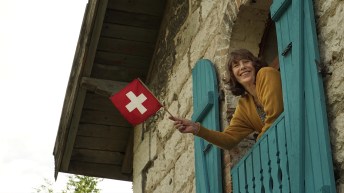
is my favourite of the five. And not just because it has trains. An aging woman discovers that her daily ritual of waving at passing trains hasn’t gotten unnoticed or unappreciated. The train’s conductor decides to write her a thank you note and their pen palling reignites her passion for litgvfe.

I’ve read one reviewer accuse La Femme et le TGV of stealing its tone from Amelie. While I agree that Amelie would give you a pretty good idea of what you can expect, I would argue that my favourite live-action short of 2016 takes some of what worked best from Amelie to deliver something funny, touching, and lovely.