
Pixar doesn’t have many missteps in its catalogue, but for me, the Cars franchise just never had any traction. I was only just recently able to watch the films straight through, and it made me want to put the Pixar crew on suicide watch. Thanks to films like Toy Story, I already knew Pixar had a real nostalgia fixation, but Cars crystallizes that notion.  The Pixar animators are living for the past. But for the first time, I could also watch the film through the eyes of my 5 year old nephew. He and his younger brother adore the franchise. They have every iteration of every car that got even a fraction of a second’s worth of screen time. Last year for his birthday, I made him a Cars racetrack cake. So even before I’d truly seen the film, I had a kinship with it.
In this third installment, Lightning McQueen (voiced by Owen Wilson) hits the racing circuit once again, but it’s been 11 years since the first film made its debut. McQueen isn’t the hot shot rookie anymore, he’s a veteran being challenged by faster, sleeker next generation race cars. Jackson Storm (Armie Hammer) is the fiercest of these new competitors, but McQueen isn’t ready to be counted out. Unfortunately, McQueen’s best efforts result in a terrible crash that many believe spells his retirement. You may remember from the first film that his old friend Doc (Paul Newman) suffered a similar fate: by the time he’d healed up\gotten road-worthy again, the racing world had moved on without him, ultimately forcing him into retirement before he was ready.
Two things about what I’ve just written: One, that crash was spectacularly animated. Disney-Pixar’s animation technology has clearly improved by leaps and bounds over the past decade. They work hard to keep the cars we know and love looking like themselves 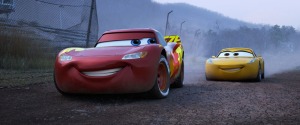 while still improving the overall quality of the animation. The crash scene is a show-stopper. But, second, so too are flash-back scenes of McQueen and his friend Doc, in a different, more emotional way. Paul Newman, who voiced him, passed away in 2008, and so did the character by the time the sequel came out. But Doc was a formative figure in McQueen’s career, and Cars 3 pays tribute to both the character and the actor in a very satisfying way.
Cars 3 focuses on McQueen’s relationship with a new trainer, Cruz Ramirez (Cristela Alonzo), who is well-versed in all the newest techniques. Old school clashes with new school. In fact, watching it, I wondered if McQueen’s mid-life crisis would resonate with the kids watching it. My nephew certainly enjoyed it, though I don’t think he picked up on McQueen’s fear of being aged out\replaced. What he did like were the repetitive race track scenes, many of which I could have done without. I guess what it boils down to is: Cars 3 panders to its audience. It does not reach the heights we adults have come to expect from Pixar’s best work, but it’s exceptionally talented at marketing toys to children. There are dozens of new characters (65 to be exact) to be bought for Christmas. Is that cynical of me? Sure. Here’s the thing: I admit I was charmed by the ending, glad old McQueen had it in him. If this is the end of the franchise, it’s a pretty noble note to go out on. But as a cynical, toy-buying aunt, I can’t help but feel that this Cruz character has the whiff of spin-off to her, and I’m not convinced that Cars 3 bought into its own message of retiring with dignity.
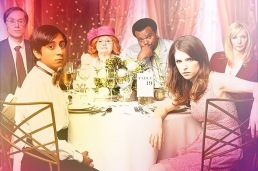 The table 19 crew: Bina & Jerry Kemp (Lisa Kudrow, Craig Robinson) who are diner owners who don’t know the bride or groom personally, and barely know each other anymore; Renzo (Tony Revolori), a young kid who’s mother told him he stood a better chance of picking up at this wedding than at his junior prom; cousin Walter (Stephen Merchant), newly out of prison for having embezzled from the bride’s father; and Nanny Jo (June Squibb) who was basically a retaliation invite.
 out on the last lap and cost him a win. So much of a jerk that when he gets lost in a small town and is pursued for speeding he wrecks the whole main street.
 stery why he is so loved, except that he is definitely the coolest looking racecar in the movies and that’s really all the explanation required, isn’t it?
 war, not men in uniform. Politicians run things but don’t bother to check in with the men on the ground, who are operating on the basis of “counter-insurgency”, a losing proposition each and every time. The soldiers can’t distinguish between the enemy and the people they’re trying to protect. The war is a clusterfuck but so is this lazy attempt at satire.
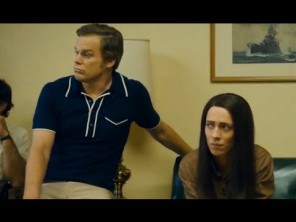 made of the fact that she (played by Rebecca Hall) was 30 and horrified of it, still a boyfriendless, childless virgin. I’m sort of offended on behalf of women everywhere that this is seen by anyone as the reason for her suicide. She was a troubled woman who’d struggled with depression and had left a job and life behind elsewhere in order to ‘rebuild.’ But this new place wasn’t going much better. A year in, she pined for the news anchor (Michael C. Hall) yet pushed him away when he got near. She yearned to do important investigative reporting but the station manager insisted on a “if it bleeds, it leads” policy. She couldn’t get promoted and wasn’t being taken seriously. She lived with her mother, sometimes happily, sometimes not.
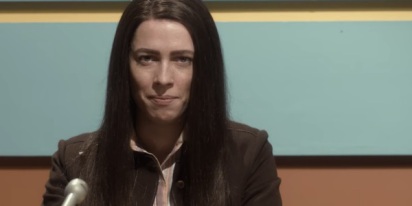 out the former since I’ve always found the circumstance of her death a little fishy. Before she put the gun to her head, she read out a brief statement, basically accusing the station of pushing her to do this drastic, bloody thing. She’d also prepared a statement for a colleague to read out afterward, though none did. In that, she described her actions as a “suicide attempt” and reported that she’d been taken to hospital alive but in serious condition. Had she not planned or wanted her suicide to be “successful”? We’ll never know.
 Their love story unfolds slowly, as it must when one person is physically removed from the other. In the novel they communicate by text or instant messaging. To make that play a little less boring on screen, director Stella Meghie imagines them within the architectural models that Maddy’s always working on. It’s a device that works while still reminding us that these conversations don’t actually take place in a face-to-face reality. Still, it’s a talk-heavy, plot-light movie that doesn’t move around too much. If you aren’t swooning over Olly’s too-long-locks, you’re probably going to find this long.
 things. Amandla Stenberg is very charming as Maddy, the brave, beautiful, but socially awkward girl next door trapped in a glass castle. She succumbs to the kind of romantic gestures no teenage boy would be caught doing and only a young-adult novelist could dream up. There’s some major eye-rolling to be had in this movie, and it starts rather early, when Olly first appears in his driveway, tossing his luscious locks in the unfiltered sunlight, shooting his pretty neighbour a cocksure grin while showing off on his skateboard. I was so sure he was about to eat it, and truthfully hoping he would, that it set a really weird tone to the movie for me. I guess my lusty teenage days are too far behind me. Your enjoyment of this movie will depend on the calculation between yourself and your own misspent youth.
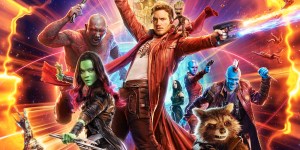 I have avoided writing this review since Thursday. Guardians of the Galaxy Vol. 2 left me entirely uninspired. Was it the mediocre 70s music? The laughable indestructibility of the heroes and villains that only disappeared when convenient to a plot point? That we have seen this movie before, a thousand times? Or that these heroes, who seemed so fresh the first time around, had nothing new to offer? Whatever the reason, this movie was missing the spark that made the first
 Hannah (Rebecca Hall) has avoided fans and journalists alike but relents for Andrew (a bearded and bespectacled Jason Sudeikis), a brash professor in search of a tenure-assuring topic for his thesis. This reclusive, rarely written about musician fits the bill. And Hannah thinks working with Andrew will bolster her own writing. So they hunker down in a little cabin in the woods and set to work, pretending that their purposes aren’t at odds with each other.
 Roessner watched Platoon for the first time in Saddam Hussein’s commandeered palace in Tikrit and it made him want to really pay attention to what was happening around him – it was film school he was hoping to attend, after all. Now he’s among the first of his generation to write a script about his own war.
 ASSHOLES WATCHING MOVIES