Tag Archives: Half-assed

Films in this category have something to offer but also have one or more flaws that detract from the experience. Still, these movies are probably better than most of the shit on Netflix.

Blind

Alec Baldwin plays Bill, a writer and English professor who lost his sight and his wife in a terrible accident. Demi Moore plays Suzanne, the woman sentenced to read aloud to him. Sentenced in a court of law, by the way, by a judge who finds her guilty by association of the insider trading perpetrated by her husband (Dylan McDermott). Although Bill is cantankerous and spends his first encounter with Suzanne boldly insulting her, the two form a predictable romantic relationship.

But then BAZINGA! – the felonious Dylan McDermott is released from prison on a nasty technicality and Suzanne is faced with the age-old question that beleaguers only the women of a certain set: stay with the man who funds her lifestyle, or leave with the man hero_Blind-2017she actually loves. Oh to be rich and luxuriously useless!

If Blind was a martini, I’d send it back. The verdict: too weak. The writing ranges from bland to cheesy to downright embarrassing. It’s also not strong enough to write a character that we can distinguish from the real-life Alec Baldwin. Neither is Baldwin up to losing himself in a character. Bill’s epic rants are a little too familiar to anyone who has access to the internet, or late night television. But those are the only facets of the character that ring true; Bill’s conflicted, tragic side is limp, unfulfilled. Not to worry, though: in choosing Demi Moore to play opposite, the film has at least assured that no one will show Baldwin up. I’m not sure if Moore was ever capable of any great heights as an actress, but these days playing a wealthy socialite seems beyond her reach, even though I think that’s pretty much who she plays outside of work, all the time. Perhaps her ability to act began to dissipate around the time she lost the ability to move her face. Too many injections later, she can’t communicate anything beyond complete and utter passivity, which is inadequate for a woman wrongly accused, full of contempt, about to embark on a passionate affair after finding out her marriage is built upon lies and infidelity. Demi Moore: blank stare.

When you pair a man who is constantly dialed up to 10 with a woman who can barely achieve a 1.8, it makes for a strange combination. It’s hard to know whether to believe the love story being told in lifeless, monotone words, or the pained expressions on their faces that say otherwise. This melodrama is better suited to the Hallmark channel.

It Had To Be You

It Had To Be You is an interesting gender-role reversal. For once it’s the boyfriend who’s the serious one, ready to make a commitment and put a ring on it, and it’s the girlfriend who is reluctant to do the whole marriage thing. Unfortunately, Sonia (Cristin Milioti) and Chris (Dan Soder) haven’t really talked about their differences, so when he blindsides her with a romantic proposal, he’s pretty hurt when she balks and can’t accept.

She doesn’t exactly say no, but the ‘time to think’ required stretches on into infinity and MV5BNzg0NzE3ODUzOF5BMl5BanBnXkFtZTgwMjY5OTgyMDI@._V1_SY1000_CR0,0,1776,1000_AL_pretty soon Chris is fed up with waiting. In the wake of their inevitable breakup, Sonia is inspired by a fellow subway rider’s thong (no I am not making that up, thankyouverymuch) to fly to Italy to find herself, and by herself, I mean some Italian guy’s dick.

I won’t pretend this is a super great movie, but I gave it a try because I really like both Milioti and Soder (any other campers out there?) as comedians, and it turns out, worth the risk. The script is just clever enough to revive a genre that usually stinks like a four day old walleyed fish, and the two leads are un-actory and quirky enough to be likeable, relatable, and not quite predictable.

So there you have it: It Had To Be You is like a nice, refreshing glass of lemonade on a hot summer’s day. Sangria would have been better, but lemonade will do. 😉

The Circle

The Circle is THE company you want to be working for. It’s a blatant stand-in for Google; the ‘The Circle’ campus and work space looks identical, comes with all the crazy perks we’ve been jealously-not-quite-believingly hearing about for years: sushi bars, yoga workshops, nap pods, etc, etc. Mae (Emma Watson) is ecstatic when she’s hired for an entry level position – the salary is generous, room and board are included, the health plan is fabulous – it’s more than any millennial has the right to expect these days. The only thing The Circle asks for in return is a complete lack of privacy.

And in fact, The Circle doesn’t just ask that of employees, but of everyone joining their network. The Circle is a platform that would link all of your online accounts. You’d have one account, one username (your own, your real one), one password that links to everything, all your aps, your bank, your email, your work, social media, etc, etc. The m-442_circle_11286fdrv1rdream come true starts to feel a little…invasive to Mae. There’s no turning off, no going off-grid. Everyone participates in everything all the time! Horray! So the dream is turning out to be a bit much, but with her father (Bill Paxton) suffering from MS, it’s extremely hard to turn down.

Most of her The Circle colleagues are drinking the kool-aid but she finds a kindred spirit in skeptical Ty (John Boyega). He’s worried about how every single piece of our lives are being accessed and stored, analyzed and monetized, by The Circle: personal data is being mined to make a few people very, very rich. And if you have any presence on the internet at all, there’s nothing you can do about it.

The Circle is a terrific book by Dave Eggers. It’s an urgently fascinating story because our reality is probably only about one and a half paces behind what’s depicted in The Circle, and that’s just what we know about. We’re creeping closer and closer every day. Unfortunately it seems that Eggers’ brilliant books are not that easily adapted into films; A Hologram for the King was also a bit of a flop and that’s too bad because there’s some really thoughtful and thought-provoking material in there that’s getting lost.

The film asks more questions than it answers. In truth, it sort of lets some of the issues it raises fall away without doing them any justice. So that’s unfortunate. I still thought the movie was compelling and watchable, and Tom Hanks is of course irreproachable. I think it’s worth your time. But the book is even more worthy of your time, and if you read it, you’ll see the changes that Hollywood makes to make a story more ‘palatable.’ But I’m pretty confident that you can handle the truth. Right?


This was Bill Paxton’s final film. He died before it was released; a dedication in the closing credits reads ‘For Bill.” Glenne Headley, who plays his wife, died in June. She’s got a couple more movies in post-production.

Snatched

This film was dismally received by critics but is not as terrible as you might think. A lot will depend on how you tolerate Amy Schumer. She’s not everyone’s cup of tea. I like her quite a bit, which makes me realize that she’s not anyone’s cup of tea, she’s more like a beloved Jaeger bomb. Some people don’t like or expect raunch from a female comedian but Amy Schumer’s proving that anyone can tell a gross-out joke. Score for feminism? Let’s say yes.

Of course Amy Schumer isn’t some new fangled-thing, she’s riding in on the backs of lots of incredibly funny women and Goldie Hawn is one of them. Hawn hasn’t appeared in a maxresdefaultmovie in 15 years and having her back is a blessing. Pairing these two together is great. It should have been better than great, I’ll grant you that. It should have been phenomenal. But Snatched isn’t ambitious. It’s pretty content to be a so-so movie with a bare-bones plot, some badly-drawn characters, and some overly convenient structures. It’s basically a vehicle for some jokes, and for some shining chemistry between Schumer and Hawn. If you can live with that, then you may just find something to chuckle about in Snatched.

As you may have gathered from the trailer, or heck, even just the poster, Emily (Schumer) gets broken up with right before an nonrefundable trip to Ecuador, and persuades her cautions mum Linda (Hawn) to travel with her. Emily meets a guy who’s too good to be true, and he is! He’s part of a kidnapping ring, and before you can say “maitai”, Emily and her Mom are hog-tied in a blood-splattered cell, begging for their lives, or at least their cell phones back.

The worst I’ll say about the movie is that there’s a lot of missed opportunity. It’s unfocused and flimsy. But Goldie Hawn is still magic. She sparkles up there on the big screen, and it’s kind of cool to see her taking her place as one of the matriarchs of comedy.

The Glass Castle

Jeannette Walls lived a turbulent childhood: her parents bustled her and her 3 siblings from town to town, evading bill collectors, never quite having enough money for both food and her father’s insatiable thirst. Poverty and addictions pock her youth, but for all their struggles, her mother would never leave her father, and the kids soon realized they’d need to fend for themselves, each disappearing to the big city as soon as it was feasible (a real challenge when someone is constantly drinking up all the money).

Walls went on to write a memoir detailing the hardships she lived through, and that tgc_d02_00156_00157_comp_r2.jpgbook became this movie, though something was lost getting from A to B. The book pulls no punches. Her parents are complex characters, and their children have conflicted feelings toward them. The movie’s a little more pat, the trajectory a little more Hollywood. Someone decided to apply some spit shine to this story, a story that’s naturally very dark and brooding now has themes of hope and redemption that maybe don’t belong.
I can’t say what exactly is wrong with the film except it’s just too easy. The grit is gone. Sure Jeannette’s father Rex is charming but he’s also kind of a monster. He’s a negligent parent who abuses his wife and kids and helps keep family molestation on the down low. And of course he wants deathbed forgiveness. Meanwhile his wife is a “free spirit” who chooses homelessness over independence from the man threatening her family’s well being. Neither parent is capable of putting their children’s needs first, or of meeting those needs even if they ever did. Which they don’t.

But The Glass Castle is worth a watch for the performances alone. As Jeannette, Brie Larson lives up to her previous Oscar win, but it’s Woody Harrelson as Rex who you’ll remember. He’s tortured and endearing and inspiring and hateful. Is this the film he’ll win his Oscar for? I wouldn’t be disappointed if he did. But shame on Hollywood for trying to put gloss and a positive spin on childhood poverty. These kids were failed not just by their parents but by the system. And now their brave story is being watered down to make it more palatable for film audiences. Shame.

Out To Sea

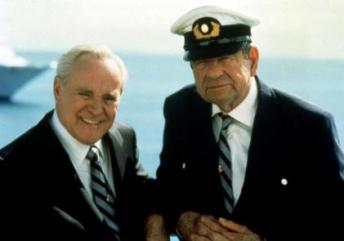
Herb and Charlie are best friends and brothers-in-law. Herb is the responsible one, Charlie the scamp. So of course it’s Charlie’s idea to scam a free cruise by pretending to be a dance instructor, and to trick his recently widowed bud Herb into doing the same (though at least Herb’s got some legit moves).

Of course, Charlie’s hoping to do more than just dance on this cruise; he’s hoping to score himself a rich wife. Herb (Jack Lemmon), still in love with his deceased wife, is not ready lemmon-and-matthau.jpgfor the swinging bachelor existence Charlie has planned for them on board, but that’s only half his trouble. A snarky entertainment director is on to them and their little ruse could cost them thousands of dollars that neither can afford (hello, gambling my old friend!) if found out and no amount of Rue McClanahan flirtation can save them.

Matthau and Lemmon are of course good for some madcap hilarity. I’m struck by how physical Matthau’s comedy continues to be into his old age. This movie is pretty stupid plot-wise, but the chemistry between old pals Matthau and Lemmon is tonnes of fun and magical as ever. This is the 9th of their 10 collaborations and you never get tired of seeing them together. Does it make up for a weak script? Not really. But if you’re reaching all the way back to 1997, you’re doing it because these are beloved figures who crack you up doing their soft-shoe shtick, not because you’re expecting to uncover a hidden gem that’s somehow lain dormant for two decades. Jack and Walt were the OGs as far as Bromance is concerned. Matt and Ben have a long way to go before we’re willing to let them flirt so shamelessly with our grandmas.

Wilson

Wilson (Woody Harrelson) is a grump and a misanthrope. He has no social filter or skills or clue. He’s just out in the world, spitting old man vitriol. His neuroses aren’t great company and his acidic “honesty” doesn’t do much to help with the loneliness.

But then he gets a chance to reconnect with his ex-wife Pippi (Laura Dern), and he finds out that they share a daughter, given up for adoption 16 years ago. This ready-made MV5BMDU0ODI3ODAtMmYxYi00Yzk3LThlNDAtNGRiZjI1MDRiMzgwXkEyXkFqcGdeQXVyNDg2MjUxNjM@._V1_SX667_CR0,0,667,999_AL_family appeals to him greatly, though his fantasy diverges quite archly from the reality. And because life isn’t fair, this grown-ass man gets to wreak havoc on the lives of not one but two women in order to finally grow up himself.

Woody Harrelson is an utter delight. Wilson should by all rights be detestable, and yet Harrelson makes our time with him enjoyable. Unfortunately, his great performance is just about the only thing this movie has going for it. It’s not that interesting or concerned with plot or momentum. Is Woody enough? For me, yes. I don’t regret watching Wilson. Harrelson finds humanity and humour in the awkwardness. And Dern’s not a bad counterpoint as a former party girl trying to turn her life straight. They’re a complete fucking train-wreck as far as couples go and completely unprepared to host a houseplant for the weekend let alone a teenage daughter, but by all means, let’s eavesdrop on their bold but bewilderingly inept stab at playing adults.

I suspect director Craig Johnson didn’t quite know what to do with what he had. The film feels a bit episodic and the shtick gets stale after a while. Full credit to Harrelson for making Wilson just charismatic enough to keep us watching. Otherwise, Johnson would have easily lost us with his generous seasoning of sentimentality and a lackluster finale.


Museum

Detective Hisashi Sawamura (Shun Oguri) of the Tokyo Metropolitan Police is having a rough go. He’s tired. His overworking, long a point of contention in his marriage, has finally culminating in his wife and young son leaving him. And now he’s got a serial killer on his hands.

A few things about this serial killer, because he’s unlike anything you’ve seen in film GAGA_C&C_A4_frontbefore, and yet draws from many familiar sources. The serial killer only works in the rain. He plans elaborate, gruesome kills that seem to be some sort of punishment to his victims. And – how do I put this – he also appears to be a man with a frog head. There. I said it. Moving on…technically, the source material here is the manga, Museum: The Serial Killer Is Laughing In The Rain. But you’ll find the movie remind you of Seven, Saw, and maybe even Oldboy. I can’t say that Museum is that caliber of film, but it’s plenty bloody.

The first half works much better than the second does. Once the serial killer is “unmasked,” for lack of a better word, a lot of the fun and the sizzle leeched out of the movie for me.  I worried that the frog head would seem cartoonish and silly but I did find it rather sinister and regretted it when we lost it. Some of the acting, though, veered toward cartoonish, and that’s particularly hard on North American audiences who are more used to subtlety.

Still, the Assholes managed to enjoy this one, more or less. It has a frenetic energy to it thanks to manic editing. And if you just give in to the weirdness, the slight foreignness, it’s a little fun to watch the whole thing go down. Montreal’s Fantasia Film Festival focuses on “genre” selections, which means you always get something special. We get exposed to titles we’d otherwise struggle to find, and it’s honestly a lot of fun to be pushed out of our comfort zone once in a while.

The Love Punch

When Richard’s company gets bought out by a bigger company, he and his colleagues see their retirement fund disappear overnight. With the prospect of not being able to support his daughter just off to college, Richard (Pierce Brosnan) and his ex-wife, Kate (Emma Thompson) appeal to the young new director who – surprise! – doesn’t give a shit. So they hatch a little plan to steal their money back in the form of the very large diamond lately dangling from his fiancee’s neck.

the_love_punchRichard and Kate, who haven’t spoken much in years, now find themselves travelling to France together to the perfect cover to their crime: the high-society wedding between the director and his blushing bride. Kate gets relegated to some hen party high-jinks while Richard naps, but her intel is good: a foursome from Texas, business partners the director has not yet met in person, are expected to attend. All they need are two more accomplices. So they call up their good suburban neighbours Pen (Celia Imrie) and Jerry (Timothy Spall) who are for some reason pretty game to join in this merry heist.

Then follow the obligatory jokes about retirement-aged folks planning the perfect crime: weak bladders, low endurance, the need for naps, har har har. If you’ve always wanted to see Emma Thompson in Dallas-era hair and a twangy accent, this is your chance. A couple of James Bond references make the movie a little cheeky and the talent between the four leads means an awful lot of charisma. Emma Thompson shines in everything. But this material is beneath her, beneath them all and they can’t save a clunky, predictable scrip that is frankly a little insulting to anyone over the age of 60. And that’s too bad because I really enjoyed director Joel Hopkins’ Last Chance Harvey, also starring Thompson and Dustin Hoffman who enjoy a late-in-life romance. Watch that one instead.

Take Me

Ray (Pat Healy) is an unconventional entrepreneur: he runs a simulated kidnap business where he abducts people and holds them hostage for as many hours as they’ve paid for. He thinks he’s hit pay dirt when a beautiful young woman (Anna, Taylor Schilling) is willing to pay for a whole weekend’s worth of captivity and is prepared to throw in a little extra for some rough stuff.

But Anna’s abduction doesn’t go as smoothly as all the others: someone’s reported her MV5BM2Q5ZWUzMGYtOWEzNS00N2IzLTlhNTItM2RjN2ZhZDBlOTg4XkEyXkFqcGdeQXVyMTE2NzA0Ng@@._V1_disappearance to the cops, for one thing. And Anna’s claiming that whoever hired him, it wasn’t her. So now her kidnapping is for real, Ray’s in trouble with the law, and he can’t let her go until he sorts it all out. Too bad Ray’s not exactly the brightest bulb. Bumble, bumble, bumble.

First time director Pat Healy creates an interesting atmosphere that’s half tension, half farce, and the two leads toe the blurry line well together. It took me a while to get into this because it’s not your typical crime thriller; Ray is not a criminal mastermind, he’s actually just not very good at his job. Tonally, you might find it more in the vein of Mindhorn than Taken. It’s quirky, there are some great gags, the character study is fascinating. It explores this seedy fantasy\role play underground culture while keeping a fairly light, jovial tone. But at 83 minutes, it also feels like it’s stretching to make an interesting premise into a feature-length idea. It feels thin in places. So while it’s an interesting experiment in film, it doesn’t quite work the way you wish it would.