
You may already know about this movie even if you haven’t seen it. Sia, the popular singer-songwriter with the oversized wigs, is its director and co-writer, but more importantly, is the woman who made a movie about a young woman on the autism spectrum without casting or seemingly consulting anyone on the spectrum. And when she was called out about it, she got kind of defensive. Understandable, maybe, but not a great look. She has since half-apologized, the very definition of too little, too late.
While I definitely believe that inclusion is good and right, and representation important, I decided to see if I could set the controversy aside and enjoy the movie anyway. The short answer is NO. The long answer is:
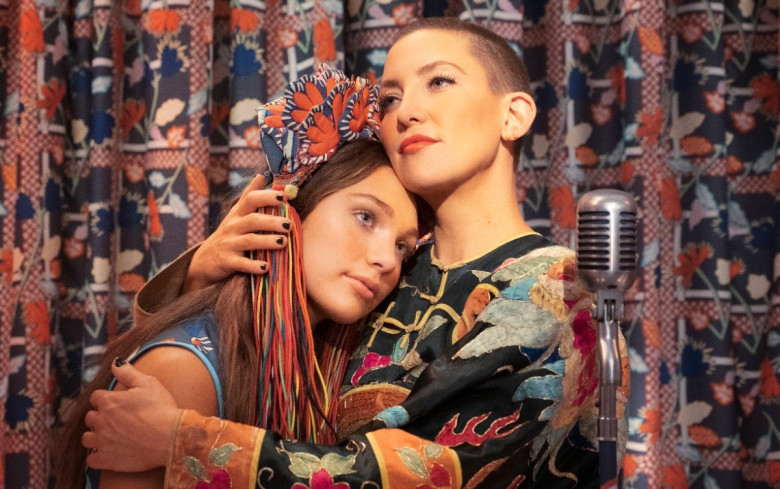
Music is not about a young woman on the spectrum named Music. Music (Maddie Ziegler) lives with grandma Millie (Mary Kay Place), who has carefully constructed a safe space in which Music can exist. Music is barely verbal, but she likes to go for walks and visit the library, and she’s never without her headphones. But then Millie suffers a deadly stroke and Music’s sister Zu (Kate Hudson) has to step up and take custody, which is a real head scratcher since Zu is an addict and a drug dealer recently released from prison and currently on parole. How she gets custody is beyond me. She can barely care for herself, she’s 40 but hardly an adult. Caring for a special needs sister seems wildly beyond her, which is probably why things get so wildly out of control. Anyway, this movie is not about Music, it’s about Zu. Music is merely used as a prop to help Zu achieve her goals. She’s a plot device on Zu’s road to redemption.
While this is hardly Hollywood’s first ‘marginalized person as a plot device’ narrative, it is a particularly offensive portrayal by Maddie Ziegler, who, by her own admission only prepared for the role by watching Youtube videos of kids on the spectrum having meltdowns. Ziegler’s performance is without depth or nuance. It’s one-dimensional, insensitive, and doesn’t begin to describe a person as a whole. But director Sia doesn’t understand this, and the script, co-written by Sia and children’s author Dallas Clayton, isn’t interested in fully-realized characters anyway. Music remains opaque and unknowable, Zu is hardly treated to anything resembling an arc or development, and other characters aren’t just basic but sometimes downright offensively stereotypical. It’s surprising that Sia was able to get the likes of Hector Elizondo, Mary Kay Place, Ben Schwartz, and Leslie Odom Jr. to sign on, but then again, none of them would have seen Ziegler’s patronizing performance until everyone was already on set and the ink on contracts was good and dry. But the whole notion that Zu can achieve some sort of absolution merely by learning to love her “challenging” sister is gross. Music doesn’t exist to make Zu look good. She shouldn’t be used as a way to illustrate someone else’s good vibes and positive intentions. She’s not an instrument or a stop along her big sister’s victory tour; her depiction as such is cruel and irresponsible. Why does a movie named after her fail to see Music as a person?

This patronizing and poorly judged filmed is frequently interrupted by an entire album’s worth of Sia songs – performed by Ziegler, Hudson, and Odom Jr. – and their accompanying music videos, which masquerade as insight into Music’s interior life but are really just an excuse to trade on the director’s only real talent. If only she had merely put out 10 videos instead. The musical interludes are of course pastel pieces of choreography heaven, but they not only have little if anything to do with the film itself, they also get really old really fast. Sia lacks the skill to connect these interjections to the larger story and the videos feel shoe-horned into a film that doesn’t want them. And though Maddie Ziegler’s other Sia collaborations (on her videos for Chandelier, Elastic Heart, and Big Girls Cry) are borderline genius, these are of course tainted by Ziegler’s self-evidently problematic aping of disability.
The film’s ignorant and infantilizing portrayal of autism is disastrous, so it might be a good time to yet again point out that actually involving people on the spectrum in this film’s conception, casting, development, and shooting would have resulted in something more authentic and representative. I know it’s tempting, in today’s cancel-prone culture, to dismiss or boycott this film, but I think that we can still learn valuable lessons from bad art. And Music is very, very bad. It’s so bad that it should serve as a new benchmark for productions going forward. It’ll be harder for mistakes like this to be made in the future. That’s not so much a silver lining as a tin foil lining, paltry perhaps, meager consolation, but it’s important to remember that a movie like this doesn’t just do a disservice to a marginalized community, it sets us all back, our understanding and our empathy and our ability to build a more inclusive society. Music isn’t a disease, it’s a symptom, and the only way we can be part of the cure is to talk about the way forward.
 Sometimes she’s mean to Rachel but mostly she just doesn’t really consider her feelings. At all. Even Darcy’s boyfriend seems embarrassed by this, and their mutual friend Ethan comments on it constantly. But Rachel is a pushover. She gives in to Darcy as if she’s a petulant child who must be tolerated and indulged. She gets nothing out of this friendship for herself. And you know what? I’m tired of Hollywood portraying female friendship in such a toxic way. A real woman would dump Darcy’s ass. But of course, the writer needs the audience to not hate Rachel too much when she steals/sleeps with Darcy’s boyfriend. Darcy is a bitch, so she deserves it. Never mind asking ourselves what kind of person Rachel is – a woman too passive to own her feelings, too insecure to insist on healthy relationships, too blind to see the hunky guy she’s friend-zoned, yet still an immoral homewrecker. Nice.
 her to write a ransom note for $5,000 and then threw her off a bridge. Papers called her accused assailant the “Negro chauffeur” or “colored servant” but his name was Joseph Spell, and he claimed he was innocent. Lucky for him, his case caught the attention of the NAACP and Marshall was dispatched to try his case. Only he couldn’t; the racist judge wouldn’t let him on the grounds that he was “from out of town” so Marshall had to team with another lawyer and somehow stay silent through the infuriating trial.
 wrong. But you know what I mean: usually a pretty blonde will linger with some glamorous kind of cancer that makes you pale but otherwise untouched. Colon cancer is a mother fucker. I mean, you wouldn’t know it from the movie. She even keeps all her hair! But she does get to suffer the indignity of the old camera up the wazoo trick, and has to admit to cute guys that she’s bleeding in her poop. So that’s kind of wonderful. A laugh riot, if you will. At least that’s what they’re striving for. In reality, the movie’s quite tone deaf.
 dying wish. And of course her oncologist happens to be dreamy Gael Garcia Bernal. But there are even worse travesties than this afoot. First, as she lays dying, Marley talks to “God” (Whoopi Goldberg), who apparently is in the business of granting 3 wishes, like a genie. Even more egregious is Peter Dinklage, who pops up as a little person hooker whose nickname is – you guessed it – A Little Bit of Heaven. Because when the jokes about butt cancer dry up, why not make a joke out of someone’s sexuality? Ugh.



 ASSHOLES WATCHING MOVIES