
Full disclosure: I am Wes Anderson’s twin sister, and thus, incapable of impartial movie reviews.
Fuller disclosure: That was a bold lie. I’m just an uber-fan, but upon reflection I don’t want to accuse myself of impartiality. Yes, I love his movies fervently, I wish to live in them, but my esteem is earned. Wes Anderson never takes a night off. He earns it every time.
I was going to watch something new, and maybe I was going to like it, but this little delicacy presented itself as an alternative, and therefore it was the only alternative.
 Wes Anderson introduces us to Gustave H, a legendary and well-perfumed concierge at the famous Grand Budapest Hotel, and Zero Moustafa, the humble lobby boy who becomes his most trusted friend. The story involves the theft (and recovery) of an invaluable painting and the battle over a will and a vast family fortune.
Immediately Anderson’s aesthetic draws you into this world, the colour palette is sumptuous and alive, and it’s like stepping into someone’s well-appointed dream. As always, the details are meticulously executed: the hotel’s shabbiness, the gritty grout, the choice of fonts, the embroidery, the mustaches, both real and drawn-on, the crest worn by Edward Norton and his army men of a little fox head greatly resembling a certain Fantastic Mr. Fox.
The movie is shot with three different aspect rations to help the audience differentiate between the time periods. The adventure is rapid-fire and the dialogue is virtually spat out. In fact, the rapid gunfire of dialogue is a problem when viewing the movie in a theatre: the laughs are so close together it’s sometimes hard to hear whatever comes next.
The characteres are vividly drawn and always so much fun to get to know – in this case, Ralph ![Main Quad_AW_[26611] Grand Budapest](https://assholeswatchingmovies.com/wp-content/uploads/2014/12/characters.jpg) Fiennes plays a character playing a character who makes pretension feel absolutely charming. Tilda Swinton makes a grand dame indeed in her voluminous old age spots, old lady lipstick, and ridiculously piled hair. There are actually so many stars jam-packed into this movie that I’ll never be able to name-check them all. The enjoyable thing is that these cameos rarely (if ever) feel forced, instead it’s intoxicating and energizing.
Fiennes plays a character playing a character who makes pretension feel absolutely charming. Tilda Swinton makes a grand dame indeed in her voluminous old age spots, old lady lipstick, and ridiculously piled hair. There are actually so many stars jam-packed into this movie that I’ll never be able to name-check them all. The enjoyable thing is that these cameos rarely (if ever) feel forced, instead it’s intoxicating and energizing.
It’s a caper-y type film and the plot covers a lot more ground than most of Wes Anderson’s films. But the crime is nestled within a sumptuous frame work and the whole film eats like one of Mendl’s delicious little cakes that are turned our so perfectly that Saoirise Ronan, who plays Agatha, said that making those little pastries convincingly was by far the hardest stunt she’s performed in any movie.
I’d like to say that this is possibly Wes Anderson’s best movie to date, but I feel that such an assertion would be a betray of sorts, like choosing my favourite among my dogs (which reminds me – great little Anderson in-joke moment: after killing a dog in nearly every other movie, Anderson finally sticks it to a cat in a manner so abrupt and cruel it can’t help but get a big, suprised laugh). It’s hard to find a movie that’s this entertaining, this varied and layered, and even if you watch it as a George Clooney edition of Where’s Waldo, you can’t go wrong.
Stay tuned for more Wes Anderson reviews – I won’t be able to resist.

 director Derek Cianfrance got the name (it’s where his wife grew up). As for what it’s about, well, that’s another story.
 Cooper will be remembered as a hero but we’ll all know he’s dirty. And what do dirty cops do? They run for public office!
 It’s sweet and wholesome and damn if that song wasn’t catchy – it even got played on our 1996 radio waves for a brief blip in time. Real 60s music was too expensive (and it had been done well and to death in Forrest Gump, thought Hanks) so it was cheaper just to have stuff written. That Thing You Do! was the result of a competition for a “faux-Beatles” song, and it was Adam Schlesinger, the bass player from Fountains of Wayne, who won. When you hear the song in the movie (and BOY do you hear the heck out of that song in the movie!- 11 different times, and the song went on to be nominated for an Oscar but lost to You Must Love Me from Evita), the actors aren’t really playing, but they could have been. Tom Everett Scott, Steve Zahn, Ethan Embry and Jonathan Schaech all learned to play their instruments, and learned every note of every song that appeared in the movie.
 only her second movie credit. Tom Hanks auditioned her and knew instantly that she’d be famous one day. She was the first person he auditioned, and the first person he cast.”No matter what, I will always claim to have discovered you” he wrote in her script. She won her first Oscar in 2004.
 showed up to work on it. Wife Wilson appears as a cocktail waitress, but Hanks was so tired from pulling 19-hour days the day she showed up on set, he didn’t even recognize her, merely noting that she was “an attractive lady” and he hoped she’d be nice to him. His son Colin also briefly appears in the film, and his daughter Elizabeth even brieflier. Unrelated but also of note: keep your eye out for Bryan Cranston playing an astronaut, and Jonathan Demme playing the director of a major motion picture.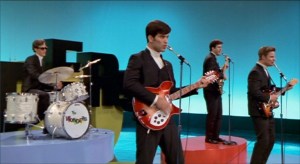
 ASSHOLES WATCHING MOVIES