Tag Archives: movies based on books

Midnight Sun

Another day, another dying teen. Hollywood loves to kill off teenagers. Movies are the #1 leading cause of 30 year olds playing 15 year olds dying prematurely.

In Midnight Sun, Katie has xeroderma pigmentosum, or XP, a rare genetic condition that means the sun is literally poisonous to her and could kill her in seconds. As you can imagine, she’s led a sheltered 17 years, sleeping by day, hanging out with her protective dad by night. But give a girl an ounce of outside contact, and she comes home with a boy, from whom she keeps her illness a secret.

This movie takes its cues from last year’s dying teen girl movie, Everything MV5BNTNkOTQ4ZjUtMjhiMC00MWNkLWJlMjQtYmY4ZmQ4ZDhkOTVkXkEyXkFqcGdeQXVyNTc5OTMwOTQ@._V1_Everything, in which the girl is also confined to her house, but she wasn’t allergic to the sun, she was allergic to everything. Possibly including the sun. And she didn’t have a dead mother, she had a dead father. And she didn’t fall in love with the boy next door. Oh wait, she did. So yeah, beautiful teen girls with terminal diseases just waiting to die up in their castles until a boy comes along who’s handsome enough to make her risk it all. So she can die on her front lawn instead.
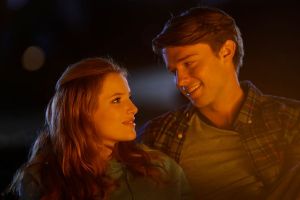
Why do teen girls want so badly to watch themselves die? I wonder if movies made to be watched while you’re on your period is a genre: movies that invite tears and ice cream binge-ing while making young women feel seen. But high school romance doesn’t need to have life or death stakes, and your first boyfriend shouldn’t be your last. I’m about 15 minutes past 17, which is way too old to sympathize with what’s going on here. Featuring Bella Thorne, star of all the straight-to-Netflix runners up, and Patrick Schwarzenegger, son of Arnold and Maria Shriver, with all the genetic talent you’d assume.

It’s astonishing, really, that a movie can work this hard at being this bad. Midnight Sun puts the jerk in tearjerker.
Bird Box

Imagine threatening very small children with their lives. Imagine threatening your own children with their deaths, their painful deaths, by your own hands if necessary. Can you even imagine a situation so dire that you would tell your kids you would kill them IF?

If you’re a fan of Josh Malerman’s post-apocalyptic horror novel, Bird Box, the good news is,  you can always reread it. Netflix has adapted this “unfilmable” book (how many books have we said that about now?), and turned it into something bibliophiles will scarcely recognize. But that doesn’t meant it’s bad.

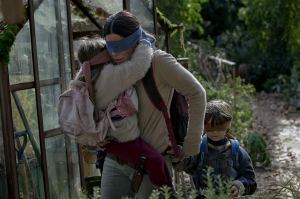
Malorie (Sandra Bullock) is in the impossible situation. She’s pregnant at the end of the world. This particular nightmare is the inverse of The Quiet Place – they had to stay silent in order to not die, and in Bird Box, they have to not see. The sight of something is causing people to almost immediately become homicidal and ultimately, suicidal. It’s a plague killing millions, killing billions, killing everyone around the world. The only way to survive is to not see, to never see. But food and water and resources inside are finite. MV5BMjE5Nzk1ODgwMV5BMl5BanBnXkFtZTgwMjU5MTE2NjM@._V1_SX1500_CR0,0,1500,999_AL_Malorie is living with a small group of people, strangers, really, who don’t always agree on the best way to exist together, or how to stay alive. Malorie’s not even the only pregnant one – Olympia (Danielle Macdonald) is expecting too, right around the same time. The house’s other inhabitants (Trevante Rhodes, John Malkovich, Jacki Weaver among them) will have to make all kinds of hard choices to ensure the group’s survival. As you probably guessed, ultimately, Malorie will need to leave the relative safety of their shared home – and worse than that, she may have to sacrifice one child to save another. Doesn’t that sound like a fun little jam to be in?

Yeah, this is a horror movie, in case you’re not picking up on the obvious. The unknown, horrible, unseeable things remain unseen by us, but they’re a constant threat. Director Susanne Bier understands it’s way creepier to only suggest the worst, and let our own imaginations prey on our fears. A newborn baby is of course the most vulnerable creature in the world. What else could heighten a dangerous situation like a helpless baby? But what else would pose a greater danger? A baby, unable to look away, unable to understand, a baby who will only need need need, and take take take, and attract attention while putting everyone at risk. A baby, two babies, normally a blessing, but in this scenario, the worst possible thing.

Bier creates a tense atmosphere and Bullock keeps us riveted. Rather than jump scares, Bier gives us a character study, and Malorie’s humanity and the children’s inherent weaknesses gives some real meat to the film’s anxiety. But the film strays quite far from the book, and to no real advantage. Since this film streams for “free” on Netflix, it’s a no-brainer if you can take the heat (or rather the chill, the frisson). Squeeze your eyes half shut.

A Simple Favor

Emily (Blake Lively) is effortlessly cool and glamourous. She works a high-profile job in the city and has a handsome husband and an air of mystery. No one is more surprised than Stephanie (Anna Kendrick), a single mom and mommy blogger, when Emily befriends her. Their boys are friendly in school and now the mums are friendly over martinis.

But just weeks after an unlikely friendship blossoms between Emily and Stephanie, Emily calls her with a request for a simple favor: a work emergency has popped up, could Stephanie pick up her son from school? Two days later, the son is still in Stephanie’s care, and no one had heard from Emily.

As the investigation into Emily’s disappearance deepens, Emily’s secrets unravel. Her MV5BMTUzNDc3NTM4M15BMl5BanBnXkFtZTgwMzYxNTM0NTM@._V1_SX1777_CR0,0,1777,999_AL_husband Sean (Henry Golding) is very revealing. Turns out, Emily was a pathological liar and her past was very closely guarded. Stephanie doesn’t know what to think about her friend, but her doubts don’t exactly stop her from getting cozy with Sean…and eventually moving right in. Which seems like a bitch move from a grieving best friend, but then, the recent widower isn’t exactly objecting. Why is Sean not objecting?

Anna Kendrick is very good at being a pathetic loser, and Blake Lively is extraordinary at being a clotheshorse. This movie is exceedingly stylish. Blake Lively’s menswear-inspired wardrobe is to die for, but I swear I’m not the one who killed her. But no matter how you dress this thing up, it’s no Gone Girl, but that’s exactly what it wants you to mistake it for. Unfortunately, it can’t quite embrace any one genre. It often looks noir but goes for the easy laugh. Which one is it, truly? I admire that Kevin Feig went for a blend of both, but I don’t think he quite pulled it off. However, if you’re a fan of the Kendrick-Lively duo, they’ve never been Livelier or more Kendricky. They each know their strengths, and Feig gives them a beautiful stage on which to drip their special sauces.

Mowgli: Legend of the Jungle

I did not think the world needed another Jungle Book movie. I felt the same about Jon Favreau’s The Jungle Book. I am too young to have any warm feelings toward the Disney cartoon – that movie felt old-fashioned to me as a kid, and I couldn’t watch it. We never read the books, and I was never a boy scout. And don’t get me started on this “live action” nonsense – this may be more sophisticated animation, a less cartoony cartoon, but this stuff is 95% computer-generated.

Anyway, as you may have gleaned: a “mean” tiger named Shere Khan (Benedict Cumberbatch) eats some humans in the jungle. He’s the menacing villain of the story, even though the tiger was only doing as tigers do. But white people think they own MV5BOWNjOGFlNTAtZDlmMS00ODdjLWFiMjQtYjMxNTUwYjY1OWMwXkEyXkFqcGdeQXVyNjUwNzk3NDc@._V1_SX1777_CR0,0,1777,732_AL_everything they see and touch and feel, and are surprised not be welcomed with open arms whenever they attempt to colonize new lands. The jungle was never meant for humans, and almost everything about the jungle makes that abundantly clear. Anyway, the dead humans leave behind a baby, Mowgli, who is accepted by and raised by a  literal pack of wolves. Mowgli is mentored by a black panther named Bagheera (Christian Bale), and a bear named Baloo (Andy Serkis). They try to teach him the ways of the jungle, but they also know the strange animal called man is edging in on their territory, and it can only be an asset to have one of them among them.

At PG-13, this is a darker, less family-friendly version of the Jungle Book. Mowgli’s story has always had something to say about fitting in, and whether how we look has ever been the best way to judge who is one of us, and who is not. But, we’ve obviously been told this story several times before, and Serkis’ version gives us nothing new, just some special effects and his trademark motion capture that actually brings nothing to the table. There’s no charm, there’s no heart. Andy Serkis may have donned the green suit to give life to Baloo, but he’s never seemed more cold and aloof. He’s not the same Baloo that people have loved for generations. This isn’t the same Jungle Book. It’s dark and it’s bloody – so, for the rare person who wishes beloved children’s books played more like war movies, I guess this is pay dirt – but for the rest of us, this is a miss.


The Little Mermaid (2018)

A young reporter, Cam, and his sickly niece Elle take a night off from closely monitoring her health (a persistent cough that causes her to fall to the floor ahem), to take in the circus that’s just come to town. Among the elephant and fortuneteller lurks an even greater mysery: a real live mermaid, Elizabeth.

She’s kept in a tank and it looks pretty real, but it must be some trick, right? Wrong. This mermaid is being kept in slavery by the evil carnival barker, and it’s up to Elle, who idolizes her, and Cam, who’d like to, um, romance her, to save her.

You might have been excited to know that a live-action version of The Little MermaidMV5BYzA5ODc3MTctNmQwNC00YjdhLTgxNTEtZTczYTQyMTQ4N2RlXkEyXkFqcGdeQXVyNjQ3NTcyNzQ@._V1_SX1777_CR0,0,1777,745_AL_ was hitting Netflix, but that would make you a fool. It’s an abomination. The plot is as poor as the production values. Seriously, the special effects were short-bus special, and the effect was that I hated it, and felt embarrassed on its behalf.
Pointless, absolutely, but also completely boring. Kids won’t have the patience for it, and parents won’t have the forgiveness. The rest of us are just chumps for watching. If I had a mermaid tail, I’d flip it dismissively as I swam decisively away. If I’d lost my voice in exchange for legs, I’d flip it the bird. If I suddenly used a fork as a comb, well, I’d get on the short bus because mermaids are the least of my trouble.

Dumplin’

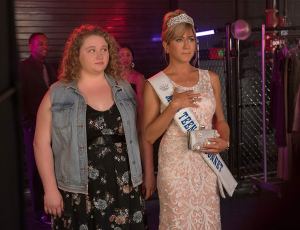
Willowdean, aka Dumplin (Danielle Macdonald), feels like a square peg trying to fit in a round hole. Her aunt Lucy always had a knack for making her feel at home and helping her to navigate life greasier spots, but aunt Lucy is gone now. Thank goodness for her best friend Ellen (Odeya Rush), a fellow lover of all things Dolly Parton. Willowdean’s mother, Rosie (Jennifer Aniston), is practically a celebrity in their small Texan town. She was Miss Teen Bluebonnet 1991, and is the pageant’s current director. Their house looks like Miss America barfed all over it, except in aunt Lucy’s old room, still not empty of her belongings, but that won’t be true for long, if Rosie has her way.

MV5BNTIwODk1MjYzMl5BMl5BanBnXkFtZTgwMzQxMzU3NjM@._V1_SY1000_CR0,0,1301,1000_AL_Dumplin’ is based on a novel by Julie Murphy, and it’s kind of like a Love, Simon for fat girls (we deserve love too!). Willowdean doesn’t have the perfect figure, a fact all the more noticeable standing next to her mother, a literal beauty queen, and the town’s image of perfection. So it’s a mystery to her when Bo, the heartthrob that works with her in the local diner, seems to be interested in her. That can’t be right, can it?
Overweight women struggle to find acceptance in the world, and remain almost invisible, undepicted, in Hollywood. Weight will be the last taboo, clearly. So when Willowdean enters the pageant, it’s an act of rebellion. Her mother isn’t thrilled and the pageant institution wants to preserve its ‘sanctity’, but when Willowdean shows up, she’s like the Joan of Arc of fat girls, inspiriting several other ‘unsuitable’ girls to sign up.

It’s interesting to watch Willowdean struggle, to know in her head that people’s judgement about her weight is complete bullshit, but also to have internalized it, to use that bit of self-loathing as as a defense mechanism. It takes a lot of strength to confront these stereotypes, and to have Willowdean do it as a high school student, so young and vulnerable, keeps our compassion levels high – as well as our concern. It makes us watch with a critical eye. Who is complicit? Store that sell a minimum of (small) sizes? Magazines that wrongfully equate weight with health? Movies that would have you believe that a boy who likes a fat girl is a hero? The pageant system itself, which celebrates a very narrow definition of beauty and weighs intellect and swim suit wearing equally?

There’s nothing in the rules that says “big girls need not apply” but all too often, fat girls see barriers everywhere. Sometimes they’re just barriers we just mentally put there ourselves after being conditioned by society to feel somehow inferior or unworthy. Dumplin’ is asking us not to buy into that – not of each other, and not of ourselves. A number on a scale is incapable of determining beauty, and it’s not even close to measuring a person’s worth. The film doesn’t follow the book’s exact plot, and it wisely edits a lot of the romantic drama, because this story is most of all about self-acceptance, as every story should be.

Angela’s Christmas

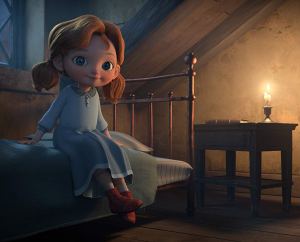
Some people believe they’ve seen a stone statue cry tears of blood. Others think they’ve seen Jesus in toast. This is the story of Angela, a little girl who thinks that the baby Jesus in her church’s nativity scene looks awfully cold, underdressed in his manger. She sneaks in to rectify the situation, which is how her sneeze has members of the congregation believing that the baby Jesus has caught the sniffles and has come to visit his germs upon them (or something like that, but very holy and earnestly felt). And if that had been the entire story, this review would be very short. But the thing is, Angela snatches the baby Jesus in order to warm him up. She is sincere in her good intentions, but this is still the theft of the lord we’re talking about – and on Christmas, no less.

Angela’s Christmas is an animated Netflix original, just 30 minutes, perfect for family viewing around the holidays. It’s adapted from Frank McCourt’s children’s book, so MV5BMDRiY2Y0NDYtODViNi00NWQzLWE2M2YtNjc4N2U4NjkzZjQ1XkEyXkFqcGdeQXVyNDkwMTM0Ng@@._V1_SX1238_CR0,0,1238,999_AL_presumably this is the very same Angela of Angela’s Ashes (McCourt’s mother). If you’re at all familiar with McCourt’s work, then you know it’s got plenty of Irish authenticity, and so does this little film.
Like all of McCourt’s work, the details are so terrifically rendered that they will inevitably bring a tear to my eye. This is a very sweet film that can’t help but please all audiences. Perhaps you’ve got a lump of coal where your heart should be? No? Well then add this to your holiday viewing list. It’s pure and innocent, and it’ll put a little coziness where you need it most. Angela’s Christmas is the anti-dote to all your holiday cynicism. There are no gifts, no turkey, no reindeer, just childhood innocence and the warmth of family. And that’s really all you need.

Don’t Worry. He Won’t Get Far On Foot

John Callahan was a dedicated alcoholic when he had a life-changing accident that left him paralyzed.

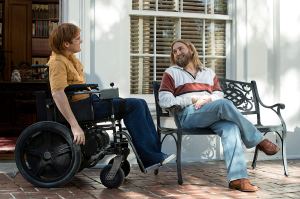
Post-accident, the path to sobriety isn’t exactly direct. Between the struggle to accept his new limitations, learning to live in a chair, caring for his broken body, and searching for the mother who gave him up at birth, there are a lot of reasons to drink. Of course, there’s always a reason to drink. Only when he truly embraces the value of AA, with the help of group leader Donny (Jonah Hill), does he start to imagine a future for himself. And he finds a healthy way to channel his anger and his energy and his wonderment: cartoons.

MV5BMjMyMTY2MzYxN15BMl5BanBnXkFtZTgwMTEwNDgyNDM@._V1_SX1500_CR0,0,1500,999_AL_Callahan is injured enough that he cannot grasp a pen but he manages somehow to manipulate a felt-tip pen between two mangled hands and he finds inspiration in his life to create funny, and often controversial cartoons. His student paper sees fit to publish him and from there he develops a national following.
Don’t Worry, He Won’t Get Far On Foot is a line ripped from one of his own cartoons; the movie is adapted from Callaghan’s memoir. Director Gus Van Sant wants to say something about the healing power of art but the movie itself reads more like a tribute to support systems and the importance of forgiveness without dipping into the considerable well of inspirational cliches.

It’s a dark comedy, as you can imagine, but between Jack Black, Jonah Hill, and an orange-haired Joaquin Phoenix wielding his wheel chair like a bat on wheels, there’s some appreciated levity to all the drama. It’s an off-beat comedy about an off-beat guy. Phoenix is irrepressible.

Sean didn’t care for the movie – he felt not much had happened. I liked it well enough – I liked the unexpected performances from the likes of Beth Ditto, Carrie Brownstein, and Kim Gordon. I liked that Callaghan’s dark vein of humour is kept in tact throughout transformation, that he doesn’t become some sort of saint, merely the same caustic guy with a new lease on life. I liked that his past is never treated like an excuse – not that I’m not sympathetic to his victimhood but I like that he finds his salvation elsewhere, that he’s allowed to not solve the puzzle of his childhood before finding peace in his present. The 12 steps are not equally cinematic, but I felt Phoenix’s charismatic performance carried us through. Obviously Sean disagreed, so I guess I’d call this a mixed-bag review. It’s not for everyone.


++


22 July

22 July 2011. Anders Behring Breivik triggered a car bomb in the government district of Oslo that killed 8 and injured 209. Two hours later he had ferried over to the island of Utoya where a summer cap for the youth division of the Labour Party was held. You likely heard about it on the news, at the very least. Breivik was dressed in a police uniform and armed to the teeth. He opened fire on the group of teenagers and killed 69 more, injuring another 110. The kids were like sitting ducks, and Breivik shot them one by one for the political affiliations of their parents.

The film, by Paul Greengrass, is difficult to watch, especially the beginning, which recreates the attack. Later it focuses on the survivors, and on the court case that wouldMV5BM2RkYThlMDQtZDZlMi00ZGVhLThiYWYtZWJlNzQ4YmQ2M2QzXkEyXkFqcGdeQXVyMDA5NjIzMg@@._V1_ keep Norway rapt. Breivik, who orchestrated the attacks to protest immigration and other stupidly racist, extremist right-wing bullshit, claimed insanity in order to avoid prison. But he also desperately wanted to stay in control of the trial, demanding the prime minister be called as a witness, and insisting that he have the opportunity to address the court to spout more of his hate, and so after “playing a role” for court-appointed psychiatrists, he decided to retract and change his plea.

As you can imagine, with 1 in 4 Norwegians in some way affected by these attacks, the whole country was fraught. The lawyers tasked with defending him were targeted themselves. But the movie’s beating heart is one kid, a survivor shot 5 times, who finds the courage to stand up and face his worst nightmare in court. He doesn’t want to let Breivik see his vulnerability, but feels the weight of all the voices who cannot speak for themselves.

It’s a moving film, of course. I said before that the first part was particularly difficult to watch, but for me, Breivik’s cold, rational, hateful testimony in court performed by Anders Danielsen Lie was even harder. Film has more or less desensitized us to horrific violence, but nothing can prepare you for looking into the eyes of a person we know exists, who really carries this hate in his chest in the cavity where a heart usually resides. That’s the tough part: reconciling ourselves with the fact that this villain has walked among us.

Thankfully, a thoughtful and humble performance by Jonas Strand Gravli balances this out. He is not just the spokesperson for the victims; he’s a stand-in for the horrified audience as well. Director Paul Greengrass has made these sorts of films his niche lately (Captain Phillips, United 93) and it’s a god-awful corner to have painted himself into, but I must admit he’s got it well sorted, but the movie’s attempt at dividing up the story gives it a sense of imbalance. It sputters a bit in the middle when it doesn’t quite know which movie it is. But it’s worth the watch. It’s an act of remembrance.

TIFF18: Hold The Dark

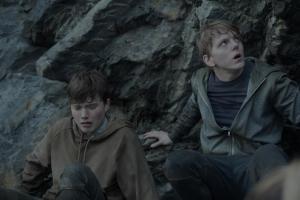
Three children have gone missing from a small, very small, very isolated community in Alaska, snatched by wolves. One of the grieving mothers, Medora (Riley Keough), hires wolf expert and writer Russell Core (Jeffrey Wright) to track and kill the wolf or wolves responsible.

But the wolves are not the villains of this story.

First, the Alaskan landscape. It’s frozen, much colder than what cold passes for MV5BODYwNTY5MDcxMl5BMl5BanBnXkFtZTgwNjAzNDQxNjM@._V1_SY1000_CR0,0,1487,1000_AL_anywhere else. It’s unforgiving. It’s unknowable. It’s remote. There are only 5 hours of daylight at midday. It’s a blank canvas, a blanket of white, relentless and renewing, where even your own footprints are quickly snowed in and covered over; one wrong step can mean the difference between life or death. It’s no place for a novice like Core, but he’s got some demons of his own that keep him from making better judgments.

Second, the village. Or rather the villagers. They’re an insular tribe and don’t take kindly to outsiders. The environment is hostile in every sense of the word. They don’t cooperate with the law.

Third, the grieving parents. Grief makes a person crazy. Some people were crazy to begin with. Medora was on her own when her son went missing, her husband Vernon (Alexander Skarsgard) away at war. Injured, he gets sent home to a probably-dead kid and a mentally disturbed wife. There aren’t a lot of times when war is the preferable scenario, the kinder one, but I think this it.

I read the novel upon which this is based (by author William Giraldi) but this screenplay is adapted by the twisted mind of Macon Blair, so I know I’m in some sort of trouble. He’s beefed up the part of Vernon for Skarsgard, sure, and he also makes sure every bit of violence is as graphically gory as possible. What else do we expect from a Jeremy Saulnier movie? The man loves to taunt us with threatening, ominous images and then leave us exposed to whatever chaos may come. It’s an exceptionally tense way to watch a film, but if Saulnier isn’t throwing you into minor cardiac arrhythmia, he feels you aren’t getting your money’s worth.

Saulnier is a master of making you shit your pants, and if anything, Hold The Dark is a little lighter on the anxiety-ridden dread. But while we buckle up for a movie about wolves and wilderness, it’s actually humanity who shows itself most vicious, and that’s all Saulnier. There are so many twists in the tundra it can be hard to keep them all straight, and you’re never quite sure just what kind of movie you’re watching, but it’s a bloody, vengeful rampage and it will not have a happy ending.