Tag Archives: movies based on books

The Hippopotamus

Based on Stephen Fry’s raucous novel, The Hippopotamus is about a drunken poet who hasn’t actually written a poem in decades. Spectacularly fired from his more recent newspaper job, Ted Wallace (Roger Allam) is hired by his ex-girlfriend’s daughter Jane to investigate a mystery.

Wrangling an invitation from his godson David (Tommy Knight) to Swafford Hall, Ted’s off to the English countryside to look into a strong of recent…miracles? Jane was on her 1227022_The-Hippopotamus-600x337.jpgdeathbed with cancer when she first went out to Swafford to convalesce in a peaceful setting. Instead, she experienced a miraculous recovery, her health and strength returning until she seemed to be in complete remission. She’s not the only one talking about these spiritual healings, so in addition to Ted, Swafford is welcoming all kinds of guests who are sneakily looking for their own miracles.
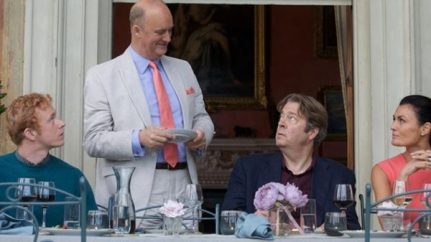
Turns out that it’s David who’s responsible for the “laying on of hands”, only he’s not just using his hands. The, erm, colourful assemblage of guests are pretty desperate and ready to swallow just about anything, so the whole household’s a twitter with whatever’s going on. Ted, ever the skeptic, is determined to get to the bottom of it. He’s sure it’s a hoax, but we’re sure he’s a drunk, bumbling fool, so who’s right?

Dubbed a “comedy of manners” it does have a distinctly English feel to it. I usually adore British comedies but I didn’t have the patience for this one. Sure there are some great zingers but it’s really kind of a mess and all the characters besides Ted are cardboard cutouts, which means tonnes of voice-over explanation is required, and that gets quite tedious. This film lacks energy and this viewer was left bored.

The Zookeeper’s Wife

On Saturday we brought our sweet little nephews to the Capital Fair, where we watched a stunt dog show, rode rides, played games on the Midway, and visited a petting zoo where the kids and I hand-fed llamas. On Monday I watched a llama get shot, point blank.

Do not confuse The Zookeeper’s Wife with We Bought A Zoo. This is no light-hearted tale. It’s about real-life couple Antonina and Jan Zabinski, who used their posts at the Warsaw Zoo to save hundreds of Jews during the German invasion. Of course I’ve read both The a6oYy417yHHP01DGIDZUeEzH7JFZookeeper’s Wife, and We Bought A Zoo, and more recently I was reading another book about a woman who led an underground railroad of sorts to smuggle Jewish children out of the ghetto, wherein the zookeeper’s wife was specifically mentioned. It was an especially brutal place to be during the war. Terrible, unspeakable things happened every day, and it’s kind of a miracle to see\hear these stories about ordinary people who couldn’t live with what was happening, so they didn’t [it’s sort of awful that these words sound very applicable even today].

Glimmers of light do not eliminate all the darkness. The Zookeeper’s Wife is not an easy watch. The film makes the stakes clear, yes for the zookeepers taking enormous risks themselves (they would surely die if discovered), but especially for the people they are helping, who would otherwise be dead – or worse.

Jessica Chastain as the zookeeper’s wife is of course fantastic. There’s no CGI used int he film; those are real lion cubs she’s cuddling, with not a shred of hesitancy. Fitting, I suppose, when she’s sitting in the middle of a war where much scarier things are happening on the streets. WW2-era films always inspire a bout of siderodromophobia in me (the fear of trains).

This movie gets some things right, and some things wrong. In the end, I think it’s just not terrible enough, which I realize is a weird thing to say. What I mean is: it doesn’t have the power to haunt you the way Schindler’s List did (does). It feels a little cold, without the emotional gravitas you’d expect. I expected to cry. What does it mean that I didn’t? Perhaps what this movie needed was a meaningful connection to just one victim. Heroics are all well and good, but they’re only important because they’re necessary. Heroes are only half the equation: both must be compelling.

Valerian and the City of a Thousand Planets

Long before I saw this movie, I was annoyed with its title. The trailer gave the impression of a crime-fighting intergalactic duo, and yet for some reason only the boy seemed to get credit. It’s based on the graphic novel Valerian and Laureline, which means the author himself thought of them as equal partners, it’s only Hollywood that’s decided to downgrade the woman’s presence while also prancing her about in a bikini at every opportunity.

Having seen it, I see there are way bigger problems. The casting, for instance, made no thumbnail_25961sense at all. Supposedly, Valerian and Laureline are capable, dependable galaxy-savers, but nothing about either of these two gives the impression of a even the remotest shred of competency. I wouldn’t trust them to house sit for me; if they were in charge of saving my world, I’d be biting down on my cyanide tooth. But this movie wants me to believe that not only are they upstanding employees, but ready for marriage, even though they look like perhaps they’re only just now discovering the growth of hair over various private body parts.

Cara Delevingne has only ever managed to be convincing as an underwear model, which is what she was before stumbling into “acting.” When a director casts her in a movie, it’s like they are putting a disclaimer on their movie “Yeah that’s right, this is going to suck. Style over substance!” Her acting technique consists of walking into a room eyebrows-first and saying the line, usually in the direction of the camera. She has the emotional range of a robot but none of a robot’s grace or fluidity. Dane DeHaan, on the other hand, looks like he should be bagging groceries at the Piggly Wiggly. Put these two chuckleheads together and what do you get? Just two dumb rocks in a potato sack. Or, in the case of Valerian and the City of a Thousand Planets, two dumb rocks in a tin can (aka, space ship). If that wasn’t enough to convince me of its utter superficiality, I guess the sight of Rihanna pole dancing would have pushed me over the edge. Though to be fair, I would have gladly watched her dance for a thousand days rather than see Ethan Hawke play a pimp with a nose ring.

The whole thing was so uncharismatic, the movie almost killed me of boredom. I was so numb I could barely follow the “plot” which, like too much sci-fi fare, consisted of: something’s in danger, someone has to save it, fight, fight, fight, special effects, special effects, the end.

The Circle

The Circle is THE company you want to be working for. It’s a blatant stand-in for Google; the ‘The Circle’ campus and work space looks identical, comes with all the crazy perks we’ve been jealously-not-quite-believingly hearing about for years: sushi bars, yoga workshops, nap pods, etc, etc. Mae (Emma Watson) is ecstatic when she’s hired for an entry level position – the salary is generous, room and board are included, the health plan is fabulous – it’s more than any millennial has the right to expect these days. The only thing The Circle asks for in return is a complete lack of privacy.

And in fact, The Circle doesn’t just ask that of employees, but of everyone joining their network. The Circle is a platform that would link all of your online accounts. You’d have one account, one username (your own, your real one), one password that links to everything, all your aps, your bank, your email, your work, social media, etc, etc. The m-442_circle_11286fdrv1rdream come true starts to feel a little…invasive to Mae. There’s no turning off, no going off-grid. Everyone participates in everything all the time! Horray! So the dream is turning out to be a bit much, but with her father (Bill Paxton) suffering from MS, it’s extremely hard to turn down.

Most of her The Circle colleagues are drinking the kool-aid but she finds a kindred spirit in skeptical Ty (John Boyega). He’s worried about how every single piece of our lives are being accessed and stored, analyzed and monetized, by The Circle: personal data is being mined to make a few people very, very rich. And if you have any presence on the internet at all, there’s nothing you can do about it.

The Circle is a terrific book by Dave Eggers. It’s an urgently fascinating story because our reality is probably only about one and a half paces behind what’s depicted in The Circle, and that’s just what we know about. We’re creeping closer and closer every day. Unfortunately it seems that Eggers’ brilliant books are not that easily adapted into films; A Hologram for the King was also a bit of a flop and that’s too bad because there’s some really thoughtful and thought-provoking material in there that’s getting lost.

The film asks more questions than it answers. In truth, it sort of lets some of the issues it raises fall away without doing them any justice. So that’s unfortunate. I still thought the movie was compelling and watchable, and Tom Hanks is of course irreproachable. I think it’s worth your time. But the book is even more worthy of your time, and if you read it, you’ll see the changes that Hollywood makes to make a story more ‘palatable.’ But I’m pretty confident that you can handle the truth. Right?


This was Bill Paxton’s final film. He died before it was released; a dedication in the closing credits reads ‘For Bill.” Glenne Headley, who plays his wife, died in June. She’s got a couple more movies in post-production.

The Glass Castle

Jeannette Walls lived a turbulent childhood: her parents bustled her and her 3 siblings from town to town, evading bill collectors, never quite having enough money for both food and her father’s insatiable thirst. Poverty and addictions pock her youth, but for all their struggles, her mother would never leave her father, and the kids soon realized they’d need to fend for themselves, each disappearing to the big city as soon as it was feasible (a real challenge when someone is constantly drinking up all the money).

Walls went on to write a memoir detailing the hardships she lived through, and that tgc_d02_00156_00157_comp_r2.jpgbook became this movie, though something was lost getting from A to B. The book pulls no punches. Her parents are complex characters, and their children have conflicted feelings toward them. The movie’s a little more pat, the trajectory a little more Hollywood. Someone decided to apply some spit shine to this story, a story that’s naturally very dark and brooding now has themes of hope and redemption that maybe don’t belong.

I can’t say what exactly is wrong with the film except it’s just too easy. The grit is gone. Sure Jeannette’s father Rex is charming but he’s also kind of a monster. He’s a negligent parent who abuses his wife and kids and helps keep family molestation on the down low. And of course he wants deathbed forgiveness. Meanwhile his wife is a “free spirit” who chooses homelessness over independence from the man threatening her family’s well being. Neither parent is capable of putting their children’s needs first, or of meeting those needs even if they ever did. Which they don’t.

But The Glass Castle is worth a watch for the performances alone. As Jeannette, Brie Larson lives up to her previous Oscar win, but it’s Woody Harrelson as Rex who you’ll remember. He’s tortured and endearing and inspiring and hateful. Is this the film he’ll win his Oscar for? I wouldn’t be disappointed if he did. But shame on Hollywood for trying to put gloss and a positive spin on childhood poverty. These kids were failed not just by their parents but by the system. And now their brave story is being watered down to make it more palatable for film audiences. Shame.

Museum

Detective Hisashi Sawamura (Shun Oguri) of the Tokyo Metropolitan Police is having a rough go. He’s tired. His overworking, long a point of contention in his marriage, has finally culminating in his wife and young son leaving him. And now he’s got a serial killer on his hands.

A few things about this serial killer, because he’s unlike anything you’ve seen in film GAGA_C&C_A4_frontbefore, and yet draws from many familiar sources. The serial killer only works in the rain. He plans elaborate, gruesome kills that seem to be some sort of punishment to his victims. And – how do I put this – he also appears to be a man with a frog head. There. I said it. Moving on…technically, the source material here is the manga, Museum: The Serial Killer Is Laughing In The Rain. But you’ll find the movie remind you of Seven, Saw, and maybe even Oldboy. I can’t say that Museum is that caliber of film, but it’s plenty bloody.

The first half works much better than the second does. Once the serial killer is “unmasked,” for lack of a better word, a lot of the fun and the sizzle leeched out of the movie for me.  I worried that the frog head would seem cartoonish and silly but I did find it rather sinister and regretted it when we lost it. Some of the acting, though, veered toward cartoonish, and that’s particularly hard on North American audiences who are more used to subtlety.

Still, the Assholes managed to enjoy this one, more or less. It has a frenetic energy to it thanks to manic editing. And if you just give in to the weirdness, the slight foreignness, it’s a little fun to watch the whole thing go down. Montreal’s Fantasia Film Festival focuses on “genre” selections, which means you always get something special. We get exposed to titles we’d otherwise struggle to find, and it’s honestly a lot of fun to be pushed out of our comfort zone once in a while.

The Lost City of Z

Percy Fawcett is a hard-working man but promotion eludes him due to his “unfortunate choice of ancestors.” This provides the desperate motivation in him agreeing on a mapping “adventure” deep in the Amazonian jungle. If disease doesn’t kill him, the hostile “savages” are likely to, but to restore his family name and support his family, off he goes…never to return.

I’m getting ahead of myself. Percy Fawcett (Charlie Hunnam) was a real British explorer who did get sent to the Amazon. While surveying there he believed he found a previously unknown, unfathomed advanced civilization. Back home he is ridiculed by his peers, but he’s obsessed, not just with a potentially huge discovery, but with proving himself. His fire is lit, his wife (Sienna Miller) supports him and his aide de camp (Robert Pattinson) enables him until one day he just disappears into the jungle.

Shooting a movie in an honest to blog jungle is difficult and uncomfortable. Director James Gray asked Francis Ford Coppola (who did the same for Apocalypse Now) for advice, and he was told “Don’t go”, which, incidentally, is the same thing Roger Corman told Coppola. Nobody listens, but it’s probably solid advice. If you do disregard it and trek to the steamiest of locations, make sure you don’t plan to film digitally. Gray was shooting 35mm thankfully, as the humidity shut down all the laptops and would have done the same to digital cameras. The actors and crew withstood and great deal of hardship – was it worth it?

The Lost City of Z (it’s pronounced Zed, you filthy Americans) has a meandering pace that reminds me of the epic adventure movies of 50 years ago or more. I can’t justify its runtime (141 minutes!) and I know exactly what I would have left on the cutting room floor, but I do love lots about the movie. I love the complexity that Hunnam brings to the role. I love the subtlety and the refusal to exploit that Gray insists upon. I love the authenticity of the script, the honest portrayal of sacrifice, the bold ambition of the story. There aren’t exactly a lot of surprises to be had. It’s about finding oneself while literally losing oneself. But there’s a lot to enjoy along the way. The jungle itself plays a stunning role; tip of the old safari hat to cinematographer Darius Khondji who captured things no CGI could hope to emulate.

1 Mile To You

1 Mile To You is apparently just a nickname; you might find Life At These Speeds on its birth certificate. A movie by any other name would still be just as cruddy though.

The film is about a high school athlete named Kevin. He wins a major race at an event but then loses his entire track and field team (plus his girlfriend) to a bus crash that he’s MV5BMTU2Mjk5MjQ3NF5BMl5BanBnXkFtZTgwMTA1ODg2MTI@._V1_SY1000_CR0,0,666,1000_AL_only spared from because he’d promised his parents to ride home with them. The grief is crushing of course, and he decides the only thing he can do is outrun it. Suddenly he’s even better than he was before, obliterating track records, leaving all his opponents in the dust. He attracts a lot of attention from the very best coaches and schools but none of it makes him happy because running just makes him remember. Grief is a complicated animal but thanks to an attentive coach (Billy Crudup), running becomes a coping mechanism rather than an escape, and we actually see young Kevin grow and develop, not just as an athlete, but as a young man coming to grips with a painful past. Can grief be a motivator? Can it be conquered? Can it be fuel?

They’re interesting questions in a not very interesting movie. Inner turmoil is difficult to show on screen I suppose, made more difficult by cheesy directing and the limitations of a young (though decidedly not young enough to play a high school student) actor. The film is inconsistent, and sometimes confusing. It has trouble deciding which characters are important, with certain members of the cast popping up at random times, as if it’s not so much a movie about grief and running as a curious game of whack-a-mole. Don’t worry though, there’s not enough character development to go around, so you won’t really care.

The Shack

Mack takes his 3 kids camping and only comes home with 2. While he was jumping into the lake to save his son from an overturned canoe, his youngest daughter disappears, presumably kidnapped and killed. The guilt and grief eat at him until a mysterious letter invites him back to the shack where her bloodstains and sundress were found. He goes out there alone, armed with a gun, and finds exactly what was promised but not what he expected. Are you ready to believe?

The Shack is a Christian movie. Sam Worthington plays Mack, the dad in mourning gallery-2who’d survived his own harrowing childhood and has his faith diluted along the way. Octavia Spencer plays ‘Papa’, the fond nickname Mack’s daughter had for God. Oooh, God is a black woman, how wonderfully liberal while still being completely conservative.

God’s son is there too (Avraham Aviv Alush), and also the “breath of wind” (Sumire Matsubara) and they’re all prepared to love him back to health and happiness. The question is whether you, potential viewer, are willing\able to swallow it.

I read the book because I read all the books. In it, Mack is described as “rather unremarkable,” “slightly overweight,” “a short white guy, balding, about to turn 56.” I bet Sam Worthington was over the moon when his agent sent him the script. It was a slightly uncomfortable read because its white author attempts ebonics, is kind of sexist despite the overt attempt to seem cool (but hello, black god is so 1997!), and constantly refers to “the trots” in the presence of god.

The shack is a literal place in the movie, but meant more as a metaphor for the house\prison you build out of your pain. As far as Christian movies go, well, this one doesn’t have Kirk Cameron, or, god forbid (ha! I made a funny) Nicolas Cage. It’s the kind of movie that, if you’re a believer, really makes you feel all warm and fuzzily validated, and if you’re not, well, you may smirk a few times, but it’s a fairly harmless work of fiction. I can see how people would find comfort in it. It’s humanizing, non-threatening, non-denominational, and embracing. But it’s not going to convert a single soul.

I don’t believe in god, and I take issue with religion, but my main problems with the film were ones like: how is god not a vegetarian? And how on earth do you let her do dishes? I can’t even let my Grandma do the dishes, and Mack’s allowing himself to be waited on BY GOD. And where did the holy spirit get those cute sandals?

Yes, some of the metaphors reach too far, and yes some of the sermonizing hits you over the head like a rubber mallet. But you know what? Octavia Spencer couldn’t be any better if she was a god. She’s sublime and note-perfect, in this and in everything. The Shack is still too heavy-handed for me to recommend it, but I will say that if you believe, and you struggle to reconcile belief with life’s tragedies, then maybe this film can shine a little light in your direction. I’m not especially fond of The Shack, but if you’re looking for some spiritual guidance, you could do worse.


Scott Pilgrim vs. The World

Edgar Wright, I think I love you.

And Edgar Wright loves movies. It’s clear from Scott Pilgrim vs. The World that Wright pours love into his film by loading it with details that’ll take you several watches to truly absorb.

Scott Pilgrim (Michael Cera) is a young dude in a band. He’s dating a high school student 9d0uzolbut is ready to drop her the moment he meets his dream girl, Ramona (Mary Elizabeth Winstead). The catch? Catches? Well, his ex-girlfriend is in town, giving him a serious drought of self-confidence, and Ramona actually has 7 exes, er, 7 evil exes, whom Scott must fight in order to “win” her favour. The movie kind of asks: what would happen if a random guy suddenly had the ability to fight as if he were in a video game? And you know what? The results are pretty fantastic.
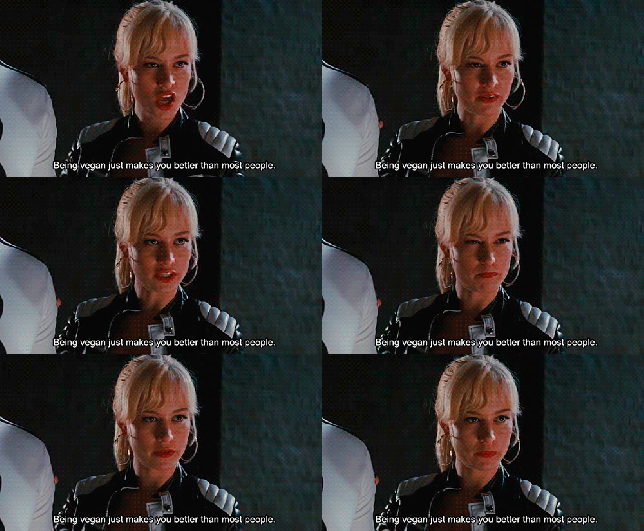
Edgar Wright soaks this movie in video game references. He got permission to use the 500fulltheme song from The Legend of Zelda by writing a flowery letter to Nintendo, calling it “the nursery rhyme of this generation.” The more you know video games, the more you’ll appreciate this, but even I can concede its greatness.
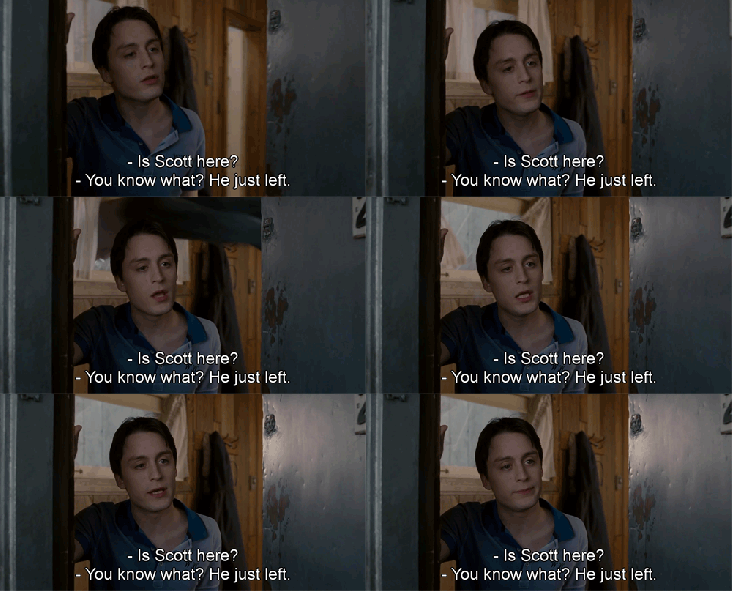
Moreover, Wright has a knack for casting that you can’t help but admire. He picked a whole bunch of young kids who would launch into stardom. Brie Larson went on to win an Oscar just a few years later, and Anna Kendrick a nomination.

Of course, my favourite part of the movie is how carefully Wright, an Englishman, preserves the Toronto locale. Toronto is a cheap place to make movies so it often stands in for other places, notably New York City. For once, Toronto gets to be Toronto, giphyunapologetically Toronto, with the TTC, Honest Ed’s, Casa Loma, and even dirty, dirty Pizza Pizza. This movie feels like home. In a meta moment, a fake New York City backdrop is literally ripped open to reveal the glorious Toronto skyline. When Scott Pilgrim earns points, the coins that rain down upon him are loonies and twonies, Canadian style.

And Wright, who is an excellent curator of music, finds some excellent Canadian bands to do the heavy lifting for him. Broken Social Scene wrote two of the 4-second songs played by Crash and the Boys (“We hate you, please die” and “Im so sad, so very, very sad”). Metric wrote the song performed by The Clash at Demonhead. And Chris Murphy vocalist and bassist for Sloan, served as the music performance supervisor, which I think means he made sure the actors held their guitars the right way and stuff. (Non-Canadian Beck wrote the music for Pilgrim’s band, Sex Bob-Omb).

Scott Pilgrim vs The World is ultra-stylized and brilliant to watch. It’s incredibly fast-paced and feels hyper real. It’s almost unbearably quotable, fresh, and inventive. The script can’t always keep up with the film’s flash and charm but darn if it doesn’t try. I’ve been in love with this movie for 7 years or so, and a recent re-watch confirmed that I’m still crushing hard.


What movies do you love to re-watch?