Two people who refuse to ever marry again meet at a wedding, as you do. Rachel’s (Meryl Streep) a writer, Mark’s (Jack Nicholson) a writer, and they both know better when it comes to love. So of course they end up marrying, though not before Rachel keeps everyone at the wedding waiting for hours and hours as she tries to warm up her cold feet in the room next door. I mean honestly, what’s the max time you would spend at a wedding if the bride was refusing to walk down the aisle?
As if that was an inauspicious enough start to their marriage, the two embark immediately on a home renovation. Which, as we all know, is responsible for like 78% of all divorces and about 94% of matricides (when a wife kills her husband). But they get through it, even with the added pressure of a baby on the way who can’t possibly be born if the lace curtains aren’t hung. And Rachel, newly domesticated, is surprised to find how happy she is. And is totally devastated to find, during the waddliest waddle of her second pregnancy, that Mark is cheating on her.
What now? The Streep takes us up and down a whole xylophone of emotions, hitting every octave with masterful precision. Nicholson is the oboe to Streep’s xylophone, a little jauntier, but hitting complementary notes, pairing nicely. Plus his back hair catches pleasingly in the moonlight. But make no mistake: the xylophone is dominant.
Directed by Mike Nichols based on an autobiographical novel by Nora Ephron, the intimacy is authentic enough to make you feel like a voyeur but you need to decide in advance that you’re here for the performance, not the story. Because there isn’t much of one: love goes off the rails. It’s sad but it happens all the time. The minute Rachel shoves a key lime pie in Mark’s face, she’s every cliche we’ve seen before and none we haven’t.
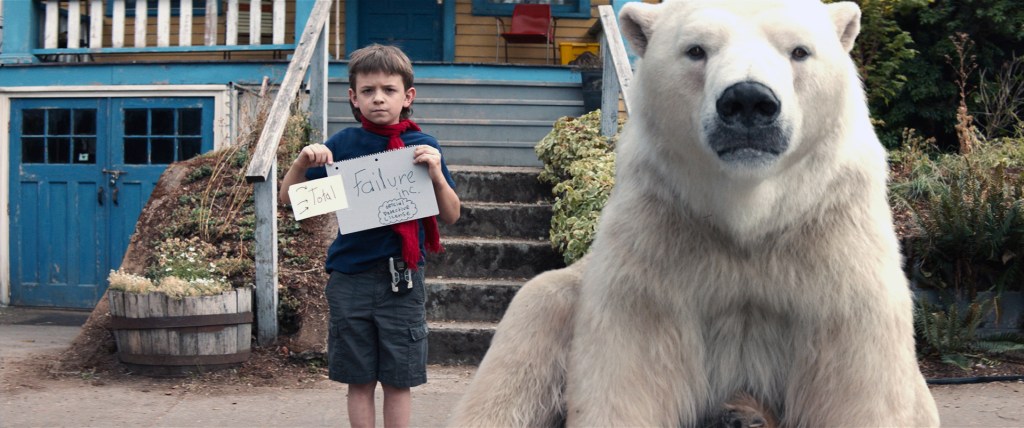
Timmy Failure has a misleading name, because he’s anything but. He may be young (11), but he’s the best detective in town (Portland). He and his partner, an imaginary 1500lb polar bear named Total, run the agency, called Total Failures, together. This may have been Timmy’s first mistake. Total is not the diligent and responsible polar bear he first appeared to be.
Timmy (Winslow Fegley), easily identified by his mullet and his red scarf (if not by his polar bear partner), roams the mean streets of Portland on the failure mobile, which looks suspiciously like a segway. But his case of the missing backpack is usurped by the case of the missing segway (eep!) which is in turn usurped by just trying to survive the 5th grade, his mom’s new boyfriend, his school’s rigid anti-bear policy, and the Russian spies overtaking his city. Gulp.
Winslow Fegley is a delightfully odd kid who pulls off charming and quirky in equal measure, exactly the kind of weirdo who’s a pleasure to watch. The whole cast, largely unknown, and largely children, are surprisingly talented and likable. It’s a good fit for a script that excels at being offbeat. Even the polar bear sidekick looks terrific, a visual witticism crashing about on screen. Timmy Failure: Mistakes Were Made is almost like a Wes Anderson starter movie, tonally odd but in a way I quickly became addicted to. I imagine this is the kind of movie the whole family can actually enjoy, its clever moments more than enough to keep adults entertained and the protagonist’s wacky antics enthralling for all ages.
Timmy Failure is a great piece of original programming for Disney+ and I wouldn’t mind a bit if there was more just like it (sequel?) on the way.
Monty Brewster (Richard Pryor) is a minor league relief pitcher who still dreams of the majors even though he’s a little long in the tooth. His best friend and catcher, Spike Nolan (John Candy), seems a little more content with their lot in life, just happy to still be playing ball alongside his best bud. But life is about to change.
A long, long, long, long-lost uncle of Monty’s has just died, leaving him, his sole living heir, millions of dollars. But there’s a catch:
He has 30 million dollars to spend in 30 days.
He MUST spend the entire 30 million, and if he does so, he’ll inherit a further $300M.
But he can’t acquire assets. At the end of 30 days, all the money has to be gone, to the penny, but he can’t have a single thing to show for it.
He can’t willfully destroy the stuff either.
He can donate 5% and gamble 5% but that’s it – the rest must be spent.
He can’t tell anyone what he’s doing. Not his best friend Spike, not even the paralegal Miss Drake (Lonette McKee) hired to keep tabs on all his receipts.
Ready, set, go! Imagine. Imagine leaving that meeting with a frothy sense of urgency. Imagine leaving the bank vault (this is 1985: it’s all cash) with a pile of money. What’s the first thing you’d do?
Monty makes a valiant attempt: he buys priceless stamps and slaps them on postcards, he prepares his minor league team to play the New York Yankees, he runs a phony mayoral campaign, he treats a lot of people to a lot of champagne lunches. But some of his attempts backfire; his high-risk investments somehow pay off, even his long-shot gambles hit big. Now he’s got to spend those dividends as well!
But the real comedy is that the people close to him look on in horror. To them, he seems to be burning through his windfall at an alarming rate. He seems crazy. And he is, more or less: this mandate to burn through money recklessly is crazy-making. Richard Pryor is a lot of fun to watch in these moments. He can hardly believe his “luck.” And the chemistry with John Candy is pure pleasure. But it leaves you wanting more: more Pryor, certainly, and more unfiltered Pryor in particular. Brewster’s Millions is a PG comedy, and Pryor is not at his best at that rating. So there are times when you’re almost seeing him reigning himself in. I’m certain that a very exciting director’s cut of this movie exists somewhere – or at least out-takes worth their weight in gold. Still, this is a fun, silly movie, not quite as good as others in its genre, but worth it for Pryor alone.
Nick Carraway meant to be a writer but is lured by the temptation of easy money to New York City for work, and a shack to stay in outside the city, on Long Island. He’s sandwiched between mansions, and across the bay dwells the old money, including his cousin Daisy Buchanan and her husband Tom. But everyone’s gossiping about Nick’s mysterious neighbour, Jay Gatsby.
There’s almost no one more suited to the decadence of The Great Gatsby than director Baz Luhrmann. Certainly Gatsby’s epic parties, brimming with booze, booming music, and beaded dresses, are brought to life with enthusiasm and an orgasmic level of detail under his direction.
But F. Scott Fitzgerald’s seminal novel isn’t just about the excess, but its flip side as well, the roaring/rotten 20s, the social upheaval and the resistance to change. But maybe a novel as ambitious as this, a book that has spoken to us for generations, belongs strictly to the page. Because as much as Baz Luhrmann gets right, the movie never quite grabs you the way it’s meant to. The way it should. Sean is a philistine who’s never actually read the novel (gasp!) and I wonder how his experience of the film differs from mine. For that matter, his experience of life.
Gatsby, you see, is the mysterious figure who haunts the pages of Fitzgerald’s genius work, but in the film, he’s all too knowable, especially when navigated by Leonardo DiCaprio, a muse of Luhrmann’s and an extremely familiar face to American moviegoers. And Tobey Maguire was already over when Luhrmann cast him as Carraway, the news just hadn’t quite made it to Australia yet. But Carey Mulligan as the luminous, quintessential, ethereal Daisy Buchanan? That was right. Inspired, even.
The best thing about this movie is and always has been Jay-Z’s genre-defying soundtrack. Luhrmann is no stranger to pairing period films with modern music to dazzling effect, but hip hop fits 1924 like it was always there, nestled between the cigarette holders and the champagne fountains and the bobbed haircuts. The costumes are a close second of course, every woman dripping with pearls and jet beads and scandalously raised hemlines. The accoutrements are perfection, so right that they almost distract from the fact that the movie itself is just wrong. And it’s not that anyone could have done it better. It’s probably just that no one should have even tried.
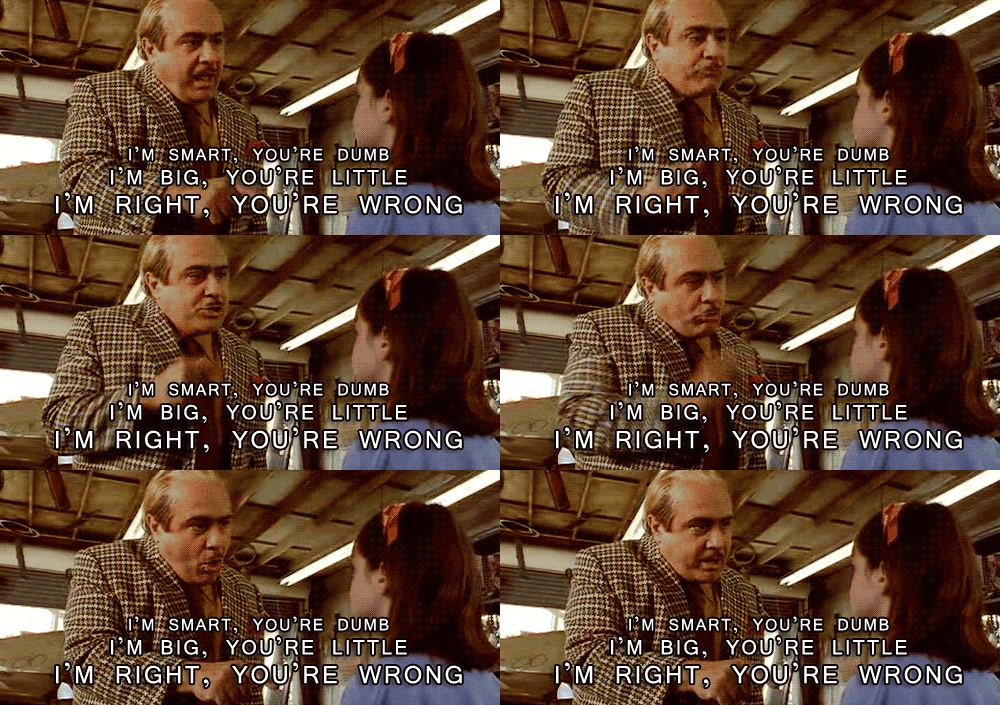
Matilda is a precocious little girl who just doesn’t fit in with her family. Her father’s a crook, her mother’s a bingo hound, and her brother is a bully and a dullard. Six year old Matilda is mostly left to her own devices, which is probably for the best. She devours books from the local library but isn’t sent to school until the elementary school’s principal buys a lemon from her sleazy salesman father and her fate is sealed. Now poor Matilda’s got three adults on her case: her buffoon of a father (Danny DeVito), her flighty mother (Rhea Perlman), and the horrid Mz. Trunchbull (Pam Ferris).
It turns out Principal Trunchbull doesn’t just terrorize the students at her school, but the teachers too, and Matilda’s sainted teacher Miss Honey (Embeth Davidtz) in particular because it turns out Trunchbully is also the mean old aunt who raised her. So Miss Honey and Matilda have loads in common, aside from the fact that they both read at the same level. They’re both looking to replace the misfit families they were born into.
As a story for children, Matilda is a bit of a weird one. It turns out that Matilda has special powers that come in handy when an adult in her life treats her unfairly. And objectively, the adults in her life are deserving of her scorn, but they’re wildly drawn caricatures, sadists and criminals. I suppose Roald Dhal wanted to acknowledge that sometimes children feel powerless and small and Matilda gets to confront this imbalance in a way that most little kids never will. They’ll simply wait to grow up and hopefully do it to their own kids one day. Such is life. Matilda gets to exact her revenge now, and it’s exactly the kind of revenge a 6 year old would think up.
Danny DeVito directs this little ensemble and though the effects have aged incredibly poorly, it must be said that the casting of Mara Wilson as the eponymous star was a stroke of genius. She is believable as a little know it all but somehow always sweet, never obnoxious. She never seems like a brat. She’s the kind of kid you might just want to scoop up and take home – so it’s almost understandable when the lovely Miss Honey does just that. Okay, not really. In real life I think it’s much harder to adopt a kid who has two living parents. But in the movie, both Matilda and Miss Honey get their happy ending, and it’s hard to argue that.
However, it’s easier to argue other things. Like when Miss Honey confides in Matilda that her father’s suicide was actually probably murder, and Principal Trunchbull the murderer. Which is a weird thing to unload on a kid. And to not share with the authorities for decades. But Miss Honey isn’t exactly the angelic teacher we’re led to believe she is. She rather passively stands by and watches her wee tiny students get abused on a regular basis. She actually seems a bit like an idiot. But who’s counting?
Once upon a time, a lovely young woman named Jay flew first class. Yup, all those travels, and it was just the one time. I don’t even remember where we were going. What I do remember: 1. it was an early morning flight 2. the breakfast was good 3. I had a mimosa 4.The Lorax was playing 5. I almost immediately fell asleep and missed the whole thing. I think we got a pretty good deal on the upgrade but still, it was disappointing to have slept through all the luxury. Of course, it was probably only because of the luxury (read: space) that I could sleep. Still. I kicked myself. I kicked Sean too; he also slept, though it’s a less a rarity for him.
But all this time, I’ve wondered: is The Lorax boring, or did I just fall asleep because it was a 6am flight and I was incredibly tired?
The Lorax is based on a Dr. Seuss story in which a 12 year old boy, Ted (Zac Efron), decides to impress a girl, Audrey (Taylor Swift), by bringing her a tree. A real, live tree. Which no longer exist. They live in a place where the trees were replaced long ago by sculptures of plastic lit up by dozens of C batteries. Their whole town is utterly devoid of nature. They’ve been denuded. But Ted has a pretty big crush on this chick Audrey so he treks out to an isolated home where he meets the elderly Once-ler (Ed Helms), the one responsible for the world’s current problems. As a young man he was so determined to have his company succeed that he thought nothing of cutting down all the trees. He butted heads with the guardian of the forest, The Lorax (Danny DeVito), but he wouldn’t change his mind until it was too late. And the thing about too late is that it’s true to its name: too late.
Sean asked me how heavy-handed the environmentalism theme was, but I actually consider it to be more anti-capitalist than anything. The Onceler’s greed costs them everything. And yet this kid-friendly, animated family film is basically one long commercial, replete with product placement, basically neutering its message.
The animation is lovely. Illumination has done several Dr. Seuss adaptations at this point and they’re pretty adept at the translation. Their trees look like swirls of cotton candy. The town is fairly bursting with brilliant details. And yet once again this film has failed to truly grab me.
Rachel (Diane Kruger) calls Thomas (Martin Freeman) and says “My father died. Again.” It’s code for: get me the hell out of here. She is the operative, he is her handler, and she worked undercover in Tehran for the Mossad where things got…sticky. Her subject, Farhad (Cas Anvar) becomes her entanglement and if things were complicated before, well, they only get more so. Is she working both sides? Have her allegiances shifted? Dude it’s hard to trust a spy. Now, years later, she’s bringing Thomas back in. But why?
And also: who cares? The truth about spy work is that it’s probably boring like 99% of the time. Lots of sitting and waiting. Reading. Researching. Waiting some more. Blending in. Not getting up to much. Waiting for the phone to ring. Movies cut that shit right out. To be fair, The Operative edits out those same things as well, gets right to the getting-the-hands-dirty in the field bits. And yet it still, amazingly, manages to be incredibly boring. Incredibly.
Neither the story nor the characters were compelling. I love Martin Freeman but despite him being as animated as this movie got, I still couldn’t muster much enthusiasm. Diane Kruger was as remarkable as a boiled potato. More than once I asked Sean how much longer this movie had left, and more than once that Netflix progress bar seemed barely to have moved.
Yuval Adler’s film is unflashy and unstylish. Calling it forgettable is an insult to films I’ve merely forgotten. This one caused a fair bit of frustration even as I forgot it. I could hardly keep my attention even half on the film, snapping it back only to be disappointed by instant boredom yet again. And then it ended. Well, not so much ended as stopped. It just stopped being a movie exactly when it seemed it might have justified its existence. But no. The thing you’ve hung in there for 2 hours for…it never materializes. And yet you’re only half mad because even if you didn’t get a satisfying ending, at least it’s over.
Richard Linklater managed to get his hands on best-selling source material (the book, by Maria Semple, spent a year on the New York Times bestseller list) and systematically removed everything that was good and charming and unique about the novel to produce a bland and facile piece of film.
In the book, Bernadette is a reclusive but loving mother who suddenly disappears. Her husband and daughter believe her to be dead. Her teenage daughter Bee more or less narrates the story, mostly told through uncovered documents of her mother’s, piecing together her mother’s life, and discovering hidden depths and wells of sorrow. In the film, Bernadette’s whereabouts are never in question – we witness her escape and follow her on her adventure and see things through her eyes. You can hardly blame Linklater for this transition; with Cate Blanchett in the role, it would feel almost sacrilegious not to. But it does change the nature and structure of the story significantly, not to mention negates the mystery completely.
But that’s hardly the film’s only problem. I mean, the characters are just not likable. Bernadette, of course, is not meant to be likable – she has retreated from society, she burned out on humanity and doesn’t suffer fools, or many non-fools either. But her husband (Billy Crudup) is a workaholic, disloyal asshole. Her neighbour (Kristen Wiig) is an entitled twat. Her assistant is a scam artist. His assistant is a homewrecker and a gossip. Their therapist (Judy Greer) is an unprofessional over-stepper. It’s an unrelenting parade of unappealing characters, the only bright spot daughter Bee (Emma Nelson) and we’ve already discussed how Linklater chose to shine the spotlight elsewhere. Oof. But only a few of these characters are without sympathy. Mostly the problem is that Linklater never takes a stance. His indecision is stamped all over this movie. He clearly wasn’t up to making the book spark on screen so he neutered it, shot it very conventionally, and then acted surprised when no one was overly impressed by his mess.
Where’d You Go, Bernadette is actually about what happens to a creative genius when she stops creating. That’s the core theme in the book: Bernadette lost her creative outlet and just started wilting. But in the movie, she just comes off as a crazy lady who has a mental breakdown and then flees to Antarctica on some hair-brained mission. And her husband makes so many poor decisions you just wish someone would throw him overboard and give the narwhals a hearty lunch.
The only thing that remotely saves the movie is Cate Blanchett, who is luminous and quirky and vibrant, doing much of the heavy lifting that realistically, both Linklater and a solid script should have done for her (and frankly, for us). She is a delight to watch but you never shake the feeling that this film should be so much more than it is – and that’s true even if you haven’t read the book and you aren’t watching it next to me, a person who is loudly bemoaning the very substandard adaptation. Where’d You Go, Bernadette is sadly lost in translation.
I forget sometimes that I speak French. Well, maybe not forget so much as don’t think about it. Much like I don’t specifically think about speaking English. I just do. If I hear or see French, my brain understands without me having to engage anything in particular. It’s just effortless. Growing up we spoke both at home, both at the same time, every sentence seasoned with both languages, choosing whichever words or expressions suited us most. So when I started watching this French film on Netflix, I listened without thinking, and since I was also doing work on my laptop, I didn’t even realize there were subtitles, and may not have consciously realized it was French until I glanced up and my brain shuddered: the subtitle had a mother calling her son “sweet pea” when in fact what she called him was a “soft caramel.” Soft caramel isn’t really a thing in English. I mean, it’s a thing you can eat, but it’s not a term of endearment. So the subtitles substituted for something that made more sense but wasn’t a direct translation. This happens all the time of course, sometimes with hilarious results, but when you’re understanding both at the same time, it can be a little jarring. I’m positive Netflix must have an option for turning off the captions but I’m also positive that about 4 minutes of bumbling through buttons netted no results.
So here I am, watching an animated movie with two tracks, basically: spoken French and written English, and the two are in basic agreement. It’s about a little boy named Naoufel who dreams of becoming a concert pianist and an astronaut. And about the same young man, grown up, who is a pizza delivery guy. Which I feel is supposed to be some sort of humbling come down, but what has an astronaut ever done for me? And yet the pizza guy routine brings joy, hot and cheesy, to my front door. My life would be worse without him. Anyway, Naoufel isn’t exactly the most exemplary of deliverymen, and one night when he’s struggling even more than usual, he just gives up, gives in, sits down in an apartment lobby talking to a woman on the intercom while he eats her undeliverable pizza. He falls in love and devises an elaborate scheme for stalking/wooing her.
Meanwhile, across town, a disembodied hand escapes from a laboratory fridge. The hand goes on an epic Parisian journey through the city’s gutters, fending off pigeons and rats. The hand is sad, I think.
Yeah, it’s weird. That might be the weirdest sentence I’ve ever written here. It’s damn weird to have a stalker love story be intercut by a dirty roaming hand. And all the dirty, greedy flies who follow it. And yet it is strangely beautiful, poetic, almost hypnotizing. The animation is soft, subtle. The story is intimate and sad, truly something unique and unforgettable.
Alice may have avoided her unfortunate tumble down the rabbit hole had her mother not been such a bore. She’s reading to her in a tree from a book that doesn’t even have any pictures. Practically a textbook. No wonder Alice resoundly rejects it, and the boring, logical world that it espouses. She’s positively ripe for following a charismatic leader, or tardy hare, into a world of nonsense and nonconformity.
Alice, as it turns out, is a self-pitying, impetuous crybaby. She is such a little deviant, in fact, I wonder if 1951 audiences figured her for a commie. Now, as an adult, I can see her for the petulant spoiled brat that she is, but as I kid I was blinded by her pristine blue pinafore and her perfect blonde hair. I writhed with jealousy when my mother cast my youngest sister as Alice in our school’s entry in the Christmas parade one year. The theme was story books and our float was Wonderland-themed. My mother, god bless her overachieving soul, was determined to make a costume for each and every kid in the school who wanted to participate (not quite as terrible as it sounds: we had less than 100 students). There were caterpillars and psychedelic flowers, the white rabbit of course, and a mad hatter. And dozens of people trailed the float as either story books of a different ilk, or members of the Queen of Hearts’ playing card army. The Queen was played by the school’s tiniest, most taciturn teacher – a part she was born to play, but I don’t know how my mother proposed the idea without being threatened with her own beheading. Meanwhile, as the eldest daughter who routinely ‘took one for the team’, I walked in front of the float, just me and my childhood crush carrying our school’s banner. We were dressed as Tweedle Dee and Tweedle Dum. I don’t remember which one I was, but pictures would prove clarifying as my little propeller hat identified me rather firmly. We lacked a proper costume from the neck down and were compelled to wear matching California Raisin costumes for uniformity, and perhaps just flat-out maximum humiliation. My mother must have WANTED me to hate my sister. She made it fairly impossible not to.
Anyway, if I sound bitter in this review, it’s because I am.
Drinking helps, which is fortunate, because Sean, Matt and I are in Disney World for the forseeable future, where we’ll have ample opportunity to meet Alice, should we want to. She hangs out by the teacups ride which is actually called the Mad Tea Party, and is often accompanied by a Mad Hatter at the very least. When I visited the park with my sister back in February (NOT the one who played Alice), she turned an alarming shade of green as her 4 year old son put an extra spin on our trip. But should we miss her in Magic Kingdom, she also hangs out in Epcot, in the U.K. pavilion, directly across from the Yorkshire County Fish Shop in The Tea Caddy Gardens. Mary Poppins can often be seen strolling about with a parasol on her arm in the U.K. portion of the World Showcase. Other countries have their own princesses: Belle in France, Anna and Elsa in Norway, Mulan in China, Jasmine in Morocco. There are no princesses in the Canadian pavilion, just a bunch of poutine and some maple-flavoured popcorn (though I sort of think Duke Caboom should hang out there, revving his motorcycle).
The World Showcase is fun in many ways, not least of all because you can literally drink your way around it, with each country providing many samples of their finest hooch. There are margaritas in Mexico and prosecco in Italy and Oktoberfest beers in Germany. Because I’m ambitious, and mean, I intend to subject Sean to this booze tour, so I’ll take the opportunity to suggest you visit our Twitter feed at @AssholeMovies because there are 11 countries and countless opportunities to get your drink on, including an alcoholic popsicle stand, and a Frozen-themed blue lemonade spiked with moonshine. I predict Sean will need propping up by the time we hit Japan.
Anyway, please pardon my little digression. Back to the movie. I’m still rather astounded at how much they got away with, stuff that feels like pretty blatant drug references to me, counterculture stuff that seems out of place in a Disney movie, especially one with a little girl for a protagonist. I mean, she literally eats mushrooms.
The Cheshire Cat sounds awfully familiar – like Winnie The Pooh really, without much embellishment. I check IMDB and I’m right: Sterling Holloway voiced both. He was also Mr. Stork, in Dumbo, adult Flower in Bambi, Kaa the snake in Jungle Book, and Roquefort in The Aristocats. Disney’s casting certainly was incestuous. Sean and I ate at the Cheshire cafe last time we were in Disney, and we can certainly recommend the Cat Tail, and the Wonderland slushy. This time we’ll be dining WITH Winnie the Pooh (can you stand the excitement?) – and his pal Tigger too!
This movie actually takes from Lewis Carroll’s two Alice books, Alice’s Adventures in Wonderland and Through the Looking Glass (fun fact: I once saw a Looking Glass play in Stratford starring a young Sarah Polley, then known as Canada’s sweetheart for roles in Ramona and Road to Avonlea). Alice is here voiced by Kathryn Beaumont, who also voiced Wendy in Peter Pan, and continued to do so until her retirement in 2005 (reminder: this movie came out in 1951!). You can still hear Beaumont narrating the Mad Tea Party ride to this day in Disneyland. That’s her here, providing a live action reference for Disney animators.
And somewhere in the Disney parks, I am currently the live action reference for a grown woman having far too much fun.
[In fact, I believe today we are attempting to ‘Drink Around the World’ in Epcot. Epcot’s World Showcase has 11 country pavillions and we’ll be grabbing a drink in each one. Sounds like potential disaster! Why not keep tabs on us via Twitter – @AssholeMovies, and be sure to play along on the Disney Bingo card.]
Update: Watch the Assholes accept the Drink Around the World Epcot challenge – and watch us demolish it???









 ASSHOLES WATCHING MOVIES