
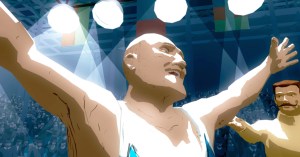
 Cafard is the French word for cockroach. But make no mistake, the animated film Cafard is not the French version of A Bug’s Life. It’s a bleak, adult tale about the horrors of the first World War, from the perspective of a world champion wrestler who enlists in the Belgian army in 1914 after his daughter is raped by German soldiers. Unfortunately for all involved, that terrible event is only the start of the awfulness.
Cafard’s story is told well but it didn’t thoroughly draw me in, and I wonder whether that is because I never related to the protagonist. While well-meaning, his brute force approach did not translate from wrestling to the rest of his life, and his journey is unsatisfying as a result.
The film’s subject matter was likely a cause of my detachment as well. This is a movie that is difficult to get close to, because it does not sugar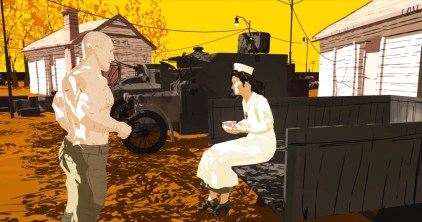 coat any aspect of war’s horrors. While that approach is commendable, it is that much more difficult to embrace Cafard. I would have liked for the film to have offered something to offset its harsh subject matter, but there is no joy to be found in this world. Any hint of happiness feels fleeting, like a consolation prize at best.
Fittingly, Cafard’s motion capture animation is harsh and eerily realistic, just like its storytelling approach. The visuals fit the movie tonally but are at times distracting, particularly because Cafard by and large is almost photorealistic but there are occasionally very roughly drawn scenes that seem like they contain animation errors. It is too bad because those moments are few and far between but that made them even more jarring when they appeared.
Despite those minor complaints, from an artistic perspective the film consistently reflects Cafard’s sad subject matter, and tells its story effectively and with purpose. That is an achievement deserving of mention. The film is thematically consistent and demonstrates the futility of war from start to finish. Cafard hammers home that theme and I left the theatre feeling that the filmmakers might even be satisfied that I found the film so difficult to enjoy. War is hell, after all, and Cafard delivers exactly that.
 As you may know, Pixar started the trend of releasing shorts before their films. It was a great way to showcase some stellar work that often gets overlooked. Disney has taken a page from the Pixar handbook and saw lots of success with its Frozen short, Frozen Fever, which aired before Cinderella. Inner Workings is slated to debut before their November release of Moana.
 and his heart. From the moment he wakes up, we see the interplay between his two most boisterous organs, and the way they direct the others as well. The organs have been properly Disneyfied – they are cute, they are funny, but they are never gross or full of blood and guts. Paul is just a regular guy who’s got to get to work. His brain marches him toward the office while his heart is distracted by the many other tempting options. The pace is jaunty, the jokes are clever, the short is colourful.
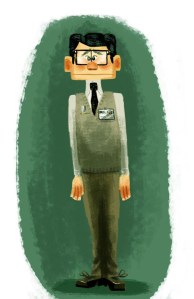 the encyclopedias he studied as a child, clear plastic pages holding the nervous system, circulatory system, etc of a man that could be overlaid on a body to see what fit where. Working at Disney as a storyboard artist, Leo along with many others, was invited to an open-pitch, where anyone could present their idea to John Lasseter and one would be chosen for production. Leo wrote his story with those encyclopedia images in mind. Spoiler alert: Leo won. Lurie mentioned that his deadpan pitched coupled with fanciful and humourous drawing really made his presentation stand out.
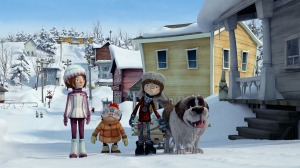 territory, the whole school would assemble into our tiny gym, and one of the few movies screened for us on a 24-inch TV was La guerre des tuques. It was a movie about a bunch of kids who wage an all-out snowball fight in the vicinity of a huge snow fort during their winter break. La guerre des tuques literally translates to war of the tuques, but the English version was called The Dog Who Stopped The War.
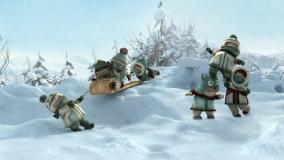 yes there are hockey sticks, but also lacrosse sticks and curling brooms.
 not going to query studios or go to auditions, they’re done with doing it the Hollywood way. Now they’re desperate enough for the lowest kind of fame: Internet fame.
 underground tape X-V, literally a supercut of every fantastically horrific, violent, gory thing that has ever happened on film, set to some delicious pop. It’s nauseating good fun.
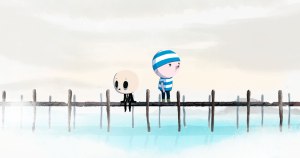 Psiconautas finds beauty in unusual places: decimation, addiction, and poverty, to name a few. In a word, the art is stunning. It feels like a throwback in its hand-drawn aesthetic, and yet feels modern in subject matter and futuristic in its setting.
 Like why a mouse’s stepfather is a human dressing up as a mouse, why her “fake brother” is a bulldog wearing a luchador mask, and why her bird boyfriend is possessed by horrific crows.
 in a good way. All of it has meaning, all of it is a blurry reflection of our society, from our proclivity to make trash to our struggles with addiction to police brutality. I left the theatre wanting to immediately watch Psiconautas again to see what other threads could be tied together.


 This movie looks different, feels different, sounds different. Actually, I’d heard it was a silent film, and that’s not quite true. There’s a smattering of dialogue, unsubtitled, but that didn’t bother me. The images and the score are so evocative they’ve already buried under your skin, and you know what’s going on even if you can’t decipher the words. I probably shouldn’t admit this next bit, but upon looking it up, I see that the language is actually just a made up one – backwards Portuguese, apparently – so
  that may reassure you while making me look stupid. Incidentally, I don’t speak Portuguese forwards either.
 his father, only to find many identical men exiting an office building. Has his father become a clone? Has the city stolen his soul? Is there simply no difference between men who don’t make things with their own hands?I’m not sure of the exact sentiment the Brazilian film makers were hoping to convey, but that’s kind of the beauty of the thing. In its quiet, it allows the viewer to be making judgments for herself, and my reading of it was obviously pretty damning.
 images we’ve ever seen” and I think that’s putting it mildly. It’s some of the most innovative work I’ve seen in a while, despite the fact that the main character is basically a stick man, truly thrilling to watch and absorb. There we go, that’s what I’ve been getting to this whole time: it’s a movie that you don’t just watch. You experience it. The visuals feel quite personal and they take you back to your own childhood while thrilling you and keeping you guessing. All the drawings were hand-made
 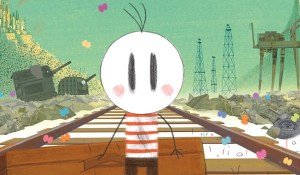 by the Director, Alê Abreu, and I just love how he makes this very basic character come to life against a geometric, swirling, abstract background. It’s moving. This is an image-heavy post, and I think you can tell it’s for good reason. Yes, I could talk about this all day but honestly, this is one you’ll have to see for yourself, if only you feel up to risking the nontraditional style.
 ASSHOLES WATCHING MOVIES