
In her late 40s, Judy Garland is down on her luck, near destitute in every way but loaded with debt, desperate to make just enough money to keep her kids with her but never quite sober enough to make it work. In America, her reputation for being unreliable practically a national headline. The real money is in London, but that’s a whole ocean away from her kids. But needs must.
The thing is, Judy’s demons are portable. They travel with her. Her engagements do not run smoothly. We flash back to her early days in the studio system, circa The Wizard of Oz. Studio head Louis B. Mayer is a total dick. He steals her childhood and replaces them with pills. Pills for everything: to pep her up, knock her out, thin her down, keep her going for 18 hour days. Judy’s addictions are traced with a very straight line back to these early days, before she’s even old enough to question them. Her parents practically sell her to the studio and she’s completely at the mercy of people who just want to exploit her.

But that voice, that talent, those unforgettable movies: it wasn’t Judy who got rich on them.
These shows, the London shows, are some of Judy’s last. She will be dead in 6 months, and the fact that she is waning is clear to all. A good day means a fantastic show: the legend is still in there somewhere. But there are bad days, and very bad shows.
Judy is not a biopic, it’s a very small sliver taken mostly from the end of her life. It is 0% glamour. This movie is a performance piece. It is a 100% ‘for your consideration’ love letter to the Academy for Renee Zellweger to be considered for her Oscar, please (in fact, she’s already got a Best Supporting, but rumour is, it’s a little lonely up there on her mantelpiece).
I never quite forgot that I was watching Renee, but I did often see Judy (and Sean, being less familiar with Judy, saw Liza), so she was doing something right. She was doing a LOT right: she channels Judy’s voice, singing more so than speaking. And she nails the spastic mannerisms of a pill-popper, jerking painfully across the screen. The total effect is an awful lot of sympathy for an icon who really just wanted to be a regular woman. But if you’re not a fan of Judy, there may not be much there for you. There isn’t a plot. There’s mostly just going to and from the venue, with gin and tonics in between. Is it a great, meaty role, well performed, with much to be admired? Absolutely, taking up so much space it leaves room for little else.

 In The Whole Truth, Keanu does indeed play a lawyer who is defending the son of a former colleague and longtime friend. The son is accused of killing his father, that very same former colleague and longtime friend. I’m sure Keanu would like to believe that his client is innocent, but his client isn’t talking. And his client’s mother (Renee Zellweger) is mostly weeping, and begging Keanu to save her son’s life.
 Must Love Dogs: Poor Diane Lane is so love-starved that her family takes her new singlehood into their hands, fixing her up with an internet dating profile she doesn’t want, or necessarily know exists, but which insists that all suitors ‘must love dogs.’ This is a pretty good gambit because along comes John Cusack, with a borrowed dog and good intentions. And that’s okay since her dog – a Newfie named Mother Theresa – is also not technically hers. Thus a relationship is born from the ashes of lies and non-shared non-interests. Condom hi-jinks and some VERY suspicious coincidences: classic.
 Florida newspapers – she successfully, he decidedly not. When they think about starting a family, they adopt a dog instead, to test the waters. The puppy is incorrigible but provides fodder for a column and suddenly he has a career too. The babies come, eventually, and changes in home, work, and friends. Marley’s there through it all – but well all know dogs don’t live forever. I’m sure this one hits Batman right in the feels. Dogs are the one thing he likes more than John Cusack.
 laundromat until one cold night a kind laundromat owner didn’t kick her out at closing time. She’s been living in Fox Laundry ever since – some 25 years now.
 her hard-won wisdom, and an outlook that’s totally unique. She’s cantankerous and whimsical and totally intolerant of homeless people (she doesn’t see the irony). And she has a knack for making famous friends: Zach Galifianakis has taken her to movie premieres (he met her while doing his laundry some 18 years ago), Renee Zellweger takes her shopping, and if you promise to keep a secret, Zach’s about to put her up in an apartment all her own. She hasn’t had a home since 1976.
 inadequate replacement is Patrick Dumpsey. I am very firmly NOT aboard the McDreamy train. I am on the station platform, eyebrow cocked, arms crossed, unamused ember in my eye, willing it to just get on with it already. Good riddance. The only thing I’ve known him from is Can’t Buy Me Love, and I’ve not been induced to rectify that. Still, I was unprepared for how astoundingly bad Dumpsey is in Bridget Jones’s Baby. Dear god. He’s really, really bad.
 she’s also got a nice social life and a good job, so she feels more well-rounded and less pathetic. Well done, feminism! And she isn’t whining and pining over two men, either. This time she’s chosen both, laid them both, and wound up pregnant. Who’s the daddy?
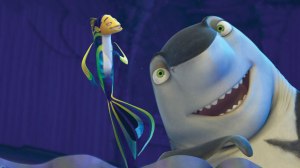 accused of that more than once, and that’s the theory behind Shark Tale conveniently riding on Finding Nemo’s coat tails. Both are animated movies dealing with outcast sharks befriending fish. Doesn’t that seem like quite the coincidence?
 my favourites were Martin Scorsese and Robert DeNiro, who recorded their lines together, and if you look carefully at their characters, you’ll see some tell-tale eyebrows and a distinguishing mole.
 that Lenny the Shark was a bad example to kids because his VEGETARIANISM was an allegory for HOMOSEXUALITY. Um, no comment.
 ASSHOLES WATCHING MOVIES