
Greg (Owen Wilson) is having a very bad day: he’s getting divorced, estranged from his kids, living in a motel, and now he’s getting fired. And now he’s accidentally killing his boss while getting fired! And how he’s hiding the body and fleeing the building! A very bad day indeed. In the bar across the street (note: not the wisest place to hide out), he meets Isabel (Salma Hayek), who tells him not to sweat it. Why? Good question. Because this whole world is fake, she tells him, a mere simulation of her own creation. She and Greg are real (in fact they’re “together”) but nearly everyone else is essentially an NPC, just a simulated person able to walk around and interact, but nothing more than a character in a very sleek video game. And there’s proof: Greg and Isabel have powers! They can make the fake characters do things with their minds. How about that?

Greg and Isabel go on a bit of a bender, Greg intoxicated by his newfound powers, happy to forget the woes of his other life and to reap the benefits of a new partner in crime. But there’s more. This world, remember, is a mere simulation. In the real world, Greg and Isabel are scientists, and this is Isabel’s research, and her creation. When they exit the simulation, Greg finds himself in a utopia, a world made perfect by science and technology. A little too perfect, actually; because you need bad in order to appreciate good, the utopia has become less and less satisfying, hence Isabel’s creation – a world in which you can live a rough life in order to better appreciate the perfection back home. Except Greg and Isabel have exited the simulation too abruptly and now both worlds are starting to bleed into each other and they’ll need to risk going back and getting stuck in order to correct it.
Or.
Or there’s another way to watch and interpret this movie. Perhaps Greg’s addiction to painkillers takes a turn for the worse when he loses his job and his home. Maybe Isabel is just a schizophrenic addict and they’re sharing a common hallucination in order to escape their life on the streets.
Bliss is purposely ambiguous and this movie is going to be very divisive because of it. Sean hated it because he made up his mind very early on and felt the whole exercise was pointless once he’d “figured it out.” I felt differently, having embraced the dichotomous possibilities. Writer-director Mike Cahill is careful to scrub the film of any telling language. No one says drugs. No one says addict. Yet there remains evidence for both sides of the coin. Greg has a grown daughter who never gives up looking for him. Isabel is adamant that Emily (Nesta Cooper) is just another fake character, but if that’s the case, why does the story sometimes get told from Emily’s point of view? That would seem to indicate that she’s real. Which goes double for Isabel, who might be just a figment of Greg’s imagination (or a side effect of his high), but she, too, is seen working independently in the movie. Sean insists that Greg is an addict, case closed, but this easy interpretation doesn’t account for the fact that we glitches in the matrix very early on. His wallet, for example, suffers a glitch, unobserved by Greg, seen only by us. Why would Cahill go out of his way to show us this if he wasn’t planting seeds of doubt? Of course there’s a third possibility here, that neither of these worlds is the “real” world and we haven’t seen the end of the simulations. Of course, you’ll have to watch the movie to find out where on the spectrum your belief lays. Some will see this in black and white and others will rejoice in the grays. But I believe there’s some hidden pink, and a very careful watch may uncover it still.
If you’re interested in taking on this puzzle, you can find it on Amazon Prime – but do promise to come back and let us know what you think, because Bliss is only 90% a movie. The other 10% depends on what you bring to the table.








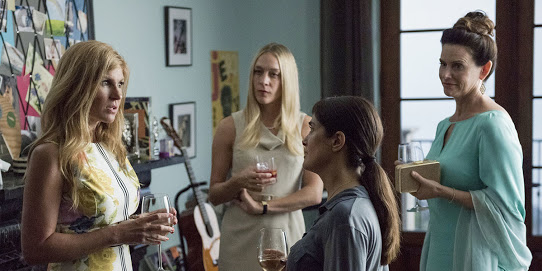 That would have made for a boring movie had Beatriz’s car started up as it should and allowed her to drive away afterward, but no. Beatriz’s piece of shit car did not start, and her friend can’t come fix it until much later, and presumably she’s too poor to have it towed, so Kathy extends a shaky, not-really invitation to dinner party since they’re “practically friends” and Beatriz accepts.
 Belorussian dictator (Gary Oldman). So he cuts a deal: if they let out his wife (Selma Hayek), he’ll give testimony. The only catch is that every other witness has been systematically murdered. Sam Jackson nearly is as well, but one of Ryan Reynolds’ disgruntled CIA exes calls him in at the last minute to try to get Jackson to the Hague in one piece.
 The basic premise is: what if your food had feelings? Like, every night when the grocery store closes, the food comes alive in almost exactly the same way the toys do in Toy Story. But in Toy Story, the worst thing we do is neglect our old toys. Worst case play with them too roughly. But we flipping eat food! And before we eat it, we torture it: we cut it, mash it, boil it up, set it on fire. At first the food is blissfully unaware of its weird relationship with us, but when they eventually find out it’s supermarket anarchy.
 sausage fest. And of course I cracked a few laughs. I absolutely did. But mostly I didn’t enjoy myself much. I feel too guilty to laugh at something so obvious and offensive as a bottle of “fire water” with a Native American accent (provided by white guy Bill Hader). And while that might be the most culturally inappropriate, it’s not the hardest to watch. Not with a used condom sloppily lamenting its fate, or toilet paper experiencing PTSD.
 scenes for her behind her back, forcing Alba to keep the bikini thing going for far longer than she was comfortable with. The gimmick worked though, and her bikini is
 what people remember most about the movie. Kate Bosworth made her bikini mark in Blue Crush, a movie about “girl surfers” with an impressive amount of wardrobe changes. Bosworth wasn’t the only one turning heads – her whole crew, including Michelle Rodriguez and Sanoe Lake, looked equally fabulous wearing not very much.
 a better example than Kate Upton bouncing around in
  o make Cameron Diaz, an honest-to-god-Charlie’s-Angel, to feel vulnerable? (Sidebar: who among us could forget when a 40&fab Demi Moore strutted around in her bikini, putting those Angels to shame?) Meanwhile, Brooklyn Decker was on hand to heat things up in Just Go With It
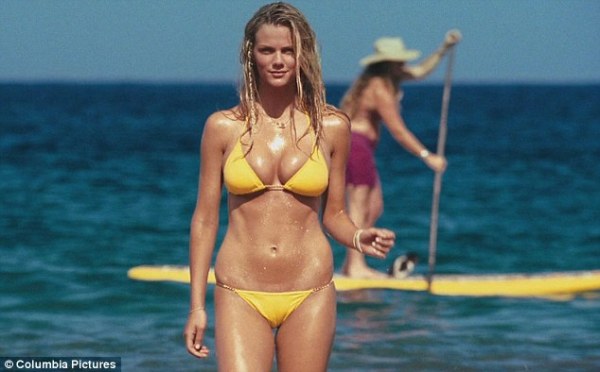 and did a mighty fine job of it until her co-star Jennifer Aniston took off her own clothes revealing that “sneaky hot
 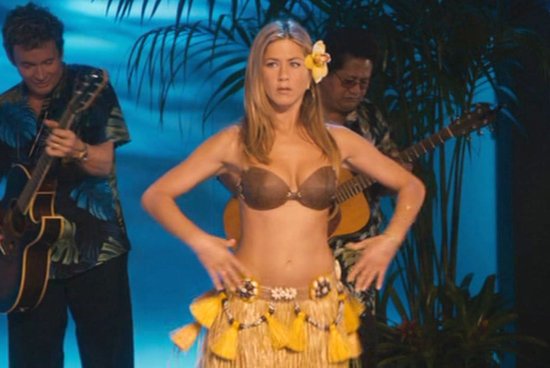 body” (and then had a coconut-bikini-off with Nicole Kidman, just to keep things classy). And I can hardly write a bikini post without mention of Bunny Lebowski (Tara
 Reid) in her lime green bikini (and matching scrunchie!) asking for her toes to be blown on. The 90s were a fabulous time. Just two years later, another bikini was making an impression on me: Virginie
  Ledoyen was looking fine in Danny Boyle’s The Beach. Oh to be the sand upon which she lays. The bikini, by the way, has a great built-in sand disposal unit. It has nowhere to hide! And how can we forget Salma Hayek revealing herself to
  English-speaking audiences in a daring little bikini (boldly accessorized) in From Dusk Till Dawn. She owned that thing like she owned us. Also
  sealing sex symbol status in bikinis: Angelina Jolie in Tomb Raider. Not that her usual Lara Croft attire left much to the imagination, but fan boys like skin and she was prepared to flash it, as long as she could still strap on
 her weaponry. Margot Robbie, however, didn’t need knives, because she’s got killer curves and puts them to devious use in
  Mousketeer, the epitome of wholesomeness) so you could say that it was her rather dowdy swimsuit that helped pave the way for newer generations of Disney stars gone sexy, like Selena Gomez in Spring Breakers.
 pin-up-worthy movie poster for One Million Years B.C. in which she wore a bikini made of animal skin, infuriating PETA. Sorry PETA, but I think it’s clear that Raquel wins.
 Another dubious choice for bikini material: Pam Grier’s crocheted bikini. I don’t want to think about what it looks like if you get it wet, but here’s the thing about Pam Grier: she makes everything look cool. And speaking of bikinis you wouldn’t want to get wet, how about that m
 etal slave bikini that Leia wears in
  This list wouldn’t exist without Bo Derek. She has proven over and over to be a perfect ’10’ and has more bikini looks than I can count. I might be slightly partial to this one. Brigitte Bardot has also earned herself multiple entries onto this list and actually starred in a movie called The Girl in the Bikini, although she’d popularized
  the look as far back as 1956 in …And God Created Woman. No matter when or where, she’s always doing it justice.
 Gloria Hendry is to be applauded not just for sporting a bikini while kicking ass in Live or Let Die, but for successfully accessorizing it with a machine gun. She’s tough and fit but proves she’s also sassy and feminine in her swimwear. James Bond never stood a chance.
 send-up to an earlier Bond Girl: Ursula Andress 40 years prior in Dr. No. She too appeared from the sea in
  nothing but a bikini and a blade. The copycats don’t end there: you may remember that Heather Graham sported a similar look in Austin Powers: The Spy Who Shagged Me.

 ssory: Sean Connery.
 Diamond-smuggling bad girl in a hot bikini: Tiffany Case (Jill St John) from 1971’s Diamonds Are Forever.
 Caroline Munro throws a kimono over her bikini in 1977’s The Spy Who Loved Me.
 ASSHOLES WATCHING MOVIES