
Growing up in Creekville, South Carolina in the 1970s, Beth (Sophia Lillis) has always felt like an outsider, even especially in her own family. The only relative to whom she relates is Uncle Frank (Paul Bettany), who seldom attends the various family functions meant to bring them all together. She feels surrounded by small minds and limited experience, and she’s not wrong. Which is why she eagerly follows in Uncle Frank’s foot steps to Manhattan as soon as she graduates.
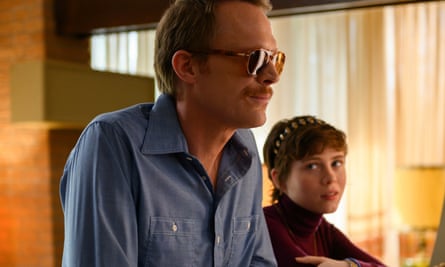
Between college and the big city, Beth is growing up and expanding her world view, but nothing hits home like finding out that Uncle Frank is gay and that his roommate Wally (Peter Macdissi) is his lover and partner of many years. She’s never known anyone gay before. No; she never knew she knew anyone gay before. As if this wasn’t milestone enough, Frank’s father (and Beth’s grandfather) Daddy Mac (Stephen Root) has died, leaving uncle and niece to get reacquainted in the context of this new information during their road trip home for the funeral. On the one hand, it’s kind of a nice opportunity to meet each other’s authentic selves, but on other hand, they’re driving toward utter disaster and they don’t even know it.
South Carolina wasn’t the happiest place to be a gay kid growing up, and if Frank isn’t exactly choked up by his father’s death, going home does stir up quite a few traumatic memories, threatening his sobriety, his relationship, and even his life. Uncle Frank is both a coming out story of sorts for Frank, and a coming of age for Beth, two misfits from the same people and place finding out whether you can go home again or if you should have stayed in NYC where you belong. Writer-director Alan Ball seasons the script with achingly realistic family dysfunction, layers of hatred as well as opportunities for healing. Young Sophia Lillis has really hit the ground running in her career, starting out already on top with several leading lady roles in a row. She’s fantastic in this, but this movie belongs to Uncle Frank, and it’s Paul Bethany’s stoic and grounded performances that really see us through. Frank has navigated his life with careful precision but his father’s death is the one iceberg he couldn’t avoid. It feels like we’d tread uncomfortably close to melodrama, but Bettany’s performance is quiet, calm, and convincing, with not one shred of over-acting in a career-defining turn.
Uncle Frank has something to say about how things were in the past, but it also implies a lot about us now, 50 years in the future, and yet somehow still living in a world full of prejudice, where in some places and for some people, Frank’s experience is still the norm. For an unspoken statement, it’s pretty profound.


 husbands of 50 years being reduced to a blood stain in the living room. Not to mention the fact that Rose and Norah’s mother committed suicide when they were young girls. So, you know, this is potentially triggering work, and Rose and Norah aren’t hardened enough yet to have strict professional boundaries.
 It’s sweet and wholesome and damn if that song wasn’t catchy – it even got played on our 1996 radio waves for a brief blip in time. Real 60s music was too expensive (and it had been done well and to death in Forrest Gump, thought Hanks) so it was cheaper just to have stuff written. That Thing You Do! was the result of a competition for a “faux-Beatles” song, and it was Adam Schlesinger, the bass player from Fountains of Wayne, who won. When you hear the song in the movie (and BOY do you hear the heck out of that song in the movie!- 11 different times, and the song went on to be nominated for an Oscar but lost to You Must Love Me from Evita), the actors aren’t really playing, but they could have been. Tom Everett Scott, Steve Zahn, Ethan Embry and Jonathan Schaech all learned to play their instruments, and learned every note of every song that appeared in the movie.
 only her second movie credit. Tom Hanks auditioned her and knew instantly that she’d be famous one day. She was the first person he auditioned, and the first person he cast.”No matter what, I will always claim to have discovered you” he wrote in her script. She won her first Oscar in 2004.
 showed up to work on it. Wife Wilson appears as a cocktail waitress, but Hanks was so tired from pulling 19-hour days the day she showed up on set, he didn’t even recognize her, merely noting that she was “an attractive lady” and he hoped she’d be nice to him. His son Colin also briefly appears in the film, and his daughter Elizabeth even brieflier. Unrelated but also of note: keep your eye out for Bryan Cranston playing an astronaut, and Jonathan Demme playing the director of a major motion picture.
 ASSHOLES WATCHING MOVIES