
Monique is not your average high school student. She acts tough and gets into a lot of fights. But it’s easy to judge someone when we don’t know anything about them. I’d say her home life isn’t good, but Monique doesn’t have a home. She has had a series of foster situations since her mother died that all end badly. Her father’s in prison, and she can’t help but daydream about the day he gets out and she can live with him and have some sort of regular life again. Until she runs into him on the street. The daydreams come to a crashing halt right about then. He’s out and hasn’t told her, hasn’t contacted her, and now that she knows – well, he’s not really amenable to her vision of their shared future (to be fair, he’s eating at soup kitchens and engaging in at least semi-criminal behaviour, so he’s not exactly capable of providing a “stable home life.”)
Anyway, poor Mo decides the only way she attract her dad’s attention, and maybe neutralize some of her school’s ire, is to join the wrestling team. There is no girls team so she joins the boys team, despite the protestations of nearly all of the boys.
First Match distinguishes itself from other similarly-themed sports movies because the team is not really Mo’s problem. If a little 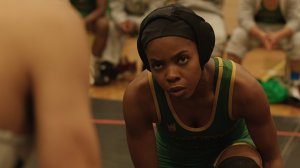 adversity from the boys were Mo’s only problem, she’s probably feel blessed. Instead, Monique excels at the sport and it becomes a source of pride and power for her. Even if doesn’t win her father back, it’s earning her some self-respect, which she needs and deserves. Monique is obviously supposed to be some problem child, but it’s impossible not to sympathize with her.
There are no easy fixes, and the script is bold enough not to offer any. Life is stacked against this kid, and even if the viewer is the only one rooting for her, at least there’s that. I’d like to give her a hug if I wasn’t totally positive she’d roll her eyes at me for even trying.
This movie is grounded in realism that bites. The team becomes her de-facto family, but First Match still retains a sense that Monique is, if not lucky, at least relatively unique in her community because she knows her father and has him in her life. It’s tragic and depressing the lengths she’ll go to in order to keep him there; she’s got daddy issues, but at least she’s got a daddy. The premise seems to imply that this will be a movie about a lone girl in a male-dominated sport, but this turns out be an afterthought. But there’s a lot else to contemplate, and Elvire Emanuelle’s performance is not to be missed. Coming soon to a Netflix near you.
 Julia Hart, the director and co-writer of Fast Color, almost had me fooled. She introduced Fast Color to the SXSW crowd as a story about motherhood, and in a way that’s true. Of course, in a way it is also true that the original Superman comics are about the experiences of Jewish immigrants. I mention Superman because both Fast Color and Superman use superheroes to tell their stories, although the movies’ respective approaches to the genre are worlds apart.
 that would really speak to the urgency and the desperation and the severity of the issue. She did scrupulous research, and the details that come through – like the fact that New York state will pay for the funeral of anyone murdered during your escape (fucking think about that for a moment) – are depressingly, frighteningly authentic. Real-life abuse survivors make up the support groups which Sadie attends. They share stories that will haunt you.
 assert themselves sexually. All the usual bullshit about female virginity is thrown into the gutter with other outdated notions like the earth is flat, and bloodletting as a cure-all. These ladies are real, raw, and raunchy when it comes to sex, which, sure, is refreshing, and that’s nice and all, but the truth is we wouldn’t give a damn about myth-busting if it wasn’t entertaining, and this movie captures that elusive comedy magic and makes its audience howl with laughter.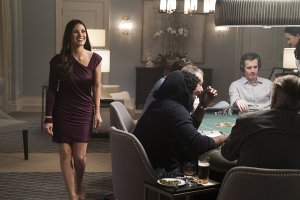
 being in charge. She’d never had another job. She was naturally meek, and kind of nervous. She was surrounded by assertive men, some of whom weren’t crazy to have her among their midst and certainly didn’t see her as an equal never mind a boss, and none of whom were shy about voicing their opinions. She was, however, an accomplished socialite, which in the city of Washington, means she counted many prominent politicians among her friends – and the particular politician at the epicenter of this scandal was among her closest. These facts are not to diminish her but to illustrate just how courageous she truly was to take the stance she did.
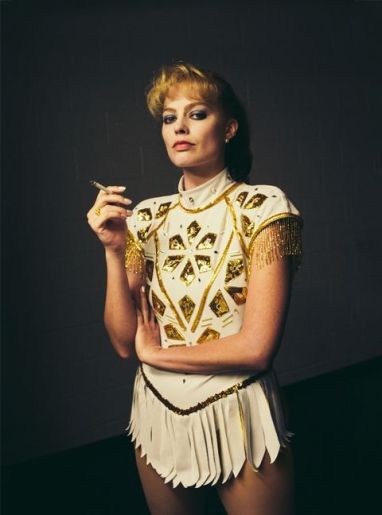 white trash, even with the poofy 90s bangs, but she comes down low and it’s pretty glorious. Sebastian Stan plays Harding’s good for nothing husband, Jeff Gillooly, and he disappears into the role of dumb fuck. Jeff’s dumb ass best friend Shawn (Paul Walter Hauser) pretends to be an international spy even though he’s a grownup who lives with his parents. Not exactly criminal masterminds, but this is the trio that brought us the most delicious scandal of 1994 (until OJ Simpson that is – if you thought Lillehammer was competitive, try being a celebrity fuck up). But for my money, I’d have to say that the real cast stand-out was Ms. Allison Janney, who plays Tonya’s mother LaVonam who, by sheer comparison, makes bathtub scum look appealing. She’s the dirtiest of dirts with not a kind word or intention in the world. If being a crummy mother was an Olympic sport, she wouldn’t have to resort to breaking any kneecaps.
 Beyonce fills out a bodysuit. She’s just spectacular in this: spectacular, spectacular. You can’t make a movie like this without the perfect lead, and Danielle Macdonald is this movie’s soul mate, its one and only. But the rest of the cast falls into place perfectly too. Siddharth Dhananjay as Jheri is Patti’s perfect partner; perhaps an unlikely duo, but if the rap game is going to turn a cold shoulder on a white girl from Jersey, so too will it be tough for a brown boy pharmacist. But disenfranchised is disenfranchised and director Geremy Jasper paints an unflinching portrait. Meanwhile, Mamoudou Athie had already won my heart in
 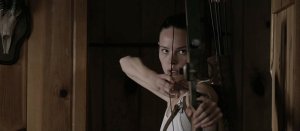 and sexual perversion isn’t just for kicks, it’s also serving a purpose. Because every time a girl fights back, her sentence is extended. And that’s very good news when you’re running a corrupt, for-profit scheme.
 This documentary is not particularly imaginative when it comes to film making; it is straight forward, with few tricks up its sleeves. But Mankiller is a compelling subject, and a documentary shedding light on her story is important when it is omitted from so many history books. When Mankiller was first elected chief in 1985, it was to a male-dominant political structure that she broke into with patience and tact. She persevered, secure in the knowledge that the traditional Cherokee way was a more gender-balanced approach. She overcame a lot of obstacles in order to improve the lives of her people, and many believed her work with the federal government might have led to a national political career had her own health not stood in the way.
 ASSHOLES WATCHING MOVIES