
Giant Little Ones is post-gay, mid-spectrum, pro-fluid. It’s a very specific adolescence, and except for a few details, it could be mine or yours.
Franky (Josh Wiggins) is on the swim team at school – the kind of swim team who showers together, shaves together, slings homophobic slurs together, apparently without irony. Franky’s best friend Nic is on the swim team too. They do almost everything together, but for Franky’s 17th birthday he’s planning something without him – the loss of his virginity, to his girlfriend, who is nice enough and pretty enough but just not that interesting. Is that a problem? Nic is emphatic: no. Nic and his girlfriend do it 6 times a day!
Franky’s mom (Maria Bello) leaves the house unattended for the party but things don’t go exactly as planned, and at the end of the night it’s just Franky and Nic, like the sleepovers of their childhood. Except this one ends in a blow job. In the morning, Franky is surprised by this turn of events, but Nic is many more things: ashamed, upset, angry. Nic destroys their friendship, and Franky’s reputation, and makes Franky’s life at school hell. The only person who doesn’t desert him is Nic’s sister, Natasha.
I really love Franky’s openness to this experience. Josh Wiggins is a big part of this: he is  charming and sweet, handsome and approachable. Franky doesn’t question his identity, he just absorbs it as part of it. It doesn’t need a label or a judgement. But there is a complication: Franky’s father (Kyle MacLachlan) has recently left the family because he’s gay. Franky’s resentment is mostly due to the abandonment and not the sexuality, but his feelings are complicated and confused and it makes dealing with this just a little harder than it has to be.
Every generation has its own set of unique problems and we’re still uncovering and discovering what it means to be young right now. High school is as hard as ever, but it’s fascinating to be able to peek in through the window to see today’s particulars. I saw Giant Little Ones on a whim and an inkling and it ended up being a really nice find, which is a happy festival occurrence. We go in with such high expectations for the Oscar hopefuls and at best all they can do is meet them. But a little Canadian indie like this can genuinely catch you off guard, and in reinvigorates you when you’re on movie #32 of the festival.
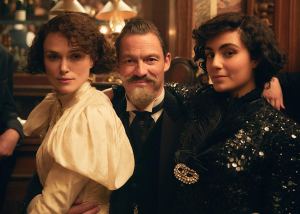 criticizes it for being too feminine and “full of adjectives” he signs his name to it and sends it off to be published. Of course it gets gobbled right up. Does Willy eat crow? He does not. He celebrates “his” success without a trace of irony and then gets mad at his wife for “implying” that she wrote it. Which, again, she did. This book does worlds better than any of his ever did so he’s eager to keep the gravy train going (imagine an actual gravy train! what a weird expression, especially since the carafe gravy is traditionally served in is called a boat). Anyway. He can’t help but lock her in a room until she produces another best-seller. It’s only logical! And she does. And when, oodles of success later, it begins to chafe and she suggests getting at least partial credit, her name alongside his, he bucks. Preposterous! Women writers don’t sell, he reminds her.
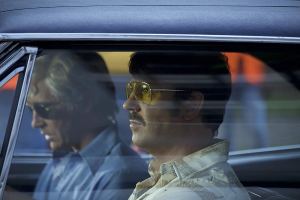 gravitates to him as he steals every scene. DeLorean could turn it on when he needed to, and that charisma bleeds through Lee’s performance – it’s only thanks to Sudeikis’ presence that I remember this isn’t a documentary.
 is so much texture here, you’ll want to pet the screen.
 enjoys a solitary go at the fuck room, riding a contraption reminiscent of Burn After Reading’s dildo chair. She enjoys a little solo S&M, her white skin framed by the black walls, the room feeling as dark and blank as the space outside, though rarely glimpsed, must also be.
 anywhere else. It’s unforgiving. It’s unknowable. It’s remote. There are only 5 hours of daylight at midday. It’s a blank canvas, a blanket of white, relentless and renewing, where even your own footprints are quickly snowed in and covered over; one wrong step can mean the difference between life or death. It’s no place for a novice like Core, but he’s got some demons of his own that keep him from making better judgments.
 Ten years later, a grown-up Rupert (Ben Schnetzer) is releasing a collection of their correspondence as a book, and a skeptical reporter (Thandie Newton) is interviewing him. The truth of their friendship is revealed through flashbacks, as is Donovan’s life, which of course was not all rainbows and lollipops.
 her – Charlotte, the mother of another kidnapped journalist who was successful in getting her son returned home. Off the record, Charlotte (Edie Falco) fund-raised the ransom among her wealthy friends and had someone walk it across the border for her in order to evade detection. They’re planning the same for Helen’s son, with a friend and colleague of his, Sam (Matt Bomer) willing to make the actual transaction. Helen can scarcely believe her son might actually come home, and isn’t sure what kind of broken man he’ll be if he does. But her focus remains on getting the work done, all of it underground, away from the unhelpful but watchful eyes of government agencies.
 Gwen lives with her mother and younger sister. They have next to nothing – their makeup bags legit comprising of a pointy stick with which to prick their fingers and use the blood as blusher. Her father is absent, away at war. Her mother is mysteriously ill. Her neighbours are disappearing, one by one, a mining company encroaching on the land. But there’s also a darkness that comes knocking. Strange things are happening, inexplicable things.
 found male identities received more sympathy. Eventually she found a way to turn it into art, and several stories and books were published under the name. She wouldn’t be the first writer to write under an assumed name, but she might be the first to have gone to such great lengths to present a pseudonym as a real person. She recruited her boyfriend’s androgynous sister Savannah to “play” JT in person, granting interviews and posing for pictures as him – even signing the rights to a movie contract. Of course, when the truth comes out, as it nearly always does, the world was kind of mad about being duped, and there was a big backlash.
 ASSHOLES WATCHING MOVIES