Tag Archives: tiff

TIFF18: The Hate U Give

It’s a sad sign of the times that police shooting an unarmed black man seem to be one of the unofficial themes of TIFF’s 2018 program much like tennis was last year.

Starr Carter (a sensational Amandla Stenberg) lives in a poor black neighbourhood but goes to school in an affluent white part of town. Starr Version Two- the censored version of herself that her friends see- can’t quote hip hop lyrics like her white friends do all the time because “when they do it, they sound cool. When I do it, I sound ghetto”. Moments after reconnecting with a black childhood friend at a party in her neighbourhood, the two are pulled over by a white police officer which quickly and tragically ends with her friend getting shot and killed.

Not only does Starr now have a lot of grief and trauma to work through. Her once compartmentalized life has suddenly gotten a lot more complicated as she- the only witness to the shotting- starts getting pulled in every direction. Everyone, from the kids at school to the local gang leader (Anthony Mackie) to Starr’s cop uncle (Common), has an opinion that they’re not shy to share and some are all too happy to resort to threats and even violence.

Whereas Reinaldo Marcus Green’s excellent Monsters and Men was a thoughtful and nuanced indie, The Hate U Give works a lot harder at being accessible to a more mainstream audience. Our introduction to Starr’s life and the world around here is often funny and Starr and her family are immediately easy to like and root for. The soundtrack doesn’t hurt one bit either. Things are obviously a lot less fun once shots are fired and Starr’s friend is killed but The Hate U Give is still the kind of movie that seeks to entertain while it makes us think and feel.

The Hate U Give hooked me much quicker than Monsters and Men did. Monsters and Men needs time to sink in. It doesn’t aim for big dramatic scenes and speeches like The Hate U Give does. The Hate U Give pays a bit of a price for its more mainstream approach. Because it always feels like a movie albeit an extremely effective one. Some parts seem a little too contrived while others are a little over-simplified.

There’s a place for both movies. Monsters and Men was a great conversation starter is a mostly satisfying and cathartic emotional experience. It’s just that I fell in love with this movie over the first half or so and somewhere along the way I lost some enthusiasm for it.

TIFF18: Papi Chulo

Sean the weatherman has a meltdown on the air, so he’s sent home for some mandatory personal time off. His partner left him recently, and left a large, unpainted circle on their deck to boot. Pretty, soft-hands Sean (Matt Bomer) is out of his element in the hardware store. He buys the paint with help but the actual painting doesn’t go well, so the next day he trolls the lineup of available day workers and brings home Ernesto.

Ernesto (Alejandro Patiño) doesn’t speak English and Sean doesn’t speak Spanish. Odd couple alert!

The thing about this movie is, it sounds pretty light and predictable. And it is. But that doesn’t do it justice, because in fact it was one of my favourite movies at the festival. And maybe that’s because 90% of the movies I saw were depressing as shit and this one comes with a hint of optimism. But it’s the movie that I needed without knowing I needed it, and I felt like a life line.MV5BMTg1ODNhODQtMTQ3YS00OTY4LTk2OGItZDExZTNiM2VlMWU5XkEyXkFqcGdeQXVyNTQ1MTYzNzY@._V1_


Poor Sean. His friends and coworkers see him floundering and all agree that he needs to talk to someone, but to Sean, the act of doing so is the same as admitting that he’s alone and things are bad. He can’t. But he does find himself opening up to Ernesto. Ernesto who continues to be paid $20 an hour for “painting” finds himself hiking the canyons instead, and posing for Instagram pics. Although it looks like friendship, Sean is using Ernesto in at least 2 strange ways:


  1. As a therapist. A therapist who is easy to talk to because he can’t understand him, thus there is no fear of judgement.
  2. As a replacement boyfriend. Sean has Ernesto doing couple-y things, like renting a boat to row around the lake, and going to parties where he lets everyone assume they’re dating.

It’s not a great pretext for a relationship of any kind, but it’s done with such sweetness from both sides it’s hard to condemn…until it inevitably escalates. But your heart aches because on some level we all understand this awkward reaching out, the inability to call it what it really is, the denial and the loss that motivates it.

Matt Bomer is very vulnerable in this, he teeters between faux-cheeriness and complete abandon and at times we’re scared for him because he feels like our friend and we see him spinning out. Alejandro Patiño is great too – the perfect mix of skeptical and concerned. I love these two together so much that I don’t want the movie to end. I don’t want Sean to get better, to outgrow a friendship I understand is toxic for him. This movie makes me selfish because it has entertained me and sustained my soul during a dark day of movie watching. Papi Chulo is a huggable movie, perfect for watching in bed with a big bag of pretzels.

TIFF18: Donnybrook

Earl, an ex-soldier, has a junkie wife and two kids and no legit way to make them a better life. The only thing he’s ever been good at is fighting, and as luck would have it, there’s a slim chance he can turn that into some cash. Donnybrook is offering up $100k to the winner of a massive, no rules cage fight. All you have to do is be the last one standing. $100k will buy a home for his kids and treatment for his wife, but he can’t even afford the $1k entrance fee. So he robs a gun store where he’s known by the owner – it’s not a perfect crime, but Earl (Jamie Bell) isn’t exactly the sharpest tool, nor does he have to be in this shit town.

On the road to Donnybrook, Earl’s story will intersect with Delia and Angus, a brother-sister drug-dealing team with a questionable relationship, and the cop who’s pursuing MV5BZTJjMDdkZDgtNDRjMy00ZGU5LThjOTMtZWE4Nzk3ZDRhZTFhXkEyXkFqcGdeQXVyNTQ1MTYzNzY@._V1_them. Lots of crazy things are going to happen. LOTS OF CRAZY THINGS. I can only hope to prepare you fractionally for the craziness that’s about to be unleashed. I was not prepared at all. Some films at a festival are hardly finished. Lots don’t have trailers yet, or even production stills. Lots will go on to be re-edited so their final, released-in-theatres version will look wholly different that the version I saw at TIFF. Donnybrook felt finished but little was known about it. The only synopsis available simply states that “two men prepare to compete in a legendary bare-knuckle fight.” I thought I was sitting down to a boxing movie, not a HOLY SHIT WHAT THE FUCK JUST HAPPENED movie, and I shouted that more than once. More than twice!

And it’s not just the gratuitous violence. There’s some pretty freaky sex stuff too. The drug-addicted wife is likely the only one headed for treatment, but she’s only the fourth or fifth most in need of it. There isn’t a healthy person for miles, and if there was, they’d probably be killed just for their car keys. Donnybrook is dark and violent and brutal.

Tim Sutton seems to want to give a voice to white rage in middle America. They’re poor, they’re addicted, they’re abused. And they’re racist, xenophobic pieces of shit, though Sutton seems to excuse that, and revel, even fetishize their anger. Which isn’t to say it doesn’t exist or isn’t a problem, just that Sutton contributes to the problem without saying anything intelligent about it. If he cared about these “marginalized” people, he wouldn’t make such caricatures out of them.

TIFF18: Gloria Bell

Why is Julianne Moore even still making movies? I can think of few American actors with less to prove than Moore, fewer still who have turned in as many brave and egoless performances as she has over the last three decades.

Chilean director Sebastián Lelio (A Fantastic Woman) admires her too. In fact, he says that he chose to remake his 2013 film Gloria as his English-language debut specifically because he was such a big Julianne Moore fan that he wanted to see what she would do with the role. To anyone like me who has not seen the original, it would feel like the part of Gloria was written for her. Gloria is a 50-something divorced mother of two adult children (Michael Cera and Caren Pistorious). She has a full-time job and her kids do spend some time with her but it’s not enough to keep her from getting lonely.

Luckily, Gloria loves disco and loves to dance and she never cuts loose quite like she does when she’s alone on the dance floor on Singles Night. That’s where she meets the charmingly awkward Arnold (John Turtorro). The two quickly strike up a relationship even if Arnold’s co-dependent relationship with his ex-wife and adult daughters seem to hold him back from completely commiting to Gloria.

Thinking back, there is something very sad about Gloria Bell. But that’s only in retrospect. Lelio, like Gloria, chooses not to dwell on the sadness. Instead, his film spends so much time being laugh out loud funny that and is just optimistic enough that you can almost mistake it for a mindless crowd pleaser. It’s only three or four movies later when I realized that this was the one that I was still thinking about that I realized what a fully realized character they’ve created (or recreated) together. It doesn’t hurt that those in her life, the supporting cast, all seem to have real lives of their own when they’re not onscreen and could easily have starred in films of their own. I for one would have loved to know a lot more about Arnold. But really this is Gloria’s story and Lelio and Moore do her proud in a really impressive and effective film.


TIFF18: The Land of Steady Habits

Anders is mid-life-crisis-ing, hard. He left his wife, quit his job, sleeps with strangers he meets in Bed, Bath & Beyond while shopping for knick-knacks to fill his empty shelves. BUT HE’S STILL NOT HAPPY! Can you believe that abandoning everything you spent your lifetime building is not the path to true happiness? Can you imagine that the real problem was him all along?

I mean, those thoughts haven’t occurred to Anders (Ben Mendelsohn) yet. He’s a man. He’s not that quick. In fact, he’s slow and dumb enough to get high with someone else’s son. Charlie (Charlie Tehan) barely survives an overdose but shows up at Anders’ new bachelor pad looking for…friendship? Anders should know better; his own son PrestonMV5BMWZlMjZiMGItMjBhZS00YTlhLTlkMDgtNDc3Y2NkOTc2OGViXkEyXkFqcGdeQXVyODI4MjAzNjU@._V1_ (Thomas Mann) has been to rehab and apparently still has a problem that isn’t quite addressed. But if his own son isn’t really his problem, why should someone else’s be?

So that doesn’t go well. Nothing does. The Land of Steady Habits is drenched in suburban angst, dripping with the failure of men, both young and old. Director Nicole Holofcener has a knack for eliciting career-best performances from her actors, and Ben Mendelsohn is no exception. His little idiosyncrasies, that devilish grin, they keep the character just shy of being unforgivable. Still, Anders is not meant to be liked. He gambled on the grass being greener and it isn’t. His discontent seems to poison those around him. Ah, the listlessness of the wealthy. It makes it so easy to sit back and judge, guilt-free.

Holofcener makes some interesting choices – notably, that Anders has already shed his previous life when we meet him. And he’s already finding the new one to be hollow. And we experience his search for meaning to be quite petty and superficial. Mendelsohn subverts his usual simmering anger to suggest an inner tension as he navigates relations with his son, ex-wife (Edie Falco), and new love (Connie Britton), with bitter, sometimes humourous results.

The Land of Steady Habits is a good character study that’s a bit uneven as a dramedy. Holofcener tends to be restrained. Sometimes that’s wonderful, and sometimes it’s a little frustrating. This movie seethes with ennui, shame, and regret, and nobody gets a free pass.

TIFF18: Homecoming

Has TV been more exciting than movies lately? People have been saying so for some time and, given that we aren’t Assholes Watching Television, the idea sometimes makes me a little defensive. I have to admit though that the first four episodes of Homecoming were the most challenging and exhilarating two hours that I spent at TIFF this year.

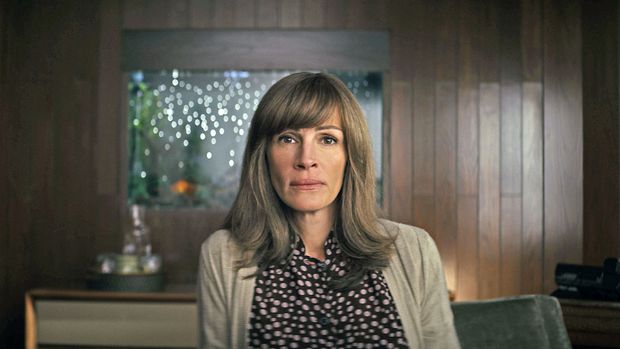
The current legitimacy of episodic television is hard to deny when Julia Roberts, one of the biggest movie stars in my lifetime, starts turning to tv for interesting roles. In the new series directed by Mr. Robot creator Sam Esmail, Roberts plays a counselor in a facility whose mandate is ostensibly to help American soldiers returning from their deployments to adapt to life back home. It’s clear from her first phone call with her superior (Bobby Cannavale, as awesome as ever) that there’s something more nefarious or at least more secretive going on at this facility. What is less clear is exactly what that is. Things start to reall get interesting when Julia’s favourite patient (If Beale Street Could Talk’s Stephan James, who will almost definitely be a huge star this time next year) starts to suspect something is amiss.

Homecoming may not be quite the best thing I saw at TIFF this year. That honour probably goes to Widows. But it’s definitely the most original. Just like in Mr. Robot, Esmail’s strange choice of camera angles and Maggie Phillips’ score which often doesn’t seem to match the tone of what we think we’re seeing all contribute to the feeling that there’s so much more going on here then we realize. I can’t wait for the show to finally air in November so I can watch the rest and find out what that is.

Somehow, Homecoming is an adaptation of creators Eli Horowitz and Micah Bloomberg’s podcast which I’ve never listened to nor do I understand what it could possibly be. Together with Esmail, they have assembled an impressive cast that also includes Sissy Spacek, Alex Karpovsky, Shea Whigham, and Dermot Mulroney. Together they have made one of many compelling examples of how television can be just as creative and satisfying as an Oscar season feature film.

TIFF18: Destroyer

Mere minutes into this film, I was ready to hand Nicole Kidman her Oscar. We meet detective Erin Bell, LAPD, as a broken down woman limping up to a murder scene looking no better than the corpse. The reek of booze preceding her, her colleagues roll their eyes behind her back and do all they can to get rid of her so she doesn’t impede the investigation. There is no love or respect for her on the force, except maybe from her partner, who she is expertly avoiding.

But flash back to when she was a young FBI agent. She and partner Chris (Sebastian Stan) were placed undercover with a gang that dealt in a little bit of everything: drugs, theft, whatever. Like any good undercover agent, they melted seamlessly into the gang, became their friends, even got together as a couple, which more or less bled into their real lives. But when the gang plans a bank heist, the operation goes south.

MV5BMjAzMDU5ODU3MV5BMl5BanBnXkFtZTgwMjMwMzcxNjM@._V1_SX1777_CR0,0,1777,999_AL_Cut back to present day: Bell is washed up, an alcoholic, estranged from her family. She looks like hell, smells like she’s pickled, practically lives in her car since that’s where she most often passes out. But when that murder scene turns out to be related to her old gang, she realizes its leader, Silas (Toby Kebbell) has resurfaced and she’ll have to dive back down the rabbit hole in order to make things right.

You might be picking up on Nicole Kidman’s incredible performance. It’s not just that she’s nearly unrecognizable – her gait, her posture, the shadow behind her eyes – her performance is so holistic and encompassing it’s a shock to our system. Contrasted with the “before” years, before she knows how life can hurt you, she looks wholesome and free, like the world exists to bloom with possibility.

Director Karyn Kusama has a very dark outlook on the world, and she’s not afraid to bring her protagonist down the narrowest, most bleak passageways to get where she’s going. Erin Bell is tortured and unlikeable, which is unusual for a female character, and it’s certainly not what we’ve come to expect from Kidman. I’m glad that Kusama doesn’t try to soften her, but I also thought that Kidman’s haggard look was a little extreme, Bell’s complete collapse perhaps not quite explained by the trauma in her past. Everything hints toward something far more sinister, and when the pieces of the puzzle come together, it’s bad, but it’s not as bad as you expect. In fact, it’s a little on the expected side. Destroyer has a great female protagonist that pushes the envelope, and Kidman’s performance is nothing short of incredible, but this movie won’t be remembered for anything more than that.

TIFF18: First Man

You know the story. The whole world knows the story. Neil Armstrong, an aeronautical engineer and Apollo astronaut, was the first man to walk on the moon. “One small step for man, one giant leap for mankind” – that was him. American hero, international phenomenon, global icon. First Man is his biopic, tracing the 304400 km path he took from humble test pilot to living legend.

First Man is Damien Chazelle’s follow-up to the ethereal La La Land, which made him the youngest Best Director to ever be awarded the prize at the Oscars. To say I was highly anticipating screening this movie at TIFF is like saying Armstrong was kind of an interesting guy – a resounding understatement. But when the lights came back up, I was feeling a little…underwhelmed? Bored? Disconnected.

Feeling uncomfortable with my initial reaction, I turned to my favourite critic in a whole cinema full of press, and invited him to discuss and unpack this movie over sushi burritos. First – Ryan Gosling. He gives a terrifically reserved, very stoic performance as a famously quiet, attention-shirking man. Armstrong is surprisingly passive when encountering life-altering choices. He’s dispassionate. He’s obsessed with technical detail and getting things right but he never seems overly impressed with the great heights involved in his job. Wait a minute – is it possible Neil Armstrong was on the spectrum? To be clear, I’ve never heard that he’s an Aspie, or had high-IQ autism. Nor have I heard it mentioned in the context of this film. However, his wife at the time, Janet (played in the Film Title: First Manmovie by Claire Foy), called him “emotionally disconnected.” In the film, he struggles to speak to fellow astronauts and even his own children, and goes out of his way  not to. But it’s not that he doesn’t care. He clearly grieves the loss of his infant daughter, and thinks of her often. And he’s sensitive to the deaths of his colleagues. But these are internal struggles that rarely get expressed, or expressed correctly. He’s not unfriendly or unapproachable, exactly, but human connection is hard for him. Is undiagnosed autism what Gosling is hinting at with such a performance? And with that question in mind, the rest of the movie unlocks before me.

I trust Damien Chazelle as a director. If I’m feeling underwhelmed, isn’t it because he wants me to? After all, this is the guy who made me sweat while watching a movie about jazz (sorry, jazz). If he wanted me soaring among the stars, he certainly has the vision not to mention the skill. He swept me away with La La Land; I danced out of the theatre even as I ugly-snot-cried. If my feet are more firmly planted on the ground for this film, there has to be a reason.

What if Chazelle is attempting to put us not just in Armstrong’s shoes, but in his head? I felt very removed during the movie, but maybe that’s exactly his intention: to show the greatest, most ambitious, most adrenaline-fueled achievement in the history of humankind through the eyes of someone who doesn’t express feelings in the usual way.

Whoa.

Now that I’m re-examining the film through this  new filter, I realize that I don’t remember Gosling smiling even once in the whole 120+ minutes. He doesn’t cry when he’s sad, nor does he ever appear to be particularly happy. At a pre-flight press conference, a journalist asks him how it feels to find out he’ll be the first to walk on the moon, to which he simply responds “I’m pleased.” Finding this response lacking, the reporter probes further, asking him to compare it to finding out he’d been selected for NASA’s astronaut program, to which Armstrong can only repeat “I’m pleased.” Although he’s certainly capable of more complex emotions, communicating them seems impossible. Another scene that struck me is one in which Armstrong is trying to sneak out of the house without saying goodbye. He’ll be gone for 2 months, strapped to a bomb that will explode him out of the atmosphere to land or crash on the moon and no one knows for sure if he’ll ever come back. His family has attended the funerals of many friends and colleagues who’ve perished in various missions. His two young sons are sad and scared and he tried to sneak away. His wife has to beg him to say a few words, but “I love you” are not among them. Knowing his father doesn’t like hugs, his brave son offers a handshake instead, not knowing if this is to be their last embrace.

This film is strangely muted, with even the score a tad alienating with unfamiliar instruments. And check out that photo from above – doesn’t that blue wash make him seem lonely, and isolated? This great adventure in the sky should be exciting and staggering, but the biggest sensation we’re given is physical discomfort as we’re rumbled and tumbled about during liftoff sequences. Not that Armstrong complains. There’s no swelling pride or patriotism, no heroic speeches or manly tears. In fact, there’s very little awe. In the vastness of space, the screen is often filled with a solitary face. I wonder if the emphasis on extreme close-ups is supposed to symbolize Armstrong’s challenge in deciphering non-verbal cues, or if it’s merely to give us a better view of his consistently flat affect.

The camera seems to offer things up from Armstrong’s point of view – one small chunk of moon dust rather than an entire lunar landscape. His trip into the infinite universe feels very small, and very  humble, but he’s not unmoved. He just has a narrow focus, more fascinated by his own boot print than by the multitude of stars. Does Armstrong feel more at home in the empty quiet of space? Maybe. But we’ll never know because he sure as heck didn’t say so.

If my little theory is correct, I wish I had know it going in rather than piecing it together in hindsight. What more would I have noticed? I can’t wait to re-watch and find out. I can’t wait to appreciate Armstrong and his accomplishments in this new light, and to celebrate Chazelle as a director who can so completely immerse and saturate you in someone else’s experience. Remarkable.

TIFF18: Can You Ever Forgive Me?

If you’re asking for forgiveness, Melissa, you’ve got it. Not that I really believe you have anything to be sorry for. The Happytime Murders was a misfire, but hardly your fault, and I admire any attempt to do something different.

With this movie, both Melissa McCarthy and the character she plays are trying something different. McCarthy is trying on a more dramatic role, and though Lee Israel has a teriffic wit, she’s got no slapstick about her at all. canyoueverforgiveme_0HEROMcCarthy only has her own skin to live in, face naked save for an inept smear of lipstick on only the most special of occasions (ie, when asking for money), hair constantly overdue for its next dye job, frumpy clothes in various shades of poop. But it’s Israel’s personality that poses the real problem. She’s abrasive and reclusive and just doesn’t really know how to exist among people, so she’s basically stopped trying. It’s just her and her cat – a daunting thought when it’s just her and a blank page. A once-celebrated writer of biographies, her agent nowadays can’t get so much as a $10 advance for a book on Fanny Brice that nobody wants.

Living in semi-squalor, Lee finds there’s good money selling literary mementos from great authors. Is it her fault that better content fetches higher prices? Isn’t it just good business sense to exploit her natural gift for writing and put it to use making money again?

Crime pays, for a while. And then the FBI gets curious about all the fraud and forgery and whatnot.

I love this script. McCarthy’s very first line earns a laugh out loud, and the script continues to reflect Lee’s caustic humour throughout. And McCarthy is just brilliant in the role, aggressively unpersonable, but also sympathetic. There’s a whole framework of supporting cast to admire too, particularly Jane Curtin, Anna Deavere Smith, and Marc Evan Jackson.

This isn’t just a film about forging letters, it’s about loneliness, and friendship, and purpose. It’s hard to say which Lee needs more – human connection or the sense that she is creatively fulfilled. Of course, when you’re crediting your best work to someone else, it’s plagiary of the heart and perhaps this is what hurts her most in the end. Lee Israel is not anyone’s idea of a hero, but her flaws are all-too-human, and it’s fascinating to slide down the rabbit hole with her.

TIFF18: A Million Little Pieces

A Million Little Pieces is a technically competent (and occasionally impressive) film that lacks perspective and personality. In life generally and this festival particularly, we have been inundated with films about addictions and recovery. If you’re going to pile on, I expect you have a hot take, a fresh point of view. It’s not unreasonable to expect that A Million Little Pieces might have had one; several years ago (2003, in fact), James Frey released his memoir (of the same name) and it was a monster best-seller. But when questions of authenticity surfaced, Frey’s shooting star burned out quickly, thanks in large part to Oprah’s dragon-fire condemnation.

The film was relegated to back burner, then cold storage, then deep freeze as the controversy was allowed to cool. But now that people have all but forgotten his name, Sam Taylor-Johnson brings his story to the big screen but curiously leaves the scandal unthawed, with only a Mark Twain quote to excuse away his dishonesty.

AMillionLittlePieces_0HEROWhat’s left is a story without a single breath of uniqueness. Drugs are bad, behaviour off the rails, shipped to rehab against his will, detox makes you sick, “I don’t need to be here,” resistance, rule-breaking, temptation, uncovering trauma, cautious optimism. Insert new names and this could literally describe at least a dozen movies about addictions, and those are just the ones I can name and I can’t name shit. Although Sam Taylor-Johnson makes things pretty (save her own husband, with cracked teeth and a broken nose), this feels like a very familiar, very formulaic iteration.

Taylor-Johnson’s husband, Aaron Taylor-Johnson, co-writes the script with her (which seems not to be a strength) and stars as Frey. She has enormous faith in his abilities as an actor, and directs him well. He’s committed and intense, and would have been great in a great role, except they failed to write one, and this “Frey” character is bland and superficial. We hardly get to know him, and the few flashbacks are not informative or expository, they’re hardly more than images. That said, his costars, including Billy Bob Thornton, Giovanni Ribisi, Juliette Lewis, Charlie Hunnam, and Odessa Young, get even shorter shrift. Back stories? Ha. These people barely get front stories. They fill the obligatory sharing-circle chairs and that’s about it.

I think there might have been a little life to this story had they not shied away from the truth of it. But as is, it’s a million little pieces of ordinary that add up to 113 minutes of boring, minus the 40 seconds or so when Aaron rocks out with his cock out. With so many options at the cinema, this just doesn’t cut it. An easy miss.