
Monique is not your average high school student. She acts tough and gets into a lot of fights. But it’s easy to judge someone when we don’t know anything about them. I’d say her home life isn’t good, but Monique doesn’t have a home. She has had a series of foster situations since her mother died that all end badly. Her father’s in prison, and she can’t help but daydream about the day he gets out and she can live with him and have some sort of regular life again. Until she runs into him on the street. The daydreams come to a crashing halt right about then. He’s out and hasn’t told her, hasn’t contacted her, and now that she knows – well, he’s not really amenable to her vision of their shared future (to be fair, he’s eating at soup kitchens and engaging in at least semi-criminal behaviour, so he’s not exactly capable of providing a “stable home life.”)
Anyway, poor Mo decides the only way she attract her dad’s attention, and maybe neutralize some of her school’s ire, is to join the wrestling team. There is no girls team so she joins the boys team, despite the protestations of nearly all of the boys.
First Match distinguishes itself from other similarly-themed sports movies because the team is not really Mo’s problem. If a little  adversity from the boys were Mo’s only problem, she’s probably feel blessed. Instead, Monique excels at the sport and it becomes a source of pride and power for her. Even if doesn’t win her father back, it’s earning her some self-respect, which she needs and deserves. Monique is obviously supposed to be some problem child, but it’s impossible not to sympathize with her.
There are no easy fixes, and the script is bold enough not to offer any. Life is stacked against this kid, and even if the viewer is the only one rooting for her, at least there’s that. I’d like to give her a hug if I wasn’t totally positive she’d roll her eyes at me for even trying.
This movie is grounded in realism that bites. The team becomes her de-facto family, but First Match still retains a sense that Monique is, if not lucky, at least relatively unique in her community because she knows her father and has him in her life. It’s tragic and depressing the lengths she’ll go to in order to keep him there; she’s got daddy issues, but at least she’s got a daddy. The premise seems to imply that this will be a movie about a lone girl in a male-dominated sport, but this turns out be an afterthought. But there’s a lot else to contemplate, and Elvire Emanuelle’s performance is not to be missed. Coming soon to a Netflix near you.
 damning comment on today’s hyper competitive culture in which young adults liken abusing prescribed drugs to drinking a cup of coffee. Like I said, amphetamines aren’t new: The Beatles took them, Andy Warhol took them, Vietnam soldiers took them in order to go, go, go. And then they became horribly addicted, and the drugs became controlled. Except now students are seeking them out as performance-enhancers, faking ADHD to gain an edge while taking the SATs, and getting their hands on drugs whether prescribed or not.
 symptoms of the caring sister who’s also sort of an enabler. Because instead of leaving him to get his shit together, she’s prepared to miss the party and spend the night driving around the dirtiest, sleaziest parts of L.A. to find her brother (Dave Franco) a detox facility, and barring that – well, something far worse.
 great choice. He can pull off the sadness and the savage humour, playing it straight, breaking the fourth wall, talking directly to us, talking to himself. Doug Kenney was the Harvard editor of the Lampoon, and he had such an epically good time just fucking around with his good buddy Henry (Domhnall Gleeson) he decided to just keep it going and took their little humour magazine national. And as if the phenomenal success of the National Lampoon wasn’t enough, they expanded into radio shows, during which they enlisted the talents of Chevy Chase, Harold Ramis, Christopher Guest, and Gilda Radner. And then they started writing movies like Animal House and Caddyshack. And while some might feel content with having their dreams come true and writing the most successful comedy movie EVER, Kenney never can be. He tries to fill the hole in his heart by shooting stuff up his nose. It’s a circuitous route that doesn’t work very well, but not for lack of trying.
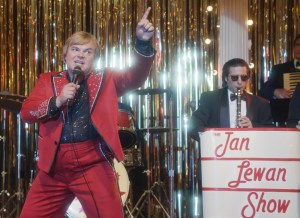 The FBI gets one whiff of this and feel it must be some sort of Ponzi scheme. They shut Jan down, but since he promises it was an honest mistake, and to pay back his investors, problem solved. Except, in order to pay back his investors, he ends up creating a second, bigger scheme.
 In fact, music alone is not enough to save them. Turns out they’ve suffered a tragedy that neither has fully grieved, and singing about it is going to be very difficult since talking about it has been impossible for years. They’re still a broken couple, now they’re just putting all their dirty laundry on the stage for the consumption of others. A particularly ambitious dream of them getting a record deal never seems all that impossible because actually, their music is good, and fun (so long as you are currently in a good space with your loved one). Sean and I found ourselves communicating in that subtle hand squeezy way that some couples have when they are relating a little too well to the awkwardness on screen.
 This holiday movie has something for everyone: spirituality, homophobia, reincarnation, crippling depression, dead babies, and more. But in its heart of hearts it’s really just about a bunch of people who don’t want to end up alone – on Christmas, on their deathbeds, in the world just generally. Some of us feel encumbered by all our obligations to friends and family over the holidays but others are completely bankrupt when it comes to people who care, and for them, the holidays can be really, really hard.
 cheated in order to get, but when he finds that it’s not enough, he doesn’t just abandon it, he makes it into a game, one that his family can never win because they don’t even know they’re playing, but even if they did, the deck isn’t just stacked against them, the rules are impossible. It’s not really his family that’s the problem – it’s Harold’s own dark, empty soul. And it’s terrifying to get glimpses of it as he spends months becoming a feral creature up in the attic of his detached garage. He risks starvation and exposure just to carry out this cruel little experiment. Is he missed enough? Grieved enough? His absence respected enough? No one can ever measure up – but Harold himself conveniently escapes his judgement.
 Kaufman just didn’t give a fuck – but Jim? The documentary has a tonne of footage from the set of the movie, which was filmed 20 years ago. A documentary was planned at the time (shot by an old girlfriend of Andy’s) but Universal pulled the plug, for fear that the public would discover their beloved Jim Carrey to be an asshole. Cut to 2017 and the cat’s pretty much out of the bag. And maybe asshole’s not even the right word, but there is no one right word: he’s a space cadet, a depressive, a nonsensical philosopher. And those things are all apparent in the documentary, which also features an interview with him present day. And it’s hard to know who to detest and pity more: the Jim Carrey on the set of Man on the Moon was was never Jim Carrey at all because he was so deep in the character Jim never showed up to work, or the Jim Carrey today who at times seems downright bewildered even in his own skin. He talks about fugue states and telepathy, but bottom line, he believes that the spirit of Kaufman inhabited his body during filming. When director Milos Forman or colleagues like Danny De Vito or Paul Giamatti tried to address Jim on the set, “Andy” would be angry and\or defensive. “Andy” was always on, and always creating a ruckus. You can see how that would wear thin. The real Jim Carrey, whoever that is, has recently claimed to have had a spiritual awakening, and depending how woke you are yourself, what he spouts is either enlightened or crazy.
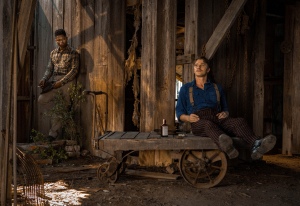 distinguish between different levels of abject poverty, but there’s no question that the white McAllan family will always be in a better position than the black Jacksons (yeah, I feel weird writing that, so go ahead and feel weird reading it). Ronsel is having trouble adjusting to this country that demands that he risk his life defending it but then will spit in his eye the moment he’s back on American soil. Tough blow.
 ASSHOLES WATCHING MOVIES