About a year ago, Wandering Through the Shelves had us binge-watching Movies Based on Young Adult Novels. The first two films in the Divergent series were neither the best or the worst things I watched that week. They’re not great- even “good” would be a stretch- but I was won over by the decency and unlikely strength of Tris (Shailene Woodley). I also couldn’t have done without the effortless charisma of Miles Teller as Peter, who brings much-needed personality to a series that takes itself way too seriously whenever he’s not on screen.
In the first two films in the series, the citizens (prisoners?) of Chicago have been assigned factions based on their defining trait (athletic, honest, kind, smart, and selfless). I’ve always found this basic premise to be a little lazy and a pretty adolescent view of the world but, hey, it’s young adult fiction. Besides, it’s what makes Divergent Divergent. To do away with these factions would be like the Twilight series continuing without any vampires or werewolves of the Fifty Shades series going straight edge. Unfortunately, that’s exactly what this series does.
Allegiant picks up where Insurgent left off, immediately after the fall of the faction system. Without it, not only does Chicago lose control over its population but the story loses its focus and coherence. Fearing that Evelyn, (Naomi Watts) is becoming as oppressive a leader as Kate Winslet’s character had been, five young adults venture over the walls. What follows is sillier than the other two films combined, exposition-heavy, and impossible to follow. Tris, the heroic non-conformist of the story, somehow starts towing the party line. Woodley does her best to keep her interest but it’s tough not to be frustrated with her when everyone onscreen and in the audience thinks it’s obvious that she’s being played. Even Miles Teller’s shtick is getting old. Pick a side, buddy!
The Divergent series isn’t really made for adults and for all I know may please its target audience. Because most 16 year-olds wouldn’t be interested in our site and most of our readers wouldn’t be interested in this series, you might wonder why I’d even bother reviewing it. To that, I can only say “Jeff Daniels”. Daniels, joining Winslet, Watts, Octavia Spencer, and Ray Stevenson, becomes the latest good actor over 40 to have his talents wasted by this trite material. How so many good actors got involved in this series, I have no idea. But judging by their performances, I can tell it’s not because they wanted to be there. By the third film, their talents are no longer just wasted. They’re giving bad performances.
What’s happening in Hollywood that the likes of Naomi Watts and Jeff Daniels need a job this badly? Or that any filmmaker could become so distracted by their pretty but mostly boring young stars that they would forget to give Oscar-winner Octavia Spencer even a single key scene?
This is why I care enough about this series to write about it.
Adam Sandler is not everyone’s cup of tea. His movies tend toward the juvenile and so lots of people give him a wide berth at the box office. But to know Adam Sandler is to love him; in actors’ circles, he’s known as the nicest guy in Hollywood.
A little shy, Sandler does as little press as he can get away with, almost no print, and only very occasional talk show appearances, which he usually does in character. As the head of his production company, Happy Madison, things are a little different. He’s the affable and humble centre of an awful lot of industry, loyally employing friends and family on projects skewered by critics but beloved by audiences. Sandler’s movies haven’t been box office juggernauts in years, but they are consistent earners, and his name has continually if quietly stayed among the top earners of Hollywood for the past two decades.
Sandler’s early success meant he could start doing things his way, and he’s surrounded himself with the same cast of characters, working with the directors and writers he trusts, to say nothing of the famous faces appearing in his movies. Always grateful to Saturday Night Live as his diving board to fame (he was discovered by Dennis Miller), he employs not just the SNL alums he worked with (David Spade, Rob Schneider, Chris Rock, Norm MacDonald) but many besides (Will Forte, Andy Samberg, Dan Aykroyd, Kevin Nealon, Rachel Dratch). He attracts big names to his movies (Jack Nicholson, Harvey Keitel), but always finds room for old friends (Allen Covert, Peter Dante), Sandler mainstays (Henry Winkler, Kevin James, Steve Buscemi), and his own wife and daughters.
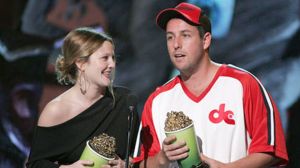
One such person who can never get enough is Drew Barrymore. In her 2015 memoir Wildflower, Barrymore describes begging for a chance to meet him after her good friend Tamra Davis (director of Billy Madison) raved about him. Barrymore was certain of his “goodness” and felt they should pair up despite them being complete opposites in their early 20s, “like a preppy and a punk set up on a bad blind date.” Her pitch worked: pretty soon he came calling with a little movie called The Wedding Singer in his pocket. Written by Sandler groupie Tim Herlihy, it was given an uncredited polish by Sandler’s friend and former roommate, Judd Apatow (another guy famous for working with a loyal crew, including Sandler himself of course, most notably on Funny People) and Carrie Fisher, to give equal weight to the feminine side. The movie was a hit, with Drew certifiably falling in love with the Sandler crew, calling them “real, no-bullshit friends” which I take is a high compliment in Hollywood.
People loved The Wedding Singer for many reasons – the 80s nostalgia, the cheesy music, but above all, the incredible chemistry between Adam and Drew (she refers to him as her “cinematic soulmate”).
Always intending to work with Sandler again, Barrymore knew they couldn’t settle for anything less than the greatness they’d already achieved. But life moved on. Drew worked intensely on a Penny Marshall movie called Riding in Cars with Boys, and it was around that time that she came across a romantic script that she thought was a great fit for her production company, Flower Films. Unfortunately that script was a hot commodity, and it kept changing hands, with big directors and stars attached, never becoming available to her, despite numerous attempts. Until one day she heard that it had landed at Adam’s studio, Happy Madison. By this time they each had an office just a few hundred feet apart on the Sony lot (she was doing Charlie’s Angels), so he was easy to hound. Sandler was already turning it into a comedy but welcomed Drew on board not only as a co-star but also as co-producer, and she’s responsible for keeping the important elements of the love story, the parts that turned us all to mush.
Adam and Drew took the Seattle drama and laid it out in Hawaii instead, each bringing their production families to paradise and basically turning the island into a happy party (so happy that her Angels co-star Cameron Diaz came to visit and never left). 50 First Dates opened on Valentine’s day, and I was there, butt in the seat, and actually watched it twice (the projector broke down half way through, and we had to star the thing over from the beginning). They broke records that opening weekend; I’m not the only one who finds these two irresistible.
It would be another decade before they reunited on-screen again, with The Wedding Singer director Frank Coraci back at the helm for a movie about modern families called Blended. This movie would be proof of how far they each had come, personally and professionally, since first meeting as successful, hard-partying kids in the 90s. Sandler, once a “bad boy of SNL” now has a reputation for being a family man. He has always been quick to attribute credit to his parents (his highest-grossing comedy album named for them, Stan & Judy’s kid, and even one of Chris Rock’s albums a tribute to Sandler’s late father). By this time Adam and Drew had 3 daughters between them and the whole crew headed to Africa, families in tow. Barrymore has downshifted on her acting career since becoming a mother, finding it hard to strike the balance, but an Adam Sandler film “celebrates wives and kids” and she was able to make a family adventure out of it, even discovering on her last day of shooting that she was pregnant with a second daughter.
Still the best of friends, Adam and Drew now attend each other’s kids’ birthday parties (2 daughters apiece – Sadie and Sunnie for him, Olive and Frankie for her) and talk about their next project, whatever that may be, joking that they’ll still be making romantic comedies when they’re old and gray. (In fact, during press for the movie Blended, Adam made a very pregnant Drew cry when he sang the precious The Wedding Singer song to her “I Want to Grow Old With You”).
No matter what it is, I know I’ll be in line to see it. These two are cute as can be when they’re together, and Drew knows why: “I once knew a boy named Adam. And I hoped that we could be a team, but what I found was a true partner. I now know a man named Adam, and trust me when I say, he is as great as you want him to be.”
Requiem for the American Dream opens with Noam Chomsky reminiscing about the good ol’ days of the Great Depression. As bad as it got during the Depression, he recalls a shared understanding among the people that this shall pass. Now things are bad again, he claims, and this time nobody seems as optimistic that things will get any better. Of course, it’s perfectly normal that the outlook of a young boy packing into the back of the family truck with Grandma, Grandpa, Ma, Pa, and Uncle Tom and heading to California looking for work (assuming of course that his childhood was exactly like The Grapes of Wrath, which is my only point of reference) is probably a little rosier than that of a cranky 85 year-old linguist but he has my attention. He claims that the disparity between the rich and poor in the US has never been higher, predicting the death of the American Middle Class. Which worries me a little, as a member of said Middle Class.
It all started with America’s beloved forefathers, who understood Democracy’s biggest problem. In a true democracy, with poor people having the right to vote, what’s to stop the underprivileged from voting to take the big fancy houses away from the rich? Hardly seems fair, doesn’t it, since the rich worked so hard for said property? So they were left with two choices: take steps to reduce inequality or to limit democracy. So, according to Chomsky, begins the process of building a system that limits the access of the underprivileged to the highest office in the land.
Honestly, I’m not a fan of documentaries like these. Requiem features four years worth of interviews with Chomsky. Visually, we’re offered only tight close-ups of the renowned political activist’s face that even the most vain of starlets would never agree to along with the occasional stock footage of skyscrapers and highways. The filmmakers seek no other opinions, neither dissenting or complementary, and Chomsky’s lecture is accompanied only by an irritating score from Malcolm Francis.
So it’s not much of a documentary. That doesn’t mean its subject isn’t worth listening to. His observations are as alarming as they are timely. Even better, he has the decency to offer some hope for the future, reminding the American people that their system is set up so that regular people can bring about real change as long as they stop fighting amongst themselves and stand up and make themselves heard. Still, the documentary has nothing to offer but the words of Noam Chomsky. So you’re probably better off just reading some Chomsky.
This summer, I wrote a little about my appreciation for some harmless eavesdropping. Not in a creepy way. But if you’re having a conversation while I’m in earshot, I’m listening in. For instance, just a moment ago, I overheard one colleague saying to another “I brought soup for supper tonight but will go out to get some salad so I can get my vegetables too. Not that salad is vegetables”.
The comments from some of our readers could not have been more validating. Who would have thought that so many bloggers loved to watch out of the corner of their eye as strangers live their lives? I’ve never felt better about not minding my own business.
The response I got was a little surprising. It seems to contradict my favorite Morgan Freeman speech of all time, where he tells Brad Pitt “In any major city, minding your own business is a science”. This line from Se7en, despite being delivered with the conviction of a great actor in his prime, may seem a little strange given our obsession with office gossip and the private lives of celebrities. Of course, this isn’t what Freeman was talking about. What if the person you’re watching happens to need your help? Suddenly, it can be quite tempting to play the “Hey, this is none of my business” card.
So it goes with Patrascu in One Floor Below, a Romanian thriller from director Radu Muntean. Climbing the stairs to his apartment, Patrascu can’t help overhearing, especially since he stops for a moment to listen in, a scandalous argument between two lovers in an apartment one floor below. From the sounds of it, the heated discussion quickly escalates into a case of domestic violence, at which point the middle-aged husband and father decides “Hey, this is none of my business” and moves on. The next day, he learns that the young woman one floor below has been murdered.
Why introduce my review with three paragraphs of questionably relevant references to eavesdropping, salad, and Morgan Freeman? Well, I had to talk about SOMETHING! What do you say about a movie where nothing much happens? However thought-provoking Patrascu’s moral dilemma, Muntean makes his point in one or two short scenes, leaving very little to talk about for the rest of the movie. The ambitious director struggles to find drama in a murder case where the main character makes no effort either to investigate or find justice (in fact, he lies to the police to avoid getting involved).
Muntean asks some good questions and makes some unsettling observations in One Floor Below but there aren’t enough of them- and not nearly enough plot- to fill 93 minutes. I admire the restraint with which he tells a story that could have so easily given in to melodrama. I couldn’t help feeling like I really should be liking this movie. But it really couldn’t hold my attention. And this coming from a guy who is captivated by two colleagues talking about soup.
This seems like a movie that had to be made. The world was captivated in 2010 by the story of Chilean miners trapped deep underground after a mine collapse.
Why then did they hand the job off to an 8th grade script writing class with only a big dictionary of awful movie archetypes at their disposal? I’m sure they earned full marks for using all of them: the new guy and his first day on the job (oh, the irony!), the old guy and his last day on the job (oh, the irony!), the guy who should have been off but begged to work (all together now: oh, the irony!), and most importantly, the evil, greedy boss on whom we can pin all our hatred and frustration.
Inside the mine, it’s as bad as you’d think. 33 miners survive the initial collapse but seem unlikely to survive the wretched, unsafe conditions, or each other’s mounting tensions.
Outside, families are in panic because it’s been days and not a single word has come from the owners or the government. The very same owners who sent men down despite knowing the mountain was moving, the very same who failed to outfit the refuge with any supplies, who didn’t even finish the escape ladder required by law. And a government who knows very well that their country depends on mining as their primary industry. So who really cares for the miners? It took 100 years to drill down as deeply as they have, and they have about a half a can of tuna per man. How quickly can they be reached, and will they be corpses when (and if) they are? The miners are afraid their families will have graves up before they’ve even breathed their last down there.
To cast this motherfucker, Hollywood looked around at anyone with dark hair and eyes. Antonio Banderas is Spanish, Rodrigo Santoro Brazilian, Juliette Binoche French (she replaced Jennifer Lopez, if you can believe it). Lou Diamond Phillipps was born in the Phillippines and is part Cherokee. Oscar Nunez, from TV’s The Office, is Cuban. Kate del Costillo is Mexican. Other actors are Indian, Columbian, English, American. Actual Chileans are tough to spot but they’re banking on us not knowing, or caring, about the difference.
Is this a good movie? It was too sanitized and trite for me. I understand that the miners, largely Roman Catholic, relied a lot on faith to get them through their ordeal. They also made a pact that what happened in the mine stayed in the mine – none would reveal the understandably dark days, bad thoughts, or low points of anyone else. So the movie is based on what – Jesus and fiction? It didn’t do a lot for me.
It is, however, the last movie scored by James Horner. The score isn’t bad, but it’s as forgettable as the movie, not a great note for a remarkable composer to go out on.
We’ve been spoiled by Pixar into thinking that animated films aren’t just for kids anymore but Adam Sandler wants to remind you that, indeed, some of them are.
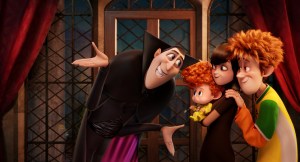
Hotel Transylvania 2 isn’t offensive, it’s just a throwback to that old style animation where a cartoon is just a babysitter for the kiddos. It’s full of monsters so colourful and appealing they could advertise sugary breakfast cereal. The movie relies on sight gags and corny jokes that just don’t cut it for the over-10 crowd.
Dracula is back, the proprietor of a high-end hotel catering exclusively to monster guests. His daughter Mavis (Selena Gomez) has just married her human sweetheart Jonathan (Adam Samberg) and they’ve got a sweet little baby boy, the apple of Dracula’s eye. The only thing is, nobody knows yet whether the baby will turn out to be vampire or human. There’s a slight allegory here, something about “mixed families” but it’s not exactly groundbreaking stuff.
Sandler brings along all his old buddies to flesh-out the awesome voice cast: SNL alums, Chris Parnell, David Spade, Molly Shannon, Dana Carvey, Chris Kattan, and Jon Lovitz; Sandler mainstays Kevin James, Steve Buscemi, Nick Swardson, and Allen Covert; and a rather inspired addition – Mel Brooks as Vlad, grumpy great-grandpa who doesn’t approve of vampire-human relations. My favourite of course, are Nick Offerman and Megan Mullaly, who together voice Jonathan’s super-square parents who get thrown into a crash-course in monsterdom when their son introduces them to vampiric in-laws and a “half-blood” grandson.
Offerman and Mullaly are a real-life couple who met while doing a play. He was a lowly carpenter, and she was a TV star still in the throes of her Will & Grace fame. Over the course of their relationship, she’s seen his star rise as well due to a similarly iconic role on Parks & Recreation. We Assholes were lucky enough to catch them doing another play together, this time on Broadway, called Annapurna. It was a simple, 2-person play, deeply intense and emotional, and a real joy to watch two master thespians up close and personal. It’s clear that they love working together, even if it’s on a shitty kids’ movie.
Well, I’m saying shitty because I was bored by it. But the producers of Hotel Transylvania don’t care what I think. They didn’t make it for me. And if you ask a kid, chances are they loved it. The sequel was a veritable monster at the box office, if you’ll forgive the pun, setting records as the biggest September opening, the biggest Sandler opening, and the biggest for Sony Pictures Animation as well. It grossed $469 million worldwide, and it just beat out Inside Out at the Kids’ Choice Awards this weekend. So hell yes there’s a #3 coming down the pipes.
Bottom line: if you run out of Paw Patrol, this movie will make a nice substitute for your single-digit-aged kids. If you hope for more than just fart jokes in your animated movies, maybe Zootopia is your better choice – though I’m not guaranteeing it’s fart-free….in fact, I distinctly remember a certain “play on words” if you can still call it that when the word in question is duty.
Some of my favourite people come together in this movie, so I couldn’t resist, but neither could I legitimately build up my expectations since it was just an unvouched-for indie among many on Netflix.
And it doesn’t have much of a plot that I can summarize for you; it’s an unambitious slice of life. It’s about a guy (Nick Kroll) who shows up at his sister’s door in suburbia, looking for a place to live. He’s had some major setbacks and he’s feeling way too old to start his whole life over again. She’s (Rose Byrne) not in a much better place, kind of not sure about her job, her marriage, or even where to be or who to be. They’re listless. But the interesting thing about the movie, to me, is that they’re not painted as losers. They’ve just had some bad luck and some hard times, and that’s life.
Not the laugh-out-loud comedy you’d expect, I was caught off guard by how thoughtful and mature this movie is – maybe one of the more realistic movies about adult family relationships I’ve seen in a long while. Byrne and her on-screen husband, Bobby Cannavale, are a real-life couple, and they play well together. Throwing funny man Nick Kroll into the mix as a more or less straight-man is a bold and surprisingly effective choice. Everyone is some degree of flawed in this movie but we don’t make monsters out of any of them. They’re very relatable, and there’s a quiet generosity in the characterization, a forgiveness I’m not used to see in movies that was really refreshing and kind of a relief.
While it doesn’t exactly gift-wrap an opaquely happy ending, it does suggest that second chances are possible, and maybe that’s as happy an ending as I really need.
In 2006, Disney purchased Pixar for the equivalent of $7.4 billion dollars. It’s becoming more and more clear how good a deal that was for Disney. Every Disney animated movie since has been amazing, from Wreck-It-Ralph to Frozen to Big Hero 6. Not only is Zootopia another success for Disney, it may be the best of the bunch since John Lasseter and Pixar came on board, and that’s probably the best endorsement I can give.
The best part of Disney Animation’s renaissance is that these movies aren’t just for kids. They’re as enjoyable for adults as for little ones. Zootopia, for example, includes a spot-on reference to Breaking Bad! Striking that balance must be incredibly hard but Disney has picked up the torch from Pixar in that area and is doing it as well as Pixar ever did. Zootopia is literally a movie that all ages will enjoy. So it’s one up on LEGO!
Most importantly, Zootopia’s underlying message is timely and may be more important for adults than kids at this point, given the horror that is theU.S.Republicanparty’snominationprocess. We as Canadians dealt with some of the same terribleness in our recent election so it’s not just an American tactic. Fortunately, enough of us were able to reject fear and demonization of minority groups to choose someone who wants to bring us together instead of tearing us apart. We really, really, really want to believe American voters will do the same (just like they’ve done in the last two presidential elections). Please don’t let us down!
As for Zootopia, it is a movie that will definitely not let you down. It’s smart, funny and deep and you should totally see it. I give Zootopia a score of ten sly rabbits out of ten.
I have been trying to make sense of 10 Cloverfield Lane for months, from the moment I saw the title of this movie at the end of its trailer. And after seeing the movie I’m still searching for answers.
Hinting at a connection between this movie and Cloverfield was probably not the best idea that J.J. Abrams has had. Cloverfield massively disappointed me. It seemed like a great concept, putting the camera in the middle of monster-created chaos, but Cloverfield ended up being your typical found footage crapfest from start to finish. So to suggest this is a sequel or prequel or some other form of spinoff was a weird choice, especially because the trailer for 10 Cloverfield Lane contained no hint of a connection between it and Cloverfield other than the similar name (and thankfully also contained NO FOUND FOOTAGE).
[SPOILERS AHEAD]
The common name is not a coincidence but it was a terrible idea. It ruined what might otherwise have been a nice twist two-thirds of the way through 10 Cloverfield Lane. To paraphrase Shakespeare, this same movie by a different name would have been just as mediocre, but at least the title wouldn’t have tipped off the audience that there was more outside the bunker to be afraid of than a lady with a melted face.
So if you’re making this movie, why tip your hand in the title? Does the Cloverfield brand really have that much value? Am I the only one who disliked that movie? I mean, I totally hated The Visit and others apparently thought it was good. So I’m open to the possibility that a similar thing happened with Cloverfield, but I would be surprised. Tell me whether or not you’re with me in the comments but know that I’m judging you based on your response.
[END SPOILERS]
It felt good to get that out of my system and now I think I can focus on 10 Cloverfield Lane as its own movie. In two words: don’t bother. The group of 13 year old girls sitting behind us couldn’t take it seriously and neither could I. There are way too many disparate elements at work and as a result the movie is disjointed from beginning to end. There’s nothing remotely redeeming or original here.
If end-of-the-world movies were drinks, 10 Cloverfield Lane would be a glass of three random types of bar-rail liquor, served to guests without a taste test. So it’s only fitting that 10 Cloverfield Lane gets a score of three bottles of cheap scotch out of ten.
“Hey everyone.” With those two simple words, the latest trailer for Captain America: Civil War reminded me that Spider-Man is my all-time favourite superhero, hands down, and made it clear that I have to drag Jay to yet another superhero movie.
My love of Spidey started as a six year old who could not stop watching the 1960s cartoon, the one where Spider-Man would swing across the same three weirdly coloured sky backgrounds with no real need for anything to swing from (he swung across the Everglades at one point, above all the trees)! I am humming the theme song right now and hopefully so are you. I truly can’t imagine a better intro to a cartoon or a better gateway drug into the world of comic book consumerism.
Then came the comic books themselves. I still remember getting my first Spider-Man comic like it was yesterday. My parents bought it for me and it was, of course, a battle between Spidey and Doctor Octopus, where Spider-Man ends up saving Doc Ock at the end, because that’s what Spidey does.
From there, I was hooked. As I got older and realized that comics cost money, I supported my habit with paper route earnings. I wasted a bit of time buying Superman comics but quickly wised up and returned to Spider-Man. Though not quickly enough, as by the time I started buying Todd McFarlane-era Spider-Man comics, it was the height of the comic book speculation boom and some of them cost $20 each (which was a lot to a paperboy).
Of course, the market crashed soon afterwards but by that time I had moved on to playing sports, though occasionally I still drew my own comics until I got suspended from high school for it (seriously).

 One such person who can never get enough is Drew Barrymore. In her 2015 memoir Wildflower, Barrymore describes begging for a chance to meet him after her good friend Tamra Davis (director of Billy Madison) raved about him. Barrymore was certain of his “goodness” and felt they should pair up despite them being complete opposites in their early 20s, “like a preppy and a punk set up on a bad blind date.” Her pitch worked: pretty soon he came calling with a little movie called
  The Wedding Singer in his pocket. Written by Sandler groupie Tim Herlihy, it was given an uncredited polish by Sandler’s friend and former roommate, Judd Apatow (another guy famous for working with a loyal crew, including Sandler himself of course, most notably on Funny People) and Carrie Fisher, to give equal weight to the feminine side. The movie was a hit, with Drew certifiably falling in love with the Sandler crew, calling them “real, no-bullshit friends” which I take is a high compliment in Hollywood.
 moved on. Drew worked intensely on a Penny Marshall movie called Riding in Cars with Boys, and it was around that time that she came across a romantic script that she thought was a great fit for her production company, Flower Films. Unfortunately that script was a hot commodity, and it kept changing hands, with big directors and stars attached, never becoming available to her, despite numerous attempts. Until one day she heard that it had landed at Adam’s studio, Happy Madison. By this time they each had an office just a few hundred feet apart on the Sony lot (she was doing Charlie’s Angels), so he was easy to hound. Sandler was already turning
 it into a comedy but welcomed Drew on board not only as a co-star but also as co-producer, and she’s responsible for keeping the important elements of the love story, the parts that turned us all to mush.
 broke records that opening weekend; I’m not the only one who finds these two irresistible.
 wives and kids” and she was able to make a family adventure out of it, even discovering on her last day of shooting that she was pregnant with a second daughter.
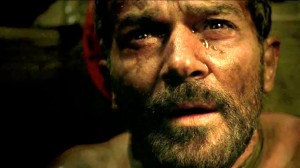 guy who should have been off but begged to work (all together now: oh, the irony!), and most importantly, the evil, greedy boss on whom we can pin all our hatred and frustration.
 country depends on mining as their primary industry. So who really cares for the miners? It took 100 years to drill down as deeply as they have, and they have about a half a can of tuna per man. How quickly can they be reached, and will they be corpses when (and if) they are? The miners are afraid their families will have graves up before they’ve even breathed their last down there.
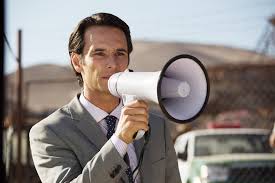 actors are Indian, Columbian, English, American. Actual Chileans are tough to spot but they’re banking on us not knowing, or caring, about the difference.
 I’ll take Phoning It In for 500, Alex.
 Dracula is back, the proprietor of a high-end hotel catering exclusively to monster guests. His daughter Mavis (Selena Gomez) has just married her human sweetheart Jonathan (Adam Samberg) and they’ve got a sweet little baby boy, the apple of Dracula’s eye. The only thing is, nobody knows yet whether the baby will turn out to be vampire or human. There’s a slight allegory here, something about “mixed families” but it’s not exactly groundbreaking stuff.
 Kattan, and Jon Lovitz; Sandler mainstays Kevin James, Steve Buscemi, Nick Swardson, and Allen Covert; and a rather inspired addition – Mel Brooks as Vlad, grumpy great-grandpa who doesn’t approve of vampire-human relations. My favourite of course, are Nick Offerman and Megan Mullaly, who together voice Jonathan’s super-square parents who get thrown into a crash-course in monsterdom when their son introduces them to vampiric in-laws and a “half-blood” grandson.
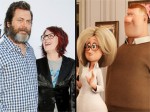 Offerman and Mullaly are a real-life couple who met while doing a play. He was a lowly carpenter, and she was a TV star still in the throes of her Will & Grace fame. Over the course of their relationship, she’s seen his star rise as well due to a similarly iconic role on Parks & Recreation. We Assholes were lucky enough to catch them doing another play toget
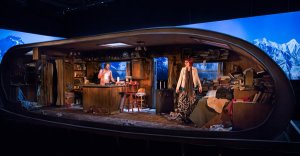 her, this time on Broadway, called Annapurna. It was a simple, 2-person play, deeply intense and emotional, and a real joy to watch two master thespians up close and personal. It’s clear that they love working together, even if it’s on a shitty kids’ movie.
 ask a kid, chances are they loved it. The sequel was a veritable monster at the box office, if you’ll forgive the pun, setting records as the biggest September opening, the biggest Sandler opening, and the biggest for Sony Pictures Animation as well. It grossed $469 million worldwide, and it just beat out
  And it doesn’t have much of a plot that I can summarize for you; it’s an unambitious slice of life. It’s about a guy (Nick Kroll) who shows up at his sister’s door in suburbia, looking for a place to live. He’s had some major setbacks and he’s feeling way too old to start his whole life over again. She’s (Rose Byrne) not in a much better place, kind of not sure about her job, her marriage, or even where to be or who to be. They’re listless. But the interesting thing about the movie, to me, is that they’re not painted as losers. They’ve just had some bad luck and some hard times, and that’s life.
 thoughtful and mature this movie is – maybe one of the more realistic movies about adult family relationships I’ve seen in a long while. Byrne and her on-screen husband, Bobby Cannavale, are a real-life couple, and they play well together. Throwing funny man Nick Kroll into the mix as a more or less straight-man is a bold and surprisingly effective choice. Everyone is some degree of flawed in this movie but we don’t make monsters out of any of them. They’re very relatable, and there’s a
  quiet generosity in the characterization, a forgiveness I’m not used to see in movies that was really refreshing and kind of a relief.
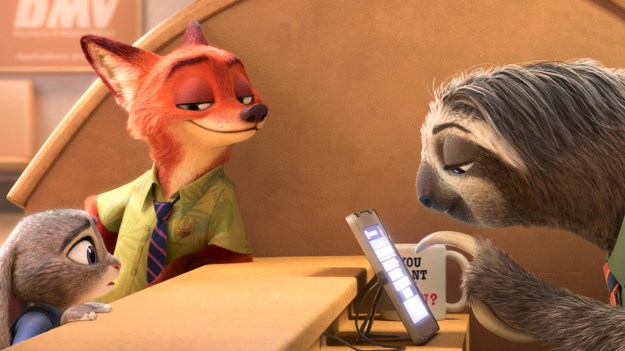 In 2006, Disney purchased Pixar for the equivalent of $7.4 billion dollars. It’s becoming more and more clear how good a deal that was for Disney. Every Disney animated movie since has been amazing, from Wreck-It-Ralph to
  Not only is Zootopia another success for Disney, it may be the best of the bunch since John Lasseter and Pixar came on board, and that’s probably the best endorsement I can give.
 Disney has picked up the torch from Pixar in that area and is doing it as well as Pixar ever did. Zootopia is literally a movie that all ages will enjoy. So it’s one up on LEGO!
 choose someone who wants to
 h no real need for anything to swing from (he swung across the Everglades at one point, above all the trees)! I am humming the theme song right now and hopefully so are you. I truly can’t imagine a better intro to a cartoon or a better gateway drug into the world of comic book consumerism.
 ASSHOLES WATCHING MOVIES