Monthly Archives: September 2016

TIFF: LBJ

We had an interesting overlap this year at TIFF: we saw both Jackie, which follows First Lady Jacqueline Kennedy in the moments and days following JFK’s assassination, and we saw LBJ, which follows Lyndon Baines Johnson as he inherits the White House following JFK’s assassination. Both movies have actors portraying Jackie, John, Bobby, Lyndon, and Ladybird, and both movies have value.

Jackie will of course be an awards contender; LBJ was more of a wild card. It’s by director lbjRob Reiner, a venerable talent who hasn’t directed anything of note in a couple of decades. As he introduced this film to the TIFF audience, however, it was clear that this movie really meant something to him. He talked of being a young man during LBJ’s time in office, and hating him because he was the man who could send you to your death in Vietnam. Only with time, age, and political engagement could he look back at Johnson as something more. He was the president who had to shoulder the burden and responsibility of John Kennedy’s legacy. He took over lots of the civil rights work that JFK had begun, and LBJ is the one who pushed it through, though history sometimes forgets to give him credit for this.
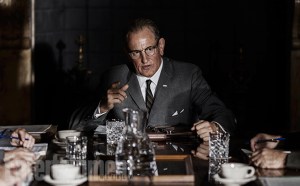
You may be surprised to hear that Woody Harrelson plays LBJ, underneath a not inconsiderable amount of makeup and prosthetics. Jennifer Jason Leigh steps in as Ladybird, in a career move that I can only imagine is a little depressing to a 1980s babe. It may not be intuitive casting, but it is inspired – it makes them come alive, not just as historical figures but as real, flesh and blood people, in a way I haven’t seen before. Rob Reiner’s position is also that Lyndon was a very funny man, and the unexpected joy of LBJ is how much you’ll chuckle watching it.

It’s a safe movie though, a conventional one that won’t speak to audiences or to history lbj-2016the way Jackie does. That said, I still found it to be quite enjoyable. The film neglects to give us a complete picture of the man, but does focus interestingly on LBJ’s rivalry with JFK, allowing Harrelson to swing between cockiness and shame and a whole presidential gamut in between – it’s refreshing to watch him flexing so readily after a string of second-banana performances. He’s playful bordering on hammy, showing us wit, vulgarity, searing intelligence, and frustrated ambition.

One of my favourite scenes occurs between Harrelson’s LBJ and a nasty Richard Jenkins as Senator Russell as LBJ haltingly tries to explain the importance of civil rights to a bigoted southern senator while his black maid serves them dinner. So while this is in fact a clichéd biopic of “an important man”, it’s also got little touches and details that make the ride worth it. Rob Reiner is no stranger to political dramas and isn’t afraid to show us that even the most idealistic of political agendas necessitate some manipulative, under the table handling.

LBJ is Reiner’s best work in years, and Harrelson’s too. It doesn’t soar to the great heights of Jackie but it does make an interesting companion piece to it. What the heck – see them both.

Ottawa International Animation Festival 2016: Window Horses

Young Canadian Rosie Ming has kept her interest in poetry a secret so her grandparents and best friend are shocked when she announces that she has been invited to a poetry festival in Iran. Though she can’t help wishing that the festival was in Paris instead, Rosie soon discovers that she has a lot to learn from her fellow poets from around the world about ancient Persian poetry and her own family history.

Of course, some of my favourite movies are animated but I am realizing lately how little I know about animation itself. I know very little about the different styles of animation and wouldn’t know how to go about describing the look of this film.

Luckily, I have some stills.


Window Horses is as much a story about multicultural identity as it is about family. Rosie was born and raised in Canada to a Chinese-Canadian mother and a Persian father. With her mother now deceased and her father now estranged, she knows very little about either family’s heritage. When asked about her father, she has only one thing to say “My father abandoned me when I was 7”. As she starts to realize that nearly every local she meets in Iran seems to know him, she is forced to revisit the oversimplified story she’s been telling herself about her father.

Yes, the resentments we hold on to, maybe especially when it comes to our own family, are more complex than we let on. We’ve seen this before in movies and I did find the family drama a little played out and predictable. Thankfully, Window Horses has a lot more to offer than just a mystery surrounding Rosie’s family. Window Horses works best when it shows us the transcendent power of art. Rosie spends a lot of the movie discovering Chinese and Iranian culture through poetry and barely even needs to speak a word of Mandarin or Farsi to relate to the words. German, Mandarin, French, and Farsi verses are all brought to life with some beautifully creative animation all without a single subtitle. It is the film’s most brilliant device by far.

Window Horses may drag a little when it relies too heavily on exposition  and voice actress Sandra Oh is badly miscast as Rosie but, for the most part, director Ann Marie Fleming has made quite a nice film. Its unique sense of humour and literally poetic animation more than make up for its any minor complains I might have.

Bridget Jones’s Baby

My biggest problem with the Bridget Jones series has always been with Bridget herself. I find her a bit insufferable. She’s whiny and vacuous and quite self-absorbed. I think she’s supposed to be relatable, but I always find her an insult to women everywhere. However, with both of my dreamboats Colin Firth and Hugh Grant on board, I couldn’t help but succumb to Bridget and her wanton ways.

In this newest incarnation, Hugh Grant is dead, and his cavernously-bridget-jones-gallery-01inadequate replacement is Patrick Dumpsey. I am very firmly NOT aboard the McDreamy train. I am on the station platform, eyebrow cocked, arms crossed, unamused ember in my eye, willing it to just get on with it already. Good riddance. The only thing I’ve known him from is Can’t Buy Me Love, and I’ve not been induced to rectify that. Still, I was unprepared for how astoundingly bad Dumpsey is in Bridget Jones’s Baby. Dear god. He’s really, really bad.
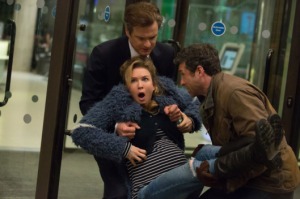
Bridget Jones, luckily, is a little more tolerable. Older now, she’s less obsessive about her weight (though this might be attributed to Renee Zellweger’s refusal to gain weight for the role), and accordingly more focused on her age. But 15-bridget-jones-baby_w529_h352she’s also got a nice social life and a good job, so she feels more well-rounded and less pathetic. Well done, feminism! And she isn’t whining and pining over two men, either. This time she’s chosen both, laid them both, and wound up pregnant. Who’s the daddy?

In a way it doesn’t matter. Bridget is 43 now, and more mature. She’s not man-hunting, she’s content to be by herself, to parent by herself. This message isn’t exactly served by the love fantasy it constantly alludes to. Firth’s character, actually called “Mr. Darcy” is every bit the prototypical Pride & Prejudice hero. Dumpsey gets a Cinderella storyline and does his best Prince Charming impression. Austen vs Disney: who would you choose? Bridget is as maddeningly flip-floppy as ever, but never mind. The real love story here is between Bridget and her baby, which is possibly the first thing this trilogy really gets right.


TIFF: All I See Is You

All I See Is You is a movie I wish I could unsee.

Blake Lively plays a woman blinded in a childhood accident. Her husband dotes on her, and in the first few scenes of the movie, director Marc Forster wants to experience her perceptions. Film is of course a visual medium, but as she and her husband have sex, we focus on different sensations – on the all-i-see-is-you-review-blake-livelysheets, on his hands, their breathing, the sounds drifting in from outside, the memories that keep cropping up. It’s a strong enough start but when she becomes a candidate for surgery that would restore her eyesight, things start to shift.

The story shifts. It’s not just her life that changes as a seeing woman, but his as well. Both struggle to redefine themselves. But now that her vision is restored, I found the film harder to follow. In fact, I didn’t follow it. Afterward, momentarily blinded by the sun upon exiting the dark theatre, Sean and I compared notes and found that neither of us could account for some strange occurrences in the movie. I was willing to believe that I was just tired and bored and inattentive, but since both of us failed I’m more inclined to blame it on bad film making.

As Blake’s vision begins to focus, she sees cracks in her marriage. Neither she nor her husband (Jason Clarke) could have anticipated the cobwebs they’d find in the corners of their relationship. And as much as she’s maybe not digging the dynamic in her marriage, she’s definitely into what she sees in the mirror! A dye job and a push-up bra are top priorities, and I’m sure her corneal transplant surgeon (Danny Huston) feels very gratified. The film continues to present images that are a little surreal, paired with incongruous sound that represent the disparity in her experience. Some of it is a little too obvious and some of it’s way out of left field. Like if you take a left at the hot dog cart behind left field, keep going pass the overflowing garbage can with all the bees buzzing around it, and head for the 3rd red Buick in the parking lot, that’s maybe where this stuff came from. And that’s me being generous because in my hard little heart I still believe some of this stuff was slotted in just to see if we were paying attention.

Her husband definitely prefers her submissive and dependent, and things crumble when she’s suddenly strutting her hot stuff all by her lonesome. But I can’t quite feel a lot of empathy such a vain and selfish character. There’s nobody here to root for, not even the dead bird stuffed mysteriously down a glass bottle in the refrigerator (?). I don’t think there is any saving this movie, but Lively definitely doesn’t have the chops for it. If I’d had an inkling that Sean was finding All I See Is You just as painful as I was, I would have organized a walk-out.

TIFF: Arrival

Arrival is exactly the kind of sci-fi film I’ve been waiting for all my life.

There are no guns, no star wars, no green men, no space cowboys, no mutually-assured destruction. The aliens touch down, and we’re not sure what their intentions are. Do we fire lasers at them? No. We study them. We gather together top academics, and we attempt to learn, peacefully (with the army on speed dial, just in case).

Amy Adams plays Dr. Louise Banks. Of all the people on Earth talking to arrival-movie-1-600x399aliens, she’s the one who listens well enough to actually crack the code. And it’s a hell of a code, unlike anything our puny human brains can really comprehend. This deep gulf of understanding makes plenty of people nervous – people with their fingers hovering over big red buttons. Annihilation-type buttons. Dr. Banks puts her own life at risk to keep things from escalating to an out-and-out global (universal? galaxal?) war.

Amy Adams is as good at playing Dr. Banks as Dr. Banks is at solving language problems. Both are beautiful to watch. Director Denis Villeneuve worked doggedly to make sure all the science is sound, but it’s also almost magical. It makes me want to call it the movie Interstellar aspired to be: rooted in science, hinging on human connection.

Arrival is the most intimate of sci-fi films, the aliens (if that’s what they are) almost incidental to humanity’s expanding comprehension of time and memory. It’s like poetry. And it doesn’t hurt one bit that visually, it’s slick as hell. Bradford Young’s cinematography is nearly stark, but it is absolutely arrival2arresting. It works in synchronicity with a hauntingly beautiful score by Jóhann Jóhannsson. Twinned together they remind you that though the plot feels startlingly realistic for a sci-fi film, there’s something otherworldly at play. Young’s work is atmospheric, Jóhannsson’s is pulsating.
It’s refreshing to have an alien encounter that relies on communication rather than violence, and to have a woman stepping in as Hero(ine) feels only natural. In fact, the only part of the movie that didn’t gel for me is a 2-minute montage that serves to pilot the plot further ahead and is narrated by Ian (Jeremy Renner). The rest of the story is told completely through the eyes of Louise, so to have her voice suspended during these few scenes is jarring and emotionally blunting.

Adams, though, is faultless; she turns out a character that is mature and complex, and I won’t be one bit surprised to see her name alongside Natalie Portman’s, and likely Emma Stone’s, come Oscar time.

Chronicles of the Ghostly Tribe

Mongolian border, 1979: soldiers are exhausting themselves digging a mine, but damn do they believe in the cause. They believe it so hard they break into song when they’re not collapsing of altitude sickness. Is this a propaganda movie? Wait: a rumble. Our hero, Hu Bayi, turns toward the tunnel in time to get hit by the force of an explosion, an explosion seemingly caused by the recent unearthing of gigantic fossils.

Many are dead, but the explosion has opened up enormous caves that lead down into previously unknown parts of the mountain. What are the fossils? What secrets does the mountain possess? A brave few volunteer: Hu Bayi (Mark Chao) of course, the venerable Professor Yang (Wang Qingxiang), and the professor’s beautiful daughter, Ping (Yao Chen).

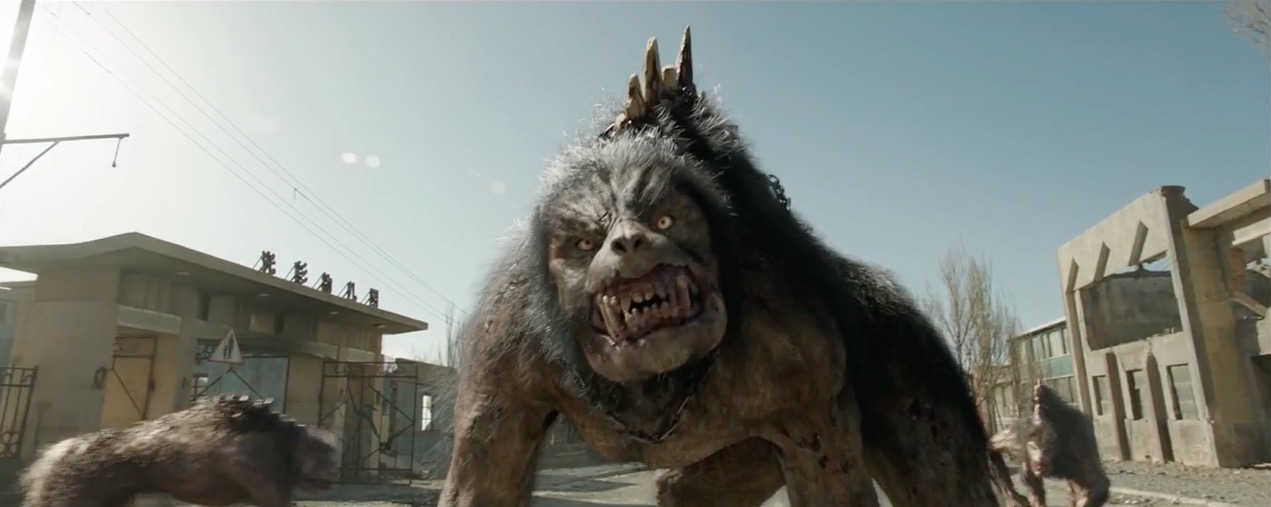
The expedition encounters a footprint of enormous proportions. They haven’t seen yet what we’ve seen: a dragon or dinosaur or big reptilian animal of some sort. Yikes. They march on, tracking the prints, when a flock of pink bats suddenly attack. The bats can change colour, and dodge bullets, and also dive into humans and incinerate them from the inside out.

With fewer and fewer survivors, the stakes get higher, the surroundings more treacherous and the CGI more ludicrous. Slo-mo avalanche deaths? You betcha. Super slo-mo avalanche deaths? Why the hell not.

And that’s when things start to get super messed up. When they stumble upon a temple, they chronicles-of-the-ghostly-tribe-5open up a portal the releases…well, I’ll call them hell bats for the sake of argument. We can debate the semantics later. Net result: Hu is the only one left standing. Years later, present day: Hu lives in NYC and spends his time studying demonology. And this is when shit gets EVEN MORE MESSED UP.

Directed by Chuan Lu, Chronicles of the Ghostly Tribe (Jiu ceng yao taIt) feels like the genetically modified bastard child of Indiana Jones and X-Men Apocalypse, only without the budget. Asia doesn’t really do sci-fi the way we understand it, but they do love the supernatural and they love love love a monster movie. Put them together, subtract reason and logic, multiply by two hours of subtitles and what do you get? A movie I regret watching.

TIFF: Brimstone

Something has to bear the banner of “bloodiest thing I saw at TIFF” and I’d wager that Brimstone bears it proudly, has indeed gone to great lengths to earn it.

mv5bndqzm2zhnzctztexns00mdk0ltgwodatzmi3zdbjmme4yzczxkeyxkfqcgdeqxvymju2otaymzq__v1_uy1200_cr8506301200_al_Dakota Fanning plays a mute woman newly married, raising a dead woman’s son and  a daughter of her own. She is unable to speak but the look of dread on her face when she hears the new preacher’s voice tells us all we need to know. That preacher (Guy Pearce) has been stalking her for years, and bathing villages in blood as he attempts to make her his.

Their story unravels backwards – chapter one sets the above scene; chapter two rewinds to her childhood in a religious-pioneer settlement when her mother was the object of his cruel “affections”; chapter three follows her to a saloon where she does what she must in order to escape; chapter four has him caught up to her, and to her kids, as she flees through snowy, barren land.

Guy Pearce is diabolical – the extent of his character’s actual super-naturalness is unclear, or up for debate, but he’s a twisted zealot AT BEST and I’ll let you decide if there’s more to it. Dakota Fanning as Liz is necessarily quiet but full of strength and grit. He comes at her hard with vengeance but she’s a surprisingly formidable opponent.

This is Martin Koolhoven’s first English-language movie and he’s determined to show us what he’s made of. And for the record: blood and guts. He’s made of blood and guts. So am I, I brimstonepearce2suppose, but I’ve never worn my intestines as a scarf. Have you?

The images are powerful, and will burrow under your skin. And there are 148 bloody minutes of them. It’s not all gore though, there’s plenty of foreboding, plenty of tension. The setting does a lot to add to it: isolation is nobody’s friend. The land is unforgiving.

The MPAA warns of brutal bloody violence, strong sexual content including disturbing behavior, graphic nudity, and language. That doesn’t really tell a story though, does it? And it certainly doesn’t account for how thoroughly you’ll scour yourself in the shower after watching it. There’s no label for that. Except maybe “A film by Martin Koolhoven.”


TIFF: Blue Jay

For 16 glorious hours, Blue Jay was my favourite movie at TIFF. Then I watched La La Land and I was in cinematic, technicolour heaven. I’ll tell anyone who will listen every single day of my life that I’m a lucky, lucky girl. Getting to watch 2 astounding, knock-your-socks-off films? Frosting on my fucking cupcake.

Blue Jay is nearly an anti-La La Land. It’s a small, quiet, black and white film that’s not destined for the Oscars, or even really theatres (a small run in LA and NY, and then Netflix by the end of the year – lucky us!). But it is superb.

bluejay_03-h_2016It stars Mark Duplass and Sarah Paulson, almost exclusively. They play high school sweethearts who bump into each other 20 years later. Agony and ecstasy, right there on the screen. And heaping spoonfuls of awkwardness, don’t forget that. Because they were in luuuuurv. The real deal. And now they don’t even know each other. It reminded me of a friend who had recently posted on Facebook that it was her ex-husband’s birthday, a date she can’t help but remember even if she no longer even knows if he’s alive. Isn’t it weird that we can lose track of people who used to be our whole worlds?

For Jim and Amanda (Duplass and Paulson), once they get over their initial weirdness, it’s almost like no time has elapsed at all. They’ve both moved on, new cities, big jobs, other lovers. And yet they can pick up where they left off, the magic reappearing in an instant. It’s like opening up a dorky little hole into time and space, hurtling these two pushing-40-year-olds back to their glory days in high school, when things were light and fun, thecaa09d60-5f6f-0134-3e92-0ad17316e277 sex was hot and heavy, and Annie Lennox was everything. Jim and Amanda will take you down your own worm hole, and if you don’t end the movie thinking about your own First Love, then you my friend have a cold, cold heart.
I picked this movie on two words alone: Mark Duplass. But Sarah Paulson is luminous; she fucking shoots starlight out of her face. The two together have incredible chemistry, and it’s obvious they work-shopped their characters together to perfection – the nostalgic backstory, their lovable eccentricities, the subtle hints to what caused their demise. Duplass and Paulson each deliver career-best performances. No kidding.

If you have ever loved and lost, this movie is for you. If you didn’t marry your high school sweetheart, this movie is for you. If you married him and left him, this movie is for you. If you appreciate things like smart dialogue, meticulous observation, authentic and vulnerable performances, and little bursts of spontaneity that are pure joy on celluloid, this movie is for you.


Oh fer fuck’s sake, just see it. It’s for everybody. It’s perfect.

TIFF: The Bleeder vs. Bleed for This

Ladies and gentlemen, it’s now time for the main event of the 2016 Toronto International Film Festival, coming to you live from the beautiful, historic Elgin Theatre.  

Introducing first, in the red corner, standing six feet five inches and weighing 223 pounds, with a professional record of 35 wins, including 17 by knockout, 14 losses and 2 draws, the former New Jersey State heavyweight champion, from Bayonne, New Jersey, please welcome from the Bleeder, Chuck “The Real Rocky” Wepner!!  

His opponent, in the blue corner, standing five feet eight inches and weighing in at 170 pounds,  with a professional record of 50 wins, 30 by knockout, against 10 losses, fighting out of Providence, Rhode Island, a former world champion in the lightweight, light middleweight, and super middleweight divisions, from Bleed for This, please welcome Vinny “The Pazmanian Devil” Pazienza!!

Jay was gracious enough to agree to include not one, but two boxing biopics in our TIFF schedule: The Bleeder, starring Liev Schrieber, and Bleed for This, starring Miles Teller.  In an all-out battle to capture my vote, who came out on top?  Let’s go ringside and find out!

bleeder

The Bleeder:

The Bleeder opens perfectly, introducing us to a guy we know even though we don’t know it.  That guy is Chuck Wepner, a human punching bag who took a punch so well he could go 15 rounds with anyone, even the Greatest.  Yes, the man himself, Muhammad Ali.  Wepner got the fight because he was the only white guy in the top ten, and during the fight he acquitted himself so well that he inspired Sylvester Stallone to write Rocky.

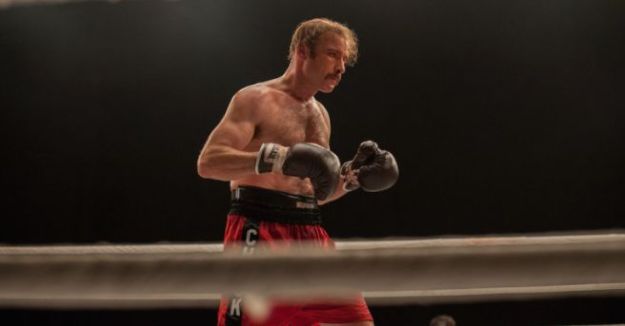
Along with taking a punch, Wepner’s other notable trait is the ability to consistently make the worst possible decision.  To the credit of Wepner and the Bleeder, the movie does not pull any punches with Wepner’s character.  He is a flawed person but the kind of flawed person who you can’t help but be charmed by.  Liev Schrieber is almost unrecognizable as Wepner and does a fantastic job of showcasing the charm while also making us feel for Chuck as he suffers some severe consequences, including losing his family and going to prison.

In the end, the Bleeder does justice to the Real Rocky’s story and gives us a true underdog who makes good in a real way, in his own way.  Somehow, the Real Rocky turns out to be the furthest thing from a cliche, and yet still manages to come out on top in the end.


Note: this movie has been renamed ‘Chuck’ and will hit theatres May 5.

bleed-for-this

Bleed for This:

While the Bleeder features the Real Rocky, Bleed for This features a comeback story too unbelievable to be used as a plotline in the Rocky franchise.  And that’s saying something considering Rocky has come back from: (a) Mickey being shoved to death by Mr. T; (b) Apollo being beaten to death by Drago; and (c) Adrien being written to death by Stallone as a convenient reason to make yet another goddamn Rocky movie.

Miles Teller makes a good showing as Vinny Pazienza, a champion boxer whose neck was broken in a car crash.  Told by doctors that he may never walk again, Paz somehow was able to return to the ring just 13 months after his accident and went on to fight boxing legends like Roberto Duran and Roy Jones Jr.  Teller looks like Paz and looks like he belongs in the ring, but in the transition to the screen the real-life magic that Paz possessed is lost and Bleed for This ends up feeling like just another boxing movie.  And that’s a shame, because overcoming this level of adversity should truly feel triumphant.

The Judges’ Decision:

The match goes the distance as both the Bleeder and Bleed for This are enjoyable films with charismatic turns by their stars.  There can only be one champion though, and by unanimous decision The Bleeder takes the belt.  The Bleeder is far more memorable because it’s not your typical happy ending, and it’s less about boxing and more about the trappings of fame.

The bottom line is that if you like boxing, you’ll enjoy both of these.   The difference maker is that even if you don’t like boxing, I am still confident in recommending that you watch the Bleeder.  It’s a fascinating story that captures the essence of the most interesting loser imaginable, a story so powerful that it inspired an entire movie genre.  It’s a credit to Paz and his tenacity that things were even this close, as in the end Rocky always wins.

ARQ

ARQ had its world premiere at TIFF and was sufficiently popular that Sean and I tried but failed to get tickets. It’s a damn good thing we didn’t get them because if I had paid money to see this piece of shit, I’d be in a REAL rage right now, the likes of yet we’ve yet to see on Assholes Watching Movies.

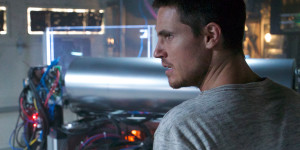
arq_01.jpgIt sounds promising on paper: a dystopian thriller meets sci-fi Groundhog Day. The protagonists, Renton and Hannah, keep waking up in bed when a bunch of bad guys burst in on them. Things don’t go well. But every time Renton gets shot in the face, they wake up in bed again, to do it all over, though not necessarily with better results.
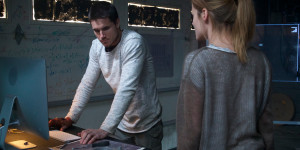
The gimmick wore off cinematically long before it evaporated on screen. Even screwball Bill Murray cottoned on to the trick quicker than this guy. The bad guys are ostensibly there to steal scripts, but it’s soon evident that Renton’s invention, the ARQ, is much more valuable…and it’s inconveniently causing a time loop.

I mentioned before that we failed to get tickets. How then did we see it? It’s on Netflix. That’s right. Just a few days after making it’s $25-a-head, world premiere at the Toronto International Film Festival, it’s airing on Netflix for free. Even at that low price, though, it arq_03isn’t worth it. The dialogue put me off immediately. It has the look and feel of the kind of television show I would never watch. Even worse, it ends like it’s the pilot of a TV show that hopes to continue this mystery in vague and infuriating terms for the next 6 years. It isn’t, though. It genuinely believes itself to be a whole movie. Don’t believe it, not for a second: ARQ is to be avoided at all costs. Keep swiping left.


Looking for something more satisfying on Netflix? Try

The Wave

The Fundamentals of Caring