
I am too young to remember Nibbler from the arcade but it was on my computer at some point during university, along with Solitaire, Hearts, and Free Cell. In Nibbler, the player controls a snake with the goal of eating all the dots on the board. But every dot you eat makes your snake get longer (in a very non-sexual way), and if you let the snake run into itself then it dies (I guess because it is super poisonous?). All in all, a pretty simple concept, but like most 80s games, you can play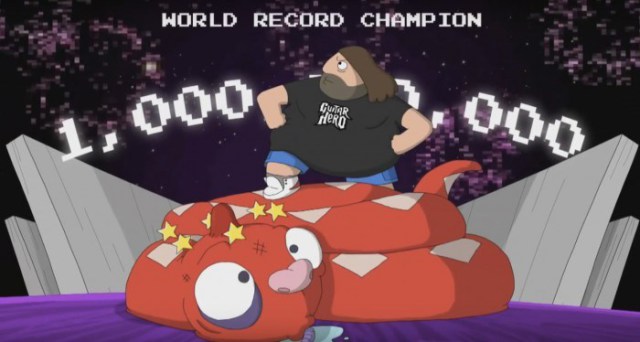 the game forever doing the exact same thing over and over, just a little faster each time.
As a natural-born procrastinator, I played a few rounds of Nibbler while avoiding writing research papers. Is it just me or has YouTube/Facebook/Twitter made all those games obsolete? Anyway, back in the day I became quite good at Free Cell but mastery over Nibbler always eluded me. Part of it was that I found the game extremely boring (possibly more boring than writing the paper I was trying to avoid), so I’d only last one or two games and then I’d move on to something else.
Unlike me, there are 40+ year olds who seem not to get bored by Nibbler, and who play that game for marathon sessions, 30 hours or more, in order to score a billion points. Nibbler’s claim to fame is that the developer had the foresight to display a score nine digits long instead of the usual six, so Nibbler’s whirring numbers went that much higher than its contemporaries before flipping back to zero (which may be part of why we feared Y2K so much, because in all these games you could lose everything by playing just a bit too long). Nibbler focuses primarily on the first player to hit a billion in the game, the unfortunately named Tim McVey. He hit the high score back in 1983 and promptly moved on to other games because after playing the game for 40 hours straight he couldn’t bear to touch a Nibbler machine ever again, but he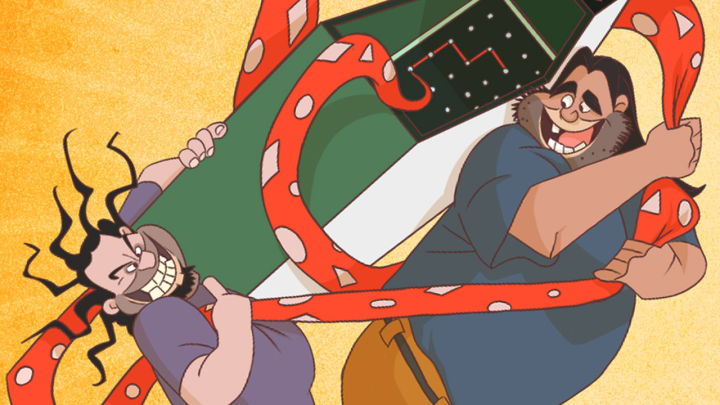 returns to the competitive Nibbler arena in his 40s when he learns he might not actually have held the world record all those years.
We’ve reviewed some very good documentaries on Netflix recently (like Ava DuVernay’s excellent 13th). Man vs Snake does not come close to those heights. It is unlikely to inspire you or educate you or show you anything worthwhile. This lifelong quest for high scores in a dull, repetitive game is led by people who like dull, repetitive things and inevitably are stuck in the past due to their nature. Certainly, the gameplay footage, which features prominently in a whodunit-type post-mortem of one marathon attempt, is going to hurt your eyes because it’s painfully archaic. I don’t know how I ever stared at any of those screens. It’s impossible for me to stare at them now or hear the incessant beeping that was a staple of the arcade experience back then, the equivalent of the bells on a slot machine, over and over and over.
While it is interesting to peek inside these people’s lives for a few minutes, my interest faded long before the movie wrapped up. At its core, Man vs Snake is a dull, repetitive experience, much like Nibbler itself. It’s a decent time-waster that you will likely get bored of before it ends, and you may want your quarter back. There are much better documentaries to be found in the Netflix arcade.
 diverse. One, Sam (Malik Zidi), or “red beard” as they call him, is an honestly devout Muslim but also an undercover journalist hoping to get a juicy story on jihadism. His Muslim buddies are all young guys like him from a range of backgrounds, easily mistaken for a group of soccer-loving 20 somethings. But one of the gang, Hassan (Dimitri Storoge), leaves France because he’s ready to make holy war. When he comes back, he tells his friends they’re charged with forming a terrorist cell right there in Paris.
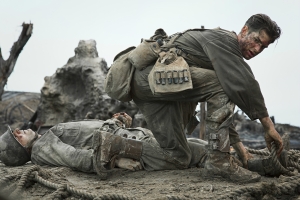 There are two main takeaways from Hacksaw Ridge: (1) even American acting jobs are now going overseas, as aside from Vince Vaughn every American soldier in this movie seems to be played by an Australian (included in that tally is Andrew Garfield, who I have since learned is British, not Australian, but still…); and (2) if the Japanese had just prayed harder they might have won the Second World War.
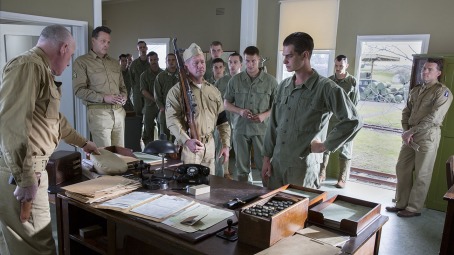 Incidentally, if the intent behind not putting Mel Gibson’s name up front in the marketing was to create some separation from those all-too-frequent racist comments in Mel’s past, it might also have been a good idea to cast at least one non-white guy. Just saying.
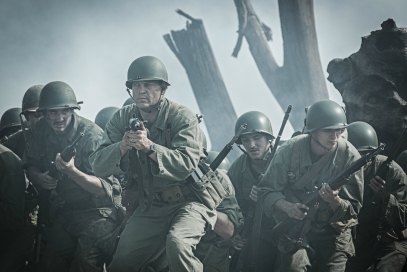 he doesn’t hold a grudge, and hauls 75 of them off the Okinawa battlefield even after they made his life so rough.
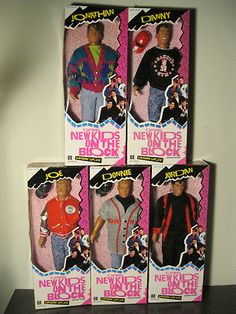 she fueled the fires of my pre-lusty desires with posters and t-shirts and perfume (I have no idea how to distill an entire boy band into one scent, but they did, and I wore it). I also had not 1 but 2 Joey McIntyre Barbie dolls. I still remember the jeans and the red jacket that he wore, and the backwards baseball cap like the baby-faced faux-bad-boy he was. My Barbies loooooved to date him, enjoyed extended closed-mouth kissing with him, and were serenaded on the reg. I never owned anyone besides Joey although the whole Barbie band was available for purchase – until a certain milestone birthday when my youngest sister paid I don’t want to know how much to assemble the boys for a reunion tour in my bedroom: she tracked down every last NKOTB Barbie and sent them to me, mint in their boxes. My childhood toys are now collector’s items. I am old.
 likely all of them. But they weren’t stingy like Justin Timberlake’s, they were full of priceless nuggets, like the sight of 14 year old Joey “shaving” before a gig, proper rat tail maintenance, and the guys discussing their astrological signs. You know, really important stuff. I ate it up. And I was starved for it because the New Kids cartoon played at noon on Saturdays and I almost always missed it because it clashed with my mother’s Nutri System weigh-ins. True story. I had a rough childhood, you know. I would wait in the Ford Aerostar, playing with my 2 Joes to console myself, waiting to see if my mother was any skinnier, and if missing my favourite show would be worth it (it pretty much wasn’t).
 man extraordinaire, Canadian superstar Gord Downie had recently announced that he had a brain tumour and was terminally ill. Since making music has always been his passion, he and the Hip went on a farewell tour and despite the ravages of cancer, he performed full-throttle at each and every show, somehow finding the energy and the courage to power through. Their final
  date was in their hometown of Kingston Ontario, just a little ways down the road from Ottawa. Our Prime Minister, Justin Trudeau, was in the front row, and spoke for all of Canada when he thanked Gord and the whole band for their decades of artistic serviced to the country. It was a stirring night. The end is coming for Gord and he knew it, you could see it in his eyes, feel it every time he was overcome by emotion, but instead of making it about him, he chose to use this spotlight (and believe me, about 32 out of our 33 million strong
  population were tuned in one way or another) to speak on behalf of Canada’s indigenous population.
 Prohibited from speaking their languages, practicing their spirituality, or honouring their cultures, teachers stripped them of their identity. Many children suffered terrible abuse, but all of these kids were deprived of their childhoods, and all of the families suffered terribly as I’m sure you would if your child was removed, perhaps never to be seen again, or if you were lucky enough to be reunited, we can only hope that you can find a common language in which to communicate. Communities were destroyed in what many Aboriginal people refer to as a genocide. It’s a dark part of Canadian history that wasn’t acknowledged until very recently. Today our First Nations peoples often live in poverty and other consequences of this intergenerational tragedy. Healing is not an Aboriginal problem, it’s something we need to address as an entire country. Gord Downie is doing his part.
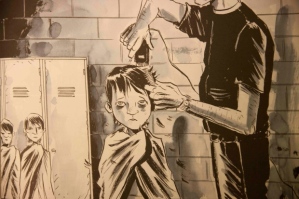 and hundreds and maybe even thousands of Chanies dotting our countryside. Lonely and miserable, many children made an escape an attempt only to lose digits or limbs to frostbite, arms and legs on traintracks, or lives to exposure, or to punishment when recaputured. How many tiny bodies are still unaccounted for? The fact that we don’t even know is proof of how little white Canada cared for Aboriginal people, and this is a guilty fact we struggle to reconcile even today.
 laundromat until one cold night a kind laundromat owner didn’t kick her out at closing time. She’s been living in Fox Laundry ever since – some 25 years now.
 her hard-won wisdom, and an outlook that’s totally unique. She’s cantankerous and whimsical and totally intolerant of homeless people (she doesn’t see the irony). And she has a knack for making famous friends: Zach Galifianakis has taken her to movie premieres (he met her while doing his laundry some 18 years ago), Renee Zellweger takes her shopping, and if you promise to keep a secret, Zach’s about to put her up in an apartment all her own. She hasn’t had a home since 1976.
 passed from one weird owner to another. The film is more like 4 shorts that only have a dog in common. I didn’t even believe that it was the same wiener dog in all 4 vignettes. The first two are clearly linked, the last 2 not so much. The shorts also become increasingly non-entertaining. I thought the first one was the strongest: a father picks up a puppy for his young son, who has recently survived cancer. The dog sparks many serious conversations between mother (Julie Delpy) and son – motherhood, personality, free will, death. But all of the conversations are straight out of a what-not-to-say handbook, with Delpy literally telling her son that her childhood dog Croissant was raped by a dog with AIDS named Mohammed. The satire is delicious. There’s an explosion of joy on the screen as a boy and his dog play together, but this outburst of happiness is quickly punished, and the dog changes hands.
 comfort, he’s not here to cushion the blow. And he’s sure as hell not here to give you a happy ending, so keep that in mind. Next up for Wiener Dog, she gets adopted by a character from another Todd Solondz movie, Welcome to the Dollhouse. Dawn is all grown up now, and played with Greta Gerwig. She runs into childhood…acquaintance (?) Brandon (Kieran Culkin) in a 7-11, and suddenly Wiener Dog’s on a road trip through some really heavy issues. She also meets disgruntled professor Danny DeVito and bitter old hag Ellen Burstyn. Through it all, Solondz’s camera is unflinching, perversely lingering over the gross and unbearable.
 And her daughter Chloe too, as it turns out (Kristin Scott Thomas). His father purchased the apartment some 40 years ago, but bought it en viager, which means he got a pretty good deal on the price, but he had to agree that not only could the current owner keep living in it until she died, he’d have to pay her for the privilege. So for 40 years the father has been paying this old lady to keep living in a home that he technically owns, and now Mathias has inherited a property he can’t sell, and which is actually a debt, with a monthly reverse-rent that must be paid or he forfeits ownership altogether.
 Equity is a cold, unblinking look at Wall Street’s backrooms, through the eyes of a female dealmaker who’s trying to recover from a failed transaction. Her client’s shares traded too low during the initial public offering, and now she’s got a target on her back. Equity throws us into the immediate aftermath and we watch her as she tries to save her career by putting together a bigger, better deal.
 If you have at least a passing interest in finance, Equity’s story will draw you in and keep your attention until the end, avoiding most cliches throughout, at least when it comes to the main females. The male supportung characters fare less well, as they are all thinly sketched stereotypes (e.g., sexist boss, backstabbing boyfriend, and frat boy internet sensation). It is refreshing, though, for women to be the most compelling and realistic characters for a change.
 ASSHOLES WATCHING MOVIES