Monthly Archives: July 2017

Wilson

Wilson (Woody Harrelson) is a grump and a misanthrope. He has no social filter or skills or clue. He’s just out in the world, spitting old man vitriol. His neuroses aren’t great company and his acidic “honesty” doesn’t do much to help with the loneliness.

But then he gets a chance to reconnect with his ex-wife Pippi (Laura Dern), and he finds out that they share a daughter, given up for adoption 16 years ago. This ready-made MV5BMDU0ODI3ODAtMmYxYi00Yzk3LThlNDAtNGRiZjI1MDRiMzgwXkEyXkFqcGdeQXVyNDg2MjUxNjM@._V1_SX667_CR0,0,667,999_AL_family appeals to him greatly, though his fantasy diverges quite archly from the reality. And because life isn’t fair, this grown-ass man gets to wreak havoc on the lives of not one but two women in order to finally grow up himself.

Woody Harrelson is an utter delight. Wilson should by all rights be detestable, and yet Harrelson makes our time with him enjoyable. Unfortunately, his great performance is just about the only thing this movie has going for it. It’s not that interesting or concerned with plot or momentum. Is Woody enough? For me, yes. I don’t regret watching Wilson. Harrelson finds humanity and humour in the awkwardness. And Dern’s not a bad counterpoint as a former party girl trying to turn her life straight. They’re a complete fucking train-wreck as far as couples go and completely unprepared to host a houseplant for the weekend let alone a teenage daughter, but by all means, let’s eavesdrop on their bold but bewilderingly inept stab at playing adults.

I suspect director Craig Johnson didn’t quite know what to do with what he had. The film feels a bit episodic and the shtick gets stale after a while. Full credit to Harrelson for making Wilson just charismatic enough to keep us watching. Otherwise, Johnson would have easily lost us with his generous seasoning of sentimentality and a lackluster finale.



The Emoji Movie

I am way too old to use emojis. I use words to express my thoughts and feelings. Also, I like to use however many characters are needed to express myself. Emojis are a crutch and aren’t meaningful. For example, this movie in an emoji is 💩. But that doesn’t even come close to saying how bad it is.

I’ve just hinted that I think emojis are stupid. Not surprisingly, The Emoji Movie does not take that stance (though that would have made for a more intethe-emoji-movie-gets-character-postersresting film). Instead, the main human in The Emoji Movie loves emojis, uses them at every chance, and seeks the perfect emoji to send to his crush so she will go to the dance with him.  He doesn’t bother to talk to her or just ask her out with words because that’s so 90s.

SPOILER ALERT: the kid finds the perfect emoji because just before the phone store employee deletes everything on his phone, the sentient emojis in the phone text him a new emoji that is like a gif of five very similar looking faces, AND HER RESPONSE IS TO REALIZE HE IS A REALLY DEEP GUY WHO IS GOOD AT EXPRESSING HIS FEELINGS. SERIOUSLY? LIKE, SERIOUSLY? I mean, sending the “perfect emoji” was a slightly better idea than sending Rihanna lyrics (which was the best the main human could come up with on his own) but both ideas really, really suck (at least the kid deleted the Rihanna email, which of course closed with a high five emoji…).

OTHER SPOILERS THAT AREN’T REALLY SPOILERS BUT PROVE THAT THE WRITERS ARE OLDER THAN ME AND HAVE NEVER USED A SMARTPHONE:

1. When the kid’s phone makes noise at inopportune times (because the emojis are moving through his apps, duh), he doesn’t shut off the volume. HE CALLS THE PHONE STORE TO MAKE AN APPOINTMENT TO HAVE THE DATA DELETED. I mean (a) you don’t need an appointment at “the phone store”; (b) you can click one thing to delete all data on your phone whenever you want; and (c) deleting the data isn’t even going to solve the kid’s problem according to the movie’s rules because the cause of the noise is the sentient emojis, who would just return to his phone when a replacement “Textopolis” was installed.

2. In the movie, it takes 24 hours for trash to be deleted from the phone – which is not a phone thing and not really even a computer thing. It also takes several dramatic minutes to do a factory reset, and if you change your mind right at the very end you just have to unplug the USB cable from the phone store’s computer and all your data will undelete itself automatically – which is not a thing at all and even my grandmothers know that.

3. The apps visited by the emojis are real (-ish) but they make no sense in execution. Jay correctly called The Emoji Movie a lame ripoff of Inside Out, and the apps are this film’s attempt to build a world inside something both familiar and mysterious (Inside Out used brains, The Emoji Movie uses phones). Inside Out succeeds and makes it look easy. The Emoji Movie fails at every turn because it has no coherent logic. At all. It is all just a bunch of 💩.

DO NOT SEE THIS MOVIE. It is truly terrible in all the worst ways – a real stinker. Avoid it at all costs.

The Gambler

Have you ever found yourself wondering: can Mark Wahlberg play a professor? Wonder no more: of course he can’t. Even if he’s got a blazer and a slightly overgrown haircut? Not even then, I’m afraid. The part where he’s a total degenerate gambler, that I believed. He has said that this was the hardest role of his career, and you’d better believe it. The fact that it’s a terrible stretch for him is evident all over this thing.

As a cereal-loving, self-loathing professor of literature and a crazed gambler who has the-gambler-4.pngliterally gambled his whole life away, Jim is in a tough spot. He has enormous debts and borrows from one low-life money lender to pay another – although he then pays neither, and loses that money at the casino too. His bottoming out is made even more embarrassing because his most promising student (Brie Larson) happens to witness it.

But the truth is, it’s exceedingly hard to care about this guy. Even if you cut him some slack in light of his compulsive disease, we also see that he’s not terribly good at his job, or at being a son, or at being a person. He’s a self-destructive guy who just stopped caring a long time ago and there are no redeeming qualities to be discovered, even if a young blonde somehow finds him alluring.

[Sidebar: young women always think they can save the bad guys they’re attracted to. They can’t. Give her 6 years and she’ll be throwing houseplants at his head while she furiously packs her bags, accusing him of stealing her youth.]

This film is watchable but it’s derivative and never justifies its own existence. The original is still king. This one flubbed the minute Wahlberg came on board and just flopped about like a balloon with a slow leak.

The Town

Ben Affleck branded Charlestown the “bank robbery capital” of America in his movie about the neighbourhood, The Town. Neither cops nor statistics actually bear that statement out, but he certainly painted a picture of a rough neighbourhood where its inhabitants (“townies”) scowl at outsiders and steal everything that’s not nailed down. Sean and I have been to Boston a few times so I can’t quite recall which time we ventured out to “the town” for some dinner but I do recall deliberating whether we should. Sure the internet was calling this Moroccan restaurant one of Boston’s best, but did we feel safe?

hero_EB20100915REVIEWS100919991ARClearly things have changed since Ben Affleck last spent the night in Charlestown. When we visited, it was gentrified as hell, Beamers parked up and down the street. It’s also been a while since we last watched the film, so without the benefit of bellydancers or couscous, we gave it a re-watch.

Ben Affleck came on board as director only after someone else bowed out. His original cut of the movie was 4 hours long, and if you’re interested, it’s available to watch on the Blu-Ray. The studio convinced him to cut it down to 2 hours, 8 minutes for our sake, still a lengthy movie, but one that just flies by. Affleck’s character assembles a team of ruffians who brazenly rob banks and armoured trucks. He’s wanting to get out of this life, but neither his friends nor his enemies are willing to let him go. So that’s a complication. Another little wrinkle: the woman he’s currently in a relationship with is a former hostage of his, only she doesn’t know it. So that’s awkward.

You can tell Affleck is an actor-director; the action scenes are electric but the editing slows way down during character-driven scenes. He lingers over them. And he knows a great performance when he sees one. In The Town, the scene stealer was Jeremy Renner, who Casey Affleck recommended when Ben couldn’t get Mark Walhberg. Affleck has since said that Renner’s performance was so strong that he could literally save a scene by cutting to Renner looking down at a napkin.

Anyway, whether or not The Town is an accurate portrayal of the people and criminals who live there, it’s an excellent film, slick and well-paced, and it definitely benefits from great on-location shooting. The Boston on screen no longer exists, if it ever did, but it’s a great cinematic accomplishment for a hometown boy.

Shorts: Fantasia

Sleazy Pete: At less than 12 minutes long, Sleazy Pete still manages to go through 55 gallons of fake blood. That seems extraneous since Sleazy Pete is a priest who lives by the principle “Love thy neighbour” but the convenient loophole there is that the homeless aren’t neighbours to anyone so are therefore ripe for the killing. If you love B-movie gore, this one is wall-to-wall apocalyptic violence

Don’t Ever Change: Karen Hickman is newly paroled after spending her entire adulthood in DontEverChange-CyndiWilliamsprison for a crime she committed when she was 17. She’s in the midst of reconnecting with her biological daughter when a “fan” shows up with an inappropriate request. The productions values are great, the writing is fun; in less than 10 minutes director Don Swaynos gives us something truly satisfying…although I wouldn’t have minded even more!
The Story of 90 Coins: A man is much more serious about his relationship than his girlfriend is. As a compromise, she agrees to be wooed for 90 days. Every day he leaves her with a coin. At the end of 90 days, they’ll either have enough money for farewell drinks, or a marriage certificate. Sure it’s hella romantic but it also puts our poor heroine in the unfortunate position of having to choose between love and career. This short film is gorgeously shot, and if you’re in the mood to have your heart strings yanked upon fiercely, there are buckets of tears wept in the 9 minute running time.

The Madame In Black: A woman was burned for witchery, and centuries later, children still remember her with a game wherein the very brave call her name 3 times into a mirror. This short horror is perfectly edited for maximum tension.

By Any Other Name

David Sedaris is one of my all-time favourite anythings, and reading his newest, Theft By Finding, leaves me needing to text Matt “omg, THIS part!” literally every 40 seconds. Sedaris has 514 pages of excellent observations, but one of them, in which he mentions that the title for Groundhog Day is not so much lost in (German) translation, but found, really caught my fancy, and so I wondered what other gems awaited me in second-language cinema.

Groundhog Day was released in Germany as ‘Eternally Weeps the Groundhog.’

What else can I unearth? I’ve published the correct titles in white; you can uncover the answers simply by high-lighting the blank space. Play along, let me know how many you guessed right, and tell me which of these you would have seen!

China calls Pretty Woman – I Will Marry A Prostitute to Save Money

Never Been Kissed is translated in the Philippines as – Because She’s Ugly

Girl, Interrupted is known in Japan as – 17-Year Old Girl’s Medical Chart

China knows The Professional as – This Hit Man Is Not as Cold as He Thought

chocolate-copyGermany knows Annie Hall as – Urban Neurotic

Which movie is known as American Bluff in France, The Great American Swindle in Spain, and United States Cheat Bureau in China? Answer: American Hustle

Japan knows You Only Live Twice by – 007 Dies Twice

Boogie Nights, China – His Great Device Makes Him Famous

France translates The Hangover as – Very Bad Trip

Ocean’s Eleven – Eleven Men and a Secret (Brazil)

Top Gun is known as – Love is in the Sky (Israel)

What movie is known as Strange Coincidences in Spain, Multinationals Go Home! in Hungary, and The Psycho Detectives in Portugal? Answer: I ♥ Huckabees

The Shawshank Redemption is known as The Prison for Angels in Romania


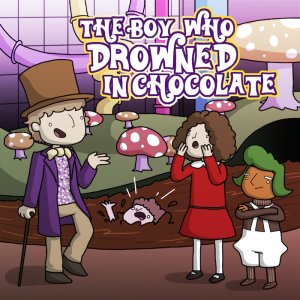
 Denmark calls Willy Wonka and the Chocolate Factory – The Boy Who Drowned in Chocolate Sauce

The Sixth Sense – He’s a Ghost! (China)

Animal House is known as I Think The Horse is Kicking Me in Germany.

Poland calls The Terminator – The Electronic Murderer

Due Date – Odd Couple, Wacky Trip, Go Together in Time for Birth. (Thailand)

What movie is called Western Department of Memories in China, Harmonica: The Avenger in Sweden, and Play Me The Song of Death in Germany? Once Upon A Time In the West

Lost in Translation, or as it’s known in Portugal, Meetings and Failures in Meetings

Risky Business – Just Send Him to University Unqualified (China)

Kong: (Bored Out of My) Skull Island

There are so many interesting components to this film that I find it unnatural and surprising how much it still sucked.

Basically: John Goodman convinces some government types that there’s this mysterious, vaguely-skull shaped island and the USA needs to LOCK THAT SHIT DOWN, like, be the first to “conquer” it and claim it as their own. So he hires crack photographer Brie Larson (for some reason), and master tracker Tom Hiddleston (for some reason) to accompany MV5BYzU4Y2VjN2ItZDA4Yy00MTBkLWI0ZGMtODcwZWY5ZDJlYTg1XkEyXkFqcGdeQXVyNjEwNTM2Mzc@._V1_SY1000_CR0,0,1500,1000_AL_him and the army led by Sam Jackson to the island that everyone knows is a no good, horrible, very bad idea. You may have noticed that the only thing more useless on this trip than the photographer is the tracker, except the little surprise that John Goodman has been keeping under his hat is: fuck surveying the island, he’s there to bring down the GIANT FUCKING BEAST, Y’ALL! Daaaaamn.
Except fuck you, John Goodman. King Kong is the least of your worries if you’re playing tourist on Skull Island. There’s much MUCH worse. But even though there’s a bevy of monsters and a bunch of a-list actors, none of them are remotely interesting. So that’s too bad. The movie is over-cast, and I’m not sure that I’ve ever said that before. But it’s just too crowded with famous faces and not one of them has a damn thing to do. And if any of them got any ideas about doing some acting or even just reciting a line that wasn’t entirely forgettable\unnecessary, Samuel L. Jackson was there to be a vacuum of talent, where his overacting is wildly disproportionate to the entire tone of the movie, thus hogging 110% of our energy, attention, and frankly, consternation, sucking up literally any sparks that anyone else was throwing off.

The only thing that I even wanted to like was Kong himself, but the movie couldn’t keep his size straight and that made me dizzy with rage (as did Brie Larson’s amazing, never ending roll of film). Kong is supposed to be big, and he is, but how big? Director Jordan Vogt-Roberts hopes you never ask that question, because he certain hasn’t. The answer is that it varies greatly from scene to scene and if you’re the kind of person who’s okay with glaring errors of continuity that don’t even take you seriously as a human being who can appreciate the difference between a station wagon, a sky-scraper, and a mid-range mountain.

Kong: Skull Island has an A-movie budget but a B-movie feel.


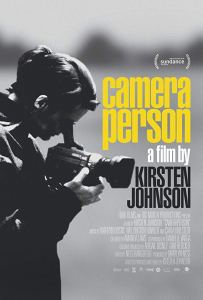
Cameraperson

“For the past 25 years I’ve worked as a documentary cinematographer. I originally shot the following footage for other films, but here I ask you to see it as my memoir. These are the images that have marked me and leave me wondering still.”   – Kirsten Johnson

MV5BMDRhMjUwYjUtYzU3OC00NTQ4LTk4MTktOGI0ODU4NmYzZWU0XkEyXkFqcGdeQXVyNDk4NTEzMTc@._V1_SY1000_SX676_AL_Capturing a thunderstorm, the camera shakes as the cameraperson sneezes.

A baby is born in Nigeria and seems to stare, and smile, directly into the camera.

A lawyer in Texas prepares nightmarish evidence for trial.

In Uganda, dancers and musicians ham it up for the camera.

That opening quote says it all. This is a series of very short clips, strung together they make up a scapbook or photo album, a collection of the places she’s been and things she’s seen and work she’s done. Some are very personal (her own twins appear) and some are political and some are funny and some are just beautiful, a magical moment caught on film. She catches more than most.

The way they’re woven together, it’s almost like we’re seeing a highlight reel from her own memory. There are patterns and there are insights. Micro-stories are told in just a few frames. And sometimes we get to know a little about what it’s like to live behind the camera, to observe something without intervening, the struggle between objectivity and responsibility and compassion.

If you’re narrative-needy, Cameraperson is not for you. It’s fresh and inventive and it tells a story in a different kind of way, but it’s worth it. Which is not to say in requires a lot of effort because for the most part, it’s a laid back, easy ride that may feel more familiar to a generation who will stream a series of unrelated clips for hours on Youtube. Except this one will feed your soul.


Personal Shopper

Kristen Stewart, I’m sorry honey, I didn’t really know you could act. You seemed up until now to have two settings: eyebrows and lip biting. Yet here you are, quietly impressing me.

Maureen (Stewart) is indeed a personal shopper. She picks up the glamourous clothes and accessories her celebrity client can’t be bothered to. Maureen despises Kyra but the MV5BOGFiY2U2ZTYtOTRmMS00MTY2LWE1OGEtZDUyNTI4N2I4YWUwXkEyXkFqcGdeQXVyNjcwNzI4MzE@._V1_money’s good enough to pay the rent in Paris, which is important to her. She’s in the city and won’t leave until she hears from her brother. Her dearly departed brother. Which is an obstacle of course. But she and her recently deceased twin brother are\were both mediums with a genetic heart defect, and they’d promised each other that whoever died first would signal the other from beyond, if such a thing existed.

But when contact IS made, how sure can Maureen really be that it’s her brother and not some creep? Or some other ghost? She wants SO badly for it to be him, but her skeptical nature can’t help but vacillate. This makes Personal Shopper a film that’s hard to pin down. It approaches grief in a way we’re unaccustomed to, but it’s also part ghost story, part coming of age, part mystery, part spiritual discovery.

Personal Shopper compels even though it’s largely about mournful solitude. Director Olivier Assayas, who previously got an excellent performance out of Stewart in Clouds of Sils Maria, creates an ambiance that pulls you in as much as it creeps you out. But he doesn’t overdose on the ghost story stuff, he knows it’s scarier and more effective to dole it out in small measures.

It probably helps that Assayas wrote Maureen specifically for Kristen Stewart; she’s actually meant to be taciturn and moody. But the character ultimately lacks depth, which is pure laziness since we spend pretty much the entire movie with her. It’s still a good movie though, with an atmosphere that won’t quit and a solution that begs to be found, even if we think we already know it.

Free and Easy

To be honest, it took me a while to adapt to the pace of this movie. It is slow, deliberate, and very measured. There’s no getting ahead of yourself. But the unusual story and glimmers of humour hooked me and I was glad I stuck it out. Free and Easy is genuinely something that feels new and unique.

It’s about a “soap salesman” who never sells a single bar but does encourage people to sniff his product (“a different scent on all 4 sides!”) because doing so induces loss of consciousness. Once his would-be customers are asleep on the ground, he frisks them for money and valuables. So he’s really a thief, posing as a salesman.

1_22_free-and-easy1-676x450Director Geng Jun shows us a side of China rarely seen: crumbling, bleak, all but abandoned. This cold, deserted, post-industrial town in northeastern China is dotted with rural characters, and they’re all as shady as the salesman.

It almost watches like loosely connected vignettes, a series of petty crimes where corruption and lawlessness is the new normal. But whenever these criminals encounter each other, you can’t help but laugh. The humour is deadpan but it landed surprisingly well for a movie that runs the risk of being lost in translation. There’s some slap stick, which I suppose is universal, but really it’s just the contrast between this totally depressing setting and the buffoons that populate it that just works.

The film is minimalist but that doesn’t mean there isn’t a lot of attention to detail poured into each shot. Out-of-focus details often sharpen into the butt of the joke. You have to stay alert to small gifts planted by the director along the way. Sure the subtext of the film is a little depressing, but it’s delivered in such an obliquely funny way, the message presented by sliding it in sideways, that you’ll laugh appreciatively at things that aren’t even overtly funny. In a film full of grifters, it’s the cops who are the dirtiest  of them all. That’s the lens through which contemporary, provincial China is explored in (ironically titled) Free and Easy, and the film stays remarkably on-brand.