Yearly Archives: 2018

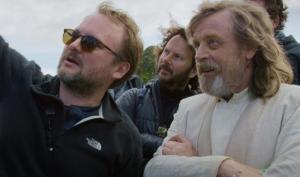
SXSW: The Director and The Jedi

the-director-and-the-jedi-sxswWhen I was a kid, I had a behind-the-scenes book detailing how they filmed the space combat in Star Wars, and I loved it. I could think of nothing better than to get to play with the spaceship models and the huge Death Star set used for the climactic scene. I found it fascinating to see how the movie was made.

And though my book did not inspire me sufficiently to pursue a career in film, my story is not much different than one that Rian Johnson tells in The Director and The Jedi, or for that matter one that Barry Jenkins told in his amazing keynote speech here at SXSW a couple of days ago about filming Moonlight in the same projects where Jenkins grew up.  Peeks behind the scenes can inspire the next generation of filmmakers, and give birth to a dream that a kid might not otherwise know to have, because it’s not immediately obvious that for every actor there are ten creative people behind the scenes, designing sets, making costumes, and on and on. But beyond that, even for someone like me who’s made a career choice that is not film, it’s just really cool to see how a huge film like Star Wars: The Last Jedi gets made.

The Director and The Jedi spans the course of The Last Jedi’s creation and documentarian Anthony Wonke was clearly given full access to the production. In granting unfettered access to Wonke and his crew, Johnson seems to have been trying to pay it forward, and in doing so he’s given a huge gift to all Star Wars fans.

There are some really amazing moments captured in The Director and The Jedi, with a particular favourite of mine being the destruction of the Jedi library, especially seeing the creature designers lose their shit over meeting Frank Oz.  And really, who can blame them? After all, he’s probably the reason they got into that career, and maybe even the reason their jobs even exist!

Maybe, just maybe, one young Star Wars fan will be inspired by this film to become the next Rian Johnson or Barry Jenkins. But even if not, there will be something of interest in The Director and The Jedi for every kid who ever wanted to fly his or her own model X-Wing through the trench run.

SXSW: The Shorts

Are We Good Parents?

Director: Bola Ogun

One day before school, a daughter lets slip she’ll be shopping for her homecoming outfit, and her parents are floored to find out that a certain “Ryan” will be picking her up for her first dance. As soon as the daughter’s out of earshot, Mom and Dad are questioning their whole parenting motif. They’d always assumed she was gay. What have they done wrong? Is she actually straight or just rebelling, or has something they’ve done or failed to do made her feel unsafe to come out?

The script is flipped from the hetero-normative expectation that a kid is straight until you hear otherwise. It’s an interesting statement to make but one which might have worn thin with a less authentic-sounding script (by Hailey Chavez). But this is no after-school special; Are We Good Parents is genuinely funny, thanks in large part to Tracie Thoms and Sean Maguire, who really tap into the self-doubting roles of two loving parents to a straight kid. This short film has big heart but it really makes you think about the assumptions we make not just as parents but as a society, and what ‘coming out’ really entails.

A first-generation American from Nigerian heritage, Ogun was born and raised in Texas and has a bright film making future ahead of her. Her film is making its world premiere at the SXSW film festival on March 10 and screens again March 12 and 15 as part of the Shorts Program 3.


The Coffin Club
Director: Briar March
This short is a documentary about a club formed by senior citizens in New Zealand. Through a lively musical number, the real members of the club tell us how they’ve formed a club that makes their own coffins. Sure they save some cash with their hand-made confections, but the best part is how they personalize their final resting places with glitter, paint, and pictures of Elvis. The film is 3 and a half minutes long, the whole thing sung (with Jean McGaffin and Kevin Quick providing spirited vocals), and it covers the snacks they nibble on between their morbid arts and crafts, and the trouble they got into from local funeral homes who felt their bottom lines were being hurt.
I am several decades too young and not a joiner by nature but I am desperate to be a member of the Kiwi Coffin Club. These are people who know that a box is just a box – but why not make the thing beautiful? They’re demystifying death, and preparing for it in their own way, putting their own stamp on a funeral that is usually designed by others. But it’s also clearly a social thing, with lots of camaraderie. If the club is looking for new members, I’m a great beaker and I have my own glitter, a glue gun of course, and a whole drawer full of ribbons. I’m not much of a singer, but I can snap and believe I look quite fetching in a top hat.
This doc is just minutes long but I felt like I’ve made some real friends. I could have watched for hours more. The production is great, and director Briar March turning the thing into a musical extravaganza shows us there’s more than one way to flip death the bird.
This film screens in the Documentary Shorts 1 block on March 10, 12, and 15 and honestly, it’s a whole lot of fun.

SXSW: American Animals

american-animals-128159American Animals is billed as a true story, and I have no reason to doubt that claim. The problem for me is an ethical one. I don’t feel good about helping people profit from their illegal activities, because it feels I am encouaging them and others to repeat that behaviour. On a related note, I also don’t want to spend any time with people who commit crimes, get caught, and then sell their stories, because they give assholes a bad name.

The criminals we meet in American Animals are a little different than expected, because they were students when they committed their crimes. I’m not sure whether their status as privileged college kids makes them more sympathetic than the average criminal, or less. It is clear that these students were not in financial need, were not stealing to feed their families and were not trying to pay off a big gambling debt to a leg-breaking mob boss. They essentially do it for kicks and, actually, I’m now sure their circumstances make them much less sympathetic. No matter how charming they are, and the real people are very charming indeed (they all feature prominently in the film in a neat hybrid documentary choice), I kept hoping they would get what was coming to them.

What made this movie work anyway, and work well, was that the script doesn’t take sides. We are allowed to feel how we want about these guys, to make up our own minds, and interestingly, to decide which of them to believe when their stories told to writer-director Bart Layton conflict with each other (which is a running gag within the movie). I did not feel at any time that Layton cared whether I liked, hated, or was indifferent to the protagonists, and it helped immensely that this movie did not gloss over or minimize these criminals’ naivete and stupidity.

American Animals is a very stylish, humourous and original film that I recommend in spite of my general misgivings about the true crime genre. My only complaint is the film dragged a bit, as by the end I just wanted them to get caught already, but that may have arisen from my desire to see the characters punished rather than any flaw in the pacing.

The film is scheduled for release on June 1 so you will soon be able to check out (and harshly judge) these (American) assholes for yourself.

SXSW: Blindspotting

So by now you know we’re in Austin, Texas for the almighty SXSW (South By Southwest, or “South By” for short) film festival (and comedy, music, gaming, plus TONNES of crazy cool conferences and networking for professionals from around the world), and we’ve seen some really cool, high profile movies like A Quiet Place, Blockers, and Ready Player One (which was a secret screening we got into by the skin of our teeth). Did we flip out to watch Ready Player One WITH Steven Spielberg? Of course we did. Did we visit the taco place recommended by Emily Blunt? You bet. But all of those movies will eventually get big theatre releases. They’re not the reason we come to film festivals. We come to festivals to see the little guys, movies that might otherwise get overlooked. In the age of Netflix, our chances of those movies being available to us are actually better than ever, but you need to hear about them in order to look them up, and we take pride in being a part of that process.

That said, Blindspotting isn’t exactly low profile; it played at Sundance earlier this year and audiences and critics came away buzzing. While Sean sat in an incredibly long line for Ready Player One (and that theatre reaching capacity two and a half hours before the screening start time!), I had a much cushier seat inside a theatre, watching a movie that just blew me away.

Written by and starring Daveed Diggs and Rafael Casal, it’s about some very current issues in Oakland California. Collin (Diggs) served a short term in prison and is serving MV5BMjk4YmVjMDUtZjJiZC00ODI2LTk4NDctMzRkNmYzNjA0YmM0XkEyXkFqcGdeQXVyNDg2MjUxNjM@._V1_SY1000_CR0,0,1642,1000_AL_his year of probation, with just 3 days left. Can he survive the next three days without any thing going wrong? The chances of that are increasingly unlikely when, while driving home before curfew one night, a young black man nearly slams into his truck at a deserted intersection. Relieved to have avoided a serious accident, Collin is unprepared for what happens next: a white cop, giving chase, pulls out his gun and shoots the man 4 times in the back, killing him.

So for the next 3 days, Collin suffers the PTSD resulting from witnessing that kind of violence, but in his neighbourhood, you’re not exactly allowed to show fear. In fact, projecting this tough guy image is maybe what got him in trouble in the first place. His best friend in the whole world, Miles (Casal), is always there for him, but he’s also always causing trouble. And though they’re both Oakland natives, born and bred, when the cops show up to break up the trouble, Collin knows that they’re more likely to blame and\or shoot him, the black guy, than Miles, who is white.

This film, directed by Carlos Lopez Estrada, takes an unflinching look at race. They understand that you can’t talk about race without mentioning the environment, which is rapidly gentrifying, or the culture, which is splitting. Everything intersects with class and opportunity and it makes for some complicated themes that the writers have unraveled a bit with hip hop, or spoken word poetry if you will, which is actually how Diggs and Casal met, at a program for at risk youth in Oakland. The script born out of their friendship and shared experience is truly genius, and makes for a movie experience that literally had  me pushed back in my seat, gulping in admiration. This movie is a cultural powder keg that the world needs right now; it’s a touch-stone that will be remembered for decades in the future as a film that really spoke not just to its time, but to the people living in it.

But please don’t think for a single minute that this film is some boring piece of art that is merely ‘important’ – it’s also wildly fun to watch, funny and thrilling and bursting with energy. Visually, it’s a love letter of sorts to Oakland. But it’s not the kind of film that pretends to have all the answers. With so many issues raised, all Blindspotting can do is point them out, and trust us to do the rest, which is a kind of self-assurance I don’t expect from a first-time film maker, but there’s a deep well of talent here, one that deserves to be tapped, so I hope I’ve inspired you to seek this one out.

Love, Simon

I wondered whether we needed a ‘coming out’ movie in 2018, but Love, Simon surprised me. It surprised me most of all by being good, but also by making a case for its existence. Simon is a high school student with a secret. He’s gay. And it’s not that he’s particularly afraid of how his family or friends will react to the news, which is nice, and sadly not everyone’s experience. But Simon’s still holding back just because he feels that life will change for him once he’s out, and he’s not feeling ready to rock the boat.

The thing is, no matter how gently the boat would actually rock, it still should be Simon’s choice when and how to come out – and that should remain true until the proverbial ‘coming out’ is no longer necessary (ie, when hetero is no longer the ‘default’). But in the MV5BZjdmNjI4NjctNWEwNi00M2EwLTg4MzItMWFmMTU0MDJiMzA0XkEyXkFqcGdeQXVyNTE0MDE1MjQ@._V1_film, Simon (Nick Robinson) has that stolen from him. Another kid, Martin (Logan Miller), learns his secret and exploits it, uses it to blackmail him for his own ends. Which, okay, further illustrates that everyone in high school is desperate and scared and going through something. But saving yourself should never  be at somebody else’s expense. Unfortunately, that’s a lesson both Martin AND Simon will have to learn, because to protect his secret, Simon makes some bad choices that will hurt the very friends who will love and support him if and when he does choose to be out.

It’s a pretty solid cast and a pretty solid story and a good reminder that just because being gay is a little more…mainstream? tolerated? understood? – it can still feel like a thing that sets you apart. And while being gay is not a choice, we should all be allowed to choose our own path. Sexuality doesn’t really set us apart but secrets do. And living your truth is the only way out.

SXSW: A Vigilante

Sadie picks up her messages. There’s a code phrase, and then a woman’s voice, shaky and furtive. She wants to leave her abusive husband. She needs help. Can Sadie come?

Sadie is a one-woman vigilante ass kicker. She gets bad husbands gone, and if they won’t go quietly, she will mess them up. It’s not just the krav maga that makes her strong, it’s the history she shares with her clients. But no matter how many women she helps flee violent situations, she can never truly escape her own, because her husband is still out there, never brought to justice for his sins.

Writer-director Sarah Daggar-Nickson wanted to make a film about domestic violence MV5BMTc2NzM2NTk0NF5BMl5BanBnXkFtZTgwMjQ1MTc3NDM@._V1_that would really speak to the urgency and the desperation and the severity of the issue. She did scrupulous research, and the details that come through – like the fact that New York state will pay for the funeral of anyone murdered during your escape (fucking think about that for a moment) – are depressingly, frighteningly authentic. Real-life abuse survivors make up the support groups which Sadie attends. They share stories that will haunt you.

But this is Sadie’s story. Sadie is intent on being strong now, for herself and for others. But as badass as Olivia Wilde is in the role, we never forget that Sadie’s husband, though no longer in the picture, still has a hold on her. It sounds easy to leave, and logical to move on, but abusive relationships are a sickness, one that keeps you coming back. So while Sadie may have trained herself to assault any man she has to, her trickiest opponent will always be the demons in her own head, and it’ll take more than physical fitness and a bunch of clever disguises to defeat those.

The film is interesting because we get to see themes like control and confidence evolve throughout. We get to know Sadie and her story through flashbacks, but the film keeps a forward momentum that manages to keep its pressure building. This movie is not exactly an easy one to watch, but neither is living with the reality of domestic violence, and for that, I think we can all dig down and find a little inner bravery.


For more South By coverage, read Sean’s review of Ready Player One, Matt’s review of The World Before Your Feet, or my review of Blockers – and check out our Twitter feed – we’ve been to Westworld, and to Roseanne’s living room, and we saw Barry Jenkins and Rian Johnson and Mark Hamill and more! @assholemovies

SXSW: Social Animals

Instagram. It has 700 million users, and this documentary is the story of 3 of them.

Kaylyn Slevin is a self-discribed dancer, “beach girl”, and aspiring bikini model. She lives in her parents’ mansion and Instagrams herself rollerskating around its cavernous hallways.

MV5BYzc3YzBmM2QtNWJkNi00NDQ1LWI5YzEtNGNmN2I4YjU0N2U2XkEyXkFqcGdeQXVyMjM3NzQzNTk@._V1_Humza Deas grew up in the projects and has come into his own as an urban photographer. He discovered his passion with a broken iphone and now has a serious Insta following thanks to his beautiful images often captured with some risk and daredevil antics. But when he accidentally exposed the subculture, he got death threats.
Emma Crockett is a midwest high school student challenging boundaries and testing limits on Instagram. Her parents don’t allow dating until age 16 but that doesn’t stop her getting dozens of DMs from strangers asking for booty pics. It’s a new world with new kinds of bullying and harassment and one wrong foot meant that Emma had to leave her Christian school to escape the nastiness.

This documentary is probably must-see for anyone over 25 because OH MY GOD it’s eye-opening and panic-inducing. I do have an Instagram account but I use it for one thing and one thing only: proof of life when I have charge of my sister’s kids. That’s it. Watching this doc, I’ve discovered that there are rules to Instagram that I never knew and break flagrantly every time I use it. Never post more than one picture a day. Did you know that? Like I said, I’ll post a hundred pictures of the kids on a weekend away with them, and then nothing for the next month. Never post two selfies in a row. Did you know that? That one doesn’t apply to me since I’ve never taken a selfie and realized I don’t know how. And I suppose don’t care to know. But teenagers, they know. They take this shit seriously, looking for love, for acceptance, but also constantly comparing and dealing with jealousy and envy. And competing for likes! And followers. And fame.

Humza takes thoughtful, inspired photos and deserves to be known for his work and his artistry. Emma is a kid who needs hugs and understanding. With Instagram’s sole purpose seeming to make popularity extremely quantifiable, it’s a dangerous beast to tussle with, and has dire consequences for some. Kaylyn is also just a kid, one who has fallen head-first into the image-obsessed culture of Instagram. And this documentary really forces us to ask how self worth will be measured when how things look is the only thing that matters.


SXSW: The World Before Your Feet

Within the thousands of neighbourhoods in the five boroughs of New York City, there are 8,000 miles of streets, bridges, parks, beaches, and cemeteries to explore. For the past six years, 37 year-old Matt Green has been on a mission to walk every single one of them.

Go ahead and ask. He won’t mind. People ask him all the time. “Why?” He really doesn’t know, other than that he loves the city, wants to be doing this, and for reasons he can’t put his finger on he feels that he’s doing something important.

How does he find the time to do all this? He doesn’t have a job. “Are you like independently wealthy or something?” one skeptical onlooker asked. “No, I’m… I’m independently homeless”.

While following Green as he walks, couchsurfs, and catsits his ways around the city, director Jeremy Workman captures way too much beauty, detail, and history to be absorbed properly in a single viewing. And his documentary The World Before Your Feet will make you want to absorb every detail. That’s what Green’s journey and Workman’s film are all about. The beauty of travelling on foot, according to Green, is that you notice things. And with nothing to do but walk and take notice, he never misses a chance to stop to smell the roses, read the signs, and meet the people.

The World Before Your Feet can seem a little episodic at times but how can it not? Green has six years worth of photos, stories, and research to share and this delightful and inspiring documentary does its best to show and tell as much of it as it can. Green and Workman answer most of the hows and whys as well as they can but really this is a film about enjoying the moment which offers a whole lot of moments of its own for us to enjoy.


Ready Player One

ready-player-oneThere are very few immutable truths in this world, but here’s one: if you don’t like Steven Spielberg’s movies, then you don’t like movies. The brilliance of Ready Player One (and it is brilliant) is that it’s a Spielberg movie through and through, only because its source material references Spielberg repeatedly, the result is something exponentially more Spielberg than you could ever have though possible.  Ready Player One is a true blockbuster and a worthy addition to Spielberg’s list of classics.
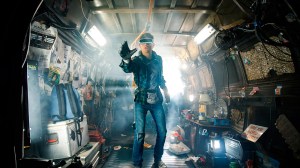
All the references contained here, not just to Spielberg’s past work but to every pop culture thing ever, are essential for this movie to work, and Spielberg clearly knows it. Moreover, he embraces it without reservation. After all, the book (which should be read immediately by anyone between ages 30 and 50 who grew up playing videogames) is the perfect vessel for 80s nostalgia. The movie clearly is trying to top the book’s reference count, and it may have succeeded (the totals are way too high to accurately count).

What is great about the book remains great in the movie. And yet, the movie and book tell significantly different stories, which is greater still because there are all sorts of some amazing surprises to be found in the film even if you’ve read the book repeatedly. At tonight’s SXSW world premiere, Spielberg introduced the film by stating he approached it as pure fan service and his mission was to give the people in the seats exactly what they wanted, and I can confirm he accomplished exactly that. Oh, yes, that’s right, WE GOT TO WATCH READY PLAYER ONE WITH STEVEN SPIELBERG. It was every bit as mindblowing as it sounds.

Also mindblowing: one particular sequence in the movie that pays homage to a classic film (incidentally, it’s not an homage to a Spielberg film; rather, it’s to a film directed by someone who influenced Spielberg – and it’s not something that was in the book).  I do not think I am exaggerating to say it is one of the finest sequences that Spielberg has given us, which obviously is a big deal because we are talking about STEVEN FUCKING SPIELBERG. You will know this sequence when you see it, and as soon as you do you will want to immediately see it again. And again. And again.

That amazing sequence is a standout but it’s not alone. There are several other incredible set pieces in Ready Player One, containing some of the best visual effects we’ve ever seen. Of course, the effects are only window dressing. What makes the scenes so great is Spielberg. As the camera swerves and dodges, and as avatars fight monsters, drive cars through obstacle courses, and traverse epic battlefields by leaps and bounds, the viewer is never lost for a second, because we are being guided through the chaos by a master. I loved this movie and I bet you will too. I’m just sorry to have to wait two weeks before I can watch it again.


SXSW: They Live Here, Now

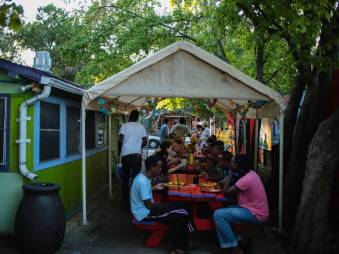
Since 1986, Casa Marianella has provided housing and assistance for thousands of recent immigrants, refugees, and asylum seekers from 40 countries around the world. Dedicated staff help create a healthy sense of community within their walls and help their guests learn English, find jobs, and see immigration lawyers.

Nayeli is a recent addition to the Casa Marianella community. She is 16 years old and would rather not say her last name. The story of her journey from Mexico (she’d rather not say what part) to Austin is a harrowing one, filled with loss, violence, and fear. She is seeking asylum in the US but, as a lawyer tells her, her chances aren’t great. It’s impossible not to feel for her while listening to her story and watching her make connections at Casa Marianella. Unbeknownst to the staff and residents, not to mention me as I was watching the film, she is a fictional character being played by an actress.

Knowing that the documentary I thought I’d been watching was in fact a “fiction/doc hybrid” changes the way I think about the film. My initial review, had I not bothered with some post-viewing research, would have admired the film’s subject and intentions but complained that, with only a 63 minutes running time, we don’t get enough chance to get to know the people staying thereI would have cited Nayeli as an exception because she gets the most screen time. I also probably would have said that this is one of those rare movies that I’d actually wished had been longer.

I now think that maybe I’d been asking a lot of filmmaker Jason Outenreath and his participants. Outenreath spent a year visiting Casa Marianella and forming relationships and building trust. He did not conduct pre-interviews but instead asked his participants “Tell me whatever you feel comfortable with, about your experience as an immigrant coming to the United States”. The answers he gets vary both in length and in how much detail they are willing to provide. Many of the residents have been through unspeakable trauma and some have good reason to fear for their safety. When I think of what they’ve been through, I appreciate even more how giving they are with their trust in Outenreath and the audience and in how much they are willing to share.

What struck me the most about many of the interviews was the gratitude of the film’s subjects. Many take the time to thank the camera for the opportunity to speak, which is something I don’t see a lot of in documentaries. Outenreath sought to give voice to immigrants and refugees who are too often left out of the much politicized discussion on immigrants and refugees. With all the statistics and rhetoric being thrown around on both sides of the debate, Outenreath reminds us to take the time to listen to the people that we’re arguing about.